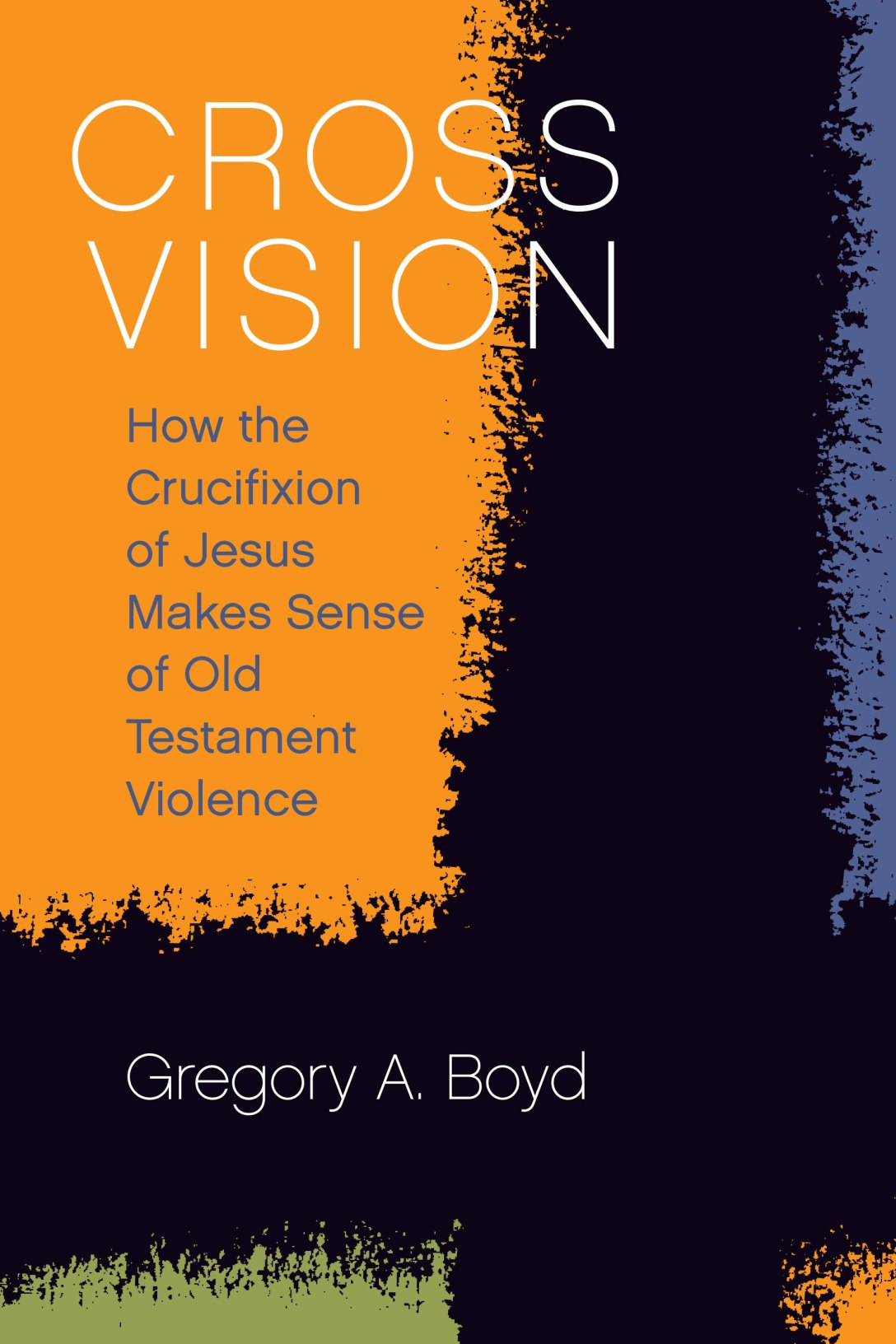
Take a seat, sit back and peruse the theological landscape of the 21st century. One doesn’t have to look far to notice that traditional perspectives of God’s wrath, violence and judgement are in a bloody war with more progressive interpretations and theology. The more progressive positions on God’s wrath abandon the traditional ways of thinking and instead strive to replace them with what is knowing as a “cruciformed hermeneutic.” In other words, everything we see in Scripture (particularly in the Old Testament) must be interpreted in light of the revelation of Jesus Christ and His work on the Cross. This cruciformed hermeneutic is championed by Gregory A. Boyd who is an esteemed pastor, theologian and scholar who has written his magnum opus “The Crucifixion of the Warrior God” and at a more popular level, his abridged version “Cross Vision.” This post will be focused on his later work.
Cross Vision was a great book to read, easy to follow, thought-provoking, very challenging at times. Like I mentioned in my review on Rob Bell’s “What is the Bible?” there’s never a time where I’d say “don’t read this book.” Every book is probably worth reading, meditating over and then considering in light of the Bible. Boyd is no exception to this rule, in fact, I’d encourage people to read if for no other reason then it is good to be challenged on ideas we’ve held for granted for so long. We all need to be rethinking and revisiting things we’ve been taught to make sure we remain faithful to the story of the Bible. To do this Boyd brings out some very heart-wrenching parables to drive his point home. Here’s one of those stories for the sake of the review:
It’s a few thousand years ago. A young Canaanite couple is enjoying an afternoon with their newborn infant. Like everybody else in their small town, this couple has heard rumors of a warring nomadic tribe called the Hebrews who worshipped a mighty warrior god named Yahweh. But the people of their town had prayed and made sacrifices to their chief god, Baal. And since Baal had protected them from other warring tribes and deities in the past, they had hope that the Hebrews would not attack their town. On this day, however, their prayers and sacrifices prove futile. This couple hears the battle horns and war cries of an approaching army. They see and hear neighbors screaming and frantically running down the dirt path outside their tiny hut. Their hearts pound as they stare at each other for a brief bewildered and terrified moment. Suddenly realizing what is taking place, the teenage mother sweeps up her newborn, the husband grabs his sword, and they turn to run out the door. Unfortunately, they’re too late. Before they reach the door, two sword-wielding Hebrew soldiers appear before them screaming, “Praise Yahweh! Yahweh is great!” The terrified husband raises his weapon, but the soldiers quickly run their swords through him. Seeing the hopelessness of her situation, the petrified mother curls up in the corner of her hut, crying and shaking as she clutches her wailing infant. As the two Hebrew soldiers approach her with their bloodied swords raised above their heads, she holds up her baby, begging the soldiers to at least have mercy on her infant. One of the soldiers is moved and hesitates for a moment as he thinks about his own young wife and newborn daughter. His comrade notices his hesitation and reminds him that Yahweh had specifically commanded Moses to have his people worship him by showing no mercy toward anyone or anything. “The mother and baby must also be offered up to Yahweh,” he the first soldier reluctantly nods his head, closes his eye, and shouts, “Praise be to Yahweh!” as he puts his full weight and strength into his falling sword. Both soldiers are splattered with blood as the sword splits the young mother’s skull. The other soldier then shouts the same praise as he bludgeons the crying infant to death.
Picture this on CNN or Fox News. This is a gut-wrenching story of how those early Canaanite conquests in the book of Joshua may have played out. Anyone today would call this genocide, and rage in protest if not vomit at such an incident. We’d be protesting and petitioning our governments to get involved and put an end to such injustice. Fair enough, I totally get that. I’d probably be protesting as well. The problem is, however, we want just that, someone to get involved and for there to be justice. There is this innate sense of retribution and a desire for justice that screams out in every one of us.
At this point, it is worth pointing out that I have written a two-part series here and here on the issue of God’s violence and wrath that will help give shape this discussion. However, in short, I’d like to say this. This is a blurry issue. I think where things become messy is in how God is presented in Scripture, and whether or not we’re ok with the person we see. Is God loving? Absolutely. Except, let’s stop defining love by our 21st Century Western standards and just take God for who He is portrayed in Scripture. This, I believe is ultimately where Boyd fails. I understand why he reinterprets God’s acts of “violence” (I’d say judgement in response to sin), but it just doesn’t stack up to the entire biblical story. God is ultimately about redeeming all of creation through Jesus, yes. But sometimes He also has to remove sinful people, places, and nations in order to achieve that ultimate goal.
Boyd is a great writer, theologian, pastor and brother in Christ. In a debate, I probably couldn’t hold my own against him but I’d still love to chat with him over a steaming hot cup of coffee. Read the book, it is a great read but stack it against other books like “Is God a Moral Monster?” by Paul Copan and “Confronting Old Testament Controversies” by Tremper Longman III (to be released in April) that I believe do a more faithful job in dealing with the issue of God’s violence and wrath.
All in all, I’d give this book a 7/10. Read it, love it, hate it, but most of all be challenged and prayerful about it. Never swallow any pill without reading the label if you catch my drift.

 Scribbling Theology