In my last post, I asked a question that sits underneath much of our theology, whether we realise it or not. Did Jesus save us from God, or from sin and death?
This is a question that comes into sharp focus on Good Friday, and Easter Sunday offers the answer.
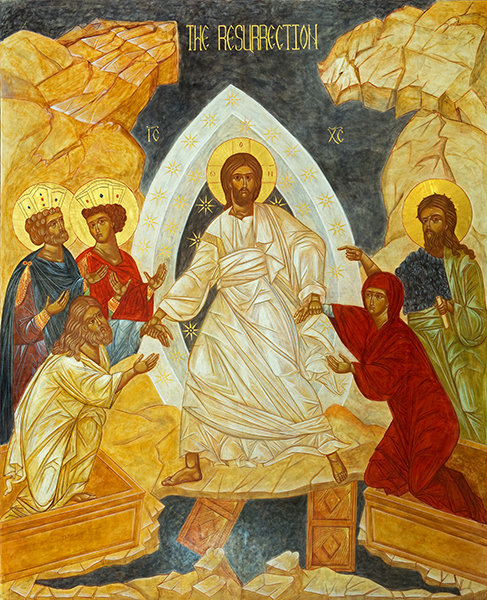
If Jesus really rose from the dead, Easter signals the single greatest change in reality: the ultimate defeat of sin and death. The resurrection is not about dealing with guilt or our moral standing but about the breaking of powers that hold humanity captive. Because Christ has risen, fears, shame, and failures no longer have the final word. Resurrection is not abstract hope, but a source of real freedom and courage in daily life. This is the heart of the Easter message.
This means the resurrection should not be seen merely as an appendix to the cross. Instead, it is the lens through which we truly understand what the cross accomplished.
The Resurrection Is Not Proof. It Is Victory
We often describe the resurrection as proof of Jesus’ identity and God’s acceptance of his sacrifice. But the New Testament presents it differently.
Paul describes the resurrection not just as proof, but as a victory. “The last enemy to be destroyed is death” (1 Corinthians 15:26). Not managed. Not reinterpreted. Destroyed.
The resurrection is not God saying that a payment has been made. It is God declaring that the enemy has been defeated.
This is why Peter says it was impossible for death to keep hold of him (Acts 2:24). Death could not hold Jesus. Death lost its grip.
From the earliest centuries, the church understood this. Irenaeus speaks of Christ entering into death to undo it from within, recapitulating Adam and reversing humanity’s trajectory (Against Heresies 3.18.1). Athanasius says that by his death and resurrection, Christ “trampled down death by death” (On the Incarnation 27).
This is not just metaphor. It is about reality itself. Something has shifted.
So What Were We Saved From?
If Easter is victory, then we need to ask the question again. Saved from what? Scripture does not present us as saved from God.
Scripture consistently presents God as the one who saves, not the one we are rescued from. “God was in Christ reconciling the world to himself” (2 Corinthians 5:19), not reconciling himself to the world.
What then holds us? Sin. Death. Corruption.
Paul describes sin as a power that enslaves us (Romans 6:6). Death is not just an event, but a force that spreads through humanity (Romans 5:14).
We are not depicted as trapped between an angry God and a moral ledger, but under powers that deform, enslave, and destroy.
Easter tells us those powers have been confronted and broken. Therefore, we do not need to live in fear. In Christ, we are free from the grip of sin and death and can walk in confidence and hope.
The Cross in the Light of the Resurrection
Without Easter, the cross looks like failure. A righteous man executed. Another life swallowed by the machinery of empire and death. But with Easter, we see the cross as the moment when death tried to go too far.
Jesus enters fully into the human condition, even to the point of death on a cross (Philippians 2:8). And in doing so, he allows death to do its worst.
But death cannot hold him. In swallowing Christ, death swallows something it cannot digest.
Paul says Christ has disarmed rulers and authorities, making a public spectacle of them (Colossians 2:15). Their apparent victory is actually their defeat.
Some scholars argue that the resurrection is about life after life after death—the beginning of a new creation breaking into the present (see N. T. Wright, Surprised by Hope). Michael Gorman describes the cross and resurrection as a single movement of divine self-giving love that defeats the powers and creates a new way of being human (Cruciformity).
The cross is not set aside by the resurrection. It is more fully understood in its light.
A Garden Again
John tells us that Mary mistakes Jesus for the gardener (John 20:15). It is a strange detail that almost seems unnecessary. Unless it is not.
The story began in a garden. Humanity was called to bear the image of God, to cultivate, and to participate in the life of creation (Genesis 1:26, Genesis 2:15). That vocation was fractured. The ground itself became a place of resistance and decay.
Now, on the first day of the week, in a garden, a man stands alive after death. Mary is not entirely wrong. New creation has begun.
Paul calls Christ the firstfruits (1 Corinthians 15:20). Not an isolated miracle, but the beginning of a harvest. What has happened to Jesus is not unique to him. It is the future of creation brought forward into the present.
God has not abandoned the world. He has begun to remake it. And this work of new creation is not something God does alone. We are invited to take part, to join together as a community in cultivating hope, working for renewal, and tending the places where resurrection life breaks into our world. As we participate in God’s ongoing work, we discover that new creation is something we are called to share and build together.
Unrecognised Life
Yet, no one recognises him.
Mary does not. The disciples on the road to Emmaus do not (Luke 24:16). Even those closest to him struggle to see. This is not incidental.
Resurrection life is connected to this world, but it is not limited to it.
Resurrection life is real, embodied, and tangible. Jesus eats, speaks, and bears wounds (Luke 24:39-43, John 20:27), yet is also transformed and no longer bound or limited in the same way.
The problem is not that the resurrection is unclear; it is that we do not yet know how to see it. For many, this can be difficult. Doubt and uncertainty are genuine parts of the journey for disciples, then and now. If you find yourself struggling to perceive resurrection life, know that you are not alone; those closest to Jesus did not recognise him at first either. As we honestly bring our questions and hopes before God, even small acts of trust can open us to new ways of seeing. Sometimes we borrow others’ faith until we catch a glimpse of resurrection life for ourselves.
Gregory of Nyssa writes of the resurrection as the transformation of human nature into incorruptibility, not the abandonment of embodiment but its fulfilment (On the Soul and the Resurrection).
The risen Christ is not less physical. He is even more alive than before.
The Wounds Remain
Thomas is invited to touch the wounds (John 20:27). This matters.
The resurrection does not remove suffering’s marks, but transforms them. The scars, no longer signs of defeat, become evidence of victory. God redeems, not erases, history.
The cross is brought into resurrection life, not as a sign of shame, but as a sign of glory.
Raised With Him
If this is true, then Easter is not just something that happened to Jesus. It is something we are all drawn into.
“Sin entered the world through Adam, bringing death to all humanity, but through Jesus Christ, righteousness and life are offered to all.” (Romans 5:12)
“We were buried therefore with him by baptism into death, in order that, just as Christ was raised from the dead… we too might walk in newness of life” (Romans 6:4).
“Set your minds on things that are above… for you have died, and your life is hidden with Christ in God” (Colossians 3:2-3).
Resurrection is not just something for the future; it is participation in the now.
Dallas Willard speaks of eternal life not as duration but as a kind of life, the life of the age to come made available in the present. Easter is the moment that life breaks into history and becomes accessible.
Following Jesus is not just about believing things about him; it is living from a different reality now. This means allowing the hope and freedom of resurrection to actually shape our daily actions and attitudes. For example, when we extend forgiveness rather than hold onto resentment, or when we choose hope in the face of disappointment, we are living out this new reality. Serving others, practising kindness, or showing generosity even when it is difficult are all practical ways in which resurrection life breaks into our world through us. Each ordinary act, offered in trust that Christ’s victory is real, becomes a sign of the new creation at work.
Sunday
Easter Sunday does not just undo death; it breaks its power completely. This is at the heart of the Christian message: death’s rule is over, and new creation has started. It is the end of its authority.
God did not need to be reconciled to us. We needed to be saved from everything that was destroying us.
Sin has been confronted. Death has been undone. Creation has begun again.
And the risen Christ stands, still bearing wounds, still calling our name, inviting us not just to believe in resurrection, but to live out of it.
 Scribbling Theology