
Friendship

Friendship is hard. Really hard. I’m talking about real friendship, not the kind where you float into a room laugh, smile, shake hands, talk about movies and books, and then leave. That’s just social convention. That’s being friendly. Friendship is something, I think, a lot of us don’t really have. Real friendship, at least the kind I believe we all long for, the kind God wants us to have is exhausting, challenging, and painful. Yet, it’s addicting, beautiful, fun, and sanctifying. True friendship requires a lot of sacrifices. It requires a sacrifice of the ego, of your own desires. Humility is essential to intimacy. Why?

Throughout the 29 years of my life on this earth, I can only count three, maybe four real friendships that I’ve ever had. Two I see every week, one lives half a world away, and the other had fallen apart long before I even realised there was anything wrong. There is a fifth. Each of these relationships has been really different, complex, fun, and exhausting in different ways. The two I see every week requires constant engagement, attention, communication, love, service, sacrifice and humility. The problem though is that I suck at all these things. Despite being bullied my whole life, I continuously put one down (under the guise of Aussie humour) to make me feel better about myself. The other (and my best friend) I almost have nothing in common with outside of Jesus. Often when we meet, I have to feign interest in what he likes because I’m afraid that if I don’t listen to him, he won’t listen to my more important stories and mind-blowing (sarcasm) thoughts on theology and the universe. This is the problem with the ego (at least with mine). It sees my friends as a commodity, something to be used to form an identity, to achieve validation and as things to serve me rather than image-bearing people to love and serve. Real intimacy and friendship are scary because if I don’t lay aside my sinful and broken desires for the sake of those around me, I will end up losing the very people that God uses to make me holy in the first place.

So, there are a few things I need to get my head around and maybe they’ll help you as well.

  1. I’m actually not that smart. My apparently amazing insights into all things spiritual are pretty lame. Even as I write this line, every part of me wants to delete it because I still think I’m pretty wise. I’m not. Stop it.
  2. Despite the prevailing cultural narrative, I’m not special. I’m incredibly average. My blogs aren’t going to change the world. God hasn’t called me to be an Avenger for the Gospel, just to earnestly love my friends and then even my enemies. If I can’t get the former right, what hope do I have for the latter?
  3. My friends are just as broken and messed up as I am, only in different ways. They need love, validation and real friendship as much as I do. They’re broken but still retain something of the image of God. This passage comes to mind when Paul says:

Let love be genuine. Abhor what is evil; hold fast to what is good. Love one another with brotherly affection. Outdo one another in showing honour. Do not be slothful in zeal, be fervent in spirit, serve the Lord. Rejoice in hope, be patient in tribulation, be constant in prayer. Contribute to the needs of the saints and seek to show hospitality. – Romans 12:9-13

So here’s my point. Let’s be better friends. See friendships as a God-given gift to heal the broken, to sanctify the sinner and for the flourishing of our souls. Lay aside “self” and honour the image of God that is the human you’re having intimacy with. Let God use them to soften you, to transform you into the likeness of His Son. At the end of the day, just get over yourself and love others as you want to be loved, right?

Should Christians Be Activists?

Activism is fast becoming a regular part of Western society. No matter where you turn, someone is advocating for the rights of women, people of colour, and refugees. There are climate change activists, those who fight against poverty, and there are those who fight for all-around equality in the hope that political and social reform will make the world a better place. I believe much of this activism is well-meaning. People genuinely have a vision for a good world and desire to be a part of that positive change. However, what are Christians to make of all this? Should we be activist ourselves? Or should we retreat into churches and monasteries and pray that the Kingdom would come?

In a previous post, I argue that politics are unavoidable because:

  1. Christians live in a kingdom ruled by a king (Jesus).
  2. As a result, Christians are inherently monarchists who bow the knee to King Jesus.
  3. Therefore, when we vote for specific policies and work towards political reform, we do so with our King in mind.
  4. Our choices in the political world display God’s character.
  5. That influencing the political world happens first in and through the Church.

So with this in mind, should Christians be activists? Yes, but not in the way you might think.

Activism, at its most basic level, is fighting for those who can’t fight for themselves. It’s protecting that which can’t defend itself. It’s giving a voice to those who can’t speak for themselves. Furthermore, it is equipping the marginalised and oppressed so that they do have a voice, so they can receive rights and work towards change themselves. Christians, however, need to work towards these things within the Church first before they work towards it in the world. Unless we can get things right in the Church, unless we begin to confess our own sins and participation in this stuff, unless we love one another as we love ourselves and find our God-ordained unity in the person and work of Jesus Christ, we cannot hope to be effective in the world around us.

The Church needs to understand and work through a few fundamental theological ideas so that we can work towards this goal:

  1. The doctrine of the imago Dei. Everybody, regardless of colour, gender, or creed, is created in the image of God. While humanity has largely failed at living this out as God intended, in Genesis 1, there is an ontological dimension that endows humanity with something unique that connects them to the Creator. If the image of God is something we do (that is to protect and keep the Garden, i.e. the world), you can see how the embers of the image still remain in those who advocate for social and political change even today. However, this is something the Church is to now take up yet, unfortunately, the Church has mostly been silent on the issue of environmental protection. No matter where you sit on the topic of climate change, one thing is abundantly clear, Christians are to do their part in keeping the world and guarding it.
  2. Unity in Christ. Every person who has placed their faith in Jesus for the forgiveness of sins, and who has given their allegiance to Jesus as king has been united to God through Christ by the Spirit. As the Apostle Paul says, “For just as the body is one and has many members, and all the members of the body, though many, are one body, so it is with Christ. For in one Spirit, we were all baptized into one body—Jews or Greeks, slaves or free—and all were made to drink of one Spirit” (1 Cor 12:12-13). When the Church is compared to any other religion, organisation, movement or group, it is the Church that should have an eminent sense of racial and gender equality as it united in the person of Jesus, as they gather to worship their God who shows no favouritism (Romans 2:11).
  3. The Gospel. If the Church truly understood, and I mean really understood the life-giving, heart-changing, mind-boggling, awe-inspiring message of the Gospel, it would produce in us such humility and passion to love others that we could have such an impact on the world that the Church would be that city on a hill (Matt 5:14-16) a royal priesthood (1 Peter 2:9), reconciling the world to God (2 Cor 5:11-21). We would be a Church that the world would struggle to criticise for doing wrong.

Finally, with these three ideas in mind, as the Church unites, heals, and preaches the Gospel; this will organically flow out into every other area of life both politically and socially. The Church should be the group that every other person looks to for guidance in these matters. Activism, change and reform happen in our hearts before it happens in our laws and the only thing that can make that change is Jesus Himself. So if you’re a Christian, can you be an activist? Yes. But fight for equality in the Church first. Fight for human rights in the Church first. Fight for environmental protection in the Church first. How? By advocating for the image of God, our unity in Christ, and the Gospel that saves.

One Covenant Just Renewed: A Review on Why Sinai Still Matters by Carmen Joy Imes

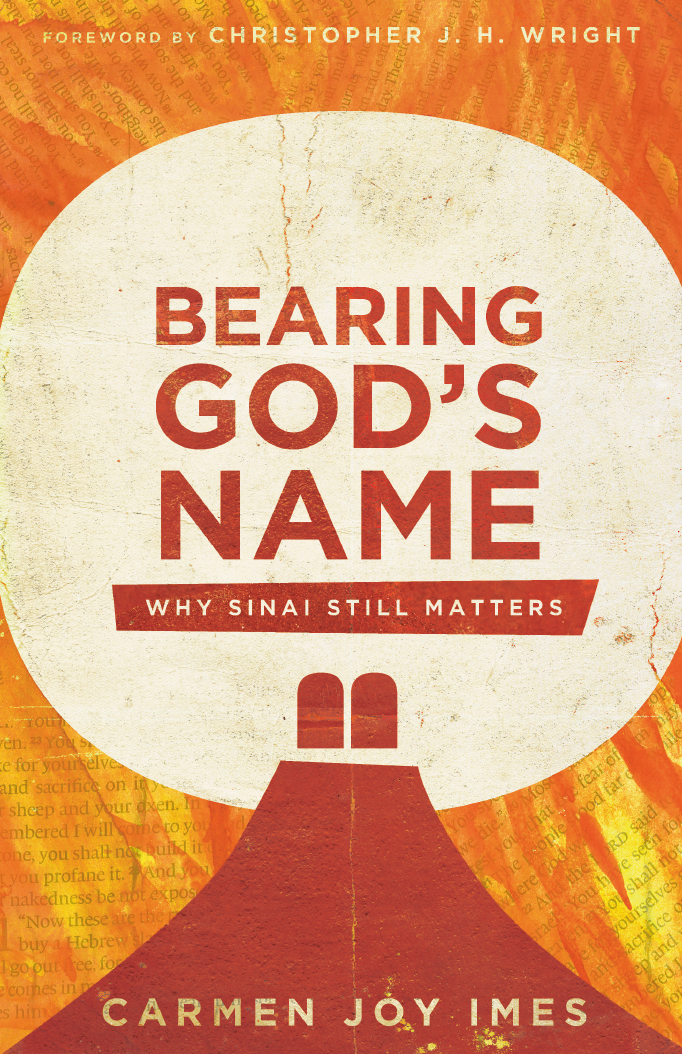
As some of you may know, I absolutely love the Old Testament. One day I aspire to be an Old Testament scholar where I do work in Genesis 1-11. However, until then I plod away on blog posts sharing my divine insights into God’s Word with all ya’ll. Recently, I picked up this tasty treat “Bearing God’s Name: Why Sinai Still Matters” by Carmen Joy Imes. I’ve gotta say right off the batt, I loved it. The stress Imes places on the importance of the Old Testament, the love of God’s law and its role in the Christian life, and how she digs deep into the meaning of “taking the Lord’s name in vain” (Ex 20:7) excites me to no end. In my opinion, there can not be enough good Old Testament scholarship in the academy (but maybe I’m a little bit biased).

I don’t know about you, but when I was first started reading the Bible, I was taught that the Old Testament was mostly about two or three things: The age of the earth, the story of Israel for some reason, and a bunch of good morally therapeutic stories we can become better people from. Be faithful like Abraham, or as bold as Moses, or as mighty as David, but never like Jonah (but God will use you anyway). The law is used to sort of place rules around humanity; a list of dos and don’ts. Don’t murder, don’t take the Lord’s name in vain by swearing, don’t steal or cheat and definitely don’t worship other gods (as if they existed anyway right?). I was taught when Jesus and the New Testament happened, the Old Testament became mostly irrelevant, replaced and kinda done away with. The Old Testament became a sort of novelty that none of us really knew what to do with. Personally, the Old Testament was way more interesting because it read more like The Lord of the Rings with battles, love lost, and deceit and the New Testament became a boring monologue from one person (Paul) to an invisible audience (the Church).

It took me a long time to realise this couldn’t be further from the truth. While the Old Testament is full of these things to be sure, it is so much more than all of that. Let me be clear, without the Old Testament, there would be no New Testament, and there would be no Jesus Christ. To this day I’m still discovering the implications and importance of the Old Testament and absolutely loving it. That journey began at Bible College where I started to realise that the Bible was one unified story about God, humanity and our salvation leading to Jesus. I often found myself asking the question “why is none of this taught in our churches?” However, Bible College only gave me the tools to do the digging. It was through years of personal study, resources like The Bible Project and other scholars like Carmen Imes that I fell head over heels in love with the Old Testament. I’m yet to learn Hebrew but it’s on the to-do list.

Personally, Imes has sharpened my thoughts around three main ideas:

  1. God’s law (the ten commandments) was given as a gift in response to Israel’s liberation and salvation, not to achieve it.
  2. That the law is about Israel living out their vocation so that people may know Yahweh.
  3. That Jesus and in turn, the Church united to Christ are the ones who take up this vocation and bear God’s name.

Traditionally, God’s law has been seen as something the Israelites must obey to be saved, to be God’s people. This isn’t entirely wrong. Imes does point out in her book that the law was a fence given to Israel so that life could flourish (pg 35). God does require obedience, however, the law was given and the obedience required comes after salvation, not before it. Imes argues that the law was a gift. She says:

Remember – the Israelites had already been resuced from Egypt when they were given the law. God did not say to them, “Do all these things and I will save you from slavery.” He saved them first, and then gave them the gift that goes with salvation, instructions on how to live as free men and women.

What a freeing truth. God’s law was given to His people as a gift to help them flourish, to help them carry His name, not to achieve salvation. There were no requirements, God simply saw His people in anguish and brokenness and said “I will save them,” and He did. This has some profound implications around my thinking of salvation as a New Testament Christian. God sees humanity and wants to rescue them out of the slavery of this world into His own Kingdom without any prerequisites. It’s only after we’ve been liberated from sin, forgiven, washed clean and united to God in Christ are we then given God’s law (i.e. to love God and others as ourselves) to flourish and carry His name. Which leads me to the next great idea.

Imes argues that the law was given to Israel to help them to live out their vocation. Israel wasn’t giving God’s law as a list of rules to obey otherwise God’s wrath and anger would just come down on them without a second chance. It was given as a gift so that His people could living out their calling, their vocation as the representatives of God on earth. As Imes breaks down the ten commandments in chapter three she argues that the command to not take the Lord’s name in vain should better be translated to not carry the name of Yahweh in a way that would dishonour Him (pg 49). Imes argues that all of Israel was supposed to carry Yahweh’s name in the same way that the high priest was (pg 50-52). Israel was to be a treasured possession, a kingdom of priests, a holy nation carrying Yahweh’s name before the nations. As Imes says:

As His treasured possession, Israels vocation – the thing they were born to do – is to represent their God to the rest of humanity. They function in priestly ways, mediating between Yahweh and everyone else. They are set apart for his service.

The problem? Israel failed woefully at this. They constantly fell into idolatry and sin as they misrepresented Yahweh to the nations. Which brings us to the final thought I loved in this book.

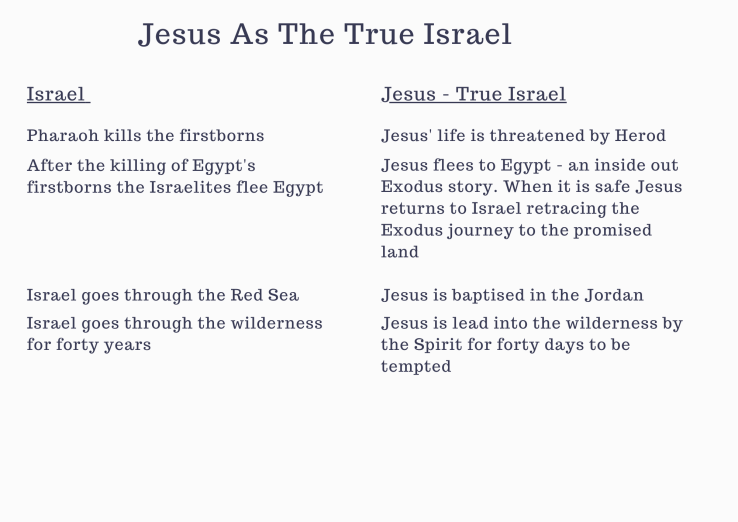
Imes beautifully and biblically argues that Jesus is the true Israel. She carefully traces this idea through the Gospel of Matthew where she compares the obvious imagery in Jesus’ story to that of Israel. Here are some examples (among many others) that she mentions:

Blue and Orange Compare and Contrast Graphic Organizer

She goes on to argue that because Jesus is the perfect image of God, that because He is in covenant relationship with the Father, Jesus ultimately fulfils all that Israel failed at. Therefore, our election is about representation, taking God’s name and carrying it to the ends of the earth (pg 164-166). The law is given to the Church as a gift for human flourishing as we’re united to God in Christ.

This was a very brief overview of Imes’ book. All in all, it was a really great read and I recommend that people read it to gain a healthier understanding of the relationship between the law and the Christian. 10/10.

Six Months In: The Journey so Far

It’s been six months since my wife and I separated. Six months of battling depression. Six months of battling anxiety. Six months of battling doubts about God. Six months doubting my future and what it has to bring. Six months of some amazing highs. Six months of a lot of struggle and lows. Almost every day it feels like a challenge to get out of bed, shower and even drink coffee (the thing I love more than anything else). Almost every day there’s something new and overwhelming to face and I’m never really sure if I’m able to face it until all of a sudden I realise it’s midnight and I’ve got to do it all over again the next day. I want to cry. I want to run away. I want to scream. I want to punch something. I feel like the Psalmist who says:

For my soul is full of troubles,
and my life draws near to Sheol.
I am counted among those who go down to the pit;
I am a man who has no strength,
like one set loose among the dead,
like the slain that lie in the grave,
like those whom you remember no more,
for they are cut off from your hand.

Psalm 88:3–5

Many days can only be described biblically as despair, the yoke is heavy, and I feel like I’ve gotten more than I can bear.

This isn’t a cry for help or attention. This isn’t me putting on a depressing show so I can get a pat on the back or a hug from you. This. Is. Life. I’ve been a Christian for over ten years now I can tell you right now that I’m learning more in this season than I have perhaps in the entire ten years of ever being Christian. Pain, trials, and tribulations refine the Christian and God is teaching me things I’m barely even beginning to grasp.

There are two types of people in this world. There are those who try to escape the pain and brokenness of life through encouragement, positive thinking and relying on the positive aspects of God’s promises. This is completely understandable. God wants us to believe that He has good things for us and that He wants to give us good gifts. Then there’s those who embrace the trials and pain and see it as a good thing in light of God’s promises to sanctify them and to grow them in wisdom. The former unfortunately seem to overlook the promises and sobering reality of life. Jesus never promised to take us out of this sinful, broken world, only to forgive us and free us from it while still being in it. Jesus never promises to take us away from pain and suffering, rather, He promised to walk with us through it. If anything is true of Christianity, it is this: pain and suffering have now become my friends. They’re a heightened, necessary experience for us in which God uses to transform the Christian into a sage and a saint for the time and place they live in.

Herein lies the rub. Pain and suffering is, quite literally the crux of the Gospel. I wonder, how many times when the Gospel is presented to someone do we offer suffering as a drawcard for conversion? Imagine “hey man! Give your life to Jesus. You’ll have forgiveness of sin, new life in Jesus… Which will probably suck. You’ll lose friends, family, jobs, money, and maybe your life. Pretty sick huh?” Not very appealing. However, this is exactly what Jesus was getting at when He said to take up your cross to follow me (Matt 16: 24-26), that one must hate all else to follow Him (Luke 14:26). Jesus knew what it would take to be His disciple. It is not easy, and one who has never experienced true suffering will never understand the importance of becoming its friend and letting it move you. Suffering takes the one who befriends it to greater heights and greater wisdom. That saint and sage glorifies his God more than he ever would have otherwise. Therefore, it is imperative to walk the same path as Christ our King. Remember, no servant is greater than their master.

“Out of suffering have emerged the strongest souls; the most massive characters are seared with scars.”
Kahlil Gibran

Why I Think Calvinism is Biblical

The central truth of God’s saving grace is succinctly stated in the assertion, “Salvation is of the Lord.” This strong declaration means that every aspect of man’s salvation is from God and is entirely dependent upon God. The only contribution that we make is the sin that was laid upon Jesus Christ at the cross. The Apostle Paul affirmed this when he wrote, “From Him and through Him and to Him are all things” (Rom. 11:36). This is to say, salvation is God determined, God purchased, God applied, and God secured. From start to finish, salvation is of the Lord alone………

April Fools 🙂