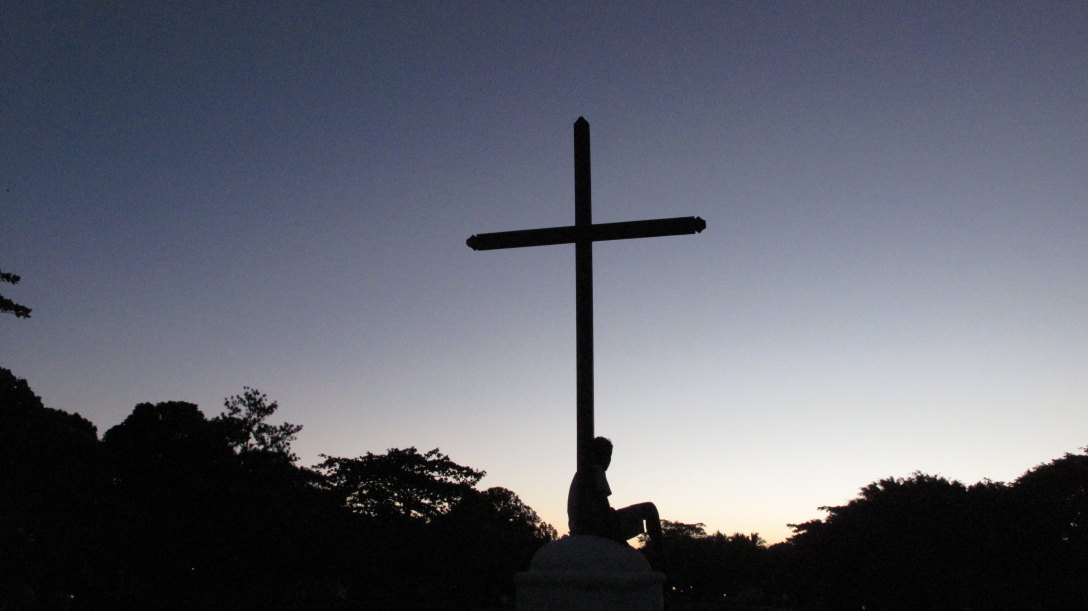

We’ve Lost Our Temple

Today I was at a sort of homeware store with my mum and aunty. This place was huge, anything you could ever want was here, both junk and treasure. I came across a little pink smooth rock with love written on it, and in a jesting fashion I said: “yeah hold that mum and feel the love that an inanimate object can give you.” She shot back quickly, “sort of like God hey Cam?” Bam. It was a good call. I immediately wanted to come back with something witty and defend God and my faith in some way. But it got me thinking…

Sometimes loving and worshipping God feels like loving that rock (an idol you could say). You pray, sing and give money to something that rarely talks back. Life goes on perhaps the same way it was always going to, at best it’s a placebo effect. Nothing seems to have changed, you don’t feel any more spiritual or holy then you did the day before church, in fact, you might walk out feeling more miserable, dirty and wretched then you did before you went. Why is this the case? Isn’t Christianity meant to be full of highs and few lows? Why does it feel like you’re speaking, worshipping into the wind?

Church for me has become more ritual and motion then it has been invigorating, and edifying. I don’t like the church at times, I do find it boring, I find it hard to connect with people unlike myself, to listen to the same preacher, to sing the same sort of songs, to experience the same sort of Christianity every Sunday. More then once I’ve walked out questioning whether there’s more to Christianity then what I’m experiencing. What about you? Does this sound like your experience at times? I’m sure I’m not alone here. Something needs to change… I think that a part of the problem is the way we “do church.”

We’ve lost something that I think was central to the ancient church’s experience. Think back, read about the way people thought of temple and sacred spaces. The temple was the space where Heaven and Earth collided. Where people would go to experience God’s presence and receive the forgiveness of sin. Sacred and holy spaces were so important to the ancient world and especially to the Israelites. People would fear being killed by God because of the sacred nature of the inner sanctum in the temple (Hebrews 9:7). Think back further to Mount Sinai, God dwelt on the top and He commanded that people and even animals were to be put to death if they even touched the base of the sacred mountain (Exodus 19 c.f. Hebrews 12). Go further back again, if Adam and Eve desecrated the Sacred Garden they were to spiritually die and be separated from God’s presence (Genesis 3). Fast forward to the early Church. People went and gathered with one another to hear the Scriptures taught (Acts 2:42), to sing psalms and spiritual songs (Ephesians 5:19), to minister to the outcast and needy (James 1:27), to practice the new found gifts that the Spirit distributed (Romans 12:6-8; 1 Corinthians 12:8-10), to edify one another (1 Thessalonians 5:11), to experience the risen Christ (Ephesians 3:19), God incarnate. For lying to the Spirit Ananias and Sapphira were killed (Acts 5:1-11), people feared the Apostles teachings (Acts 2:43), they had the fear of God. Yet today we treat church like nothing more than a thing we do on Sunday, another meaningless distraction, as a club, not a temple.

Rick and Morty: Nihilism and How the Gospel Heals Our Deepest Despair Part II

“Nobody exists on purpose. Nobody belongs anywhere. Everybody’s gonna die. Come watch TV?” This line, spoken by Morty encapsulates the essence of Nihilism and the trivial distractions we have in our life to help medicate that meaningless existence. Like BoJack Horseman, Ricky and Morty takes a good hard look at our reality and doesn’t shy away from dishing out Nihilistic truisms to continuously remind its audience that even the show they’re watching is nothing more than a distraction from their own meaningless existence. Distractions, they’re everywhere. Television, books, work, relationships, food, alcohol, sex, drugs, and even religion can all be distractions (idols) for humanity to help them forget the painful empty experience that many people (perhaps even unwittingly) experience every second of every day. Rick and Morty have it right, if there is no purpose to our existence then going on crazy space adventures is a great way to fill in the time. Unfortunately, despite their adventures, despite Rick’s intelligence, despite Morty’s futile attempts at avoiding it the void of life catches up to you. You can’t escape it.

Like Rick and Morty, even as a Christian, I tend to find things to constantly distract me. There are days, weeks or even months where video games, Netflix, or books take up more time than the time I spend intentionally worshipping God. There are days when the call to party, drink myself silly and splurge my money is so strong I wonder if I’m going to make it through the day. If you knew what sin was knocking at the door to my heart you’d never look at me the same way again… let alone speak to me. Life sucks, it’s hard, trying, and more complicated then it should be. But, the Gospel heals our deepest despairs.

The Gospel is wonderful. Here it is: There is this God named… well He has a few names in the Bible but let’s use Yahweh. Yahweh is crazy. What I mean is, He is so different, so apart, so “other” from any other god in any other story that it’s almost impossible to describe what He is like. He is so ridiculously loving, a kind of love that is so deep and so fierce it’s actually kind of scary. It’s kinda like sitting really close to a fire down the beach or something, and you know if you sit too close you’ll probably die because it’s just that intense in the fire, but you just can’t stay away from it. Also, Yahweh is so good. He is this God where you know you can be content with Him and He just wants you to flourish. He is like drinking the perfect cup of coffee in the morning knowing that it’s going to spur you on for the day. The reality is I could go on and on about what God is like He is just out of this world. The reason I tell you this is because every one of us has turned away from this amazingly “other” God and have basically told him to piss off. We have to be mentally insane reject something so good, yet here we are trying to pave our own way which has only lead to this sort of Nihilistic life.

Now, we’ve rejected this amazingly “other” God who loves us and wants to be in a relationship with us. I think this would be frustrating for Him. I know what it is like to have someone go their own way even though you only want what’s best for them. God has a right to be upset, not only are we rejecting His love and goodness for us, but we’re actually killing the world around us in the process. War, corruption, death… sin permeates and ensnares everything around us leading us further away from the source of all that is good and pure. So, knowing we’re never going to get it right ourselves, God comes and sets things right through the sacrificial death of His Son Jesus and His resurrection. There’s more to it and I recommend you go here to read more about what the Gospel is. But here’s my point. Nihilism is the consistent default position of the World, the World divorced from their loving God. God sees our despair, our nihilistic hearts and our woes, He invites us into a life of purpose, love, freedom and hope. He invites us into a relationship with creation the way it was meant to be, He invites us into a relationship with Himself. For us, the Church, we must do better at showing this to the World instead of being ensnared by it. Love fiercely, worship fearfully and serve the world purposefully with the Gospel on your lips and the love of Christ in your heart. I’ll leave you with this:

“You are the light of the world. A town built on a hill cannot be hidden. Neither do people light a lamp and put it under a bowl. Instead they put it on its stand, and it gives light to everyone in the house. In the same way, let your light shine before others, that they may see your good deeds and glorify your Father in heaven.” ~ Matthew 5:14-16

For the Love of God: Love and Violence in the Bible Part I

“For God so loved the world that he gave his one and only Son, that whoever believes in him shall not perish but have eternal life” (John 3:16).

Probably the most famous line in the entire Bible, this one verse has encapsulated the entire nature of God’s character and message for centuries. Rightly so, for God is love (1 John 4:8), endlessly merciful and kind (Lamentations 3:22), wanting none to perish, but all to be saved from their sin (2 Peter 3:9). God is willing to forgive the most wretched sinner, the most vile among us for no other reason than because He is so radically loving (Micah 7:18). It sounds good doesn’t it ? What an amazingly loving God we have. How do we know God is truly this loving? One needs to go no further than the Gospels and see how God’s love is displayed in the person and work of Jesus, especially in His atoning sacrifice on the Cross… But there’s a problem.

Christians, if we’re to be honest with ourselves, God doesn’t always seem so loving. God can seem genocidal, rash, unnecessarily angry, and even at times unjust. There are circumstances all throughout the Scriptures where God doesn’t seem to be the all loving and merciful God we see in Christ in the Gospels. How can we, for example, reconcile the God who floods the whole earth (Genesis 6-9), who commands the killing of Canaanites (Joshua), who uses Babylon to punish the Israelites (Habbukuk) with the God who takes no pleasure in the destruction of the wicked (Ezekiel 18:32), that loves someone as wicked as Paul (Acts 9), that sends His only begotten Son to die for the sins of the world (1 John 2:2)?

Lately, I’ve been tracking with this renewed debate. The issue is “how can God be both violent and loving at the same time?” From what I can tell there’s a bit of a spectrum with who sits where on the debate. On one end you have the classic evangelicals who argue that God is just and that when He kills people (or commands killing) it is because of sin. When He floods the world, when He judges nations He is completely in His right to do so. This they say is consistent with His character. On the other side, you have theologians like Gregory A. Boyd and Brian Zhand that advocates for a very high Christo-centric hermeneutic. In other words, unless you see Jesus doing it in the Gospels God isn’t doing it at all. For me, this debate brings some important questions into sharp focus:

  1. To what extent are the Scriptures inspired/infallible?
  2. What purpose does the Old Testament serve for the New Testament Christian?
  3. What about what the New Testament authors say about God’s love and violence?

For the moment I’ll let these questions simmer around in our thoughts before spilling my own thoughts on the issue. But I will say this. How we view the above questions, I believe, play a huge role in where we fall on this issue. This issue is an important one, it isn’t something we should just ignore.

BoJack Horseman: Nihilism and How the Gospel Heals Our Deepest Despair Part I

So, this might trigger some Christians (you’ll be ok), but the last couple of days I’ve been watching Netflix’s BoJack Horseman, and thanks to the guys over at Wisecrack  I got thinking about Nihilism and how it seems to permeate our culture. First, a quick rundown on what Nihilism is for my more ill-informed readers. Nihilism, championed by Friedrich Nietzsche (1844-1900), is the idea that everything in life is a series of random, chaotic, and purposeless events. What you do doesn’t ultimately matter, there is no meaning to life, and things like religion and spirituality are attempts to bring sense to a meaningless existence. Let me get real with you. Sometimes life feels this way. Sometimes Christianity feels like a vain attempt to bring meaning to a meaningless existence.

Sometimes I wonder if being a Christian is worth it. Sometimes I wonder if God is really there or if He is a product of my own making. I know Christians aren’t supposed to talk like this, but this is real life. Christianity doesn’t mean everything is fine and dandy, and that if you close your eyes real hard with a sprinkle of faith, and click your heels three times you’ll be transported to the loving embrace of God. Don’t get me wrong, I believe God loves us and that love is displayed in the person and work of Christ, but I think some of us need to be real with ourselves and admit that there are days that feel empty and void of meaning.

For BoJack, every day is like this. He is a washed-up alcoholic that is in desperate need to connect to the people around him and regain his former glory as a T.V star. Everything about BoJack’s life screams a broken, lifeless, enslaved, idol loving, mess. As I look back on my life, even since becoming a Christian, I’m not sure if my life has fared much better in some ways. I mean, I’m certainly not an alcoholic, but like BoJack I desperately yearn for people to love me while my natural disposition is to push them away. Like BoJack, I go to the little idols in our lives that distract us from doing real life. Like BoJack, I can live a functional Nihilistic life even while I intellectually ascend to the doctrines of God and Christ. This is not the Christian life.

The Good News is the Christian life. And the Christian life embraces the likes of BoJack and aims to transform him from a broken human being (or horse) to a human being that is shalom. It seeks to deal with the idols that enslave him and set him free. The Good News not only reconciles BoJack to God but also to other people giving him authentic relationships that are real and raw. The Good News gives BoJack fulfilment, purpose, meaning, the forgiveness of sin, it gives him a new life in Christ. I have experienced this, tasted this, and I know that it is good. God loves the BoJacks of this world, no one is too far gone. It just takes a bit of courage to admit that we need Him, to admit that we need fixing.

If we confess our sins to him, he is faithful and just to forgive us our sins and to cleanse us from all evil and brokenness” (1 John 1:9).

The Lost World of Genesis One: A Messy Book Review (possible trigger warning)

Not long ago I asked people on Facebook what books I should review, so here’s the first one in that list “The Lost World of Genesis One.” Before I dive into it, I just want to remind any readers that this isn’t a traditional book review, I’m more spitting ideas and thoughts out as I reflect on the book. Anyway, here we go.

For as long as I’ve been a Christian at least, being a legitimate Christian meant a few things 1. It meant that you are saved by the blood of Jesus 2. It meant that you go to church and pray 3. It meant that you took the Bible seriously, literally, and unquestionably. For someone like me who came out of a worldview that was vague and largely based on “what you felt was right,” this came as a breath of fresh air. Finally, I had rules and expectations to fall on to and for a while I loved it, it felt safe, and I just followed pretty confidently anyone who taught me the Scriptures. But as I grew in my faith, as I went to Bible college and into ministry, I started to realise a lot of this stuff wasn’t so black and white especially when it comes to how one interprets the Scriptures…

There are so many different understandings on different things when it comes to the Scriptures. The Atonement, the gifts of the Spirit, the last days, and even Genesis 1 and creation. As I see it there is somewhat of a spectrum when it comes to where Christians land on the creation issue. On one end of the spectrum, you have Young Earth Creationists that take the creation account in Genesis 1 literally. They believe that God created the heavens and the earth in seven literal twenty-four hour days and that the age of the earth can be traced back (through genealogies and scientific method) to be about only ten thousand years old. On the other end of the spectrum, however, you have Theistic evolutionists. They believe that the creation account doesn’t serve to give us a literal account of how God created the universe, rather, God used the evolutionary process over potentially billions of years to create the cosmos.

John H. Walton’s book “The Lost World of Genesis One” speaks into the Genesis 1 debate and clears up a lot of the messiness that so often clouds this issue. Walton digs deep into the ancient near eastern context, using great exegesis, and suggesting that Genesis 1 isn’t about whether or not God literally created the world in seven literal days or how old the earth is, rather, it is about God Himself, and how everything that He created functions (including humanity) in relation to Him. He argues this by giving us 18 propositions (though I think he could have argued his point in less).

Personally, I found his book overall to be a breath of fresh air. For me, the age of the earth debate is one of the biggest wastes of time that the Church has ever been involved in. There are legitimate Christians on the entire spectrum. A lot of trees have had to die over something the Bible doesn’t really emphasise, but I think it is fairly typical of us to get caught up in something that’s not that important (trust me I understand for some people it is). I don’t think Genesis 1 cares about young earth or evolution, I think Genesis 1, 2 and 3 serve to set up the entire biblical narrative that ultimately culminates in Jesus’ first and second coming. I recommend anyone from any place on that spectrum to read it and be challenged by what Walton has to say and then maybe, just maybe, we can start to work towards putting to rest some of the messiness surrounding these discussions and start talking and doing the more important things like actually preaching the Good News (which of course is found in Genesis 1-3 if taught properly).