
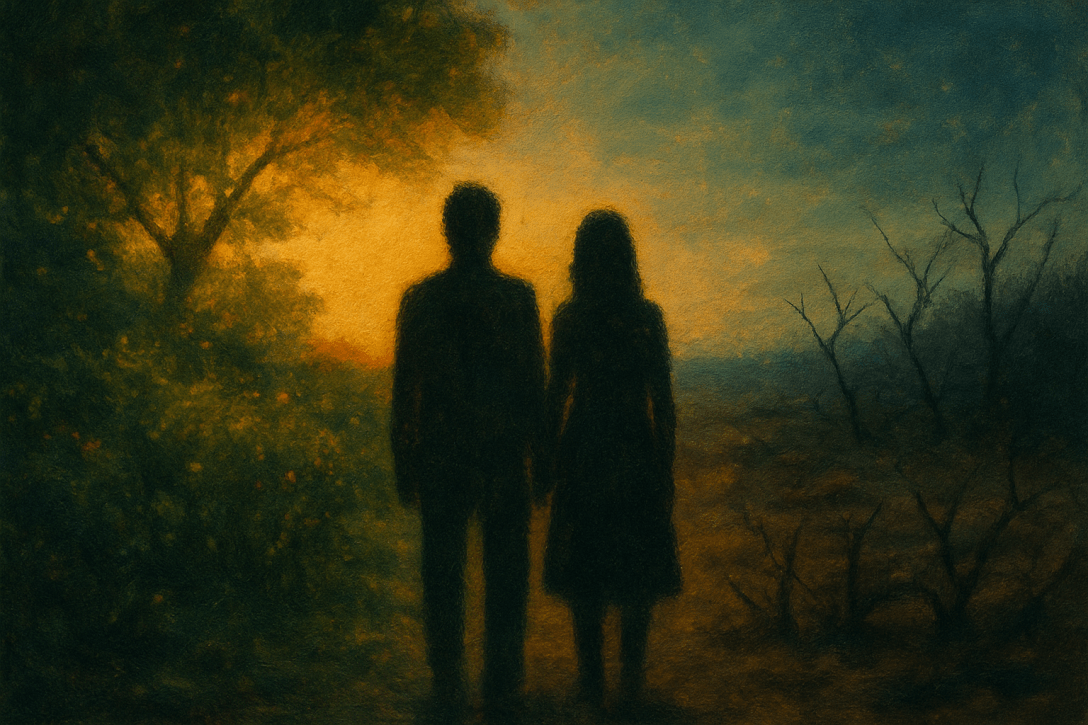
Where did it all go wrong?
Genesis does not begin with a courtroom but with a garden. It does not give us a manual of origins but a story of longing, freedom, and fracture. These early chapters are less about when and more about why. They are not fossils of a world long gone but mirrors of our own. They speak of desire that bends, of Exile that begins, of God who keeps walking into the story anyway.
“In the beginning, God…” (Genesis 1:1). Before the ache, before the questions, there was only God. All that exists flows out of this life. Gregory of Nyssa said that only God truly has being in Himself, while all else exists only by participation. Creation is not necessary, but a gift. The beginning is not a moment in time but the eternal One whose presence holds everything in existence.
Wisdom desired, wisdom distorted
The tree was not poisonous. It was a possibility. Wisdom was always meant to be humanity’s inheritance, but in God’s time, not ours. In Genesis 3, the grasping of fruit is less about appetite and more about autonomy. To seize before its time is to make wisdom collapse into folly.
Paul would later write, “The wisdom of this world is foolishness with God” (1 Corinthians 3:19). The mystics often spoke of a wisdom that comes not by grasping but by surrender. True wisdom is received, not snatched. It ripens only in the soil of trust. To forget that all wisdom is participation in God is to fall back into Exile.
The question in the garden
When Adam and Eve hide, God does not thunder judgment first. He asks a question: “Where are you?” (Genesis 3:9). It is the first question God asks in Scripture, and it has never stopped echoing. It is less a demand for location than a call to self-awareness. Where are you? Not just in the garden, but in your soul, in your wandering, in your ache.
The desert fathers and mothers taught that prayer begins not with words but with awareness. To stand before God is to hear that question again and again. Where are you? The psalmist answers, “Where can I go from your Spirit? Where can I flee from your presence?” (Psalm 139:7). Even in hiding, God is near. Even in Exile, our being still participates in Him.
Shame, blame, and the covering of God
We cover ourselves with fig leaves, then point fingers to deflect the weight of our shame. The first man blames the first woman. The first woman blames the serpent. This is the rhythm of fallen humanity: hiding, deflecting, excusing. But even here, grace intrudes. God does not leave them naked. “The Lord God made garments of skin for Adam and his wife and clothed them” (Genesis 3:21).
The covering is both tender and terrible. Tender, because it restores dignity. Terrible, because it hints at the cost of covering. Life surrendered for life preserved. The cross is already flickering in the shadows of Eden. To be clothed by God is to be reminded that even when we try to cover ourselves in fear, our true being remains grounded in Him.
The curse and the serpent
The serpent is not annihilated but transformed. Dust becomes its food, enmity its destiny. The curse is not a spell but a new pattern of existence. Relationships fracture. Creation distorts. Struggle is woven into soil and womb alike.
Yet even here, hope is stitched in. “He will crush your head, and you will strike his heel” (Genesis 3:15). A wound will remain, but victory will come. The first gospel is spoken over the dust. The Eastern fathers often called this the “protoevangelium”, the first glimmer of redemption. Even in curse, God remains the source of being, and from Him redemption begins to unfold.
Exile and the ache of humanity
To be human is to be east of Eden. To till soil that resists. To live under a curse and yet still carry promise. Adam names Eve “mother of all living,” even as death has entered the story (Genesis 3:20). Exile is unavoidable, but so is God’s relentless pursuit.
And yet, to be truly human is more than east of Eden. It is to walk in the cool of the day with God. It is to flourish in the garden, unashamed, at peace with creation, with self, and with one another. Exile names our condition. Communion names our calling.
Julian of Norwich once wrote, “Our soul is made of God and in God it is grounded.” To be human is to ache for that grounding. We evolve, not merely biologically but spiritually, socially, and theologically. From garden to city, from scattering to gathering, from Babel’s confusion to Pentecost’s tongues of fire. Humanity is still in process, but its being remains anchored in the One who was there in the beginning.
The ache of new creation
Genesis 1 to 11 is not just about what went wrong but about what God will set right. These are the seed-stories, and they lean forward. From the waters of the flood to the scattering at Babel, creation keeps unravelling. And yet the Spirit hovers still, waiting to call forth a new beginning.
Paul names Jesus the “last Adam” (1 Corinthians 15:45), and John sees a new heaven and a new earth (Revelation 21:1). The garden at the beginning becomes the city at the end, the Tree of Life reappearing, its leaves “for the healing of the nations” (Revelation 22:2).
Gregory of Nyssa’s words echo here, too. Only God has being in Himself, and at the end, all creation will be drawn into that fullness. “In the beginning, God” will one day be heard again as “God all in all” (1 Corinthians 15:28). The end is a return to the beginning, to the One who called us into life.
We read these stories not as distant myths but as mirrors. They are the patterns we still live in: hiding, blaming, longing, wandering. But they are also the patterns of God: seeking, covering, promising, recreating.
Perhaps the most profound truth of Genesis 1 to 11 is not simply how the world began, but that God refuses to let the story end in Exile. The God who walks in the twilight of Eden still walks among us, still asks the old question, still whispers us toward new creation.
 Scribbling Theology