Hermeneutics, Method, and Epistemology in a World of Fractured Voices
A World of Fractured Voices
Tamriel doesn’t begin with a single creation story. It begins with many, and they rarely agree. Ask an Altmer, a Khajiit, a Nord, a Dunmer, a Yokudan, or an Imperial, and you’ll get a different version of how the world began and what it means. Each account is told with conviction, yet each undermines the others. Theology in Tamriel starts, not with certainty, but with a clash of voices.
- The Altmeri Account — The Monomyth
The High Elves see themselves as descended from the Aedra, divine beings who gave of themselves to shape the world. It was both noble and tragic: “Anuiel, who was Anu’s soul, became the many. Padomay, who was Anu’s brother, became the few. And their interplay created the et’Ada, the original spirits, who sacrificed themselves to give birth to the world.” (The Monomyth)
For the Altmer, creation is a fall from divinity, and mortality is a kind of exile. - The Khajiiti Account — Words of Clan Mother Ahnissi
The Khajiit remember creation through moons and shadows. Their matriarch tells how Jone and Jode danced the world into being: “When Ahnur and Fadomai were still in love, Ahnur gave birth to many children. Fadomai was tricked by Lorkhaj, who made her give birth to the Great Darkness. Yet out of her pain came Jone and Jode, the moons, who guide us still.” (Words of Clan Mother Ahnissi)
For the Khajiit, Lorkhaj is no simple villain but the Moon Beast, betrayer and patron, curse, and blessing at once. - The Nordic Account — The Five Songs of King Wulfharth
The Nords sing of Shor, their name for Lorkhan, as a warrior-father who carved out the world for the sake of men: “Shor made the world from the corpse of a god, and men rose from the earth, strong and free. But the elves hated this world, and they betrayed Shor, striking him down.” (The Five Songs of King Wulfharth)
What the Altmer see as tragedy, the Nords see as triumph. The world is a gift won through blood and betrayal. - The Dunmeri Accounts — The 36 Lessons of Vivec and Velothi Tradition
The Chimer abandoned the Aedra for the Daedra, believing the so-called “Ancestors” had betrayed mortals. Their prophet Vivec recasts creation as paradox: “The world is illusion, but the world is also true. To know this is CHIM.” (36 Lessons of Vivec, Sermon 12)
For the Dunmer, the world is not simply wound or gift, but a puzzle to be unravelled. - The Yokudan Account — Satakal the Worldskin
The Redguards, heirs of the Yokudans, remember creation as an endless cycle of devouring and rebirth. In their myth, Satakal the Worldskin consumes each world, and only those who learn the Walkabout escape to the next: “Satakal ate itself over and over, and every time a world was devoured a new world came to be.” (Satakal the Worldskin)
Creation here is not a single act, but an eternal cycle of death and renewal. - The Imperial Synthesis — The Annotated Anuad
The Empire, ever the administrator, tried to weave the rival myths into one “official” story: “Anu, the Everything, was in himself all things. Padomay, the Nothing, was his brother. Their conflict gave rise to the et’Ada, the Original Spirits, who then gave birth to Nirn.” (The Annotated Anuad)
But even here, the contradictions remain. Lorkhan is both a deceiver and a necessary architect. The Imperial voice tidies, but cannot silence, the discord.
In Tamriel, creation is remembered as a tragedy and triumph, a betrayal and a gift, a prison and a puzzle. Every account claims to tell the truth. None agree. This fractured chorus is not a flaw. It is the theology.
Hermeneutics: Reading Amid Contradiction
Theology in Tamriel begins in a library, not a creed. One cannot simply ask, “What do the people believe?” because the answer depends on which book, song, or sermon you open. Vivec’s riddled sermons conceal as much as they reveal. The Nords glorify Shor; the Altmer vilify him. Even prophecy refuses clarity:
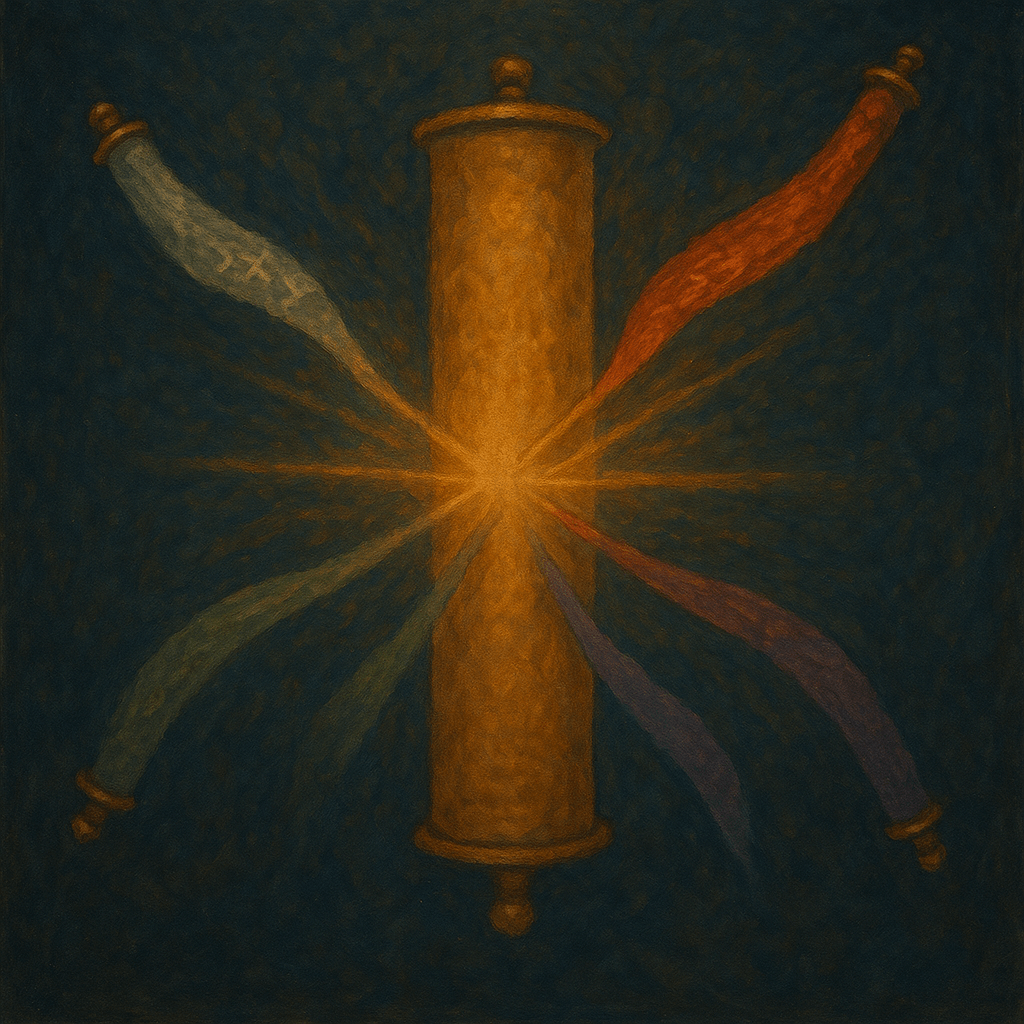
“The Scrolls change, and their meaning is never fixed. To read one is to risk madness.” (Divining the Elder Scrolls)
The hermeneutic task, then, is discernment. Truth must be sifted from contradiction, carried through paradox, wrestled from unreliable narrators.
The Player as Theologian
TES doesn’t just hand down these texts; it makes the player hold them. You might read The Monomyth in an Imperial library, only to find a bard in Windhelm singing Shor’s defiance, or an Ashlander dismissing Vivec’s sermons as lies. The game never tells you, which is “true.” Instead, it places you in the position of theologian gathering stories, comparing them, discerning patterns, and learning to live with contradictions you cannot resolve.
In this sense, TES turns every player into a pilgrim-reader. The task is not to possess final answers, but to walk among testimonies and weigh them.
Methodology: Theology as Pilgrimage, Not System
If theology often aims at coherence, theology in TES must be walked as pilgrimage. The Imperials’ Anuad gestures at system, but it cannot silence the Nords’ defiance or the Khajiiti moon-myths.
A theology of Tamriel can’t be written as one definitive voice. It must take the form of journeying through competing testimonies, living with tension as the method itself. Theology here is less a blueprint and more a pilgrimage through paradox.
Epistemology: Knowing Through Unreliable Narrators
In Tamriel, knowledge is not primarily about propositions but about relationships and allegiances. The unreliable narrator is not a mistake. It is the way truth appears. The Five Songs of King Wulfharth contradict themselves. Vivec insists “the world is illusion, but the world is also true” (36 Lessons of Vivec, Sermon 12). The Elder Scrolls themselves change with each reading.
To know is not to possess certainty but to live inside a story, to commit to a patron, to follow a path. The Khajiit trust the moons because their lives are woven into their phases. The Nords trust Shor because his story shapes their courage. Knowledge in Tamriel is lived allegiance, even when the stories clash.
Thus epistemology in TES is not propositional but relational. To know is to live inside a story, to commit to a patron, to walk a path, even while knowing that path contradicts another. Knowledge is not the absence of unreliability, but the courage to live with it.
Why This Matters
Without attending to method, a theology of TES would collapse into fan cataloguing a list of gods, myths, and cultures without coherence. Beginning with hermeneutics, methodology, and epistemology reminds us that these contradictions are not problems to be explained away, but the very form of Tamrielic revelation.
This matters because it teaches us how to read. It teaches us to hold paradox without panic, to see myth as meaning-bearing, to discern in fractured voices rather than demand a single answer. And this posture, once learned in Tamriel, can shape how we approach knowledge, faith, and story in our own world.
A Christian Glance: Contradiction, Myth, and the Shape of True Knowledge
For Christians, this way of knowing is not so strange. Scripture itself is full of tensions that don’t resolve neatly.
Consider the genealogies. Matthew traces Jesus’ line through Solomon and shapes it into symbolic groups of fourteen (Mt 1:1–17). Luke traces it instead through Nathan, another son of David, stretching back to Adam, “the son of God” (Lk 3:38). The lists diverge entirely after David. Both cannot be historically identical, yet both are true in what they proclaim: Matthew presents Jesus as Israel’s royal heir, Luke as the universal Son of Adam.
Or consider the words from the cross. In Matthew and Mark, Jesus dies with a cry of abandonment: “My God, my God, why have you forsaken me?” (Mt 27:46; Mk 15:34). In Luke, he breathes his last in trust: “Father, into your hands I commit my spirit” (Lk 23:46). In John, it is triumph: “It is finished” (Jn 19:30). These final words cannot be collapsed into one, yet the church preserved them all, as if contradiction itself was revelation: Christ’s death was both forsakenness and faith, defeat and victory.
These contradictions are not mistakes. They are invitations. They tell us that truth is not a tidy system but a mystery large enough to hold paradox. Knowing God is not mastering a set of airtight propositions, but learning to dwell faithfully in a story that resists simplification. Faith is the courage to inhabit contradiction, trusting that meaning is held in God.
Here, TES can sharpen Christian eyes. Tamriel’s fractured myths train us to see unreliable narration as a space where truth can still break through. For Christians, it may even be a more authentic way of engaging with knowledge: not by erasing tension, but by receiving it as part of how God chooses to reveal himself.
The Task Ahead
The first doctrine, then, is method. Both The Elder Scrolls and Scripture confront us with unreliability, contradiction, and the need for discernment. In Tamriel, the contradictions remain open. In Scripture, they are preserved as sacred testimony. Both demand that we read, not as consumers of facts, but as pilgrims seeking meaning.
In the next part, we turn to the heart of TES theology: Who, or what is God? Anu and Padomay, the primordial twins? The Aedra and Daedra? Or is divinity itself a riddle with no single answer?
 Scribbling Theology