
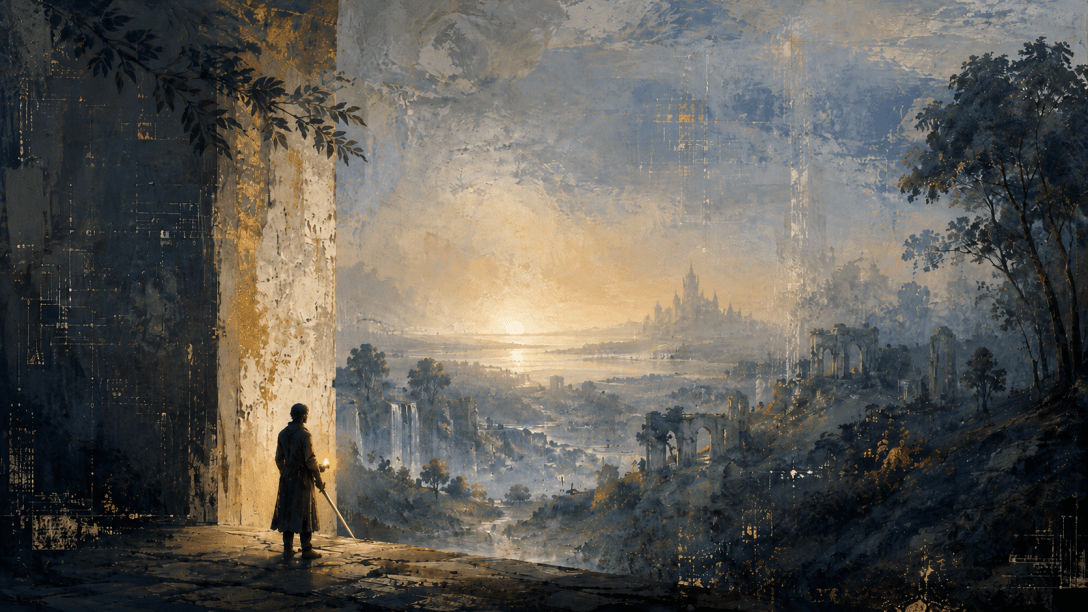
Wonder, Formation, Sacramentality, and the Ache For a Healed World
Some of you might not know this, but I love video games. I really love video games.
It probably started when my mum and dad had a Sega. I cannot remember which one, but I remember playing Alex Kidd. Then came the Super Nintendo, with Yoshi’s Island and Mario Is Missing. But the console that probably defined my childhood was the Nintendo 64.
That grey little box was magic.
GoldenEye. Star Wars: Rogue Squadron. Super Mario 64. Lylat Wars. Pokémon Stadium. And of course, probably my favourite game of all time, The Legend of Zelda: Ocarina of Time.
Gaming has changed a lot since then. We have moved from blocky pixels and split-screen chaos to vast open worlds, emotional storytelling, online communities, virtual reality, and games that feel less like toys and more like places you inhabit.
Christians have never quite known what to do with video games. Are they harmless fun? A waste of time? A spiritual danger? A strange little doorway into wonder?
For some Christians, the answer has usually been simple. Video games are violent, addictive, childish, escapist, and spiritually dangerous. And sometimes, honestly, that criticism is fair.
I have had plenty of negative experiences with games. I have rage quit more times than I care to admit. I have felt my body tense, my anger rise, and my patience evaporate because someone beat me in a match I thought I should have won. Online gaming can also be toxic. Anyone who has played competitive multiplayer games knows how quickly a lobby can become a little digital hellscape of contempt, insecurity, abuse, and ego.
Gaming can form us badly.
It can train impatience. It can feed escapism. It can reward domination. It can make us cruel, distracted, compulsive, resentful, or numb. It can turn rest into avoidance. It can turn play into compulsion. It can turn community into competition without love. So no, video games are not harmless by default. But I do not think they are spiritually empty either.
Video Games Form Our Loves
Years ago, I read James K. A. Smith’s You Are What You Love. His basic argument is that human beings are not just “thinking things.” We are lovers. We are creatures of desire. We are shaped not only by what we believe, but by what we repeatedly do, imagine, practise, and give our attention to.
In other words, our habits form our hearts. That gave me a better question to ask of gaming. Not simply, “Am I allowed to play this?”
But: What kind of person is this game forming me into?
That question is harder to dodge. It does not let me hide behind easy condemnation or easy permission. It asks me to pay attention. And attention is spiritual work.
Video games are not just entertainment. They are interactive stories. They invite us into worlds. They give us roles to play, enemies to face, choices to make, quests to complete, landscapes to explore, powers to wield, and endings to long for. A film lets you watch the hero. A game lets you become one.
I know there are dangers here. I have felt some of them in myself. But I also know games have given me moments of real wonder. There was a world worth saving
Think about Zelda. As a kid, I wandered through Hyrule in awe. I crossed fields, explored temples, fought monsters, rescued people, and slowly discovered that the world was deeper, stranger, and more sacred than it first appeared. There was evil, yes. But there was also beauty. There were monsters, but also music. There was darkness, but also courage. There was a world worth saving.
That kind of story resonates deeply with the Christian imagination. Scripture is full of the cry for evil to be defeated, for creation to be healed, for captives to be rescued, for peace to come, for the world to be made new (Romans 8:19–23; Revelation 21:1–5).
The Bible is not less imaginative than our games. It is more so.
It gives us a world charged with glory. A creation groaning for liberation. A humanity called to image God (Genesis 1:26–28). A dragon to be defeated (Revelation 12:9). A Lamb who conquers not by domination, but by self-giving love (Revelation 5:5–10). A city where heaven and earth are finally reunited (Revelation 21:1–3).
When a game tells a story of courage, sacrifice, beauty, justice, friendship, resistance, wonder, or hope, it is borrowing from a deeper moral and spiritual grammar. It is echoing, however faintly, the shape of the gospel.
Imagination and Disenchantment
Maybe part of the reason I care about this is because many of us were formed to distrust imagination.
In my own church tradition, faith was often treated as something that lived mostly in the mind. Christianity was about believing the right things, defending the right doctrines, reading the Bible correctly, and avoiding anything that might lead you astray. None of those things are bad, of course. Doctrine matters. Scripture matters. Truth matters.
But somewhere along the way, imagination became suspicious.
Fantasy was treated as childish at best and spiritually dangerous at worst. Beauty was secondary to correctness. Play was tolerated, but rarely honoured. Mystery was often something to solve rather than something to enter. The body was treated with caution. Desire was treated as a threat. Joy was allowed, but only if it behaved itself.
I suspect that is not only a church problem. It is also a Western problem. We inherited a deeply rationalised vision of the world, where truth was reduced to information, faith was reduced to propositions, and maturity was measured by how well we could explain, defend, categorise, and control things.
But biblical faith has always needed imagination.
Walter Brueggemann writes about the prophetic imagination: the Spirit-given capacity to see through the dominant stories of empire, despair, scarcity, and control, and to announce another world made possible by God. Imagination is not the opposite of truth. Sometimes imagination is what allows truth to become visible again.
Tolkien understood something similar when he described human creativity as “sub-creation.” We make worlds because we are made by the Creator. Our imagined worlds are not replacements for God’s world, but small acts of creaturely participation within it.
That gives me a different way to think about fantasy, story, and play.
At their worst, they can become escape. But at their best, they can become resistance to a flattened world. They can train us to hope, to grieve, to long, to notice beauty, to imagine healing, and to remember that the world as it is now is not the world as it must always be.
So for some of us, holiness became suspicion. Maturity became the ability to avoid anything that looked too strange, too magical, too bodily, too joyful, too human. But the Christian story is not thin like that.
The world begins in goodness. Humanity is made in the image of God. Creation is blessed before it is broken (Genesis 1:31). The biblical imagination is full of gardens, rivers, mountains, beasts, angels, songs, dreams, visions, meals, temples, cities, wounds, resurrections, and new creation.
Christian faith does not ask us to abandon imagination. It asks for our imagination to be healed.
And sometimes, strange as it may sound, a game can awaken something that a flattened faith has buried.
Video Games As Sacraments
A game like The Legend of Zelda can stir wonder. It can remind us that evil is real, but so is courage. It can give us the feeling of standing at the edge of a vast field, hearing the music swell, and sensing that the world is larger than our fear.
A game like Sky: Children of the Light can feel almost liturgical in its very mechanics. You move through darkness toward light. You carry light, share it, lose it, recover it, and help others keep going. There is no sermon in that. No heavy explanation. Just a shared journey where light is not only something you seek, but something you bear for others (Matthew 5:14–16).
A game like NieR: Automata can raise questions about consciousness, suffering, meaning, sacrifice, and whether love can survive in a world that feels mechanical and absurd.
A game like Elden Ring can immerse us in a world where glory and ruin are tangled together. Everything is broken, but not meaningless. Beauty is still there, even among rot, ash, violence, and decay. There is something profoundly human about wandering through a ruined world and still pressing on.
These games are not Scripture. They are not substitutes for prayer, worship, therapy, friendship, church, or actual embodied life.
But at their best, I do think they can be sacramental.
Not sacraments in the formal ecclesial sense. I am not saying Ocarina of Time is baptism, or that Elden Ring is the Eucharist. But sacramental in the older, deeper sense: created things becoming transparent to grace. Ordinary objects, sounds, images, stories, and experiences becoming signs that point beyond themselves to the God who made the world good, entered it in Christ, and is renewing it by the Spirit (John 1:14; Colossians 1:15–20).
God, Code, and the Digital World
As a Christian who leans panentheist, I believe God is not one more object inside the universe, but the One in whom all things live and move and have their being (Acts 17:28). God is beyond creation, but not absent from it. Creation is not God, but neither is it sealed off from God. All things are held together in Christ (Colossians 1:17). All things are sustained by the word of God’s power (Hebrews 1:3).
So what do we do with a video game?
A game is not “natural” in the same way a tree, river, mountain, or human body is natural. It is made from code, art, electricity, plastic, metal, labour, memory, and imagination. It is made by human beings, who are themselves creatures made in the image of God. Even the 1s and 0s are not outside the world God sustains. They are not divine. They are not magic. But they are still part of a creation held in God.
That thought does something to me.
It means the digital is not automatically unreal. It means human-made worlds, however fragile and limited, can still participate in the goodness of creation. They can still carry beauty. They can still become places where attention, friendship, grief, and hope are awakened.
Not because the game is God. Not because every game is holy. But because there is nowhere grace cannot reach.
Little Rehearsals of Grace
A game can be sacramental when it awakens us to our own humanity.
Gregory of Nyssa gives me language for this. For Nyssa, the life of faith is not static. We do not simply arrive, possess God, and stop moving. We are drawn ever deeper into God’s infinite life, changed “from one degree of glory to another” (2 Corinthians 3:18). The Christian life is a journey of becoming, an endless movement into love, freedom, holiness, and communion.
That may sound a long way from video games, but I am not sure it is.
So many games are built around movement: setting out, failing, learning, returning, growing, helping, losing, recovering, and pressing on. At their best, they can echo something true about the human vocation. We are not finished creatures. We are being formed. We are being healed. We are becoming human in communion with God and one another. And perhaps, in small and partial ways, games can even help facilitate that journey toward God. Not because they replace prayer, Scripture, worship, sacrament, or community. They cannot bear that weight.
But because they can train us to attend, to persevere, to repent, to begin again, to receive help, to offer help, to face darkness without surrendering to it, and to keep moving toward light.
They can become little rehearsals of grace. A game can be sacramental when it draws us into a shared, participatory story. When it does not merely entertain us, but invites us to practise courage, patience, grief, wonder, mercy, and hope. When it reminds us that we are not passive observers of the world, but creatures called to respond, to choose, to bear, to repair, to seek, to love. When it makes us feel the ache of a ruined world and the longing to become the kind of people who participate in its healing. When it helps us sense, even faintly, that beauty is not an accident, evil is not ultimate, and becoming human is something we do together.
They are stories. And stories shape us. They give us images for grief. They give us symbols for courage. They let us explore ruin, beauty, failure, hope, fear, and perseverance from the inside. At their best, games can help us practise attention: attention to beauty, to desire, to the kind of world we long for, and to the kind of person we are becoming.
Better Questions for Christian Gamers
I still think discernment matters here. Not fear. Not legalism. Not the lazy assumption that everything new is dangerous. But also not the equally lazy assumption that entertainment is spiritually neutral because “it is just a game.”
If it is forming our loves, then it is doing more than passing the time. I wonder if Christians have been asking the wrong questions. Not only, “Is this game violent?” But, “What does this game do with violence?”
Does it glorify domination, or does it expose the cost of harm? Does it turn enemies into objects, or does it make me feel the tragedy of a broken world? Does it invite wonder, or simply consumption? Does it deepen patience, curiosity, courage, and compassion? Does it help me rest, or does it help me hide? Does it reconnect me to joy, or does it numb me from pain I need to face? Does it make me more human, or less?
These questions are not only for games, of course. They are questions for everything that forms us.
Work can deform us. Ministry can deform us. Social media can deform us. Theology can deform us. Even good things become destructive when they become ultimate things. The problem is not that we love games. The problem is when we ask games to save us.
When gaming becomes our escape from responsibility, our substitute for friendship, our anaesthetic against pain, or our primary source of identity and achievement, then something has gone wrong. We have asked a creaturely good to bear the weight of God.
And it cannot.
But when gaming becomes play, rest, imagination, beauty, friendship, and wonder, it can be received as a gift. A creaturely, deeply human gift.
Learning to Notice
Christians confess that creation is good. Not only the obviously religious parts of life. Not only church services, sermons, Bible studies, quiet times, and worship music. Creation itself is charged with meaning because it comes from God and is held in God.
The world is sacramental before we ever learn the word.
Bread can become communion. Water can speak of death and resurrection. Wine can become joy. A meal can become grace. A garden can become a temple. A body can become the dwelling place of God (1 Corinthians 6:19). The Word became flesh, not an idea, not a concept, not a disembodied message, but flesh and blood in the middle of creation (John 1:14).
Maybe I do not need to ask whether God can be found in video games, as though God were hiding in some places and absent from others.
Maybe I need to ask what kind of attention I bring with me. Am I playing with numbness, compulsion, and escape? Or am I awake enough to notice beauty, grief, longing, friendship, courage, and the quiet pull of new creation? Not by forcing a Bible verse onto every boss fight. Not by pretending every game is secretly Christian. Not by baptising everything uncritically. But by noticing.
Noticing what stories move me. Noticing what kind of hero I want to become. Noticing what frustrates me. Noticing whether I am playing from joy or compulsion. Noticing beauty. Noticing grief. Noticing the longing for evil to be defeated and the world to be restored. Because that longing is deeply Christian. The desire for the world to be healed is not childish. It is holy.
Maybe that is why games have stayed with me for so long. Not because they saved me. Not because they are always good for me. Not because every moment I have spent gaming has been wise, healthy, or spiritually fruitful.
But because, at their best, they taught me to notice. To notice the longing for evil to be undone. For beauty to survive. For courage to matter. For friendship to carry us through the dark. For a world where joy is not naïve and hope is not foolish. Sometimes, with a controller in hand, wandering through a digital forest, hearing the music swell, facing the darkness, and hoping for the dawn, I remember something true.
We were made for more than survival. We were made for communion. We were made for wonder. We were made for a world where evil does not get the final word.
And that, I think, is why video games can have spiritual power.
 Scribbling Theology
Looking forward to part 2 boss…
LikeLike