Introduction
This Sunday I will be preaching a sermon on John the Baptist, and I have got to say if John the Baptist was the greatest of those born of a woman (Luke 7:28), I have a lot to live up to. What’s more, the next thing Jesus says is that even the least in the Kingdom will be greater than John (very convicting). As I reflect on this, I think to myself, “I’ve baptised maybe 3 or 4 people in my life, preached a hand full of sermons and have hardly ever experienced or seen a person come into the Kingdom.” Not everything is that bad. I’ve seen incredible growth in people’s lives in the church that I minister in. Those baptisms I mentioned have happened this year, and our youth and young adults are starting to grasp concepts and parts of the Gospel that I have only just started to come to terms with myself. However, I think there are some great lessons to be learnt as we look at the (brief) ministry of John the Baptist (lessons that even I need to take into account).
First: John was Chosen
The first thing that stands out to me is that John was chosen by God. That might scare some people, however, not only does the angel Gabriel appear to John’s father Zacharias (Luke 1:11-20), but John’s coming, and ministry was foretold hundreds of years before he was born (Isaiah 40:3). I know that John was a particular case, but the New Testament says that we’ve been chosen in Him before even the creation of the world (Ephesians 1:4), and chosen for good works in Jesus Christ (Ephesians 2:10). So in this sense, we are all pretty special, and we all have a pretty important role to play in God’s plan. I think that the main point here is that we need to take the call on our lives seriously, just because we weren’t necessarily foretold, it doesn’t mean God didn’t have us in mind before the world was even created.
Second: John was Chosen to Prepare the Way
He said, “I am the voice of the one crying out in the wilderness, ‘Make straight the way of the Lord” (John 1:23, ESV). Another interesting element of John’s ministry was that he was chosen to prepare the way for the coming Messiah. John did this by baptising people (Matthew 3:5-6) and preaching a message of repentance and the immanence of the Kingdom of Heaven (Matthew 3:1-2). Scripture doesn’t give us a lot to go off, but we know from Luke that all of this was wrapped up into the promise that John would “turn many of the children of Israel to the Lord their God” (Luke 1:16). This is a prominent call to Christians because the Church is called to do the same thing. For example, John preached a message of repentance and of the Kingdom, in the same way, we are to preach to the world that the only way in which a person can be saved from their sin is if they repent and believe in the Gospel (Acts 16:31; Romans 10:9) and that the Kingdom of God is near (Matthew 10:7; Luke 10:9).
Furthermore, John Baptised people who responded to his message immediately into the Jordan River. Likewise, Jesus commands us to baptise as this was a necessary part of the Great Commission (Matthew 28:16-20). However, why is baptism so important to both John, Jesus, and the early Church?
The Importance of Baptism
The act of Baptism is scattered all throughout the New Testament (Matthew 3:13-17; Mark 1:9-11; Acts 2:38; Acts 8:35-38; Acts 16:31-33). However, where we find the importance of baptism, and it’s meaning in Romans 6:1-14 (See also: Galatians 3:27; Colossians 2:11-14). The main thrust of Paul’s argument in this section of Scripture is that water baptism is a picture of a deeper spiritual reality that has happened to every believer. That is, we have all been baptised (immersed or united) into Jesus’ death (6:3), and resurrection (6:5), and as a result, sin no longer has the power to rule over the believer (6:14). Water baptism was important because it showed an unwavering act of commitment and trust that a person has been spiritually united with Christ by grace, through faith. Essentially, it meant that a person was born again and that they had become a new creation in Christ (2 Corinthians 5:17).
Third: Baptising and Preaching with Fire
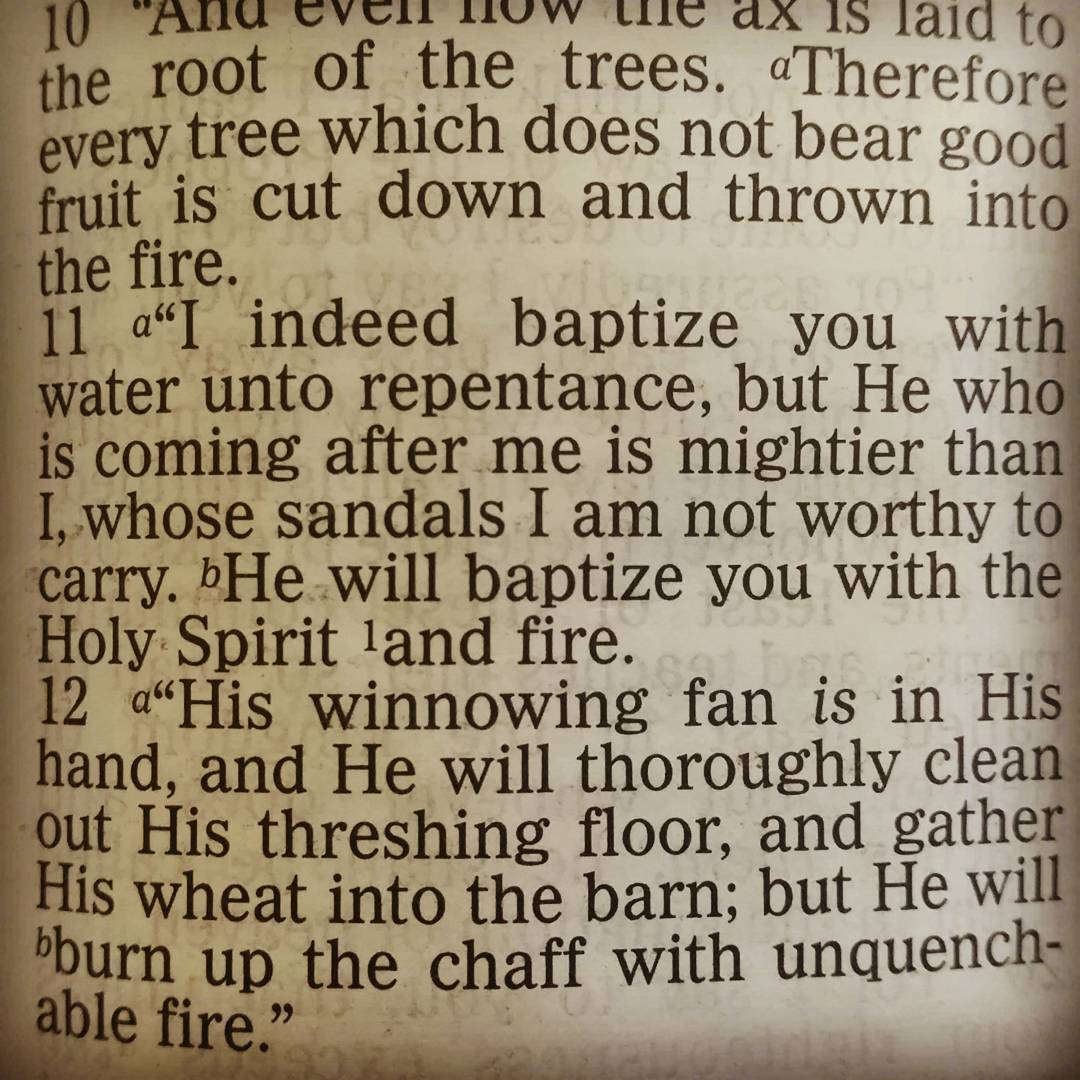
Unfortunately though, one of the saddest things that I’ve seen in the Church (in my experience at least) is the under-appreciation and even neglect of baptism. These days we can wait months or even years before we baptise a professing Christian. This is usually because we want to wait until we are sure that they are serious about their commitment to Christ, or because we want to make sure they are “orthodox” before we dunk them in water. The saddest thing about this though is that this is just a product of the Gospel we preach. The Church preaches such a weak Gospel in the power of the flesh, and not in the power of the Spirit that we are afraid that people are really only giving Christianity “ago” because it’s new and fresh, not because they are fleeing the wrath to come or that they want to be reconciled to God. The early Church wasn’t like this. The early Church preached the Gospel that was the power of God unto salvation to whoever would believe (Romans 1:16). This was the same Gospel that, coupled with the power of the Holy Spirit, cut people to the heart and added thousands of people to the Church in one moment (Acts 3:37, 41). We’ve missed out on the relentless preaching of the Gospel and the immediate act of baptism that John held so dear. Leonard Ravenhill in his book Why Revival Tarries really gets to the heart of the matter when he says,
John the Baptist was in God’s School of Silence, the wilderness, until the day of his showing forth. Who was better fitted for the task of stirring a torpid nation from its sensual slumber than this sun-scorched, fire-baptised, desert-bred prophet-sent of God with a face like the judgement morning? In his eyes was the light of God, in his voice was the authority of God, and in his soul was the passion of God! Who, I ask, could be greater than John? Truly “he did no miracle,” that is, he never raised a dead man, but he did far more he raised a dead nation!
Likewise, who is better fitted for the task of stirring a dead world and even in many cases a dead Church then each one of you reading this blog? God has called every Christian to be filled with the Spirit (Ephesians 5:18) and preach the Gospel boldly. My point is this. Like John, preach the Gospel in its entirety, be filled with the Holy Spirit, and baptise people immediately upon their confession of faith because if the Gospel is preached in power, what have we to fear?
Conclusion
As we reflect on the calling that John the Baptist had on his life, we can start to be encouraged and pursue God, and His calling for the Church in the same manner. Let us consider God’s call on our lives, let us prepare the way for the second coming of our Lord with a fiery tongue that has been lit by the power of the Holy Spirit. Let us repent of our half measured Gospel, our measured half-life of faith, and walk in the Spirit so that we, like John, may stir the Church, and the world, into God’s Kingdom.



 Scribbling Theology