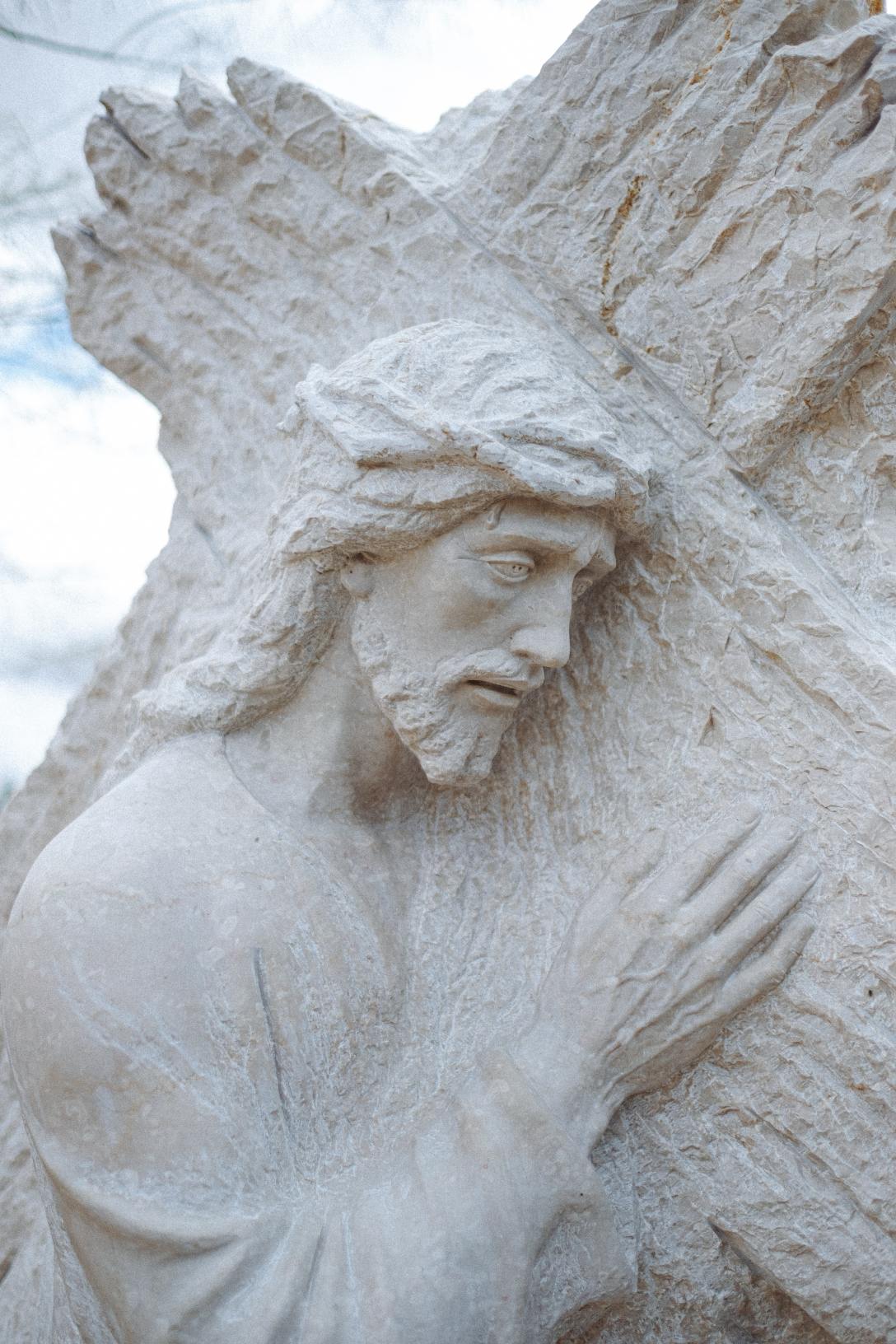
Where are You Lord?

How long O’ Lord


How long must I wait?


What are you trying to teach me?


What are you trying to say?


What are you, Lord?


I cannot see you.


Are you in the green grass?


The mountain air?


A lover’s embrace?


Emptiness and pain are often louder than Your words,


Uncertainty and loss blind me to Your presence.


Yet, there is a stirring inside of me,


a flicker, a lump of coal, smouldering – gently within.


Tenderly blow upon these embers and awaken this old and dying heart.


Breath from Your nostrils – life.


Where are You, O’ Lord?

Propitiation and Redemption in the Book of Romans

This was a recent essay I did in my Romans class at college. I’m proud of this because I got pretty good grades for it so I thought I’d share it with all of you. Enjoy šŸ™‚

The themes of redemption (į¼€Ļ€ĪæĪ»Ļ…Ļ„ĻĻŽĻƒĪµĻ‰Ļ‚) and propitiation (į¼±Ī»Ī±ĻƒĻ„Ī®ĻĪ¹ĪæĪ½) can be found throughout the entire storyline of the Bible. From Genesis 3, where God makes the promise that a seed will come to destroy the serpent (Gen 3:15), then God takes an animal, slays it, and covers Adam and Eve in animal skin (Gen 3:21), through to the sacrificial laws in Leviticus, all the way to Jesus in the Gospels, these themes are richly integrated into the very fabric and thrust of the Bible’s entire narrative. Paul, in particular, picks up on these essential themes and, in his epistle to the Romans, he masterfully espouses a rich theology in light of the Messiah and the entire Old Testament Scriptures. However, the themes of propitiation and redemption in Romans have not been without controversy.

This essay will aim to trace Paul’s usage of both themes of propitiation and redemption throughout the book of Romans. This will be done by exploring critical passages in Romans where these themes occur, exploring the debate among scholars and the various interpretations of the terms, and finally exploring any implications that are applicable to the Christian life.

  • Redemption in Romans

First, it is crucial to have some historical context behind the idea of redemption to better understand how Paul uses the word in Romans. In the Greco-Roman world, to redeem someone was to liberate a slave by purchasing (or ransoming) their freedom (Morris 1993, 784). This understanding of redemption was true for all of antiquity, going back as far as the Exodus story where God frees (redeems and ransoms) Israel from servitude to the Egyptians (Ex 12-24). For Paul and his audience, the theme of redemption would have evoked memories of the exodus stories of freedom from slavery, crossing the red sea, wilderness wanderings, Passover, promised land, and exile (Wright 2002, 470-471). 

Twice we come across the word redemption explicitly being used. The first is in Romans 3:24 ā€œand are justified by his grace as a gift, through the redemption that is in Christ Jesus,ā€ and then again in Romans 8:23 ā€œAnd not only the creation, but we ourselves, who have the firstfruits of the Spirit, groan inwardly as we wait eagerly for adoption as sons, the redemption of our bodies.ā€ However, redemptive imagery can be found all over the letter such as in Romans 6, where Paul uses slavery language to demonstrate that those in Christ are now slaves to righteousness and God rather than sin and the flesh (Morris 1993, 785). 

  • Redemption in Romans 3:24

As aforementioned, the first place we find the word redemption is in Romans 3:24 quoted above. In this passage, Paul is arguing that justification (the forensic declaration of being acquitted from sin) is a gift from God that comes via freedom from slavery (redemption) to sin (Hagner 2008, 70-71). Scholars debate whether redemption in this passage includes payment (or ransom) so that one can be set free. As already mentioned, the ancient world and secular Greek literature always assumed some payment would occur for the slave to be set free. However, when one considers both the Septuagint (LXX) and the New Testament, it is evident that a ransom is not always present in the idea of redemption (Schreiner 2018, 197-198). Nevertheless, most scholars agree that Paul most likely had both ransom and redemption in mind (Schreiner 2018, 198). Though, instead of the ransom being paid by God the Son to God the Father (Moo 1996, 230-231), it was paid by God in Christ to ā€œthe personified power of sinā€ mentioned in Romans 3:9 (Dunn 1988, 180).

  • Redemption in Romans 8:23

The second passage we find the word redemption is in Romans 8:23. Here we have Paul discussing the redemption of the created order in relationship with human redemption. Throughout the entire letter of Romans, Paul has an impressive theology of creation that culminates in this passage as he is concerned with the renewal of everything God has created, not just humans or His elect (Stenschke 2017, 261-289). Scholars agree that redemption is closely related to adoption as they are used almost interchangeably to demonstrate the now and not yet tensions in Paul’s argument. Paul argues that the Christian has already been redeemed (adopted), that they are being redeemed (spiritually), and that they will be redeemed (physically) at the eschatological end of the age (Moo 1996, 518-520). Mike Bird explains this well in his commentary when he says, ā€œin the case of redemption, it is not just redemption from the penalty of sin, but the redemption of the body from the presence of sin that remains outstanding. The resurrection of the body will be the event that will consummate both adoption and redemptionā€ (Bird 2016, 280).

  • Hilasterion in Romans

Propitiation or the Greek word hilasterion (į¼±Ī»Ī±ĻƒĻ„Ī®ĻĪ¹ĪæĪ½) occurs only once in all of Paul’s letters in Romans 3:25, ā€œwhom God put forward as a propitiation by his blood, to be received by faith. This was to show God’s righteousness, because in his divine forbearance he had passed over former sins,ā€ making Paul’s use of the word a hot topic for debate among scholars. C. H. Dodd famously argued that the word should be translated as expiation (the removal of sin) as opposed to the pagan idea of God’s anger needing to be satisfied through sacrifice (Hodd 1935, 82-95). Later, the reformed interpretation of propitiation (to satisfy God’s wrath) was championed by Leon L. Morris in his book ā€œThe Apostolic Preaching of the Crossā€ (Morris 1965, 144-213) as he called into question the validity of Dodd’s interpretation of the word (Moo 1996, 198-199). Additionally, others have argued that the hilasterion should be interpreted as ā€œmercy seatā€ where atonement took place in Leviticus 16 (Gundry-Volf 1993, 279-284).

  • Propitiation

Some scholars argue that hilasterion should be translated as ā€œpropitiationā€, meaning ā€œthe removal or satisfaction of God’s wrath.ā€ Interestingly, there is some debate among exponents of propitiation as to whether ā€œsacrificeā€ exists in the passage. Scholars agree that a sacrifice is not found in the atonement, making it difficult to argue for a sacrifice in Romans 3:25. However, some would argue that Paul innovatively develops the idea of a present sacrifice in the propitiatory theme (Moo 1996, 236). On the other hand, scholars would reject the idea of a sacrifice being present that Paul’s expression means ā€œto make atonementā€ not ā€œto offer a sacrifice.ā€ They argue that, at best, sacrifice is in the back of Paul’s mind, not in the forefront. Nevertheless, advocates all agree that ā€œChrist adverted the divine wrath from sinnersā€ (Morris 1988, 181).

Scholars argue for propitiation in Romans 3:25 in two primary ways. First, scholars explain that the common use of the word in the ancient world was to either satisfy or remove wrath (Kidner 1982, 119-136). Second, proponents of propitiation argue that the biblical context of Romans 3:25 is that all of humanity are sinners under the wrath of God (Rom 1:18-3:20), insinuating that if hilasterion does not mean the removal of wrath, then humanity is still under it (Mounce 1995, 117). 

  • Expiation and Mercy Seat

Other scholars argue that hilasterion should be translated as expiation meaning that Christ’s death “is how God does away with his people’s sin – not symbolically, as in the ritual of Leviticus 16 in which the material mercy-seat figured, but really” (Bruce 1985, 111). In other words, God removes sin or cleanses a person via Christ’s blood and His death. Scholars who advocate for this view recognise the Old Testament connections that Paul is making to Exodus 25 and Leviticus 16, where the lid of the ark or “the mercy seat” was the place where sin was dealt with. It is where the high priest during the Day of Atonement would sprinkle blood as a sacrifice to cleanse the temple and himself so that he would not die in the presence of God (Wright 2002, 474). Additionally, the priest would lay the sins of the people on the head of a goat and literally remove the sin by sending the goat away from the camp. All of this was in Paul’s mind in Romans 3:25 (Dunn 1988, 171). These same scholars point out that in these rituals there is no mention of judgement or wrath being vicariously satisfied through the animals on behalf of the people. In fact, the killing of the animals was never part of the atonement, they were slain elsewhere, and it was the blood that was used at the alter (Wright 2016, 295-355). Finally, these scholars are quick to point out that the word hilasterion nearly always means or refers ā€œmercy seatā€ in the LXX (Bailey 2000, 155-158) and in it means mercy seat in its other New Testament occurrence in Hebrews 9:5 (Stott 2001, 114).

  • Satisfy or Cleanse?

So out of the interpretations discussed in this essay, which are the most convincing? Both. When all the evidence is considered, there is no reason not to believe that Paul here has both in mind the secular use of the word hilasterion (propitiation) and the biblically canonical one (expiation and mercy seat). As N. T. Wright says in his commentary, ā€œBut that fact remains that in 1:18-3:20 Paul has declared that the wrath of God is revealed against all ungodliness and wickedness and that despite God’s forbearance this will this will finally be meted out; that in 5:8, and in the whole promise of 8:1-30, those who are Christ’s are rescued from wrath; and that the passage in which the reason for the change is stated is 3:25-26ā€¦ā€ (Wright 2002, 476). In other words, the redemption of humanity comes via Christ’s hilasterion, that is, His expiating sacrifice as that removes sin and, in turn, wrath from those who are united to Him by faith (Bird 2016, 119).  

  • Implications for Christian Ministry and Living

The themes of redemption and hilasterion are among some of the most important themes in all of Scripture as they relate to the death of Jesus and our salvation. These themes are central to the Gospel, and therefore, central to the Christian life and ministry. For some, the nuance and semantics might lead some to dismiss the question of there being any implications in these fleshed out themes. However, without a nuanced understanding of our salvation, the Christian is left deficient in their ability to espouse the Gospel that saved them. These themes affect Christians in two main ways, in our church ministries (i.e., pulpit ministry) and how we live out our vocation as image-bearers (Gen 1:26).

  •  Ministry

Gospel-centred preaching is at the heart of our church services and ministries. Preaching God’s Word is how we teach, rebuke, correct, and instruct our members in righteousness so that they may be equipped to live out the Christian life (2 Tim 3:16-17). Therefore, having a nuanced and concise understanding of how we are saved shapes the way we live our lives. Is the emphasis of the Gospel on being saved from an angry God who hates humanity until we trust in Jesus, or is that we have been freed (redeemed), cleansed from sin (expiated) so that we can now live out our vocation as God intended? If it is only the former, then that simply solves God’s attitude towards humanity. The latter however, free’s humanity, in Christ to live as they were meant to, a kingdom of priests imaging God (1 Pet 2:9). This freeing and vocational calling needs to be the focus of our sermons.

  • Christian Life: Our Mission

If we get the Gospel nuances right in our pulpits, then we can live biblically in our lives and mission. If we see that Jesus’ death has freed us, ransomed us, cleansed us from sin for a purpose, we are starting to get to the heart of the Gospel. God has always intended humanity to be a new creation in Christ that images him and lives as genuinely human. N. T. Wright sums this up well when he says, ā€œthrough the cross of Jesus won the Passover Victory over the powers, that he did this precisely by dying under the weight of the world’s sin, and that Christian mission consists of putting this victory into practice using the same meansā€ (Wright 2016, 408). Love your neighbour (Mk 12:30-31) and enemies (Matt 5:44), even to the point of death so that they may ā€œtaste and see that the Lord is goodā€ (Ps 34:8). 

  • Conclusion

In this essay, we explored the themes of redemption and propitiation in Paul’s epistle to the Romans. Paul’s use of the word redemption in Romans 3:24 indicates a clear theology of the individual being set free from sin, and 8:23 indicated Paul’s theology that the entire created order groans as it eagerly awaits to be set free (redeemed) from sin on the eschatological day of judgment when Jesus comes to make all things new. Furthermore, this essay explored Pauls use of the word hilasterion, which could either be translated as propitiation or expiation (and mercy seat taken from Leviticus 16). From all the evidence considered, it seems that Paul emphasises a theology of expiation with a propitiatory theme implicit in the text. This means that Jesus’ death cleanses the believer from sin, sets him free and then because of that expiation, God’s wrath is turned away from the believer (an implied consequence of Jesus’ death, not an explicit one). Finally, with that in mind, it is clear that this emphasis on expiation, when preached from our pulpits, results in a vocational calling for the Christian instead of simply an attitude shift from God’s behalf towards the person. 

List of References

Bailey, Daniel P. 2000. ā€œJesus as the Mercy Seat: The Semantics and Theology of Paul’s Use of Hilasterion in Romans 3:25.ā€ Tyndale Bulletin, no. 51.1: 155-158.

Bird, Michael F. 2016. Romans. 2nd ed.The Story of God Bible Commentary. Edited by Tremper Longman III and Scot McKnight. Grand Rapids: Zondervan.

Dunn, J. D. G. 1988. Romans 1–8, Vol. 38A. World Bible Commentary. Dallas: Word Incorporated.

Bruce, F. F. 1985. Romans an Introduction and a Commentary. Tyndale New Testament Commentary. Downers Grove: Inter-Varsity Press.

Gundry-Volf, J, M. 1993. ā€œExpiation, Propitiation, Mercy Seatā€ in The Dictionary of Paul and his Letters, edited by Gerald F. Hawthorn, Ralph P. Martin, and Daniel G. Reid, 279-284. Downers Grove: Inter-Varsity Press.

Hagner, Donald A. 2008. ā€œRomansā€ in The Expositors Bible Commentary, Vol. 11, edited by Tremper Longman III and David E, 19-238. Grand Rapids: Zondervan.

Hodd, C. D. 1935. The Bible and the Greek. London: Hodder and Stoughton.

Kidner, Derek. 1982. ā€œSacrifice – Metaphors and Meaning.ā€ Tyndale Bulletin no. 33: 119-136.

Moo, Douglas J. 1996. The Epistle to the Romans. The New International Commentary on the New Testament. Grand Rapids: Eerdmans Publishing Company.

Morris, L. 1955. The Apostolic Preaching of the Cross. Grand Rapids: Wm. B. Eerdman Publishing Co.

Morris, L. 1988. The Epistle to the Romans. The Pillar New Testament Commentary. Grand Rapids, MI; Leicester, England: W.B. Eerdmans; Inter-Varsity Press.

Morris, L. 1993. ā€œRedemptionā€ in The Dictionary of Paul and His Letters, edited by Gerald F. Hawthorn, Ralph P. Martin, and Daniel G. Reid, 784-786. Downers Grove: Inter-Varsity Press.

Mounce, R. H. 1995. Romans, Vol. 27. The New American Commentary. Nashville: Broadman & Holman Publishers.

Schreiner, Thomas R. 2018. Romans. 2nd ed. Baker Exegetical Commentary on the New Testament. Grand Rapids: Baker Academic.

Stenschke, Christoph. 2017. ā€œHuman and Non-Human Creation and Its Redemption in Paul’s Letter to the Romans.ā€ Neotestamentica, no. 51:2. 261-289, 

Stott, John. 1994. The Message of Romans: God’s Good News for the World. The Bible Speaks Today. London: Inter-Varsity Press.

Wright, N. T. 2002. ā€œRomansā€ in The New Interpreters Bible, Volume X. 393-770. Nashville: Abingdon Press.

Wright, N. T. 2016. The Day the Revolution Began. New York: Harper Collins Publishers.

Reflections on Why the Biblical Story Makes the Most Sense

This is part IV in a series on apologetics. If you want to read the other articles click on the following links:

Part I What is Apologetics?
Part II People and Apologetics
Part III Christianity and the Questions of Right and Wrong

Enjoy!

“The value of the myth is that it takes all the things we know and restores to them the rich significance which has been hidden by ‘the veil of familiarity.’ The child enjoys his cold meat, otherwise dull to him, by pretending it is buffalo, just killed with his own bow and arrow. And the child is wise. The real meat comes back to him more savory for having been dipped in a story…by putting bread, gold, horse, apple, or the very roads into a myth, we do not retreat from reality: we rediscover it.”

― C.S. Lewis, On Stories: And Other Essays on Literature

Life is full of myth, lore, and drama that ensnares the imagination and catches us up within the rich tapestry that makes up our human story – that makes sense of our existence. Every one of us has this deep sense of our life, meaning more than it does, from the Sun rising in the East to the birds singing in the early morning. From the kettle boiling, our stomachs rumbling, the caress of a brisk winter wind, or the smell of saltwater in the Summer. The high pitched cry of a newborn baby and the roof of your mouth burning after taking a bite from a slice of hot pepperoni pizza. The gutted feeling you get over betrayal or the stress of paying your bills on time. The weariness one feels after a long day at work or looking after the family. For some, depression, for others, worse. Finally, the contentment (or excitement) of being in the arms of a lover – these are all paragraphs in the chapters to the book that makes up our existence.

The greatest stories ever written are told so that humanity can make sense of themselves. So that we can all slowly stitch together those chaotic, beautiful and terrifying chapters that we’ve all starred in. The world’s oldest stories, from the Enuma Elis (The Epic of Gilgamesh), The Hermopolis Egyptian creation myth, and The Eridu Genesis, to the Aboriginal dream-time stories and the Native American Creation myths, every culture and civilization has within their memory a story that defines who they are and why they’re here. For the modern West, we look to science and western philosophy to make sense of our humanity. According to evolutionary biologists, humanity (Homo sapiens) evolved from Homo heidelbergensis somewhere around 100 000 years ago. All life (a biologist might argue) evolved from the big bang event approximately 13.7 million years ago, and humanity is the latest in the evolutionary chain (that we know of). In light of this, philosophers like Fredrick Nietzsche and scientists in the neo atheist movement such as Richard Dawkins, and socio-political critics such a Christopher Hitchens might argue that life has no intrinsic meaning or value (this is called existential Nihilism). As Dawkins famously said, “the universe we observe is precisely what we should expect if there is, at bottom, no design, no purpose, no evil, no good, nothing but blind, pitiless indifference.” However, for most of us, this bleak commentary on the nature of existence remains unsatisfactory. Most of us, perhaps even Dawkins himself (though he might never admit it), have a deep-seated sense of “something more.” One cannot look at oneself in the mirror of the cosmos and not have their heart leap as it longingly grasps for something greater than themselves. We want to be known, we want to be loved, but we must first know ourselves and our place.

Herein lies the power of the biblical story (i.e. the Gospel – the Good News). The unfolding drama of the biblical story compellingly peels back the lays of the human existence and uniquely relates them to God, to one another, and the world in a way no other story does. Why is this story significant? Because of the way we live, relate to one another, and the world around us, the way we relate to God profoundly depends on how we comprehend, perceive and understand all of these things; otherwise, Nihilism may be true. Let us then explore this narrative so that we may judge for ourselves how this story makes sense of our existence.

  • God gives meaning and purpose to all that exists and orders it out of a chaotic state (Genesis 1:1-25)
  • Humanity is endowed with God’s image (Genesis 1:26), and they’re tasked to multiply and subdue the earth (Genesis 1:27-28)
  • This image that God gives humanity is two things. It is 1. an ontological reality (a part of their nature) in which every human somehow shares in, participates, and retains something of God (separate but related to His likeness). 2. It is a task or vocation that God bestows upon humanity to live out this ontological reality. That task is to multiply, subdue the earth, and guard and keep the Garden (Genesis 2:15), the dwelling place of God.
  • Humanity fails at walking in God’s image. Instead of guarding the Garden, Adam and Eve allowed the serpent to enter God’s dwelling place and corrupt it. Adam and Eve, therefore, chose for themselves wisdom apart from God and decided to rule themselves apart from God’s love and wisdom (Genesis 3).
  • God takes Adam and Eve and removes them from His dwelling place, stopping them from eating from the Tree of Life. Humanity has now chosen spiritual death and disunity with God, and as a result, they are disconnected from one another and the creation around them.
  • However, God doesn’t let the world fall into chaos. He promises that through the line of Eve, humanity will be saved by crushing the serpents head even at the risk of the seed’s own life (Genesis 3:15).

In just the first three chapters of the Bible, we have a densely rich narrative that paints humanities reality. We were created and chosen by God for good things. For unity, for love, peace and joy. Yet we went our own way. From Genesis 3:15 onwards, the entire Bible is story after story of God rescuing the world through chosen individuals and people groups, eventually culminating in the person and work of Jesus Christ (1 Corinthians 15:3-8). In the final pages of the Bible, the Apostle John tells of a world where through Jesus the Messiah, there will be no sickness or death. There will be no separation from God, life, each other, and the world around us (Revelation 24).

At the end of the day, it is up to the individual to decide which stories they want to believe in, and which they don’t. The Bible is a big book, and it isn’t something that’s supposed to be read and understood in a day, week, or even a year. It’s complex, gritty, raw, alien, but all too familiar at the same time. I believe, if we wrestle with every page and let the Scriptures speak for themselves, this metanarrative we call the Bible makes the most sense of who we are (image bearers made to be in relationship with God, one another, and the created world), where we are (in an unjust fallen world that we all contribute to), and where we’re going (new creation free from the tyranny of sin and death). My invitation to you is to consider its message carefully, reflect, and ask yourself this critical question “does this make sense of our story?” Whether you realise it or not, you’re a character in its unfolding drama.

How will your chapter end?

Jesus The: Sage

A short series of short reflections on the person of Christ in the Scriptures

For me, Jesus is The Sage. He is enlightened, inspiring, and His teachings reach into the very depths of one’s soul. Out of all that Jesus said and did, the sermon on the mount (Matt 5-7) is probably among some of His greatest teachings. From “blessed are the poor in spirit” (Matt 5:3), “salt and light” (Matt 5:13-16), the lord’s prayer (Matt 6:5-14), to the golden rule (Matt 7:12-14), Jesus’ teachings drip with wisdom for all to come and drink from. If the Bible is anything, it’s wisdom literature that reaches its crux in the teachings of Jesus (Ps 19:7). As I walk through the pages of God’s Word, I can almost feel Jesus leading me by the hand from Genesis 1 to Revelation 22 into a life long journey to wisdom. The Bible says in Proverbs 4:6-7, “Do not forsake wisdom, and she will protect you; love her, and she will watch over you. Wisdom is supreme; therefore, get wisdom. Though it cost all you have, get understanding.”

The cost of following The Sage is your life. Yet, The Sage will protect you and watch over you if you love Him. However, a life walking after The Sage feels like anything but. I believe wisdom’s most effective tools in the classroom of life is time plus suffering. Jesus Himself spent a life full of suffering up to the cross itself, and no servant is greater than The Master (Jhn 15:20). The Sage has taught me much about suffering, much about self, much about God. The greatest lesson? “to fear God, keep His commandments, and to love others as yourself” (Ecc 12:13; Lev 19:18; Mk 12:31).

ā€œBy three methods we may learn wisdom: First, by reflection, which is noblest; Second, by imitation, which is easiest; and third by experience, which is the bitterest.ā€

― Confucious

Thoughts on the Sacraments

Hey guys. I’ve written elsewhere on church here and here and this is sorta in that same vein with a focus on the sacraments. Enjoy šŸ™‚

Church. It is vitally essential for the life of a Christian. A church is a place where people from all tribes, tongues, and nations can come together to worship their King Jesus as one body; one family unified to one another in Christ. Churches look different all over the world from place to place, from context to context. However, there should be fundamental biblical principles that guide every church in how it looks. Why? Because Jesus is the head of the Church, and it’s up to him, not us, in how it is ultimately governed, in how it runs. Where do we turn to then to discover what a biblically healthy church is? Well, of course, the Bible.Ā 

As good Christians, we believe that “All Scripture is God-breathed and is useful for teaching, rebuking, correcting and training in righteousness so that the man of God may be complete, fully equipped for every good work” (2 Timothy 3:16-17). Notice the implications of this passage. Scripture (the Bible) is:

  1. “God-breathed.” This means the Bible comes from God Himself and therefore carries a certain weight of authority that no other text does. 
  2. “Useful for teaching, rebuking, correcting and training in righteousness so that the person of God may be complete, fully equipped for every good work.” This means that the authoritative scriptures have everything we need in them to live the Christian life. Or in other words, if you want to know how to build a healthy church, read the Bible (especially the New Testament). 

Of course, that doesn’t mean it’s always as simple as picking up the Bible and knowing exactly what God wants for the church. The Bible is by no means an exhaustive treatise on building a church, but the New Testament does give the standard for one. Here are some of those principles now: 

  1. The Word. God speaks in different ways (through nature, people, and other sources). However, the most straightforward and most authoritative way God has spoken is through the Scriptures. Therefore, coupled with the idea of 2 Timothy 3, it makes complete sense then to have faithful teaching as the centrepiece of church.
  2. The Sacraments.
  • Ā The Lord’s Supper: the sacraments have had various use throughout church history and have all been interpreted differently. Yet, one thing in common remains; among nearly every major Christian tradition, these two sacraments have been observed regularly in one way or another. Why? Because it’s thoroughly biblical. Every Gospel mentions Jesus having Passover (the Lord’s Supper) with his disciples (Mt. 26:17–30, Mk. 14:12–26, Lk. 22:7–39 and Jn. 13:1–17:26). The early church carried on this tradition (Acts 2: 42, 46; 20:7), where they did it regularly in remembrance of Jesus (1 Cor 11:24-25). The Lord Supper took on three principal dimensions. 1. The remembrance of Jesus’ death and resurrection (the new covenant) and the churches unity to Christ. 2. the unity believers had with one another. 3. The covenant’s performance or drama. As the local church takes up the elements (the bread and wine), they are acting out the establishment of the new covenant as the Spirit draws them closer into the presence of Christ and one another.Ā Ā 
  • Baptism: The occurrences of baptism in the Bible are numerous. First, we see Baptism in the New Testament performed by John the Baptist (Matt 3) and subsequently, Jesus being baptised (Matt 3:13-17). As He was being baptised, Jesus said, ā€œLet it be so now, for thus it is fitting for us to fulfil all righteousness.ā€ Whatever this means, it at least proposes that baptism is extremely important, so much so that Jesus expected us to baptise people as part of the great commission (Matt 28:19). The early church took up this sacrament as it was an integral part of their life and ministry (Acts 2:38). It was an important part of the salvation process (Acts 2:38, ā€œrepent and be baptizedā€) and was accomplished via confession and prayer ā€œin the name of Jesus Christā€ (Acts 2:38; 8:16; 10:48; 19:5). Like the Lord’s Supper, Baptism took on three principles dimensions. 1. The symbolism of a new believers passage from death in the world to life in Christ (Rom 6:1-11). 2. The unity they now had with Christ (Gal 3:27). 3. the unity they had with other believers (1 Cor 12) hence the need for it before one becomes a member of a local church in some traditions (i.e. reformed traditions). As a local church baptises a new believer into the faith, they are publicly declaring their identification and unity to Christ and that new believer as the Spirit works through the drama of passing from death to life. What about Spirit baptism? Both baptisms are taught in the Bible and typically are inseparable (Jhn 3:5). No one denies that Spirit baptism is a thing, but to be baptised by the Spirit without water would have been an unthought of practice in the early church and vice versa.Ā 

As I’ve explained, these sacraments are essential to any church for three main reasons. 1. The Bible and, in turn, God expects a church to practice them (this in itself should be reason enough). 2. They’re transformative in that the Spirit works through the practice of them to sanctify the participant in a similar way that He works through the Word. 3. They supplement good preaching and demonstrate the Good News to new believers and people we invite to church. 

Finally, all this presupposes the assembly of a local church which consists of members (1 Cor 12:21-26), elders and deacons (1 Tim 3:1-13; Tit 1), and discipline (Matt 18:13-17). 

With all these elements in place, a local church can image God and fulfil the great commission. Without them, a local church will become deficient and simply unbiblical. We should never trade a biblical principle for a pragmatic one, no matter how much it seems to work. If something is working, it might be cause for us to re-evaluate our theology, but never to compromise on it. God’s standards are there for a reason, and it’s our job to simply obey even if droves of people aren’t coming through the doors.Ā