God Who Walks in Twilight

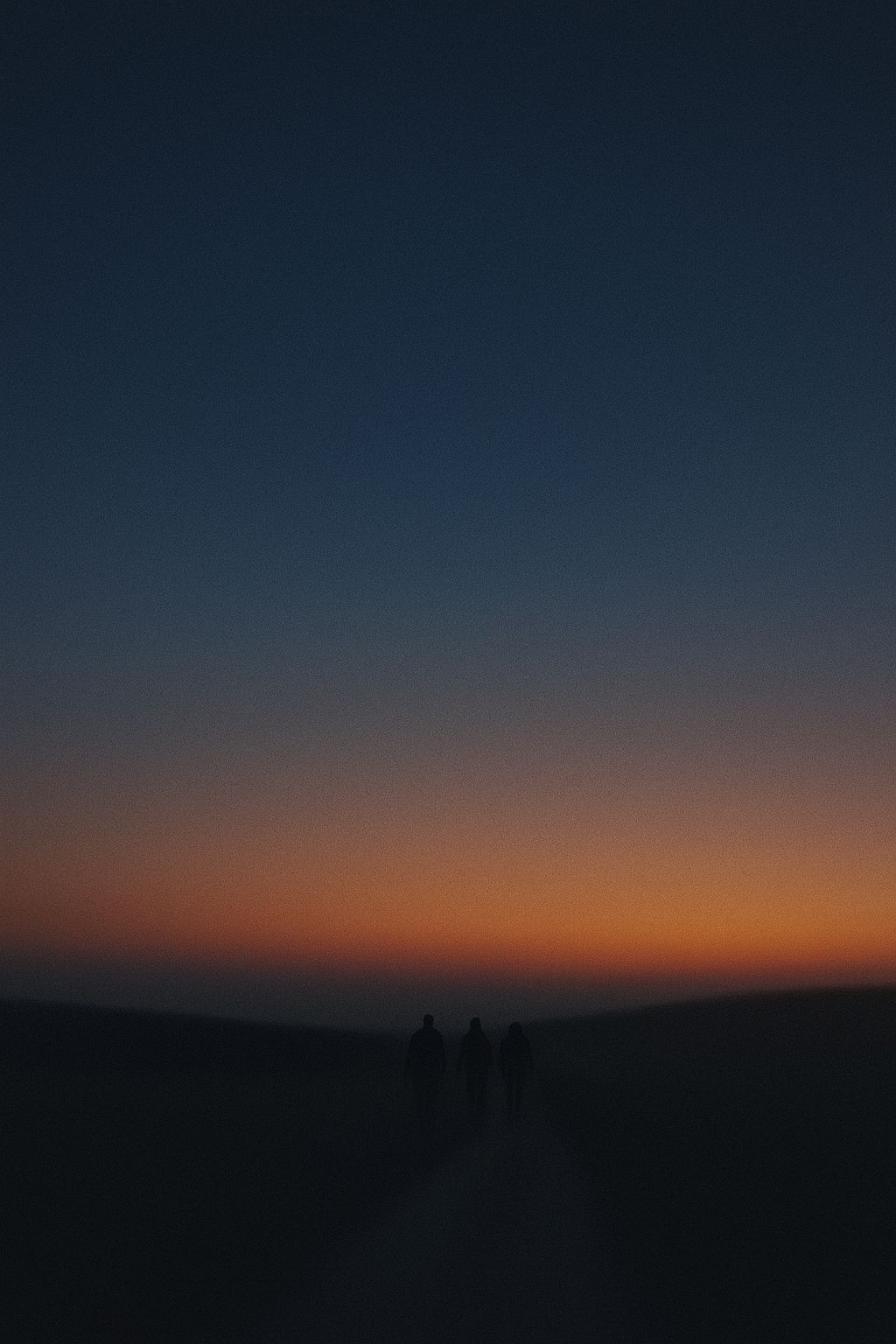
Twilight scene with a person walking on a winding path under a colourful evening sky, symbolising God walking in the cool of the day.

At the Wind of the Day

The first time we hear of God walking, it is not in a blaze of glory.
Not in the brightness of noon when everything is sharp and defined.
It is in the cool of the evening, Genesis says.
The Hebrew calls it l’ruach hayom, “at the wind of the day.”

That soft shift when the heat is letting go and the air changes,
when light seems to slip away almost without you noticing.
It is the time when the work has been done
but no one has yet gone to bed,
when the shadows pull long lines across the ground
and you feel that strange mix of ending and beginning at the same time.

From the start, God is not a voice far off in the heavens.
He is there in the dust, walking.
Unhurried.
Not pressing toward a task.
Just present in that in-between space.

And that time of day keeps turning up in the story, as if God likes it.
Abraham meets Him near the oaks of Mamre when the sun is leaning away.
Israel’s first Passover happens “between the evenings,”
with lamb’s blood on doorframes while the light is thinning.
In the Temple, the daily rhythm gives that same hour a place of its own
the evening sacrifice,
the smell of bread and incense
rising into the dimming sky.

Jesus keeps to the pattern.
On the road to Emmaus,
He meets two people when the day is almost spent.
He walks with them,
talks with them,
and sits at their table,
and in the breaking of bread,
as the darkness edges in from the fields,
they know Him.

It feels like twilight has always been His hour,
the place where He can hold light and dark together in one moment.

Maybe that is why most of life with God seems to happen in the in-between.
We live in the “already and not yet” of His kingdom.
Evening-souled people,
learning the slow pace of faith,
breathing out hope that has learned how to wait,
lingering in love that does not rush away.
He still comes walking when the air cools
and the day takes its last breath.


Creation to New Creation

That first walk in Eden ended badly,
with hiding and shame where welcome should have been.
But the story does not stay there.
At the end of Scripture, in the New Jerusalem,
there is no night at all, and the gates are never closed.
It is as if the first invitation to walk with Him is restored and made permanent.

The story that began with God searching for His image bearers in the evening breeze
ends with Him living among them,
no lamp needed,
because the Lamb Himself is their light.

For now, we live in the long dusk between creation and new creation.
But when the wind shifts,
when shadows stretch out over the ground,
when the air feels like it is holding its breath before the dark,
I think of Him.
I think of how He has not stopped walking.
And I hold onto the hope
that one day this twilight will give way,
not to night,
but to a dawn that never ends.

Hard to Pray

The prayer I can’t quite pray yet

I keep meaning to say something to you, God.
Or maybe not to you.
Maybe at you.
But then I stop.
It catches somewhere in my chest.

It is not that I do not believe.
I do.
Probably too much.
It just hurts in ways I do not know what to do with.

If you are listening
and I keep hoping you are
you would hear all of it.
The sharpness in my voice.
The tiredness tucked in my bones.
That little stone in my coat pocket
I have carried since winter started.
It is smoothed down now
from my fingers rubbing it.

I do not want this to be prayer.
I want prayer to sound like afternoons when I was ten,
playing video games with the window open,
Tracey Chapman’s voice spilling from the stereo,
and Mum cleaning in the background,
the smell of dust and polish drifting into the room.

But this is all I have
bits of half sentences
silences that keep stretching
the weight of this stone in my pocket.

If you are there
and I guess you already know if you are
then you know
this is the best I can manage
today.

God in the Dark: After Psalm 97

I used to think
that certainty was faith—
a sure thing, a clean answer,
a way of knowing
without the waiting.

But the text says
clouds and thick darkness
are around Him,
which means
whatever throne He sits on
is hidden—
not because He is cruel,
but because He is close
in a way that won’t be tamed.

It says righteousness and justice
are the foundation,
not visibility.
Not control.
Not clarity.

So now I wonder
if faith is less about knowing
and more about trusting
the One
who sometimes stays behind the smoke,
but never leaves the room.

And maybe this is how
He teaches us—
not with thunder,
but with the stillness
that follows.
Not with a map,
but with a presence
that unsettles
and also holds.

Maybe certainty
was never the point.
Maybe love is.
And maybe
that’s enough
to worship in the dark.

The Church of Eden

Some people, in order to discover God, read books. But there is a great book: the very appearance of created things. Look above you! Look below you! Note it. Read it. God, whom you want to discover, never wrote that book with ink. Instead, He set before your eyes the things that He had made. Can you ask for a louder voice than that?

Saint Augustine. The City of God, Book XVI

In my experience, Christianity and nature don’t go together. I think a lot of us Protestants are scared of making an idol out of cheese. Stepping out and getting any spiritual substance from nature feels like pagan worship. Nevertheless, for thousands of years, the Church and even the Old Testament Jews have had a rich tradition of finding God not only in the pages of sacred texts or within the walls of a temple or a church but in nature itself. For me, church on a Sunday can get boring. Nature doesn’t. At church, we have baptisms in a font. In nature, God baptises the world with ever-winding rivers, boundless oceans, and tranquil lakes. At church, we have choirs and bands that stir a crowd. In nature, God stirs the heart with the clap of the trees, the melody of the wind, and the euphony of the animals. At church, we preach from the Scriptures to teach, correct, and rebuke. In nature, God strikes the reader with awe as we pore over the stars. In church, we meet with God in sometimes clinical rituals, polished halls, and typically with masks on. In nature, we meet with God in untamed sacraments, wild establishments, and unmasked hearts.

I’m not a hippy. I don’t hug trees, and I’m not about to join PETA. I’m not even a good environmentalist. I love long showers, I’m often lazy with recycling, and I love a good steak. (and wings). There are days, weeks even where I’d rather spend my time playing video games, binging the Big Bang Theory, and scrolling through Facebook. I love rainy days, coffee, and sleeping in. As much as I know nature is a good place for me to be, it takes more effort than I’m proud to admit to get amongst. Nevertheless, when I’m forced to climb that mountain and see that view, or when I’m walking along the esplanade and I see the ocean stretched out before me, I’m always struck, even just a little, by how God takes up and dwells in more than the four walls of a church.

Elsewhere, I argue that our churches should be a slice of paradise. A taste of the newly created earth. A miniature Eden and a sacred space. I can’t remember the last time, if ever, where I felt awe-inspired, moved, and truly like I was treading hollowed ground in a church. Particularly within the Protestant tradition, we have demystified, disenchanted, and robbed our sacred spaces of their “magic.” We’ve traded awe and wonder for fog machines and light. We’ve sold profound unity and community and bought programs. We’ve replaced stories and myths with conversations about the weather and movies. We’ve exchanged God’s presence for “doing church.”

In the beginning, God created the world; it was wild and waste; there was darkness and chaos, but God’s Spirit hovered over the deep. Over six days, God moulded the world. He placed the stars, the sun, and the moon in the sky and gave them purpose. God divided the seas above from the waters below, filled them, and gave them purpose. He raised trees, shrubs, bushes, mountains, oceans, rivers, and streams from the earth and gave them purpose. God filled the world with birds, fish, and land animals and gave them purpose. He created humanity and gave them purpose. Finally, on the seventh day, God dwelled with what He had made, and there was purpose and goodness. This is how things are supposed to be in our local churches. Our local churches should feel like we’ve tasted a bit of heaven. Goodness, purpose, God’s presence, unity, flourishing, and life should all be markers of a healthy church. Yet I talk to people who experience emptiness, frustration, shallow relationships, trivial teachings, and superficial prayers every week. It seems that our churches are less Eden and more Tower of Babel.

2024

Some may or may not know I took a year off writing (despite this, I’ve had the most views since I started writing). In 2023, I posted one blog (I felt compelled then). It is 2024, and I’m slowly emerging out of blogging hibernation. From my first blog in 2015 to my next, as is faithful with most things in life, my theology and thoughts on Christian spirituality have evolved. I look back on my first blog and chuckle. I’m sure I’ll look back on 2024 in another ten years and cringe. Since I started blogging, I’ve started and graduated from bible college. I’ve married and remarried. I’ve gone through different jobs, moved around, and gone through various churches (finally, I’ve found a nice one to rest in). I’ve had my doubts and struggles. I’ve wanted to walk away from the faith. I’ve wanted to give up and try other things. Yet here I am, still tripping after Jesus (good blog title).

So what does this year hold for Scribbling Theology? More meaningless ramblings of a guy who has literally no idea what he’s talking about (I guarantee that). We’ll discuss God’s creation, beauty and some of the not-so-traditional ways of engaging with God. On the flip side, we’ll discuss the importance of finding a healthy community of believers where you can flourish. We’ll talk about liturgy and the importance of ancient rituals and beliefs. We’ll talk about how stories, both new and old, can transform us and lead us deeper into ourselves (collectively and individually) and into the presence of God. I’ll review a book or two (to start you off read, “How to Know a Person by David Brooks”), a podcast or three and maybe spin a poem. I don’t know where I’ll start or finish. But as always, Scribbling Theology has been an outlet, a creative and even spiritual practice that has helped me to release and vent my own thoughts.