Protestants Should Celebrate the Saints

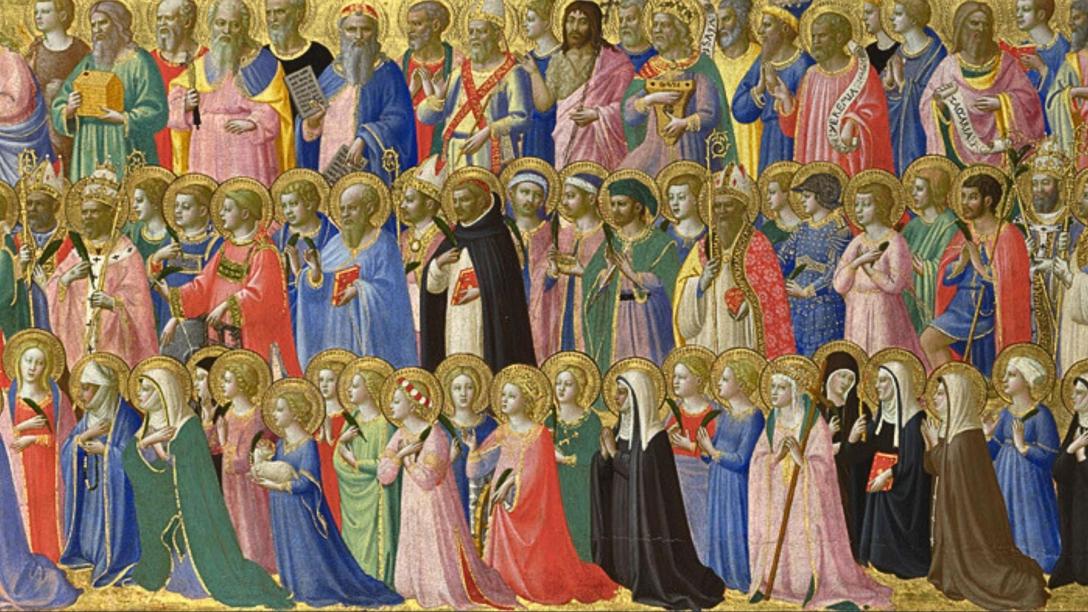
Fra Angelico's painting depicting rows of Christian saints and martyrs dressed in colourful robes, with golden halos against a gold background.

Suggest celebrating All Saints’ Day in some Protestant churches, and there’s a reasonable chance somebody will ask whether you’re planning to start praying to Mary next.

I’m not, for the record.

But I do find our discomfort with the saints rather interesting, especially at this time of year.

Yesterday was Halloween, a celebration that seems to generate an extraordinary amount of anxiety in certain Christian circles. I’ve written about that previously, so I won’t revisit the argument here.

Today, however, is All Saints’ Day. The Christian celebration from which Halloween, or All Hallows’ Eve, gets its name. Yet in many Protestant churches, the occasion will pass without much attention.

Obviously, this isn’t true everywhere. Anglicans, Lutherans, Methodists and others have long maintained traditions of remembering the saints. But in some evangelical and independent Protestant communities, the language of sainthood can still feel suspiciously Catholic.

I wonder whether, in our determination to distance ourselves from certain Catholic practices, we’ve ended up neglecting something that belongs to the whole Church.

After all, saints were around long before the Reformation.

Did the Reformers Actually Reject the Saints?

The Protestant Reformation raised serious questions about the veneration and invocation of saints, particularly whether Christians should seek the prayers of those who had died.

These weren’t trivial concerns. They involved genuine theological disagreements about prayer, mediation, biblical authority and practices that had developed within the medieval Church.

But the Reformers weren’t necessarily opposed to remembering the saints themselves.

The Augsburg Confession, one of the foundational documents of Lutheran theology, explicitly approves remembering the saints so that Christians might imitate their faith and good works.

Its accompanying Apology goes further, describing three appropriate ways of honouring them: giving thanks to God for their lives, strengthening our faith through their example, and imitating their virtues.

The same documents reject invoking the saints. Evidently, the Reformers responsible for them could distinguish between remembering faithful Christians and seeking their intercession.

The Reformed tradition also retained the language of sainthood. Chapter 26 of the Westminster Confession describes the communion of saints as a shared participation in Christ and in one another’s spiritual gifts. It doesn’t prescribe celebrating All Saints’ Day, but it certainly doesn’t treat sainthood as a foreign concept.

John Wesley was rather fond of the occasion, too. In his journal entry for 1 November 1767, he described All Saints’ Day as a festival he loved.

So the idea that remembering the saints is somehow inherently un-Protestant doesn’t hold up particularly well.

I suspect part of the problem is that, in certain circles, we’ve inherited a suspicion of Catholicism without necessarily understanding the theological arguments behind it. Something looks Catholic, so we assume it must be unbiblical.

For a movement that places so much emphasis on returning to Scripture, that seems a rather strange way of approaching things.

Paul Had a Rather Generous Definition of Sainthood

The New Testament doesn’t reserve the word saint for an exclusive collection of spiritual celebrities.

Paul opens his first letter to the Corinthians by addressing the believers as those sanctified in Christ Jesus and called to be saints (1 Corinthians 1:2).

Which, if you’ve read Corinthians, is rather amusing.

The Corinthian church was an absolute mess. They were fighting over leadership, dealing with sexual misconduct, taking one another to court, and somehow managing to turn the Lord’s Supper into an occasion where wealthy members ate well while poorer members were left hungry.

Yet Paul still calls them saints.

He certainly doesn’t excuse their behaviour. Much of the letter is devoted to confronting it. But the Greek word hagioi, usually translated as saints or holy ones, describes their identity as people belonging to God.

Their holiness is grounded in Christ, and Paul expects that relationship to transform how they live.

Of course, Catholic theology also recognises that all Christians are called to holiness, while formal canonisation recognises particular individuals. The disagreements between our traditions are more complicated than simply who gets to be called a saint.

Still, Paul’s language challenges our tendency to associate sainthood with extraordinary religious achievement.

The Corinthians were saints who still had an awful lot to learn about following Jesus.

I find that rather reassuring, actually.

We Have Our Own Saints. We Just Don’t Call Them That.

One of the more amusing things about Protestant discomfort with the saints is that we’re perfectly capable of creating our own religious heroes.

We quote Luther, Calvin, Wesley, Spurgeon, Bonhoeffer and whichever contemporary theologian happens to be popular in our particular circles.

We name institutions after them, write books about their lives, preserve their sermons and occasionally defend them well beyond what their behaviour deserves.

I’m not suggesting this is identical to Catholic veneration. But there is a certain irony in being comfortable celebrating the legacy of a Reformer while becoming deeply uncomfortable with the suggestion that we honour the saints.

Perhaps the language is what bothers us.

And to be fair, there are important distinctions worth preserving.

Catholic and Orthodox Christians distinguish between worship owed to God and the honour given to saints. They understand the saints’ intercession within the unique mediation of Christ. Many Protestants remain unconvinced that requesting prayers from departed Christians has sufficient biblical warrant, particularly in light of passages such as 1 Timothy 2:5.

I think those disagreements deserve serious theological attention. We don’t need to pretend they can all be resolved with a cheerful appeal to Christian unity.

But surely we can appreciate Augustine without praying to him. We can learn from Gregory of Nyssa without agreeing with every theological conclusion he reached. We can honour Francis of Assisi without treating every story associated with him as historically reliable.

We should also be capable of remembering these people honestly, including their failures. Christian history contains extraordinary faithfulness alongside cruelty, prejudice and abuses of power.

The saints weren’t flawless, and we do them no favours by pretending otherwise.

Perhaps we’d have a healthier understanding of Christian history if we stopped treating its most influential figures as either untouchable heroes or people whose every mistake disqualifies them from being remembered.

The Church Is Bigger Than Our Little Corner of It

The Apostles’ Creed includes a phrase I’ve become increasingly fond of:

I believe in the communion of saints.

It’s easy to recite those words without considering what we’re actually confessing.

Christians have understood the communion of saints in different ways, particularly regarding the relationship between those still living and those who have died in Christ. But the phrase reminds us that Christian faith belongs to a community much larger than our own congregation or denomination.

We didn’t invent Christianity.

We inherited the Scriptures through generations of Christians who preserved, copied, translated and interpreted them. Our creeds emerged through centuries of theological debate, prayer and sometimes rather unpleasant disagreement. Even the language we use to describe God has been shaped by people who lived long before us.

Hebrews 12:1 describes believers as surrounded by a great cloud of witnesses, following the stories of faithfulness and suffering recounted in the previous chapter.

I don’t think we need to imagine those witnesses sitting in heavenly grandstands, watching our every move. Their lives bear witness to God’s faithfulness and encourage those still running the race.

And I think there’s a certain humility that comes from recognising our place in that story.

We can sometimes speak about biblical Christianity as though we’ve independently rediscovered the original faith, untouched by centuries of Christian history.

Yet even our understanding of what constitutes biblical Christianity has been shaped by the Christians who came before us.

That doesn’t mean tradition should be accepted uncritically. The Reformers themselves demonstrated why inherited practices sometimes need to be challenged.

But perhaps we could approach our Christian ancestors with a little more curiosity and a little less suspicion.

The Saints Who Never Made the Calendar

One of the traditional readings for All Saints’ Day is Revelation 7:9–17, where John describes an enormous multitude gathered before the throne of God and the Lamb, drawn from every nation, tribe, people and language.

It’s an extraordinary picture.

John’s vision offers suffering Christian communities a glimpse of God’s victory over death and the powers that oppose his Kingdom. The people gathered around the Lamb are promised that their hunger and thirst will end, and that God will wipe away their tears.

Another reading, Matthew 5:1–12, gives us Jesus’ description of those who are blessed: the meek, the merciful, the peacemakers, those who mourn, and those who hunger and thirst for righteousness.

It’s hardly a list of qualities that would guarantee somebody religious celebrity status.

And perhaps that’s worth remembering when we think about the saints.

For every Augustine or Francis whose name survives in the history books, there are countless Christians whose stories have disappeared.

People who cared for the sick, welcomed strangers, resisted injustice, raised families, or simply tried to follow Jesus through some fairly difficult circumstances.

Some probably did all of that rather imperfectly.

They won’t have feast days named after them. There are no stained-glass windows telling their stories. But their lives were part of the Church’s story all the same.

And for some of us, the saints we remember most fondly won’t be famous theologians or ancient martyrs.

They’ll be people we knew.

A grandparent who taught us to pray. A friend who stayed when life became difficult. Somebody whose quiet generosity made a difference without anyone else noticing.

All Saints’ Day gives us an opportunity to remember them.

There’s something particularly meaningful about that in a culture where death is often treated as something to avoid discussing. Christians can sometimes be so eager to proclaim the hope of heaven that we rush past the grief of losing somebody.

But Jesus wept at the tomb of Lazarus, even knowing what he was about to do.

We can believe in the resurrection and still be devastated by death. In fact, Scripture calls death an enemy, one that Christ has defeated through his own resurrection and will finally destroy (1 Corinthians 15:26).

Remembering those who have died can be an expression of that hope. We can speak their names, give thanks for their lives, and acknowledge the absence they’ve left behind.

We don’t need to settle every theological disagreement about the departed to recognise the value of doing that.

Perhaps It’s Time We Reclaimed the Saints

I don’t think Protestant churches need to adopt every Catholic or Orthodox practice associated with the saints. Some disagreements are substantial, and there’s no point pretending otherwise.

But I do think we ought to reconsider our instinctive suspicion of sainthood.

We can remember the martyrs who endured persecution, learn from the theologians who wrestled with difficult questions, and give thanks for the people whose ordinary faithfulness shaped our own lives.

We can even set aside a day to do it.

All Saints’ Day reminds us that the Church existed long before our particular denomination came along, and that the Christian story will continue long after we’re gone.

Most of us will never have our names written into a church calendar. We probably won’t have theological colleges named after us, or biographies written about our lives.

But perhaps somebody will remember that we loved them well, that we showed up when they needed us, or that something about the way we lived helped them recognise Jesus.

I quite like that thought.

And if Paul was comfortable calling the Corinthians saints, perhaps Protestants can learn to be a little more comfortable with the word too.


Techno Jesus: AI, Technology and Christian Spirituality

I have ADHD, and AI has revolutionised how I approach research, manage tasks, and train my attention towards things that matter to me. If technology can help me engage more deeply with something I care about, why wouldn’t I explore what it could offer prayer, Scripture, or life in a church community?

Can Technology Deepen Christian Spirituality?

We already accept quite a lot of help when we pray. We read words somebody else wrote, listen to music, light candles, and look at images. A prayer book gives us language when we struggle to find our own. An audio Bible lets us hear a passage while walking.

AI can answer back, and we have to decide how much to trust its response. I’m interested in whether that back-and-forth helps someone stay with a passage or pray in their own words. I’d also want to understand what it changes about the practice along the way.

John’s Gospel introduces Jesus as the Word who became flesh and lived among us (John 1:14). In the Gospels, he eats with people, touches the sick, and gets tired. For me, that makes it difficult to imagine Christian spirituality as something we do by getting our bodies and their needs out of the way. The person praying has a particular body, a particular mind, and circumstances that affect how they pray.

Technology, Disability and Accessible Worship

Take the expectation that prayer happens best when we sit still in silence. That can be a helpful practice, but I wouldn’t assume that difficulty with it tells us much about someone’s desire for God. A person might find it easier to listen to a Psalm while walking, or follow a short guided prayer. A reminder on their phone might help them return to prayer during the week.

The same applies when we gather. Captions and transcripts can make a sermon accessible to someone who cannot hear it or needs more time to process what was said. Speech-to-text could help someone prepare the prayers they will lead. A member living with chronic illness might be able to lead a small prayer group by video even when travelling to the church building is difficult.

I’m drawn to that last possibility because it changes who gets to contribute. In 1 Corinthians 12, Paul describes a church whose members need one another and whose gifts belong to the whole body. If our arrangements make it difficult for someone to take part, the congregation also misses out on what they bring. So I’d want the conversation about technology to begin with the people facing those barriers. They may have a much simpler idea than whatever the church was about to buy.

Using Virtual Reality for Christian Prayer

Then there is the idea of putting on a headset to pray, which admittedly takes a little more getting used to. Imagine being unable to travel to a retreat, but having access to a headset and a guided time of prayer in a quiet virtual chapel. You hear a Gospel passage, sit with it, and have time to pray without the programme constantly moving you on to the next thing.

The Church of England’s 2022 Prayers at the Foot of the Cross, filmed at Bristol Cathedral, brought prayer, choral music, and silence into a 360-degree service viewable with or without a headset.

I can also see a connection with Ignatian imaginative prayer, where someone pictures themselves within a Gospel scene and attends to Jesus. A virtual setting might give a person a way into that practice. Of course, a designer would be deciding what the scene looked and sounded like, so we would need to recognise those details as an interpretation. A convincing reconstruction could easily make us forget how much has been imagined.

A headset may be distracting or uncomfortable for some people, and an audio recording may work better. I’d ask those who try it what helped them pray and what got in the way.

How AI Can Help with Bible Study

AI interests me for a slightly different reason: you can keep asking it to explain something. If an answer assumes knowledge you don’t have, you can ask it to go back a step. You can compare interpretations, work through unfamiliar terms, or break a large research task into something you can actually begin.

Given the difference AI has made to my own research, I can see why this would be useful to someone opening a biblical commentary and wondering whether they need another book just to understand the first one. They might ask for an explanation of the argument, then return to the commentary with a clearer idea of what the author is saying. They could also bring a more specific question to their Bible study group.

I would be careful about letting the answer end the enquiry, though. AI can produce plausible explanations and references that turn out to be wrong. With theology, there is also the question of whose interpretation it has presented as obvious. Asking where an idea comes from, checking the source, and reading a different view are part of using it well. I want to come away better able to read the passage and judge an interpretation for myself.

Using AI to Write Sermons

For someone preparing to preach, that help can extend into the writing itself. A minister could give AI their notes and argument, ask for a first draft, and work through the result. It might suggest a structure they hadn’t considered or help untangle a paragraph that looks fine on the page but sounds dreadful aloud. Tools such as Logos’s Sermon Assistant already offer help with outlines, illustrations, applications, and discussion questions.

I can understand why people hesitate here. Working out what to say is part of coming to understand a passage. If a preacher skips that process and delivers an argument they have barely considered, the congregation may hear something polished that its speaker cannot really explain. There is also the congregation itself to consider. A sermon on forgiveness will be heard differently by someone recovering from abuse, and a fluent draft may fail to recognise what its advice would ask of that person.

Also, it’s worth noting there is no substitute for the Spirit. A good preacher labours over the text and submits it to God. Technology will always have its limits. But I wonder if occasionally the Spirit can even work through code.

I think AI could help write a sermon if the preacher can explain and take responsibility for the final words. Quotations need checking, invented stories cannot become personal testimony, and substantial AI involvement ought to be acknowledged. Private pastoral conversations also need to stay private; they aren’t material to casually paste into a prompt.

There are useful possibilities after Sunday as well. St John’s Cathedral in Brisbane is exploring AI in ministry, including devotional material and ways of sharing sermons with reflection questions and captions. A checked, plain-language summary could help a group return to a difficult sermon during the week. I like the possibility of giving people more time with an idea, especially when hearing it once wasn’t enough.

AI, Mental Health and Pastoral Care

Someone struggling to contact a pastor, friend, or counsellor might ask AI to help organise what they want to say. They can read the draft, change it, and decide whether it says enough to begin the conversation. For someone who keeps putting off that first message, having a few sentences to work with could help.

Healthdirect explains how online services can connect people with mental health support, while advising that AI should not replace professional care. A church can help someone find a qualified counsellor and make room for prayer and friendship alongside that care. A quiet video conversation may also be easier to manage than a crowded gathering for someone who is struggling.

I’ve written before about knowing and being known. If AI helps someone put words to what they are going through, I’d hope it also becomes easier to share that with a person they trust. Someone who knows them can stay in touch over time and ask how things are going. A video call might make that possible during a week when meeting in person is too much.

For a church wanting to try some of this, I’d start with a conversation: what are people finding difficult, and what would they like help with? Let them help decide what happens next, then give them time to try it. I’d want to hear from the person who joined the discussion, or found a way of praying they wanted to keep.

Moving Beyond Biblical Literalism

The Bible Is Not One Kind of Book

“The Bible was not meant to be read merely literally. It was meant to be read literarily.”

For many Christians, ‘taking the Bible literally’ is often seen as a sign of faithfulness. Questioning a literal reading can feel like doubting Scripture itself. But this idea quickly runs into trouble, since the Bible is not just one type of book, written in a single style or for a single purpose.

The Bible is a library. Even the word itself reflects this reality. It comes from the Greek phrase ta biblia, meaning “the books”. From the beginning, Scripture was understood as a collection of writings spanning centuries, cultures, authors, and literary styles.

Within its pages, we find poetry, wisdom literature, parables, prophecy, apocalypse, genealogy, narrative, law, and song. Some passages are historical. Others are metaphorical. Some invite reflection. Others provoke imagination.

Psalmists speak of rivers clapping their hands and mountains singing for joy (Psalm 98:8). Jesus says faith can move mountains (Matthew 17:20). Revelation describes beasts rising from the sea. Few Christians insist these are literal descriptions. We instinctively recognise genre.

The issue is not whether the Bible contains truth, but what kind of truth a passage is communicating.

Modern readers often approach Scripture with assumptions shaped more by post-Enlightenment Western culture than the ancient world. We expect precision, science, and factual reporting. Ancient authors were often doing something else.

Old Testament scholar John H. Walton argues that modern readers ask questions that the biblical authors were not trying to answer. These texts are often concerned with meaning, purpose, and theology more than technical description.

This becomes especially clear in books like Genesis, Job, the Psalms, and Revelation. They are not merely reporting information. They are inviting readers into reflection, wisdom, and participation in the story of God.

As Tremper Longman III notes, responsible interpretation requires attention to genre. Different kinds of texts communicate differently.

“Good interpretation asks not just what happened, but what the text is trying to say.”

Literalism, in its modern form, often flattens Scripture into something it never claims to be: a single genre document written with modern expectations in mind.


Biblical Interpretation Has Never Been As Simple As We Imagine

“Modern biblical literalism is often a reaction to modernity, not a reflection of historic Christianity.”

One of the great myths surrounding biblical literalism is that Christians have always interpreted Scripture in a single, straightforward way. History tells a different story.

From early Judaism through the Church, Scripture has been read with depth and diversity. Ancient interpreters saw layers of meaning. A passage could be historical and symbolic at the same time. Jewish traditions long before Christianity engaged Scripture through poetry, symbolism, and pattern. This continued into the early Church.

Origen argued that some passages were designed to push readers beyond surface meaning (On First Principles). Augustine warned against rigid readings that ignored reason and reality (The Literal Meaning of Genesis), even cautioning Christians against making foolish claims about the natural world.

Even the Reformers did not read Scripture the way modern literalism often assumes.

Martin Luther read the Song of Songs not simply as romance, but as a picture of Christ and the Church (Lectures on the Song of Songs). John Calvin argued that God accommodates revelation to human understanding (Commentary on Genesis). He noted that Moses described the world in ways people could grasp, not as a scientific explanation. When Scripture speaks of the sun rising, it uses ordinary human language, not astronomy.

For much of Christian history, interpretation included multiple layers:

  • literal
  • allegorical
  • moral
  • anagogical

Scripture was seen as capable of communicating on multiple levels at once.

This does not mean agreement. It means diversity has always existed.

“There has never been a single, universally agreed ‘plain reading’ of Scripture.”

Modern literalism often emerges as a response to scepticism, treating the Bible like a document that must defend itself through precision and certainty. Ironically, this imposes modern expectations onto ancient texts.


Even Jesus and the New Testament Do Not Read Scripture Hyperliterally

The New Testament authors often interpret the Old Testament in ways that do not fit modern literalism. This is not because they take Scripture lightly, but because they take it deeply. They see patterns, symbols, and trajectories pointing toward Christ.

Jesus regularly moves beyond surface-level readings. When he speaks of destroying the temple (John 2:19), his listeners think in physical terms. John tells us he meant his body. Literalism misses the point. Jesus also teaches through hyperbole and metaphor: mountains moving, camels through needles, eyes torn out. These are not instructions. They are invitations to deeper reflection.

Paul continues this pattern. He reads Sarah and Hagar allegorically (Galatians 4), and describes Christ as the rock in the wilderness (1 Corinthians 10:4). These are theological readings, not literal ones.

Matthew does the same. He applies Hosea 11:1 to Jesus, even though Hosea is clearly referring to Israel’s past. Matthew reads typologically, presenting Jesus as embodying Israel’s story. He does something similar with Jeremiah 31:15, applying it to Herod’s massacre (Matthew 2:17-18). This also echoes the Exodus narrative, where Pharaoh kills Hebrew children.

Matthew is not just quoting predictions. He is drawing patterns.

  • Israel suffers.
  • Israel comes out of Egypt.
  • Israel enters the wilderness.

Jesus relives this story.

This was normal in the Jewish world of the first century. The issue is not seriousness. It is recognising the kind of reading Scripture invites.


Literalism Often Creates Fragile Faith

“Many people do not lose faith because Scripture failed, but because their framework for reading it could not hold.”

Modern literalism often tries to protect Scripture but ends up weakening faith. When every passage must function as science, history, or precision, the system becomes fragile. One challenge can feel like everything is collapsing. This is especially clear with Genesis.

Many were taught it must function as a scientific account of origins. When that clashes with modern knowledge, people feel forced to choose between reality and faith. But this is a false choice created by the framework, not the Bible.

John H. Walton argues that Genesis is concerned with function and meaning, not scientific mechanics.

The same issue appears elsewhere:

  • Proverbs are treated as guarantees.
  • Revelation is treated as a predictive code.
  • Poetry is treated as science.

Literalism often shrinks Scripture, and when cracks appear, people feel betrayed. A richer understanding of Scripture does not weaken faith. It strengthens it.


When Literalism Becomes Harmful

“The question is not just what a text says, but what it produces.”

The problem with literalism is not just intellectual. It can become harmful. Throughout history, rigid interpretations have been used to justify abuse, control, and injustice. This is not a problem with Scripture itself, but with how it is read. A flat reading struggles with the Bible’s movement and development. Scripture is a story moving toward Christ.

Jesus consistently resists rigid interpretation. He prioritises mercy, restoration, and human flourishing. “The Sabbath was made for man” (Mark 2:27). In the Sermon on the Mount, he deepens the law beyond behaviour into the heart. Literalism can confuse faithfulness with control. Texts become tools of enforcement rather than tools of transformation.

This is especially damaging around:

  • shame
  • power
  • mental health
  • fear

“People are often taught how to be afraid of being wrong, rather than how to love God.”

This raises a deeper question:

What kind of person is this interpretation producing?

Scripture points to Christ. And Christ becomes the lens through which Scripture is read. The goal is not information, but transformation.


Toward A Better Way Of Reading Scripture

“Scripture is not just meant to be understood. It is meant to form us.”

Rejecting literalism does not mean abandoning Scripture. It means reading it more faithfully. The Bible is not a modern textbook. It is a collection of human texts through which God reveals himself.

Reading well requires asking:

  • What kind of text is this?
  • What is it doing?
  • How would it have been understood?
  • How does it point to Christ?

It requires humility. No one reads Scripture neutrally. It requires comfort with mystery. The Bible does not offer simplistic certainty. It invites wisdom, trust, and transformation. Historically, Scripture was meditated on, not just analysed.

A healthy reading holds together:

  • literary awareness
  • context
  • theology
  • community
  • formation

Its poetry deepens. Its tension becomes meaningful. Its humanity becomes part of its beauty. The Bible was never meant to produce certainty alone. It was meant to form a people capable of love, wisdom, justice, and communion with God. And perhaps that is not a departure from Scripture, but a return to reading it well.


Sources and further reading

John H. Walton, The Lost World of Genesis One: Ancient Cosmology and the Origins Debate.

Tremper Longman III, How to Read Genesis.

Origen, On First Principles, Book IV.

Augustine, The Literal Meaning of Genesis.

John Calvin, Commentary on Genesis.

Henri de Lubac, Medieval Exegesis: The Four Senses of Scripture.

G. K. Beale, “The Use of Hosea 11:1 in Matthew 2:15.”

What Is Religious Trauma?

In many Christian communities, trauma and pain are often overlooked or explained away with spiritual answers. Churches struggle to support people whose wounds do not fit into familiar theological boxes. Even now, in 2026, common mental health issues like depression and anxiety are sometimes dismissed as a lack of faith, not praying enough, or not believing the right things.

The National Church Life Survey (NCLS) found in 2021 that in Australia, one in five Christians faced mental health problems like anxiety and depression. Of those, 38% said their church did not know they were struggling. The study does not explain why, but from my own experience and conversations with others, I can guess some reasons. People may fear being judged or dismissed, worry their struggles will be given only spiritual answers, or feel afraid of being isolated and losing friendships. Some even fear losing their ‘salvation,’ especially if leaders see their struggles as a problem.

What is even more concerning is that these mental health issues are only part of a bigger problem. Stories of religious trauma and years of spiritual, institutional, and sometimes even physical or sexual abuse are becoming more widely known. From Mars Hill to Bethel, there are many accounts of church leaders using their power to manipulate or harm people in vulnerable situations. Sometimes it feels so overwhelming that I want to ignore it all and disconnect from social media. This reality can be discouraging, leading many people to feel disillusioned, question their faith, or even leave the Church. Clearly, we are not doing a good job of representing Jesus.

In this post, I want to make room for us to think about religious trauma and the misuse of power in our churches. I hope to define it, name it, speak against it, and share some ideas for a better way forward.


Not Everything That Hurts Is Trauma: Religious Trauma Defined

I once heard someone say that life is a series of traumatic events we learn to manage. For many of us, that feels true. Some people go through more pain and hardship in a few years than others do in a lifetime. Still, not every hard experience in life or church is trauma. The word ‘trauma’ has become a buzzword lately and is often used for any distressing or uncomfortable experience. Using it this way can actually take away from the real struggles of people who live with true trauma every day.

This is also true when we look at the Church. Christianity is meant to change us. It challenges us, reveals our flaws, and helps us grow. This kind of transformation is often uncomfortable and sometimes painful, as we are shaped into the likeness of Jesus (John 15:1-5; Romans 8:29). But trauma is something very different. Here is how I define religious trauma:

Religious or spiritual trauma is psychological, emotional, relational, or physical harm that is caused, intensified, or sustained within a religious context, particularly when people in positions of spiritual authority or influence misuse their power, or use God, Scripture, or their role in ways that distort truth, override personal agency, or damage a person’s sense of self, safety, or relationship with God.


Questions to Ask Yourself

With this definition in mind, we can ask ourselves some pressing questions to help us discern the difference between something that looks to transform us and something that causes genuine trauma.

Honesty

  • Do I feel safe saying what I actually think and feel here?
  • What would happen if I said something that disagreed?
  • Am I editing myself to avoid consequences?

Pressure

  • Do I feel free to take time and think, or do I feel pushed to respond quickly?
  • Would saying “no” feel genuinely acceptable, or risky?
  • Do I feel like I am being led, or steered?

Fear

  • Am I more motivated by love and trust, or by fear of getting it wrong?
  • Do I worry about disappointing God or specific people in a way that feels heavy or constant?
  • Do I feel watched, evaluated, or measured?

Clarity

  • Do I understand what is being asked of me, or do I feel confused but still expected to comply?
  • Am I allowed to question and process, or is that discouraged?

Authority

  • Can leaders be questioned without tension or fallout?
  • Do certain people carry a weight that makes disagreement feel unsafe?
  • Is “God said…” or “the Bible says” ever used in a way that shuts down conversation?

Sense of Self

  • Do I feel more grounded in who I am, or more unsure of myself over time?
  • Am I becoming more honest and whole, or more careful and guarded?
  • Do I feel like I am growing or shrinking?

Relationship with God

  • Do I experience God as someone I can trust, or someone I need to manage?
  • When I struggle, do I move toward God, or pull back?
  • Is my spiritual life marked more by connection or pressure?

Pattern Over Time

  • Is this an occasional moment of challenge, or a repeated pattern?
  • Am I becoming more alive, or more exhausted?
  • Do I feel freer now than I did before, or less?

A Final Question

If I were completely honest about my experience here, would I feel safe, or would something in me expect consequences?


My Experience

In the early years of my faith, I was part of a church, and I use that term loosely, that placed a heavy emphasis on spiritual warfare. It was the kind of environment where there seemed to be a demon behind every bush. There was a strong us-versus-them mentality. We knew where the evil was. Others didn’t. At the time, it felt intense, even meaningful. However, over time, there were moments that stayed with me.

I remember being told not to read certain books or listen to particular teachers because they were spiritually dangerous. Even things like clothing, music, and movies were treated with suspicion. I have a vivid memory of my mum buying me a simple leather ankle bracelet from a market. I wore it without thinking much of it. Not long after, I was told it carried something spiritually attached to it. A curse. Something only certain people in the group could discern. I was told I needed to cut it off.

So I did. I was young. I trusted the people around me. But even then, something in me felt uneasy. Over time, that environment began to shape what was happening inside me.

I felt constant pressure to perform, to be a certain kind of Christian. I became hyperaware of everything, believing evil could attach itself to ordinary things.

It was exhausting and fear-based. Looking back, some in the community genuinely believed they could see demons or curses at work in everyday things, believing their spiritual insight was unique.

Was it group delusion?
Was it control from leadership?
Was it a mix of both?

I am still not entirely sure. What I do know is this: I began to see the impact it was having on people. I watched others get hurt and leave. Something in me, perhaps a stubborn resistance to control (I’ve always been a contrarian at heart), began to push back. Eventually, I decided to leave.

I remember walking along the beach with my best friend. We had both been deeply involved in the same group. And I told him that the moment I decided to step away, I felt something I had not felt since first becoming a Christian. Freedom. And I really did.


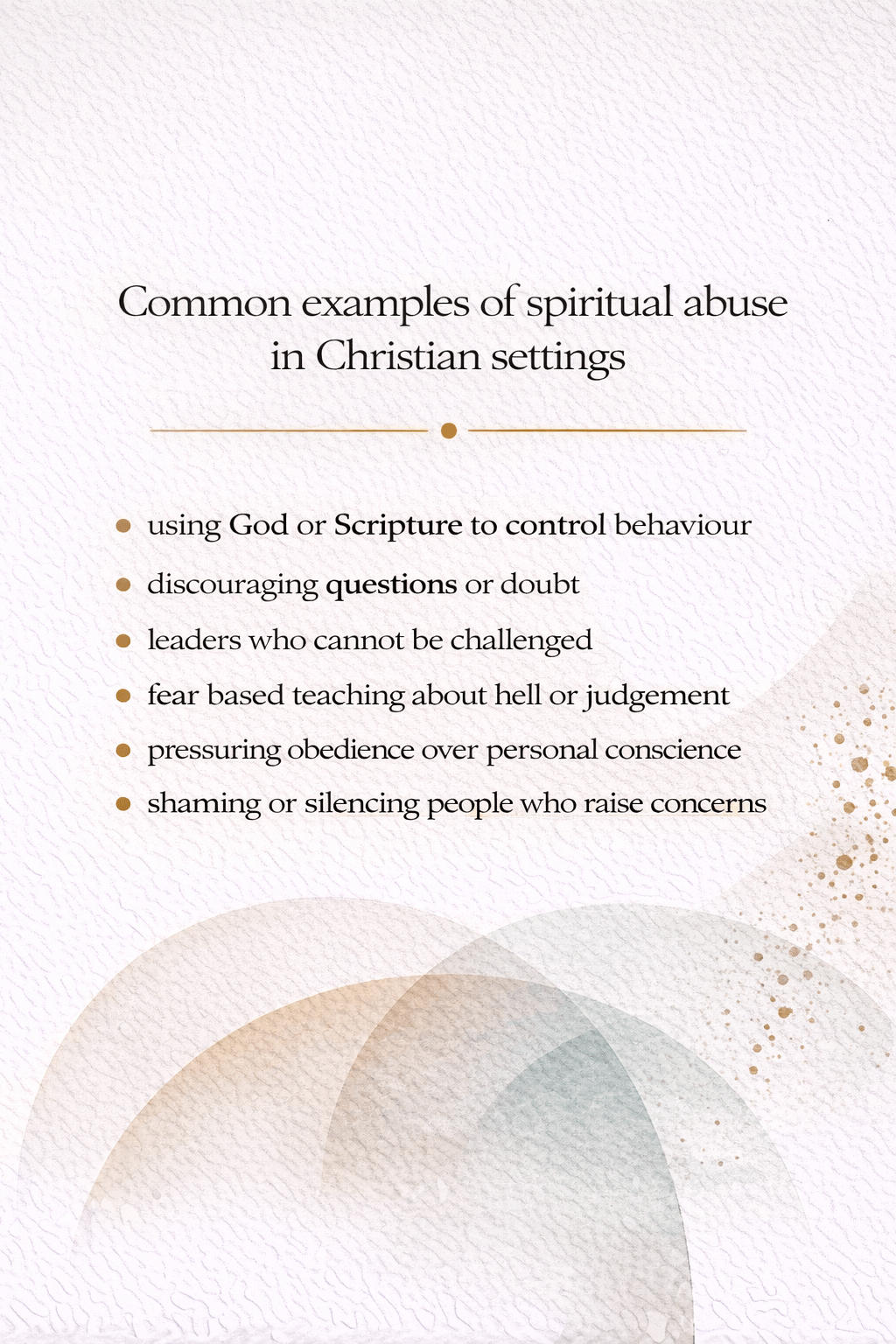
Common Examples of Spiritual Abuse

To name these patterns more explicitly, spiritual abuse in Christian settings often looks like:

  • Using God or Scripture (particularly Scripture misread and taught out of context) to control behaviour.
  • Discouraging questions or framing doubt as rebellion.
  • Leaders who cannot be challenged or held accountable (this happens when there is unhealthy leadership in the local church).
  • Fear-based teaching about hell or judgment used to drive compliance.
  • Pressuring obedience over personal conscience (Romans 14:5).
  • Shaming or silencing people who raise concerns.
  • Equating loyalty to leadership with loyalty to God.
  • Creating environments where leaving results in relational or spiritual threat and isolation.

None of these, on their own, always constitute trauma. But sustained exposure to these patterns can.


The Role of Power

Where there is trauma, there is usually an imbalance of power. Not always overt power. Sometimes it is subtle. Cultural. Assumed. It is usually found in a leader who cannot be questioned. A community where leaving means losing your salvation, your friends, and your family. A system where blind obedience is equated with faithfulness and being a part of the ‘in crowd’.

In those environments, the ability to say no is removed and twisted so that the person feels they’re not giving their all to God. And that is important to understand, because healthy spiritual formation always preserves agency. It invites. It does not coerce. It calls, but it does not control.

When a person cannot disagree, say no, or question without consequence, something is wrong.


What It Does to a Person

These environments don’t just shape beliefs. They reshape a person’s inner world.

Psychologically, it can look like:

  • Persistent anxiety.
  • Chronic guilt or shame.
  • Hyper awareness of failure.
  • Seasons (even years or entire lifetimes) of depression and anxiety.
  • Isolation from community, friends, and relationships.
  • Grief.
  • Exhaustion and burnout.

Spiritually, it can look like:

  • A constant sense of fear of God and separation rather than trust
  • Difficulty praying without tension
  • Confusion about what God is actually like

Relationally, it often leads to:

  • Loss of community
  • Fractured relationships
  • Difficulty trusting others

And perhaps most disorienting of all, it can destabilise identity. If your sense of self was formed within that system, leaving it can feel like losing yourself entirely (Herman, Trauma and Recovery).

People struggling with these things are often lost, unsure where to find help. They stop attending church. They stop reading Scripture. They stop praying. They isolate themselves, exhausted and unable to properly process what they’re experiencing.

To everyone else, especially those in positions of power and authority, the person struggling is seen as unspiritual, faithless, and rebellious. The answer to their problems, after all, must be prayer, faith, and church.


A Theological Line We Cannot Ignore

At this point, the question becomes theological, not just psychological. What is the fruit? The New Testament gives us a remarkably clear vision of what life in Christ produces.

Life in Christ looks like freedom. Not just freedom from guilt, but freedom from the powers that enslave us (Galatians 5:1; Romans 6:6–7). It looks like a life marked by love, joy, peace, patience, kindness, generosity, faithfulness, gentleness, and self-control (Galatians 5:22–23). Not as ideals we strive to perform, but as fruit that grows as we are united to Christ. It looks like a renewed mind. A way of seeing the world that is no longer shaped by fear, anxiety, or cultural pressure, but by the truth and character of God (Romans 12:2). It looks like becoming more fully human. Being conformed to the image of Christ (Romans 8:29), who reveals what true humanity actually is. It looks like love that is patient and kind, not easily angered, not keeping record of wrongs, rejoicing in truth (1 Corinthians 13:4–7). It looks like a community where burdens are shared, where people confess, forgive, and restore one another (Galatians 6:2; James 5:16). It looks like peace replacing hostility, reconciliation overcoming division, and walls of separation being torn down (Ephesians 2:14–16). It looks like boldness without fear. Confidence to draw near to God, not shrink back from Him (Hebrews 4:16; 1 John 4:18). It looks like life. Not just survival, but participation in the life of God Himself. A life that is described as abundant (John 10:10).

So when we ask what a Christian environment should produce, the answer is not unclear. It should produce people who are becoming more alive, more whole, more grounded in love, and more free. If the consistent outcome of a system is fear, control, and shame, we have to pause. Not everything that uses the language of Scripture reflects the heart of God. This is not a new problem.

In the Gospels, even Satan quotes Scripture. In the wilderness, he uses the words of God in an attempt to distort the will of God (Matthew 4:1–11). The issue is not whether Scripture is being used, but how it is being used, and to what end. And this pattern has not stayed confined to the pages of the Bible.

Throughout church history, there have been seasons where theology, grounded in biblical language, has been used to justify control, harm, and exclusion. Often this has happened when the Church has become entangled with power, status, or empire. The more there is to protect, the easier it becomes to distort.

So we have to be honest. Biblical language, on its own, is not proof of truth. Even Scripture can be weaponised. Which means the question is not simply, “Is this biblical?” The question is, “Does this reflect the character of Christ?”


Formation or Distortion?

We are always being formed. The question is whether that formation reflects the life of Jesus or does it conform to the way that those in positions of power want us to live? The goal of Christian formation is to become the kind of person who naturally lives in the way of Christ. A person whose inner life is marked by faith, peace, and love.

But formation can be distorted. When fear becomes the primary motivator. When control replaces invitation. When conformity is valued over transformation. The process may still be called discipleship, but it no longer reflects the kingdom.


The Gospel Still Leads to Freedom

Talking about religious trauma is not an attack on Christianity. It is, in many ways, an attempt to take Christianity seriously. Because if the gospel is what it claims to be, then it cannot be the source of fear-driven control. If the Gospel is about Jesus dying to free us from that which oppresses and enslaves us (sin, satan, death), to unite us to God in Christ, and to transform us into his image, then being part of a community that preaches a gospel that disintegrates life, that’s seeded with anxiety, fear, and depression is nothing short of anathema. If something consistently leads away from freedom, it is worth asking whether it truly reflects Christ.


Moving Forward

If we are honest about the problem, then we also need to be honest about the responsibility. Creating safer, healthier spaces in the church does not happen by accident. It requires intention, humility, and a willingness to change. So what might this actually look like?

1. Create cultures where honesty is normal, not risky

People should not have to edit themselves to belong. That means leaders modelling honesty first. Naming their own limits. Admitting when they do not know. Creating space for people to speak without immediately correcting, fixing, or spiritualising their experience. If people only feel safe when they agree, the space is not actually safe.

2. Teach people how to think, not just what to think

A healthy church forms people; it does not control them. This means encouraging questions. Letting people wrestle with Scripture. Making room for disagreement without labelling it as rebellion. When people are trusted to engage, not just comply, their faith becomes their own.

3. Be clear about power, and accountable with it

Where there is unexamined power, there is always potential for harm. Churches need visible, functional accountability. Not just in theory, but in practice. Leaders who can be questioned. Structures where concerns can be raised safely. Processes that do not protect reputation at the expense of people. Authority in the kingdom is meant to serve, not control (Mark 10:42–45).

4. Separate conviction from control

The Spirit convicts. People do not need to be coerced into transformation. There is a difference between being invited into truth and being pressured into conformity. One leads to life. The other leads to fear. A healthy environment allows people to move at a human pace. It does not rush, force, or manipulate decisions in the name of spiritual urgency.

5. Take mental health seriously, not spiritually

Depression, anxiety, trauma, and burnout are not signs of weak faith. They are human experiences that require care, wisdom, and often professional support. Churches should be places that normalise this, not minimise it. Sometimes the most spiritual response is not prayer alone, but referral, rest, and practical support.

6. Protect people, not systems

When harm happens, the instinct is often to protect the church, the leader, or the reputation. But the call of the church is to protect people. This means listening well. Taking concerns seriously. Acting decisively when needed. And being willing to name failure without defensiveness. Truth builds trust. Silence destroys it.

7. Centre everything on the character of Christ

Not every environment that uses Scripture reflects Jesus. So we return to Him again and again. Does this community reflect His posture? Is there gentleness here? Patience? Freedom? Truth without fear? Jesus does not coerce. He does not manipulate. He does not crush the bruised reed (Isaiah 42:3; Matthew 12:20). If our spaces do not look like Him, then something has gone wrong.


A Better Way Is Possible

The goal is not to create a perfect church, because that does not exist. But we can build healthier churches. These are places where people can be honest without fear, where questions are welcome, and where leaders serve others. In these communities, spiritual growth leads to freedom, not control. Such a church does more than avoid harm—it becomes a place where people can heal.

Deconstruction Led Me to a Deeper Orthodoxy and Faith

A warmly lit study with a wooden desk and chair, an antique table lamp glowing on the desk, stacks of old books, and tall bookshelves filled with leather-bound volumes lining the walls.

When Faith Stops Feeling Life-Giving

I once managed belief like a fragile museum piece, feeling the weight of maintaining it rather than living it. Before deconstruction, my faith felt exhausting. Not because I didn’t believe, but because the answers I had adopted stopped helping me live freely or flourish. Over time, they settled into a shallow kind of idea-ism, a way of thinking about faith that meant my spirituality, my questions, and even my own human experience had to be constantly filtered through categories that needed defending, maintaining, and keeping in order. Faith became something to manage rather than inhabit. Something to defend instead of embody.

Unresolved Theological Tension

Faith started to feel like something that needed constant attention instead of bringing rest. I carried a lot of unresolved tensions. The sharpest was the contradiction of a loving God who was also described as perpetually angry. It was difficult to reconcile the message of the cross as good news with explanations that felt wrong to me. I was told to trust Scripture, but only within rigid boundaries, which impacted how I viewed science and historical contexts. These tensions weren’t just ideas. They manifested in politics and in divided groups. Faith increasingly felt like an exercise in picking sides to stay ‘biblical.’ Underneath, I was sorting people: who was orthodox or heretical, faithful or compromised, who belonged and who didn’t. None of it felt life-giving. All of it carried weight, and over time, that weight became unbearable. Eventually, I didn’t just feel strained. I stopped altogether. I stopped engaging. I stopped trying to hold everything together, not out of rebellious spirit or a hard heart, but out of exhaustion.

Why I Stepped Away

It wasn’t some hidden sin I wanted to justify that led me to deconstruct. Rather, it was the heavy burden of traditional evangelism, a way of holding faith that was slowly hollowing me out rather than giving life. I needed distance. Not dramatically or all at once, but carefully. Slowly and surely, I removed myself from it. Stepping back didn’t feel brave. It felt disorienting. I wasn’t replacing one system with another. I was letting go of the constant explanations and seeing what was left.
At first, stepping back felt uncomfortable, but also freeing. Without my old ways of thinking, I didn’t know what to do next. My prayers changed. I stopped trying to say the right words and just sat with my feelings, embracing these moments as a form of silent prayer or centering. This contemplative posture allowed me to talk less at God and be more present. Faith didn’t come with easy answers anymore. There were no safe categories or certain words. The mystery I used to fear started to feel interesting instead of scary.

Deconstrucion Research

As I went through this, I noticed I wasn’t alone. Increasingly, I realized that deconstruction was happening everywhere. Research shows that about 42 percent of adults have questioned the faith they grew up with, and many still call themselves Christian. Barna’s research says about a third of practising Christians have seriously re-examined their inherited beliefs without leaving their faith. This shows that deconstruction isn’t simply about leaving Christianity. For many, it’s a personal reckoning inside the Church. Commentators such as Scot McKnight helped me understand this further. In Invisible Jesus, McKnight says that much of modern Christianity has replaced the real Jesus with other versions: a political Jesus, a nationalist Jesus, a moral enforcer, or a doctrinal gatekeeper. When people deconstruct, they’re often not rejecting Christ, but these distorted versions, hoping to find the real one.

Deconstruction as Reformation

Seen this way, deconstruction begins to look less like collapse and more like correction. Building on this, it almost ironically carries the marks of reform and renewal. Historically, movements that return people to the centre of faith are rarely neat or reassuring in the moment. They disrupt settled systems and force hard questions. Consider Martin Luther’s 95 Theses in 1517, which challenged the practices of the Church and sparked the Protestant Reformation, a period of profound religious renewal born out of significant disruption. Today, deconstruction feels like that kind of moment. As Brian Zahnd has often said, the future Christian will likely be a mystic, not someone chasing spiritual novelty, but someone formed by presence rather than control, encounter rather than certainty, love in place of fear. Taken together, the data and lived experience tell the same story. Deconstruction is not about killing Christianity. For many, it is about clearing away what is brittle and broken, so that something more ancient, deeper, and more Christ-centred can emerge.

Deconstruction as Formation

When I stepped back, not everything disappeared. In fact, some things stayed, not because I fought to keep them, but because they were never tied to the frameworks I had let go of. Christ stayed. Not as a system to defend or a set of conclusions to maintain, but as the person I kept returning to. Even when I wasn’t sure what I believed, Jesus himself remained compelling. His way of being in the world. His closeness to those on the margins. His refusal to grasp for power. Whatever else shifted, I couldn’t shake him. Sometimes, in silent prayer, it felt like Jesus whispered, ‘I’m here with you.’ It was as if he was telling me, ‘It’s okay to ask questions, to seek understanding. I am with you in your doubts and your discoveries.’ Scripture stayed too. And in many ways, it became more profound. I never stopped loving the Bible. I’ve always been a Bible nerd. What changed wasn’t my affection for the text, but the way I read it. As I let go of the lenses I had adopted, Scripture stopped being something I approached primarily to extract answers or defend positions. It became sacramental. Life-giving. Formative.

Deconstruction and Orthodox

I came to recognise the Bible not as a puzzle to solve, but as a place to meet God. Reading it this way made me slow down. It shaped how I think and what I care about. It worked deep inside me, not just in arguments. The text didn’t always answer my questions, but it kept bringing me back to Christ and to living more like him. That didn’t weaken my faith. It made it stronger. Orthodoxy came back, but it felt different.

What I eventually realised was that orthodoxy really is about healthy boundaries. In its earliest expressions, orthodoxy existed to confront heresy and guard the heart of the Christian confession. The creeds and confessions were shaped in conflict because what was at stake was not abstract correctness, but the truth about God, Christ, and what it means to be human. That work mattered. It still does. What surprised me was discovering that those boundaries were never meant to suffocate faith. They were meant to protect life.

Reading the early Church Fathers made this clear. Figures like Athanasius and Gregory of Nyssa were deeply orthodox and fiercely committed to doctrinal clarity, yet their theology was never anxious or thin. For Athanasius, orthodoxy mattered because if Christ is not truly God, then humanity is not truly healed. Doctrine was inseparable from salvation. Gregory of Nyssa, equally committed to the creedal faith, insisted that God always exceeds our concepts. Orthodoxy did not eliminate mystery. It required it. Doctrine named the centre, but it also opened the soul toward continual growth, desire, and transformation.

From there, the tradition opened rather than closed. I found this same orthodoxy expressed across several streams of the Church, in the earthy devotion of Celtic Christianity, in the depth and union spoken of by Catholic and Eastern mystics, and even in modern voices who continue to live this faith attentively and sincerely. Each tradition nurtures humility and compassion, drawing from the same well of Christ’s love and teachings. What united all of it was Christ, not as an idea to defend, but as a life to enter.

Deconstruction didn’t take me away from orthodoxy. It led me into a deeper kind of orthodoxy.

To Those Watching Other’s Deconstruct

That’s why I want to offer a word of caution to those watching others deconstruct: how we respond matters. Treating deconstruction as betrayal, danger, or moral failure does not protect faith. It reinforces the very wounds that made faith unlivable in the first place. If the goal is depth, maturity, and Christlikeness, then fear-driven responses are counter-formative. What deconstructing people need is love, not suspicion. Curiosity, not control. Space to ask honest questions without punishment. Orthodoxy was never meant to be enforced through fear. It was meant to form people into the likeness of Christ.


I didn’t lose my faith. I lost a version of it that could not carry life.
What remains now is not certainty, but commitment. Not answers I can deploy, but a way of living I am learning to inhabit. Christ abides at the centre again. Scripture is sacramental. Orthodoxy is formative. Mystery is no longer something I rush to resolve. For the first time in a long while, faith doesn’t require vigilance. It asks for faithfulness. Faith now feels like breathing, not balancing plates. It sustains me quietly, like a gentle rhythm that I can finally rest in. And that feels like something I can truly live with.