
In many Christian communities, trauma and pain are often overlooked or explained away with spiritual answers. Churches struggle to support people whose wounds do not fit into familiar theological boxes. Even now, in 2026, common mental health issues like depression and anxiety are sometimes dismissed as a lack of faith, not praying enough, or not believing the right things.
The National Church Life Survey (NCLS) found in 2021 that in Australia, one in five Christians faced mental health problems like anxiety and depression. Of those, 38% said their church did not know they were struggling. The study does not explain why, but from my own experience and conversations with others, I can guess some reasons. People may fear being judged or dismissed, worry their struggles will be given only spiritual answers, or feel afraid of being isolated and losing friendships. Some even fear losing their ‘salvation,’ especially if leaders see their struggles as a problem.
What is even more concerning is that these mental health issues are only part of a bigger problem. Stories of religious trauma and years of spiritual, institutional, and sometimes even physical or sexual abuse are becoming more widely known. From Mars Hill to Bethel, there are many accounts of church leaders using their power to manipulate or harm people in vulnerable situations. Sometimes it feels so overwhelming that I want to ignore it all and disconnect from social media. This reality can be discouraging, leading many people to feel disillusioned, question their faith, or even leave the Church. Clearly, we are not doing a good job of representing Jesus.
In this post, I want to make room for us to think about religious trauma and the misuse of power in our churches. I hope to define it, name it, speak against it, and share some ideas for a better way forward.
Not Everything That Hurts Is Trauma: Religious Trauma Defined
I once heard someone say that life is a series of traumatic events we learn to manage. For many of us, that feels true. Some people go through more pain and hardship in a few years than others do in a lifetime. Still, not every hard experience in life or church is trauma. The word ‘trauma’ has become a buzzword lately and is often used for any distressing or uncomfortable experience. Using it this way can actually take away from the real struggles of people who live with true trauma every day.
This is also true when we look at the Church. Christianity is meant to change us. It challenges us, reveals our flaws, and helps us grow. This kind of transformation is often uncomfortable and sometimes painful, as we are shaped into the likeness of Jesus (John 15:1-5; Romans 8:29). But trauma is something very different. Here is how I define religious trauma:
Religious or spiritual trauma is psychological, emotional, relational, or physical harm that is caused, intensified, or sustained within a religious context, particularly when people in positions of spiritual authority or influence misuse their power, or use God, Scripture, or their role in ways that distort truth, override personal agency, or damage a person’s sense of self, safety, or relationship with God.
Questions to Ask Yourself
With this definition in mind, we can ask ourselves some pressing questions to help us discern the difference between something that looks to transform us and something that causes genuine trauma.
Honesty
- Do I feel safe saying what I actually think and feel here?
- What would happen if I said something that disagreed?
- Am I editing myself to avoid consequences?
Pressure
- Do I feel free to take time and think, or do I feel pushed to respond quickly?
- Would saying “no” feel genuinely acceptable, or risky?
- Do I feel like I am being led, or steered?
Fear
- Am I more motivated by love and trust, or by fear of getting it wrong?
- Do I worry about disappointing God or specific people in a way that feels heavy or constant?
- Do I feel watched, evaluated, or measured?
Clarity
- Do I understand what is being asked of me, or do I feel confused but still expected to comply?
- Am I allowed to question and process, or is that discouraged?
Authority
- Can leaders be questioned without tension or fallout?
- Do certain people carry a weight that makes disagreement feel unsafe?
- Is “God said…” or “the Bible says” ever used in a way that shuts down conversation?
Sense of Self
- Do I feel more grounded in who I am, or more unsure of myself over time?
- Am I becoming more honest and whole, or more careful and guarded?
- Do I feel like I am growing or shrinking?
Relationship with God
- Do I experience God as someone I can trust, or someone I need to manage?
- When I struggle, do I move toward God, or pull back?
- Is my spiritual life marked more by connection or pressure?
Pattern Over Time
- Is this an occasional moment of challenge, or a repeated pattern?
- Am I becoming more alive, or more exhausted?
- Do I feel freer now than I did before, or less?
A Final Question
If I were completely honest about my experience here, would I feel safe, or would something in me expect consequences?
My Experience
In the early years of my faith, I was part of a church, and I use that term loosely, that placed a heavy emphasis on spiritual warfare. It was the kind of environment where there seemed to be a demon behind every bush. There was a strong us-versus-them mentality. We knew where the evil was. Others didn’t. At the time, it felt intense, even meaningful. However, over time, there were moments that stayed with me.
I remember being told not to read certain books or listen to particular teachers because they were spiritually dangerous. Even things like clothing, music, and movies were treated with suspicion. I have a vivid memory of my mum buying me a simple leather ankle bracelet from a market. I wore it without thinking much of it. Not long after, I was told it carried something spiritually attached to it. A curse. Something only certain people in the group could discern. I was told I needed to cut it off.
So I did. I was young. I trusted the people around me. But even then, something in me felt uneasy. Over time, that environment began to shape what was happening inside me.
I felt constant pressure to perform, to be a certain kind of Christian. I became hyperaware of everything, believing evil could attach itself to ordinary things.
It was exhausting and fear-based. Looking back, some in the community genuinely believed they could see demons or curses at work in everyday things, believing their spiritual insight was unique.
Was it group delusion?
Was it control from leadership?
Was it a mix of both?
I am still not entirely sure. What I do know is this: I began to see the impact it was having on people. I watched others get hurt and leave. Something in me, perhaps a stubborn resistance to control (I’ve always been a contrarian at heart), began to push back. Eventually, I decided to leave.
I remember walking along the beach with my best friend. We had both been deeply involved in the same group. And I told him that the moment I decided to step away, I felt something I had not felt since first becoming a Christian. Freedom. And I really did.
Common Examples of Spiritual Abuse
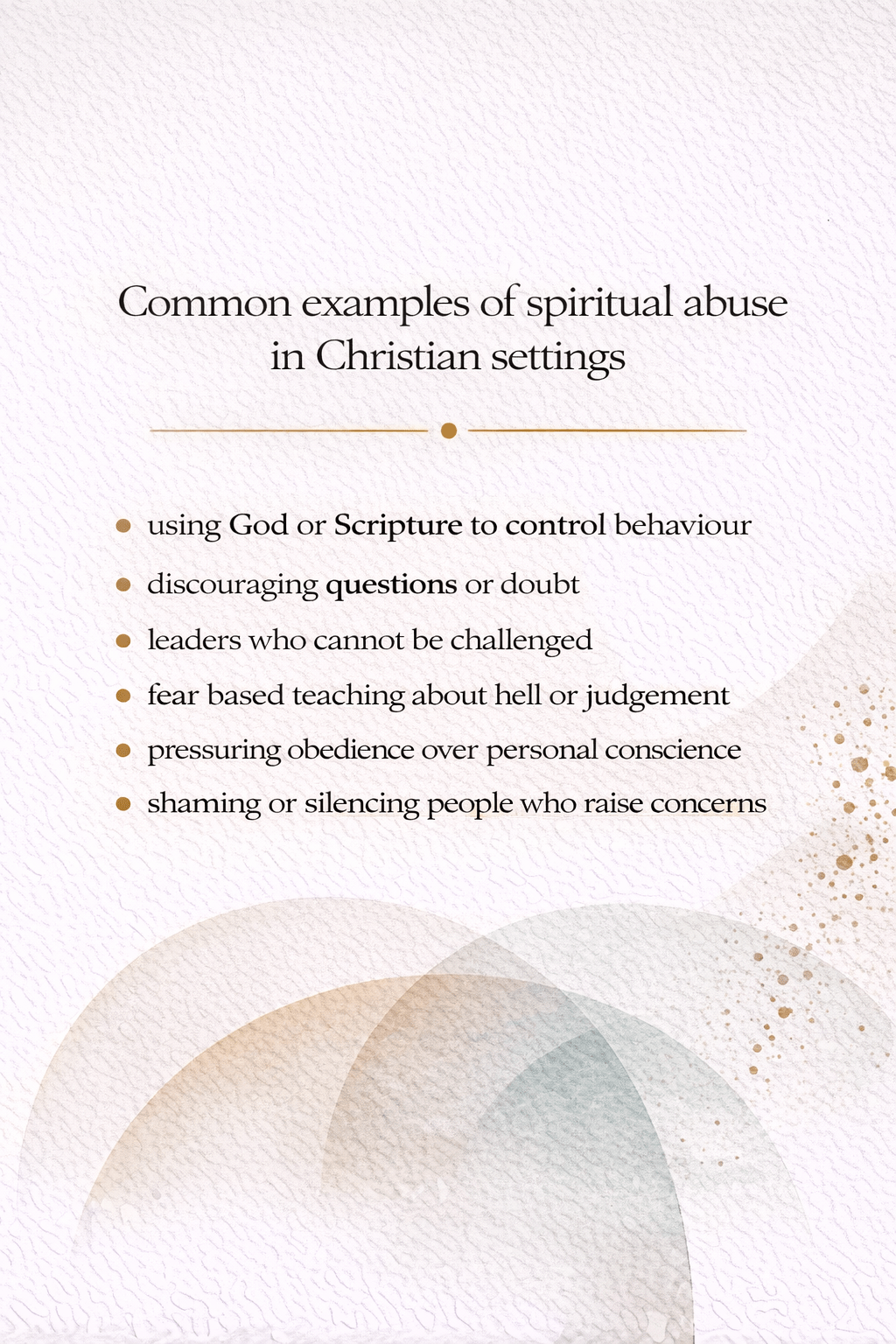
To name these patterns more explicitly, spiritual abuse in Christian settings often looks like:
- Using God or Scripture (particularly Scripture misread and taught out of context) to control behaviour.
- Discouraging questions or framing doubt as rebellion.
- Leaders who cannot be challenged or held accountable (this happens when there is unhealthy leadership in the local church).
- Fear-based teaching about hell or judgment used to drive compliance.
- Pressuring obedience over personal conscience (Romans 14:5).
- Shaming or silencing people who raise concerns.
- Equating loyalty to leadership with loyalty to God.
- Creating environments where leaving results in relational or spiritual threat and isolation.
None of these, on their own, always constitute trauma. But sustained exposure to these patterns can.
The Role of Power
Where there is trauma, there is usually an imbalance of power. Not always overt power. Sometimes it is subtle. Cultural. Assumed. It is usually found in a leader who cannot be questioned. A community where leaving means losing your salvation, your friends, and your family. A system where blind obedience is equated with faithfulness and being a part of the ‘in crowd’.
In those environments, the ability to say no is removed and twisted so that the person feels they’re not giving their all to God. And that is important to understand, because healthy spiritual formation always preserves agency. It invites. It does not coerce. It calls, but it does not control.
When a person cannot disagree, say no, or question without consequence, something is wrong.
What It Does to a Person
These environments don’t just shape beliefs. They reshape a person’s inner world.
Psychologically, it can look like:
- Persistent anxiety.
- Chronic guilt or shame.
- Hyper awareness of failure.
- Seasons (even years or entire lifetimes) of depression and anxiety.
- Isolation from community, friends, and relationships.
- Grief.
- Exhaustion and burnout.
Spiritually, it can look like:
- A constant sense of fear of God and separation rather than trust
- Difficulty praying without tension
- Confusion about what God is actually like
Relationally, it often leads to:
- Loss of community
- Fractured relationships
- Difficulty trusting others
And perhaps most disorienting of all, it can destabilise identity. If your sense of self was formed within that system, leaving it can feel like losing yourself entirely (Herman, Trauma and Recovery).
People struggling with these things are often lost, unsure where to find help. They stop attending church. They stop reading Scripture. They stop praying. They isolate themselves, exhausted and unable to properly process what they’re experiencing.
To everyone else, especially those in positions of power and authority, the person struggling is seen as unspiritual, faithless, and rebellious. The answer to their problems, after all, must be prayer, faith, and church.
A Theological Line We Cannot Ignore
At this point, the question becomes theological, not just psychological. What is the fruit? The New Testament gives us a remarkably clear vision of what life in Christ produces.
Life in Christ looks like freedom. Not just freedom from guilt, but freedom from the powers that enslave us (Galatians 5:1; Romans 6:6–7). It looks like a life marked by love, joy, peace, patience, kindness, generosity, faithfulness, gentleness, and self-control (Galatians 5:22–23). Not as ideals we strive to perform, but as fruit that grows as we are united to Christ. It looks like a renewed mind. A way of seeing the world that is no longer shaped by fear, anxiety, or cultural pressure, but by the truth and character of God (Romans 12:2). It looks like becoming more fully human. Being conformed to the image of Christ (Romans 8:29), who reveals what true humanity actually is. It looks like love that is patient and kind, not easily angered, not keeping record of wrongs, rejoicing in truth (1 Corinthians 13:4–7). It looks like a community where burdens are shared, where people confess, forgive, and restore one another (Galatians 6:2; James 5:16). It looks like peace replacing hostility, reconciliation overcoming division, and walls of separation being torn down (Ephesians 2:14–16). It looks like boldness without fear. Confidence to draw near to God, not shrink back from Him (Hebrews 4:16; 1 John 4:18). It looks like life. Not just survival, but participation in the life of God Himself. A life that is described as abundant (John 10:10).
So when we ask what a Christian environment should produce, the answer is not unclear. It should produce people who are becoming more alive, more whole, more grounded in love, and more free. If the consistent outcome of a system is fear, control, and shame, we have to pause. Not everything that uses the language of Scripture reflects the heart of God. This is not a new problem.
In the Gospels, even Satan quotes Scripture. In the wilderness, he uses the words of God in an attempt to distort the will of God (Matthew 4:1–11). The issue is not whether Scripture is being used, but how it is being used, and to what end. And this pattern has not stayed confined to the pages of the Bible.
Throughout church history, there have been seasons where theology, grounded in biblical language, has been used to justify control, harm, and exclusion. Often this has happened when the Church has become entangled with power, status, or empire. The more there is to protect, the easier it becomes to distort.
So we have to be honest. Biblical language, on its own, is not proof of truth. Even Scripture can be weaponised. Which means the question is not simply, “Is this biblical?” The question is, “Does this reflect the character of Christ?”
Formation or Distortion?
We are always being formed. The question is whether that formation reflects the life of Jesus or does it conform to the way that those in positions of power want us to live? The goal of Christian formation is to become the kind of person who naturally lives in the way of Christ. A person whose inner life is marked by faith, peace, and love.
But formation can be distorted. When fear becomes the primary motivator. When control replaces invitation. When conformity is valued over transformation. The process may still be called discipleship, but it no longer reflects the kingdom.
The Gospel Still Leads to Freedom
Talking about religious trauma is not an attack on Christianity. It is, in many ways, an attempt to take Christianity seriously. Because if the gospel is what it claims to be, then it cannot be the source of fear-driven control. If the Gospel is about Jesus dying to free us from that which oppresses and enslaves us (sin, satan, death), to unite us to God in Christ, and to transform us into his image, then being part of a community that preaches a gospel that disintegrates life, that’s seeded with anxiety, fear, and depression is nothing short of anathema. If something consistently leads away from freedom, it is worth asking whether it truly reflects Christ.
Moving Forward
If we are honest about the problem, then we also need to be honest about the responsibility. Creating safer, healthier spaces in the church does not happen by accident. It requires intention, humility, and a willingness to change. So what might this actually look like?
1. Create cultures where honesty is normal, not risky
People should not have to edit themselves to belong. That means leaders modelling honesty first. Naming their own limits. Admitting when they do not know. Creating space for people to speak without immediately correcting, fixing, or spiritualising their experience. If people only feel safe when they agree, the space is not actually safe.
2. Teach people how to think, not just what to think
A healthy church forms people; it does not control them. This means encouraging questions. Letting people wrestle with Scripture. Making room for disagreement without labelling it as rebellion. When people are trusted to engage, not just comply, their faith becomes their own.
3. Be clear about power, and accountable with it
Where there is unexamined power, there is always potential for harm. Churches need visible, functional accountability. Not just in theory, but in practice. Leaders who can be questioned. Structures where concerns can be raised safely. Processes that do not protect reputation at the expense of people. Authority in the kingdom is meant to serve, not control (Mark 10:42–45).
4. Separate conviction from control
The Spirit convicts. People do not need to be coerced into transformation. There is a difference between being invited into truth and being pressured into conformity. One leads to life. The other leads to fear. A healthy environment allows people to move at a human pace. It does not rush, force, or manipulate decisions in the name of spiritual urgency.
5. Take mental health seriously, not spiritually
Depression, anxiety, trauma, and burnout are not signs of weak faith. They are human experiences that require care, wisdom, and often professional support. Churches should be places that normalise this, not minimise it. Sometimes the most spiritual response is not prayer alone, but referral, rest, and practical support.
6. Protect people, not systems
When harm happens, the instinct is often to protect the church, the leader, or the reputation. But the call of the church is to protect people. This means listening well. Taking concerns seriously. Acting decisively when needed. And being willing to name failure without defensiveness. Truth builds trust. Silence destroys it.
7. Centre everything on the character of Christ
Not every environment that uses Scripture reflects Jesus. So we return to Him again and again. Does this community reflect His posture? Is there gentleness here? Patience? Freedom? Truth without fear? Jesus does not coerce. He does not manipulate. He does not crush the bruised reed (Isaiah 42:3; Matthew 12:20). If our spaces do not look like Him, then something has gone wrong.
A Better Way Is Possible
The goal is not to create a perfect church, because that does not exist. But we can build healthier churches. These are places where people can be honest without fear, where questions are welcome, and where leaders serve others. In these communities, spiritual growth leads to freedom, not control. Such a church does more than avoid harm—it becomes a place where people can heal.

