Healing Before Obedience: The True Path of Discipleship

Illustration of a therapy session at sunset, showing a gentle bearded therapist in a robe listening attentively to a person holding a cracked clay vessel glowing with soft light, symbolising healing and restoration.

There is a kind of spiritual exhaustion that settles into people who genuinely want to follow Jesus but can’t seem to make themselves “better”. They are not defiant. They are not lazy. They are not looking for loopholes. They are simply tired of carrying an inner world that feels frayed, reactive, anxious, or numb. Unfortunately, what they often receive from the Church is more “weight”.

Try harder. Pray more. Read your Bible. Stop doing that. Start doing this. Be disciplined. Be holy.

Those words can be true, as far as they go. But they can also be cruel when they are spoken to someone who is not yet safe in their own skin. We keep asking wounded people to behave like healed ones. We keep demanding fruit from branches that are still snapped at the core.

The tragedy is that we call this “discipleship”. However, Jesus rarely starts where we do. Instead, He begins with restoration. He begins with presence. He begins with the gentle work of putting a human being back together.

And only then, sometimes quietly, sometimes with clarity, other times with mystery that requires faith, He invites them into a new way of living.

Healing comes before obedience.

Not as a modern self-help slogan. Not as an excuse to ignore holiness. But as a thoroughly Christian ordering of grace, truth, and transformation.

The Order of the Gospel

When the Church reverses the order, people either become hypocrites or casualties.

Some learn to perform. They polish the outside. They memorise the right phrases, adopt the right posture, and keep the right habits. But the inner world remains untouched. Desire stays bent. Shame remains in control and untouched. Anxiety continues humming under the surface. They become “good” in public but brittle in private. Their faith becomes performative image management.

Others collapse. They try to obey, fail, repent, try again, fail again. Eventually, they decide they are broken beyond repair, that God must be disappointed, and that everyone else must be doing Christianity better than them. They’re exhausted. They adopt impostor syndrome. The spiritual life becomes a treadmill powered by fear. Neither of these outcomes resembles the peace of Christ.

The gospel is not God issuing demands from a distance. It isn’t behaviour management. The gospel is God drawing near. It is God’s life moving toward our death. God’s wholeness moving toward our fracture. God’s love entering the places where we have learned to survive and transforming us from the inside out.

The Christian story begins with the incarnation: God in flesh. God in weakness. God in the ordinary and the wounded. Before Jesus teaches a single sermon, he is already saying something with His presence: you do not have to climb your way up to me. I have come down into you. We tend to treat obedience and rules as the entry point into transformation (though we’d never admit it). However, Jesus treats God dwelling among us as the entry point into the Kingdom.

Jesus Heals First

If you read the Gospels with even a little attention, a pattern emerges. Jesus does not primarily meet people with a checklist. He meets them with a kind of attention that feels like warm sunlight on a winter morning.

He touches lepers. That alone is a theological act. The body that society calls untouchable becomes, in Jesus’ hands, a place of divine contact and healing. Before the man has a new life, he has a new experience of belonging. Before he changes, he is met. He restores a bent-over woman and calls her “daughter”, publicly naming her dignity. He does not begin with a lecture about her habits. He begins by working on the inside and then the outside. Christ sits at the table with sinners, not as a tactic, but as a declaration: my holiness is not contaminated by your mess, and my love is not withheld until you are clean. I am here.

Even when Jesus confronts behaviour, he often does so after re-establishing safety. Consider Peter. Peter fails loudly. He denies Jesus, not once, but repeatedly, and then collapses into shame. After the resurrection, Jesus does not begin with punishment. He begins with breakfast. A fire. Fish. Ordinary warmth. Then, and only then, he asks Peter the most restorative question imaginable: do you love me? Not “why did you do it?” Not “how could you?” But: do you still want me? Is the relationship still alive?

It is psychologically sophisticated and spiritually profound.

Jesus is not ignoring sin. He is going beneath it.

Because sin is rarely (if ever) just about behaviour. It is often the surface, or the fruit of something deeper: fear, pain, disintegration, misdirected desire, unmet longing, a nervous system stuck in survival. Behaviour is the fruit, brokenness, and the things that enslave us are the root.

Jesus treats the person, not just the symptom.

Why Obedience Fails Without Healing

We have to be honest about how humans work. God made us embodied. That means spiritual formation is not only about ideas or willpower. It involves the mind, the body, memory, attachment, desire, and the patterns our nervous system has learned for staying alive.

Trauma does not only happen when something terrible happens. Trauma also happens when something good should have happened and did not: safety, protection, nurture, comfort, stable love. The wounds of absence can shape a person as much as the wounds of violence.

When the inner world is formed under threat, the body learns to survive. It develops strategies: people-pleasing, controlling, numbing, avoiding, performing, disappearing, and exploding. These behaviours are never acted out in a vacuum. They are learned responses to pain, suffering, and brokenness.

If you tell a person like that to “just obey”, you might get compliance, but you will not get transformation. Compliance is fear dressed in religious clothes. It looks like holiness from a distance. Up close, it is often anxiety and depression.

In these cases, obedience does not heal. It intensifies the fracture.

This is where shame becomes especially dangerous. Shame is not simply “I did wrong”. Shame is “I am wrong”. It collapses the whole self into failure. It makes the soul hide. It makes vulnerability feel like a threat. It teaches people to lie, even to themselves, because telling the truth would feel like committing suicide. You can’t build a mature Christian life on shame. You can build a controlled community with it. You can build a performance culture. You can build a church that looks clean (but is dead inside). But you can’t build the kind of people Jesus makes: honest, free, humble, resilient, tender, brave.

Obedience without healing is not sanctification. It is behaviour management. It is pruning leaves while the roots rot.

Sin as fracture, not merely rule-breaking

This is one of the places where theology and psychology can actually hold hands, if we let them.

Sin is real. Scripture does not downplay it. But sin, in the biblical imagination, is not only the breaking of rules. It is disunion. It is misalignment. It is a turning inward that fractures our capacity for love. It is a distortion of desire. It is a bondage to the powers that dehumanise humanity and cause fear, shame, death, violence, and idolatry. When sin is understood only as legal guilt, the solution becomes a legal transaction. When sin is also understood as wound and bondage, the solution becomes healing and liberation. This is why the gospels feel like a rescue story, not a courtroom drama.

Jesus does not merely announce forgiveness. He casts out what oppresses. He heals what is broken. He restores people back into community. He re-humanises them. He makes them whole. Forgiveness is a doorway back into right relationship with God, the world and even yourself.

And it is in relationships where true healing happens.

If God’s goal is union, then God’s work will look like reconciliation, restoration, and integration. God does not just want “better behaviour”. God wants you back. God wants your heart unknotted. God wants your body to breathe again. God wants your desires to become truthful. God wants your life to be free enough to love.

This is not therapeutic Christianity. This is Christianity as it always was when it was at its best – salvation as becoming truly human.

What Obedience Looks Like After Healing

This is where some people get nervous. They hear “healing comes first” and assume it means “obedience does not matter”. It matters. But it matters as fruit, not as an entry fee.

There is a kind of obedience that is fundamentally self-protective. It obeys to avoid punishment, to maintain image, to manage anxiety, and to stay in control. It is often rigid. It struggles to be honest. It is terrified of ambiguity. It becomes harsh toward others because it is harsh toward itself. It’s bitter, judgmental, scared and closed off.

Yet there is another kind of obedience. It is both softer and stronger. It obeys because it trusts. It obeys because it has been loved. It obeys because desire has been sufficiently healed to want the good without being forced into it. This kind of obedience is not held onto; it is surrendered.

It is not performative. It is quiet. It is not obsessed with being seen as “right”. It is more concerned with being real. It is what love looks like when the soul is no longer defending itself.

This is why Jesus speaks so often about trees and fruit. Fruit grows when the conditions are right. It is not manufactured through pressure. You can tie fruit to branches with a string, but everyone can tell it is fake. Real fruit comes from life moving through the tree.

Union produces obedience the way sunlight produces growth. Not instantly. Not perfectly. But organically.

A Pastoral Reorientation

If healing comes before obedience, then a lot of our church instincts need to be re-examined. It means we should stop treating people as problems to be fixed and start seeing them as souls to be loved. It means we should be slower to correct and quicker to listen. It means we should create communities where confession is not a public execution but a doorway into mercy and change. It means we should stop confusing “high standards” with spiritual maturity. Many people can keep standards. Fewer people can become humble. Fewer still can become gentle. The Pharisees obeyed plenty of rules. Jesus still called them blind.

It also means we need to distinguish between conviction and condemnation.

Conviction is usually specific. It has clarity. It leads toward life. It can be painful, but it does not crush the self. Condemnation is vague. It is global. It tells you that you are the problem, that you are unworthy, that you will never change. One draws you into God. The other drives you away.

If your spirituality leaves you terrified, brittle, performative, and exhausted, there is a good chance you are obeying without healing. Or you are trying to heal yourself through obedience. And it will not work. It cannot work. That is not how grace works.

Grace is not God lowering the standard. Grace is God raising the dead to it. That includes the dead places in us. The numb places. The angry places. The frightened places. The places we learned to hide. Jesus does not stand at the door of those places shouting instructions; He enters them. Jesus sits there with the patience of God. He touches what is untouchable, and He speaks to what has been silenced.

He stays.

And from that staying – slowly, obedience begins to make sense again. Not as a threat. Not as a way to earn belonging. But as a response to love.

A Contemplative Closing

There is a gentleness in God that we often mistake for permissiveness. It is not permissiveness. It is wisdom. God knows that fear cannot heal fear. God knows that shame cannot heal shame. God knows that woundedness cannot be commanded into wholeness. So God comes near. He heals. He restores, and He puts the pieces back together.

And then, like a path appearing under your feet, a new way of living opens. Not because you finally became strong enough. But because you were met by a person strong enough to hold you and see you while you learned how to walk again.

If you are tired, if you feel stuck, if obedience feels like grinding your teeth in the dark, consider this: maybe the invitation in front of you is not “try harder”. Maybe it is “come closer”. Maybe the next faithful step is not another vow of effort, but a quiet act of consent.

“Lord, heal what is beneath my habits.

Lord, meet me where I am fractured.

Lord, restore the parts of me that have been surviving.

And let obedience be fruit, in season, from a life finally learning how to breathe.”

Amen

When Christians Misunderstand the Gospel: Why “God Reigns” Is More Radical Than We Think

A lone silhouetted figure runs along a distant mountain ridge beneath a vast twilight sky of deep blue and violet. Golden light breaks at the horizon, symbolising heaven and earth meeting in the reign of God. The atmosphere is quiet, cosmic, and filled with hope.

What if the greatest misunderstanding in modern Christianity is not about morality or politics but about the gospel itself? What if the good news we share is smaller than the one Jesus announced?

We often describe the gospel as a private story about forgiveness, heaven and personal salvation. Yet in Scripture the gospel is something far larger. It is the announcement that God reigns. It is not only about the state of our souls but about the state of the world. It is a claim about reality itself, a declaration that creation has a rightful King.

And that claim changes everything.

The Gospel as Royal Proclamation

In Hebrew, the word for good news is besorah, a royal announcement of victory (Isaiah 52). In Greek, it is euangelion, the public declaration that a king has triumphed (Mark 1).

Imagine an ancient city under siege. The people wait behind their walls, anxious for word from the battlefield. Then a runner appears on the hills, covered in dust, shouting between breaths, “Good news! Victory! The king has won!”

That was euangelion. It was not advice or philosophy but the kind of announcement that makes the world different because it is true.

When Isaiah writes, “How beautiful on the mountains are the feet of those who bring good news, who say to Zion, ‘Your God reigns’” (Isaiah 52:7), he is describing that runner. The heart of the gospel is that Yahweh has returned to rule His world.

Centuries later, Jesus begins His ministry with the same royal declaration: “The time is fulfilled, and the Kingdom of God has come near. Repent and believe the good news” (Mark 1:15). He is not inventing a new religion but announcing that Israel’s long-awaited hope has arrived. God’s reign is breaking in.

The Kingdom Woven into Creation

The story of God’s Kingdom does not begin with Jesus. It begins in Genesis, where the rhythm of creation beats with divine rule (Genesis 1-2).

In the first three days, God shapes the realms of creation: light and darkness, sky and sea, land and vegetation. In the next three, He fills those realms with rulers: the sun and moon, the birds and fish, the animals and humanity.

The story is one of order and relationship. God reigns by creating and sharing. His rule is not control but care. Humanity, made in His image (Genesis 1:26-28), is invited to share that reign and to reflect His goodness, justice and creativity into the world.

To rule, in the biblical sense, is not to dominate. It is to cultivate. It is to join God in the work of making the world flourish.

The Kingdom of God is not a future dream. It is the structure of reality itself. Heaven and earth were made to live together (Genesis 2:15). Sin fractures that harmony, but the mission of God is to bring it back, to restore what was lost and heal what was broken.

Jesus: The King in Person

When Jesus announces the Kingdom, He is not speaking about a distant future or an inner feeling. He is proclaiming a change of reality. Where He walks, heaven and earth meet. The sick are healed, the outcasts restored, and the powers of darkness pushed back (Luke 4:18-9; Matthew 12:28).

At the cross, the world’s false rulers do their worst. Yet in that act of humiliation, the true King is enthroned (John 19:19). Through resurrection, His victory is declared not over Rome but over the powers that hold all creation captive: sin, death and decay (1 Corinthians 15:25-26).

Paul’s hymn in Colossians captures it perfectly:

“He is the image of the invisible God, the firstborn over all creation. In Him all things hold together. Through Him God was pleased to reconcile all things, whether on earth or in heaven” (Colossians 1:15-20).

This is not private spirituality. It is cosmic renewal. Christ holds the whole story together. In Him, the Creator’s original dream of heaven and earth united is set in motion again.

The People of the King

The early Christians understood this far better than we often do. They did not treat faith as an escape plan but as a new citizenship (Philippians 3:20). They believed that the Spirit who raised Jesus now lived within them, calling them to live as citizens of a new world (Romans 8:11).

Every act of love and hospitality, every work of justice or reconciliation, was an echo of the good news. It was a small proclamation that “our God reigns” (Isaiah 52:7).

The Kingdom is not confined to heaven or to church gatherings (though, as I argue elsewhere, the church should be a slice of the new creation). It is wherever the reign of Christ shapes hearts and habits, homes and communities (Matthew 5-7). It is wherever people reflect His character in the ordinary and the everyday.

N. T. Wright once said that the church does not bring the Kingdom by force; it embodies it by faithfulness. That is the invitation: to embody the reign of the King.

The Kingdom Completed: New Creation

The story of Scripture ends where it began, but expanded and fulfilled. A garden becomes a city. Heaven and earth are reunited.

John’s vision in Revelation captures it:

“I saw a new heaven and a new earth… and I heard a voice from the throne saying, ‘See, the home of God is among mortals’” (Revelation 21:1–3).

This is not an escape from the world, but rather its healing. The good news is not that we leave creation, but that God enters into it and restores it (Romans 8:19–21).

Every tear will be wiped away. Every injustice will be answered. The scars of the old world will become the beauty of the new (Revelation 21:4–5). The reign of God will fill everything.

Living Under His Reign

If the gospel is the announcement that God reigns, then discipleship is the art of living as if that reign were already true (Matthew 6:10). Repentance means realigning with reality, turning from our small empires to join the life of the King.

Faith is allegiance. It is trust that God’s rule is good and that life under His care is freedom, not bondage (John 8:36).

Every prayer, every meal, every act of mercy or courage is a way of saying again, “Your God reigns” (Isaiah 52:7).

The gospel is not good advice. It is good news.

And that news is this: heaven has begun to come down to earth. The reign of God is arriving quietly, patiently, beautifully, until all things are made new.

Faith and Mental Health, Part Two: The Tenderness of Hope

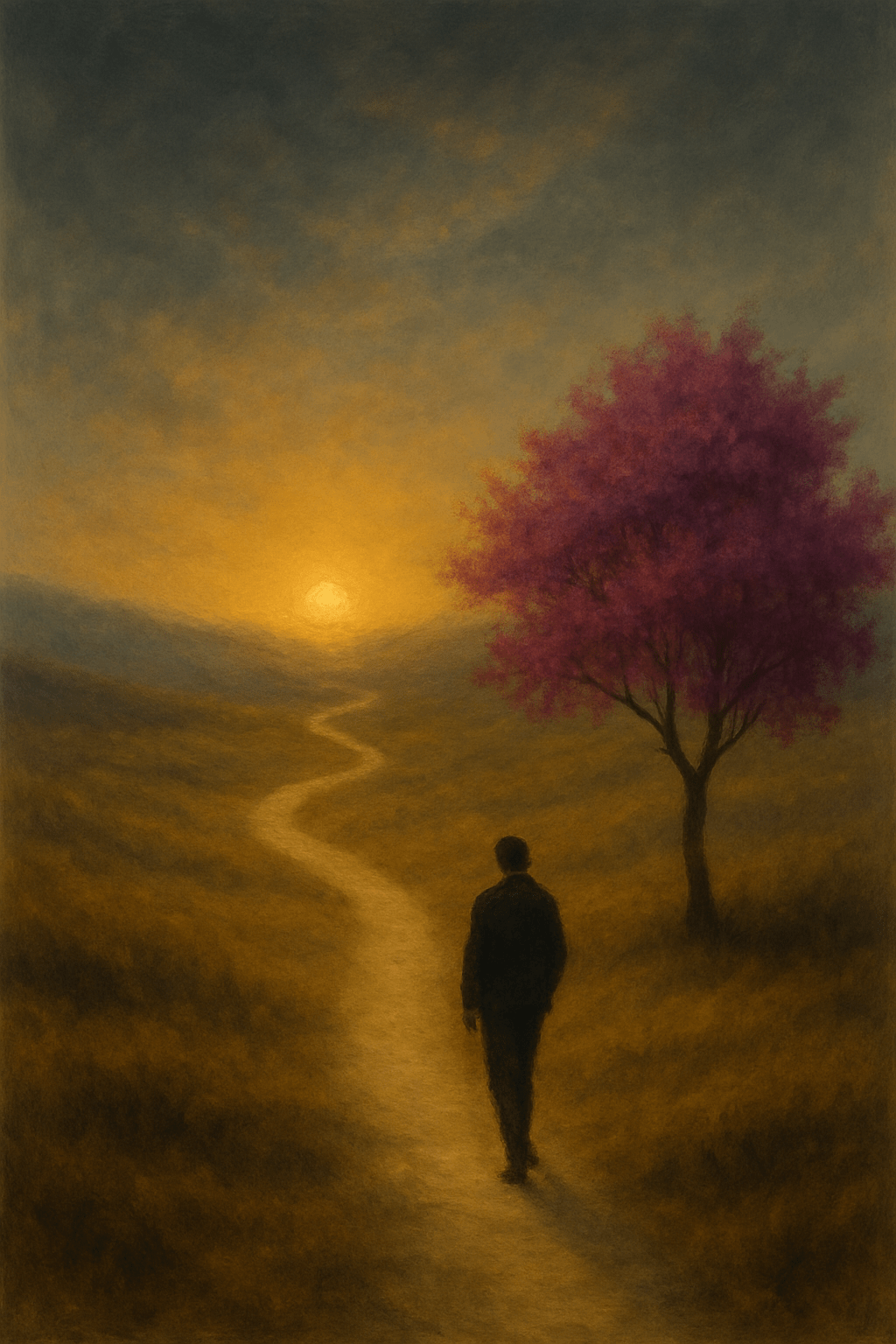
A solitary figure walks a winding path toward the sunrise, symbolising hope and new creation.

Faith does not erase suffering. If Part I was about honesty in the ache, Part II is about the slow tenderness of hope. Not a hope that denies pain or covers it up, but one that sits with it, honours it, and still dares to believe that God has not let go.

Picking Up the Thread

The Bible’s honesty about despair is matched by its honesty about hope. The psalms of lament often end in trust, but never without tears first. Job ends not with tidy answers but with God showing up in the whirlwind (Job 38). Jesus rises from the grave, but he rises with scars still on his body (John 20:27).

Hope in the Christian story is not neat or fast. It is not the removal of pain but the presence of God within it. Hope does not compete with suffering. It accompanies it. And it points forward, to new creation.

God With Us in Weakness

At the centre of Christian faith is the incarnation. God chose to take on human flesh, not in power but in vulnerability.

The Gospels give us a Jesus who is weary by a well (John 4:6), who weeps at the tomb of a friend (John 11:35), who withdraws to pray alone when the crowds overwhelm him (Luke 5:16), and who sweats blood in Gethsemane under the weight of anguish (Luke 22:44).

This is not a God who condemns weakness. This is a God who enters it.

Paul writes that the Spirit intercedes for us with groans too deep for words (Romans 8:26). When you cannot pray, when the silence feels unbearable, the Spirit is praying in you. When words fail, God does not. This is the same Spirit who raised Jesus from the dead and who will one day give life to our mortal bodies (Romans 8:11).

The Slow Dawn of Healing

Psychology tells us that healing is rarely instant. Trauma does not evaporate. Depression is not prayed away. Anxiety does not dissolve just because we will it to.

Healing takes time, care, and patience. It takes therapy, medication, a safe community, and embodied practices that help the body and mind recover. None of these are signs of weak faith. They are means of grace.

Taking your medication can be sacramental. Going to therapy can be more nourishing than confession. Choosing to keep breathing, even when you want to disappear, can be holy. These are not second-rate versions of spirituality. They are faith lived in the grit of real life.

Theologian Jürgen Moltmann once wrote that hope is not an escape from reality, but the strength to endure reality because God’s future has already broken into it. Healing is like that too. Slow. Patient. Painful at times. But still a witness that God is not done.

The Mystic Thread

Mystics spoke of hope not as triumph but as trust in darkness. St John of the Cross called the “dark night of the soul” not abandonment but the hidden place where God works most deeply. It is love stripped bare, learning to cling when nothing else remains. Hope is not the quick confidence that all will be fixed, but the quiet courage to stay when nothing makes sense, trusting that God is near even when unseen.

Hope, in this sense, is not shallow optimism. It is not pretending. It is a quiet trust that even in silence, even in sorrow, God is present. It is a trust that the story is moving toward new creation, when God will wipe away every tear (Revelation 21:4).

A Community of Sanctuary

The church at its best is not a hall of triumph but a sanctuary for the weary. A place where people can say “I’m not okay” and still belong.

Too often, churches have offered slogans instead of presence and belonging. But the call of the church is to be the body of Christ, scarred, vulnerable, open to touch. The early church carried one another’s burdens (Galatians 6:2). They wept together. They broke bread together. They bore witness to a kingdom where the wounded are not cast out but welcomed.

What would it look like if our churches became places where mental health struggles were not seen as shameful but as part of what it means to be human? Places where therapy is affirmed, medication is blessed, and silence is held without fear?

The world does not need churches that tell people to “pray harder.” It needs communities that sit in the dark and wait together for dawn, trusting that God and his kingdom is already breaking in.

The Shape of Hope

So what does hope look like when you live with depression, anxiety, or the weight of trauma?

Hope is not always joy. Sometimes it is simply endurance. Sometimes it is the quiet conviction that your story is not over. Sometimes it is the love of a friend who does not leave. Sometimes it is the courage to wake up to another day.

Hope is the scarred Christ showing up in the locked room to say, “Peace be with you” (John 20:19). Hope is the Spirit praying when you cannot. Hope is the Father who does not break a bruised reed or snuff out a smouldering wick (Isaiah 42:3).

Hope is tenderness. It does not rush. It does not shame. It does not demand. It whispers: you are not alone. And one day, this tenderness will give way to joy when creation itself is made new.

A Closing Blessing

So, may you know that your sorrow is not a failure.

May you find a small mercy in the day, even if it is only breath.

May the silence not undo you, but hold you,

until you can trust that God is still there.

May hope come like a slow dawn,

not rushing, not demanding, but faithful.

And may you remember that the One who carries scars

carries you, too,

into the promise of all things made new.

The Contemplative Gospel Part I: Creation, Fall, and Our Lost Communion with God

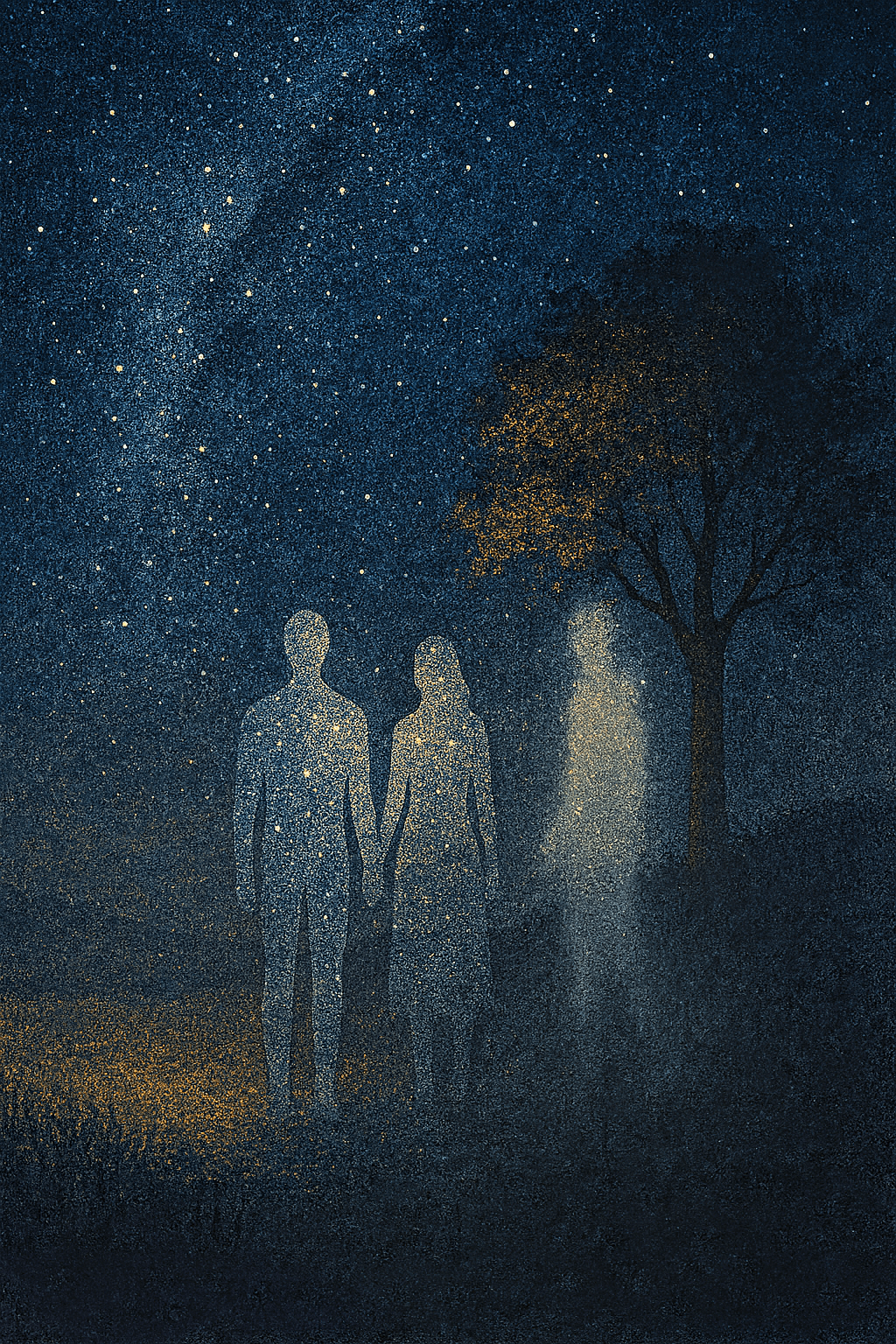
Abstract contemplative artwork of two glowing human silhouettes beneath a starry night sky, their bodies filled with starlight. Beside them stands a lone tree, half in shadow and half in light. Near the tree, a larger silhouette made of starlight represents God walking with them. The scene is cosmic, sacred, and symbolic, in deep blues, purples, and gold.

The Gospel Begins with Wonder, Not Sin

The gospel does not begin with sin. It begins with wonder.

“In the beginning, God created the heavens and the earth” (Genesis 1:1). From the first moment, creation was spoken into being within God’s own presence. Life emerged as song, at his call, not apart from him but held inside his life. Mountains rose and oceans gathered, their beauty already shimmering with his nearness.

And then God stooped low, pressing his breath into dust. Humanity came alive, not only because of lungs and blood, but because every heartbeat throbbed with the life of God. As Paul would later say, “In him we live and move and have our being” (Acts 17:28).

The world has never existed outside of God. We dwell in him, even as he dwells in us. Every breath you take is not just survival. It is communion.


Created to Share in the Divine Life

Let us make humankind in our image, according to our likeness” (Genesis 1:26). From the beginning, we were not just creatures surviving on borrowed breath. We were made as mirrors of the divine, meant to shine with another’s glory.

The apostle Peter writes, “we were made to be partakers of the divine nature” (2 Peter 1:4). Creation is not simply about survival or usefulness. It is about communion. It is about living our lives inside the very life of God.

Irenaeus of Lyons once said, “The glory of God is a human being fully alive, and the life of the human consists in beholding God.” That is creation’s secret. We were meant to live every breath as communion, every heartbeat as sacrament. The mystics remind us again and again that the world is charged with God. Meister Eckhart could say that every creature is “a word of God and a book about God.” Before sermons, before catechisms, creation itself was already preaching. “The heavens declare the glory of God” (Psalm 19:1).

What would it look like to see creation, the tree outside your window, the face across the table, as a word of God spoken to you?


The Fracture of the Fall

But then the story bends.

The serpent’s whisper is subtle. “You will be like God” (Genesis 3:5). The tragedy is that likeness to God was already our inheritance. What could have been received through communion, we tried to seize through grasping. What was meant to be given in love, we reached for in desire.

And in the reaching, something broke. Their eyes opened, but not to glory. Only to shame (Genesis 3:7). Hearts that once lived open to God turned inward and hid from the Presence that still walked in the garden (Genesis 3:8). Communion became exile.


Sin as Broken Communion and Blindness

For the mystic, sin is not simply breaking rules. It is breaking communion. Augustine captures it in his Confessions: “You have made us for Yourself, O Lord, and our hearts are restless until they rest in You.” Restlessness is the echo of what we lost. It is the ache of a heart turned from the fountain of life, thirsting for water while standing beside the spring. Jeremiah gave it his own words: “My people have forsaken me, the spring of living water, and dug their own cisterns, broken cisterns that cannot hold water” (Jeremiah 2:13).

Gregory of Nyssa, the great contemplative, saw humanity as created for an endless ascent into God. Our destiny was always to go deeper into beauty without end. But in the fall, our gaze turned from the Infinite to ourselves. We lost our horizon. We curved inwards. The soul that was meant to climb into God instead closed in on itself.

This is why the mystics often speak of sin as blindness. John of the Cross wrote of the dark night, when the soul cannot perceive the light even though it surrounds her. That is Eden’s exile. The Presence never left. The light still shines in the darkness, but our eyes have forgotten how to see it (John 1:5).


God’s Presence Remains After the Fall

And yet, even here, grace remains.

God does not abandon Adam and Eve to their shame. He clothes them with garments (Genesis 3:21). He keeps walking, keeps calling: “Where are you?” (Genesis 3:9). This is not the cry of a detective chasing criminals. It is the voice of a lover searching for his beloved. Even in exile, God follows. Even in our turning, he does not turn.

Julian of Norwich, reflecting on human sin, once heard Christ speak these words to her: “Sin is behovely, but all shall be well, and all shall be well, and all manner of thing shall be well.” For her, sin was not the end. It was the place where mercy would be revealed.

We are dust, but dust still held by God’s breath. We are exiles, but never outside his gaze. The wound is real, but so is the promise. The God who made us to share in his own life will not rest until we do.


A Contemplative Practice

Take a few minutes today to sit quietly. Place your hand on your chest. Feel your breath rise and fall. With each inhale, pray: “In You I live.” With each exhale, pray: “In You I rest.”

As you breathe, remember that the first breath you ever received was God’s. Even in exile, his life still holds you.

Running Between Worlds: A Poetic Retelling of Hebrews 11–12:2

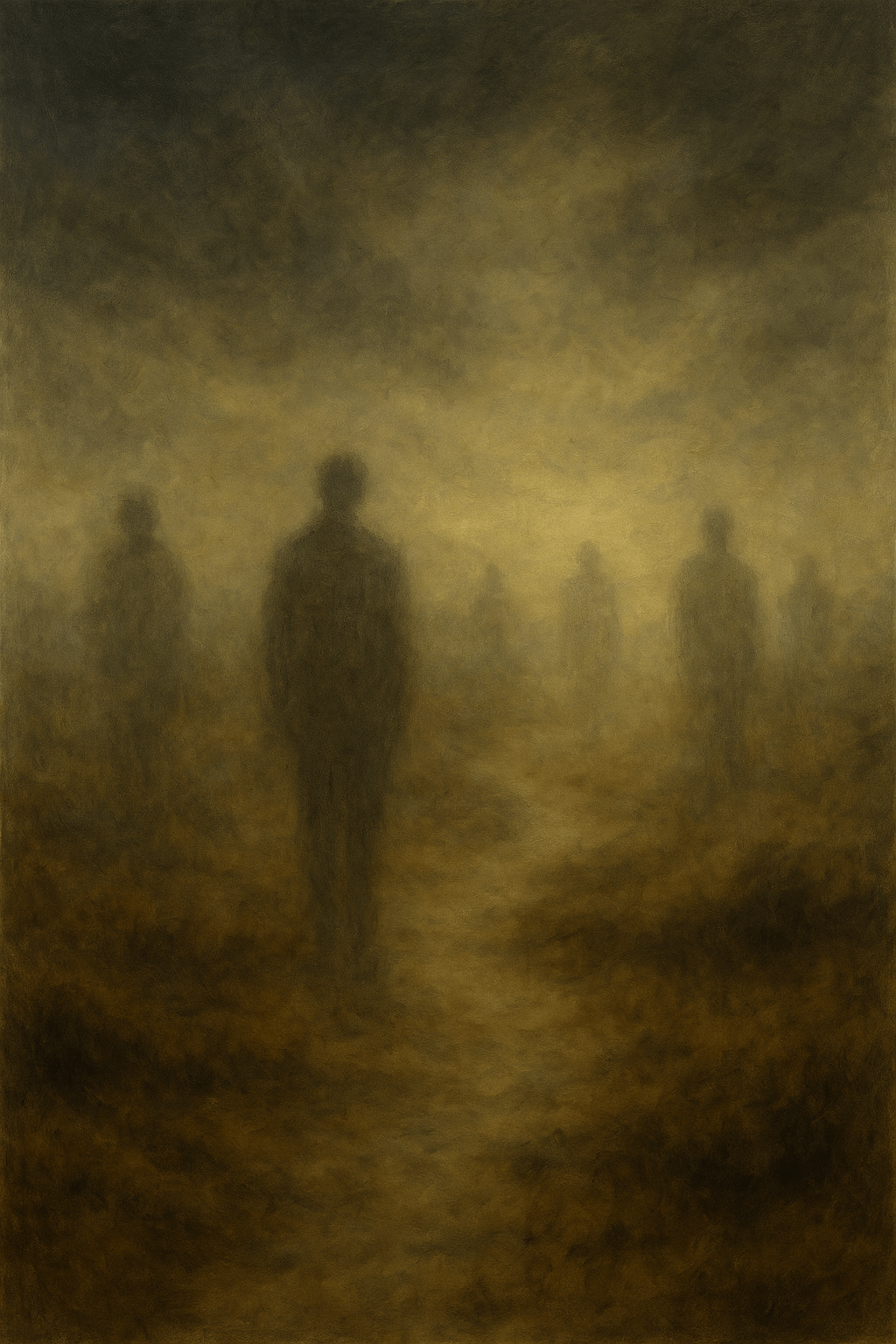
Five shadowed figures walk along a narrow path through a golden field toward distant mountains, under a dark, moody sky.

I think of faith, and it feels like a pulse beneath the skin.
Not loud.
Not something you can point to.
Just the quiet certainty that what we hope for is already alive, even when the eyes see nothing.

This is how they lived, those who came before us.
They stepped forward into places they could not see.
They believed a voice that spoke before time began.
The world was called out of nothing, from what no hand could hold.

I remember Abel, whose blood still sings.
Enoch, who walked with God until the earth could no longer keep him.
Noah, hammering wood while the sky stayed clear.
Abraham, leaving the warmth of the known, set up tents in a land that was only his by promise.
Sarah, laughing at the thought, then held laughter itself in her arms.

The dying blesses the living.
The bound blessing the free.
The exiles blessed the land they had never touched.

Some saw seas open.
Some saw walls crumble.
Some silenced the mouths of lions.
Others felt the weight of chains, the teeth of the saw.
They wandered deserts, hid in caves, clothed in skins, strangers, the world was not worthy of.

And all of them died still looking forward,
eyes lit by a promise that waited for us too.

So here we are, surrounded by their presence,
their stories still breathing in the air around us.
We let go of what weighs us down.
We shake free from the sin that clings like a shadow.
We run, slow and steady, breath after breath,
our eyes on Jesus.

He is the one who began this faith.
He is the one who will bring it to completion.
For joy beyond the grave, He endured the cross.
He bore the shame and broke its hold.
And now He rests in light, at the right hand of God.