I’m Back!

Where have I been? Well, I’m back after a long time of letting this site rot away, unloved… forgotten. Obviously, though I have decided to pick it up again, invest in it, and use it as an outlet to share with the world what matters to me (well to whoever reads it). I expect most of these to be raw, not make a lot of sense, and to be largely unedited (at least by anyone but myself). So good luck with that. To those who are interested, the last year or so have been some of the most formative of my life so far. My theology has evolved, my relationships have changed, and my spirituality has, and is being shaped in ways I never really expected (I expect that this process will go on for some time yet). I’ve been a best man at two different weddings, a groomsman at a third. I’ve had dreams come and dreams go. Allanah and I have joined a new church (we’ve been there for about a year now), we work new jobs with new people and we’re experiencing city life at its best. All in all, life has changed… and I think change is a good thing… it is scary but I think it just means God is working in me for my good even though it’s hard at times to see the forest through the trees.

The biggest challenge for me at the moment is the desire to practice real spirituality. I think my love for theology has at times become an idol… a sort of blockage to actually walking with Jesus. I’d never pit the two against one another as it’s one’s theology that informs how they walk with Jesus. But there are times when the accumulation of knowledge has taken the main stage over legitimate intimacy with God. So think I’m going to cut down on the big and lofty books and stick to the Bible, and just one or two books or podcasts that are immediately relevant to my walk right now.

What am I listening to? At the moment I’m binging The Bible Project’s podcast and I’m loving every minute of it. What’s particularly impacting me is their eschatology and how that affects living out your faith in the here and now. I’ll probably end up writing about it so I won’t get into much but I will say this. If you believe as I do that there will be a New Heaven and a New Earth and Jesus will be king ruling over that newness with us as His people (as He already is in a sense), where there will be no sickness, death, sadness, but pure love, joy and splendour, how do we live in light of that reality? That’s a big question with big answers, and big implications… something we’ll explore in future posts I think.

What have I read recently? Recently I’ve read Rob Bell’s new book “What is the Bible?” I’ll be posting a review on that I’ve already written after this post. I’m also slowly making my way through N. T. Wright’s new book “Paul: A Biography.” One thing that keeps standing out to me time and time again is how important context is when reading Scripture (I’ll probably end up writing about this concept). Wright really makes this clear. Oh, I’ll probably write a review on this book as well. Finally, a book I keep going back to is Donald Miller’s “Scary Close.” Miller is one of my favourite all-time authours. His stuff on relationships, being genuine and his journey in Christian spirituality speaks to me in ways no theology book ever has. I’d love to write a review on this book as well.

Finally, I just want to say how excited I am to start journeying with anyone who wants to on this site. I’m really keen for dialogue and discussion, ideas and stories. Feel free to reach out to me and engage with anything you read or hear that might spark inspiration for you. See you guys in the next one.

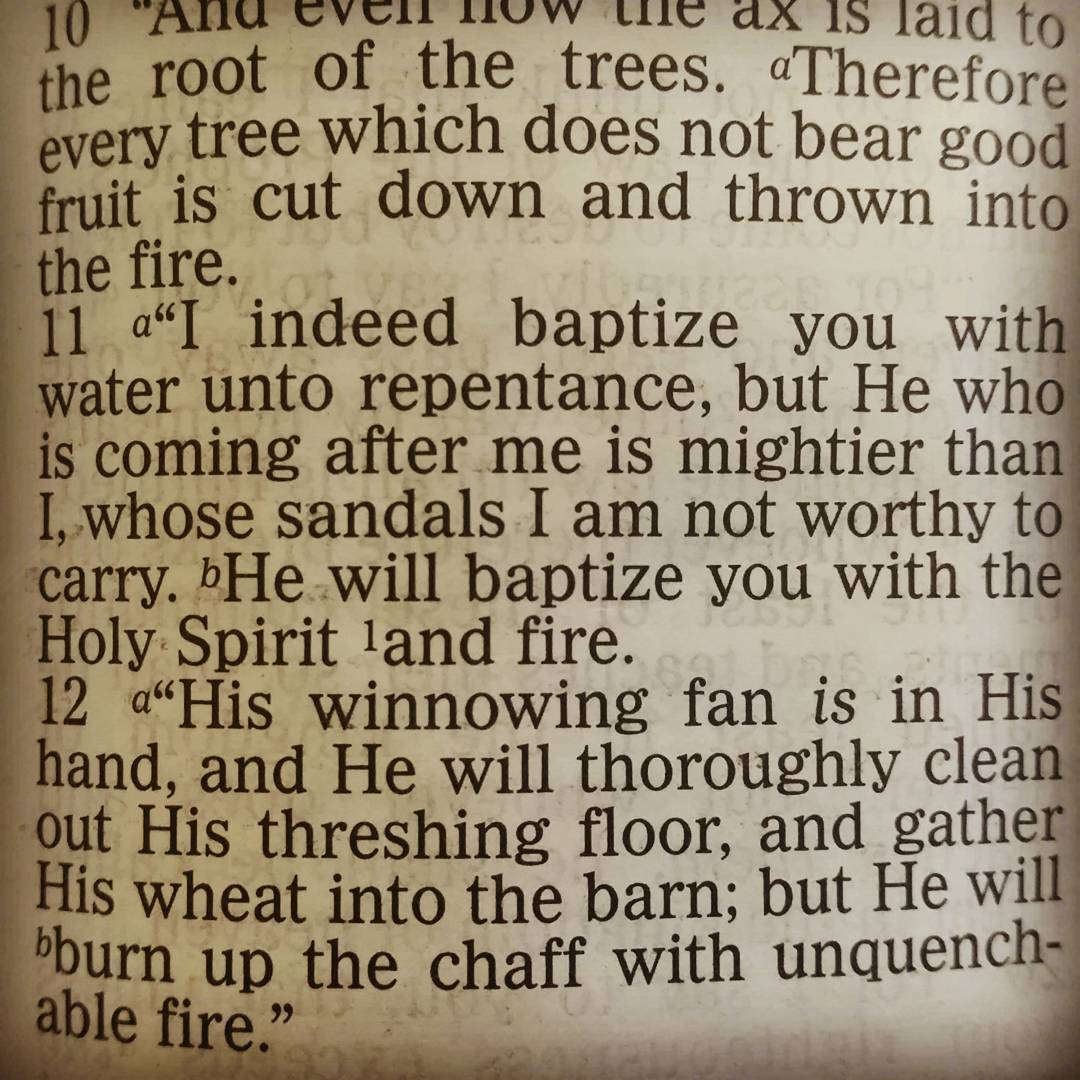
John the Baptist: Water and Fire

Introduction

This Sunday I will be preaching a sermon on John the Baptist, and I have got to say if John the Baptist was the greatest of those born of a woman (Luke 7:28), I have a lot to live up to. What’s more, the next thing Jesus says is that even the least in the Kingdom will be greater than John (very convicting). As I reflect on this, I think to myself, “I’ve baptised maybe 3 or 4 people in my life, preached a hand full of sermons and have hardly ever experienced or seen a person come into the Kingdom.” Not everything is that bad. I’ve seen incredible growth in people’s lives in the church that I minister in. Those baptisms I mentioned have happened this year, and our youth and young adults are starting to grasp concepts and parts of the Gospel that I have only just started to come to terms with myself. However, I think there are some great lessons to be learnt as we look at the (brief) ministry of John the Baptist (lessons that even I need to take into account).

First: John was Chosen

The first thing that stands out to me is that John was chosen by God. That might scare some people, however, not only does the angel Gabriel appear to John’s father Zacharias (Luke 1:11-20), but John’s coming, and ministry was foretold hundreds of years before he was born (Isaiah 40:3). I know that John was a particular case, but the New Testament says that we’ve been chosen in Him before even the creation of the world (Ephesians 1:4), and chosen for good works in Jesus Christ (Ephesians 2:10). So in this sense, we are all pretty special, and we all have a pretty important role to play in God’s plan. I think that the main point here is that we need to take the call on our lives seriously, just because we weren’t necessarily foretold, it doesn’t mean God didn’t have us in mind before the world was even created.

Second: John was Chosen to Prepare the Way

He said, “I am the voice of the one crying out in the wilderness, ‘Make straight the way of the Lord” (John 1:23, ESV). Another interesting element of John’s ministry was that he was chosen to prepare the way for the coming Messiah. John did this by baptising people (Matthew 3:5-6) and preaching a message of repentance and the immanence of the Kingdom of Heaven (Matthew 3:1-2).  Scripture doesn’t give us a lot to go off, but we know from Luke that all of this was wrapped up into the promise that John would “turn many of the children of Israel to the Lord their God” (Luke 1:16). This is a prominent call to Christians because the Church is called to do the same thing. For example, John preached a message of repentance and of the Kingdom, in the same way, we are to preach to the world that the only way in which a person can be saved from their sin is if they repent and believe in the Gospel (Acts 16:31; Romans 10:9) and that the Kingdom of God is near (Matthew 10:7; Luke 10:9).

Furthermore, John Baptised people who responded to his message immediately into the Jordan River. Likewise, Jesus commands us to baptise as this was a necessary part of the Great Commission (Matthew 28:16-20). However, why is baptism so important to both John, Jesus, and the early Church?

The Importance of Baptism

The act of Baptism is scattered all throughout the New Testament (Matthew 3:13-17; Mark 1:9-11; Acts 2:38; Acts 8:35-38; Acts 16:31-33). However, where we find the importance of baptism, and it’s meaning in Romans 6:1-14 (See also: Galatians 3:27; Colossians 2:11-14). The main thrust of Paul’s argument in this section of Scripture is that water baptism is a picture of a deeper spiritual reality that has happened to every believer. That is, we have all been baptised (immersed or united) into Jesus’ death (6:3), and resurrection (6:5), and as a result, sin no longer has the power to rule over the believer (6:14). Water baptism was important because it showed an unwavering act of commitment and trust that a person has been spiritually united with Christ by grace, through faith. Essentially, it meant that a person was born again and that they had become a new creation in Christ (2 Corinthians 5:17).

Third: Baptising and Preaching with Fire

Unfortunately though, one of the saddest things that I’ve seen in the Church (in my experience at least) is the under-appreciation and even neglect of baptism. These days we can wait months or even years before we baptise a professing Christian. This is usually because we want to wait until we are sure that they are serious about their commitment to Christ, or because we want to make sure they are “orthodox” before we dunk them in water. The saddest thing about this though is that this is just a product of the Gospel we preach. The Church preaches such a weak Gospel in the power of the flesh, and not in the power of the Spirit that we are afraid that people are really only giving Christianity “ago” because it’s new and fresh, not because they are fleeing the wrath to come or that they want to be reconciled to God. The early Church wasn’t like this. The early Church preached the Gospel that was the power of God unto salvation to whoever would believe (Romans 1:16). This was the same Gospel that, coupled with the power of the Holy Spirit, cut people to the heart and added thousands of people to the Church in one moment (Acts 3:37, 41). We’ve missed out on the relentless preaching of the Gospel and the immediate act of baptism that John held so dear. Leonard Ravenhill in his book Why Revival Tarries really gets to the heart of the matter when he says,

John the Baptist was in God’s School of Silence, the wilderness, until the day of his showing forth. Who was better fitted for the task of stirring a torpid nation from its sensual slumber than this sun-scorched, fire-baptised, desert-bred prophet-sent of God with a face like the judgement morning? In his eyes was the light of God, in his voice was the authority of God, and in his soul was the passion of God! Who, I ask, could be greater than John? Truly “he did no miracle,” that is, he never raised a dead man, but he did far more he raised a dead nation!

Likewise, who is better fitted for the task of stirring a dead world and even in many cases a dead Church then each one of you reading this blog? God has called every Christian to be filled with the Spirit (Ephesians 5:18) and preach the Gospel boldly. My point is this. Like John, preach the Gospel in its entirety, be filled with the Holy Spirit, and baptise people immediately upon their confession of faith because if the Gospel is preached in power, what have we to fear?

Conclusion

As we reflect on the calling that John the Baptist had on his life, we can start to be encouraged and pursue God, and His calling for the Church in the same manner. Let us consider God’s call on our lives, let us prepare the way for the second coming of our Lord with a fiery tongue that has been lit by the power of the Holy Spirit. Let us repent of our half measured Gospel, our measured half-life of faith, and walk in the Spirit so that we, like John, may stir the Church, and the world, into God’s Kingdom.

Glorifying God With Our New Year’s Resolutions

Introduction

It’s about this time of year, as Christmas slowly creeps upon us, with the New Year hand in hand, that we start to think about what the New Year will hold for us. This time of year we start making New Year’s resolutions which usually include working out more, eating right, reading a certain amount of books (tick), starting a new love life, getting promoted etc. etc. The problem, however, is that a lot of the resolutions we end up making are empty and end up not working out. I can’t even count how many times that I have promised to myself that I would work out better in the New Year, but instead, get caught up playing Halo or the new Fallout. For Christians, though, our resolutions can look a bit different. We can say to ourselves that we are going to pray more in the year to come or read the Bible more. These are great goals to set, don’t get me wrong. The problem, however, is that 9 out of 10 Christians (in my experience) that I’ve met fail to fulfil these resolutions as well. So maybe the question we should all be asking ourselves as the New Year approaches is, “as a Christian, what resolutions should I be setting for myself that I can actually fulfil so that God may be glorified?”

Glorifying God First

As I have mentioned in my blog on Identity and Idolatry: Part I, we were all created in the image and likeness of God (Gen 1:26-27). Furthermore, the reason why we were created was to reflect God’s image to the world so that He may be glorified and be made known to all of creation. If this is true (I will write on this in a separate blog), then as Christians we have to consider if the resolutions we want to make are set up so that they make God more known to the rest of the world.

John Piper has a lot of great stuff to say about glorifying God. However, one quote stands out to me where he says,

I asked, Why did God create the world? And I answered: God created this world for the praise of the glory of his grace displayed supremely in the death of Jesus. The problem is that at the heart of that answer is God’s self-promotion. God created the world for his own praise. For his own glory.

What Piper says is pretty profound. I think if we all gave serious consideration to what is being said, it would change the way we would do everything in our lives. God created everything (and ultimately us) so that His glory would be displayed to everyone and so that He would be praised. This means that when we make resolutions for the New Year, we need to ask the question, “does this display the glory of God, or is this self-serving?”

Making the Right Resolutions

If, as Christians, we want to make the resolutions for the New Year, we have to seriously consider a few essential things. First, we have to (like I have already mentioned) ask, “what will glorify God the most?” If we are mindful of glorifying God in every resolution we make, then it will be easier for us to decide which resolutions are worth pursuing and which ones aren’t.

Second, if we want to glorify God in our resolutions, then we must actually take seriously the call to reflect His greatness to all of creation. Unless we take seriously the call that God has on each Christians life to reveal His fame and glory to the world, every resolution (and everything we do for that matter), will ultimately fail and fall short of what God has intended for us. So take the time to read Scripture and pray to God so that the call to glorify God settles deep into your heart.

Lastly, we have to do whatever God is calling us to do without compromise. It is so easy to compromise on our resolutions. Many of us begin our New Year well, but a few months into our resolution, we start to neglect and compromise on what we originally set out to do. If we are serious about glorifying God in our resolutions, this can’t be an option. We have to see the resolutions that God has placed onto our hearts to its end, no matter how long this takes. This can only be done if we depend on God for everything, and if we walk by the Spirit (Galatians 5:16). Whatever your resolutions for the New Year may be, do it all to the glory of God without compromise and with a serious heart to reflect God to the entire world.

What Christmas Means to Me

Introduction

Christmas, what a wonderful time of the year. For half of the world, Christmas day is covered in snow, gingerbread houses, fireplaces, and eggnog. For the other half, Christmas day is all about the surf, the pool, ice-cold drinks, cold meats and trying to find the right balance of tan versus sunburn. Christmas means a lot of different things to a lot of different people. The one common thread at Christmas for the majority of the world are presents, Santa, and reindeer. For Christians, however, Christmas has a spiritual element to it.

It is pretty well known that Jesus’ birthday wasn’t on the 25th of December. However, Christians all around the world take the day to remember the birth of our Lord and Saviour. Christians think back to the day Jesus was born in a dirty old manger among animals, dirt and muck, and celebrate the beginning of what was to be the end of our problem with sin (John 3:16). For me, however, Christmas has not always been like this.

My Christmas’

I grew up in a non-Christian family. So Christmas for me was never about Jesus. Christmas was more about prawns and fresh seafood. It was about beer and cold drinks. It was about family and friends gathering around one another and having a good old time. Mostly, though, Christmas was about what presents I would be getting that year. Christmas was about me.

I have a lot of fond memories of Christmas. I remember getting really excited and waking up at 5 or 6 am ready to unwrap all the cool new toys that I had asked for that year. What I don’t remember is Jesus. I remember going to my Nanny’s house in New South Wales and spending time at the beach exploring the rocks and getting dunked by waves. What I don’t remember is Jesus. I remember the laughter and joy that our friends and family had when they came over and visited. What I don’t remember is Jesus.  I remember a lot of great things. Things that I will cherish for the rest of my life. What I don’t remember though is Jesus or anything about Him. It wasn’t until I became a Christian that the meaning of Christmas changed for me.

The Change

I think one of the biggest things I realised as I experienced my first few Christmas’ as a Christian was how much Jesus really was absent. I would turn the T.V on in the morning to find someone preaching on the Christmas story. Instead, I would discover cartoons or prosperity preachers. I became hyper-aware of how much God was not a part of Christmas in my family. This really surprised me (it probably shouldn’t have) because Christmas was meant to be all about Jesus, right? I guess so. What I’ve come to realise though is that Christmas is really a non-Christian holiday that Christians use to glorify God in the best way that they can. So it shouldn’t surprise us when we don’t find Jesus on many Christmas cards or on T.V. Why would there be? Christmas isn’t really Christian…

A New Meaning 

So then what does Christmas mean to me now? Well, Christmas means to me three main things. First, Christmas is a day of connection. Connecting to people, family and friends I never see for the rest of the year are vital for me because, for some of them, I am the only Christian influence that they might have that entire year. Second, Christmas is a day that the Gospel can be talked about almost freely without repercussions. Most people know who the “Jesus guy” is, now is the time to declare to them the depth and love of His grace so that they might enter into His kingdom. Lastly, it is a day in which I can bring glory to our Lord. For me, Christmas can be a day where God can be glorified in the gift-giving, food eating, and every other activity that I do. With these three things in mind, every Christmas day can be centred on the person and work of Christ. Christmas has taken on a new meaning.

Identity & Idolatry: Part I

Introduction

I started my pastoral-ship in March of 2015, and I have to say it was one of the most intense decisions of my life. Ever since I became a Christian, I had the strongest desire and calling to teach God and His Word. However, I think it took me a while until I started to grasp what being a teacher really meant for my life. Early in my Christian walk, I remember holding Bible studies for Christians who had been walking with the Lord 3 or 4x as long as I had been. Yet despite their experience, I always had this deep longing to share the profound mysteries that God had been revealing to me in my zealous youth. I can just imagine now that those same Christians must have been grinning from ear to ear as I grappled with things like justification by faith, and the second coming of Jesus. However, as I reflect upon the friendships, I have developed over the years with those people I realise now that those things are still being talked about like as though we are only beginning to understand what they mean. However, I digress. That is a topic, perhaps for another blog. I suppose the point that I am trying to make is that it took me some time before I came into my own and felt comfortable in certain theological topics of conversation. Over the last 6 months, one of the topics that have gripped me the most has been Identity and Idolatry (hence the title for this series). So, reader, I implore you to come on this journey with me as we start to delve into what the Bible says about these things and try to make heads and tails of something that runs deep into the hearts of every person.

Idolatry: The Root

“Sin is the fruit, and idolatry is the root.” This was something my Bible College lecturer continuously reminded me of in my class on Romans and Pauline Theology. This is one of those sayings I think that will last a lifetime as it will remind me of the real reason why I do the things I do (we all reap what we sow). That is, I can tend to worship things that aren’t God. These things are called idols.

Idols saturate our culture. I’m not really talking about Hinduisms myriad of gods, or Buddha, or Allah. I’m talking about real influences that destroy our very souls. These idols can be pleasure, riches or fame. An Idol can be anything or anyone that you love more then you love your Creator. Idolatry is the root, and the sin in your life is the fruit. If you worship money (the root), you could be found overworking and not spending time with your family (the fruit). If you are worshipping pleasure (the root), you could be found caught in a range of sins from adultery, to drunkenness, drugs or any combination of these sins (the fruit). If you are found worshipping other people (the root), you usually can be found becoming obsessed, and your identity is found in whether or not that person (or thing) approves or disapproves of you (the fruit). It is important to understand that our identity is directly intertwined with whatever it is we worship. This can be seen clearly at the Fall with Adam and Eve.

The Fall: Our Identity Lost

In Genesis, we undoubtedly see God portrayed as the supreme ruler of the universe, and sovereign over all creation. God creates the sun, moon, stars, water, earth, birds, fish, cattle, and plants. To top it all off, God creates mankind in His image and likeness (Gen 1:26-27). Everything was good. However, something went terribly wrong. Adam and Eve were tempted into sin and were separated from God. Most people might read that and understand what happened and simply move on. However, Genesis 3 explains everything that is wrong with humanity and why we so desperately need our Creator to make us new once more. Let us explore what happened and its relevance to us today.

Now we know that back in chapter 2, God had made it forbidden to eat from the tree of knowledge of good and evil (Gen 2:16-17). The consequence of eating from the tree was death, spiritual separation from God. Unfortunately for us, that didn’t really take precedence in the minds of Adam and Eve because they were enticed with a greater promise. The serpent (presumably Satan) promised that if they were to eat from the tree, they would become gods themselves (Gen 3:4-5). Many people might rightly understand this to be a lie or a trick that the serpent had played on our original parents. However, if we continue in the story we actually see God Himself confirm that this became a reality saying, “Behold, the man has become like one of us in knowing good and evil…” (Gen 3:22). How does this make sense though in light of idolatry and identity?

First, it is essential to see that when Adam and Eve were tempted, they were enticed into receiving a new identity outside of the person of God. Instead of worshipping and loving God (which ultimately leads into becoming like Him), they wanted to become like gods themselves so that they could become worshipped and adored instead (I mean why else would you want to become a god right?).

Second, though becoming a god happened in some sense, it wasn’t what they expected. The moment they put their trust or faith into the created thing (the serpent) rather then the Creator God, they recognised their shame and sin and tried desperately to cover it up using fig leaves (Gen 3:7). What this ultimately means is that the promise was empty. There is always a catch when it comes to idolatry.

Third, because they trusted in created things instead of the Creator God, their image (or identity) was now scarred, and they reflected the image of corruptible idols (creation) instead of the image of the incorruptible God. The Apostle Paul practically writes a commentary on this in his letter to the Romans where he says,

For although they knew God, they did not honour him as God or give thanks to him, but they became futile in their thinking, and their foolish hearts were darkened. Claiming to be wise, they became fools and exchanged the glory of the immortal God for images resembling mortal man and birds and animals and creeping things (Rm 1:21-23). 

Paul has two things in mind here. Though I believe that he had Adam and Eve in the back of his mind, I also think that he has the entire state of humanity at the tip of his pen. We have all worshipped creation instead of Creator. All of us have received a different identity because we worship idols instead of worshipping God, who gave us life and purpose.

So is there any hope?

… To be continued