Christian Perspectives on Gaming and Imagination

Wonder, Formation, Sacramentality, and the Ache For a Healed World

Some of you might not know this, but I love video games. I really love video games.

It probably started when my mum and dad had a Sega. I cannot remember which one, but I remember playing Alex Kidd. Then came the Super Nintendo, with Yoshi’s Island and Mario Is Missing. But the console that probably defined my childhood was the Nintendo 64.

That grey little box was magic.

GoldenEye. Star Wars: Rogue Squadron. Super Mario 64. Lylat Wars. Pokémon Stadium. And of course, probably my favourite game of all time, The Legend of Zelda: Ocarina of Time.

Gaming has changed a lot since then. We have moved from blocky pixels and split-screen chaos to vast open worlds, emotional storytelling, online communities, virtual reality, and games that feel less like toys and more like places you inhabit.

Christians have never quite known what to do with video games. Are they harmless fun? A waste of time? A spiritual danger? A strange little doorway into wonder?

For some Christians, the answer has usually been simple. Video games are violent, addictive, childish, escapist, and spiritually dangerous. And sometimes, honestly, that criticism is fair.

I have had plenty of negative experiences with games. I have rage quit more times than I care to admit. I have felt my body tense, my anger rise, and my patience evaporate because someone beat me in a match I thought I should have won. Online gaming can also be toxic. Anyone who has played competitive multiplayer games knows how quickly a lobby can become a little digital hellscape of contempt, insecurity, abuse, and ego.

Gaming can form us badly.

It can train impatience. It can feed escapism. It can reward domination. It can make us cruel, distracted, compulsive, resentful, or numb. It can turn rest into avoidance. It can turn play into compulsion. It can turn community into competition without love. So no, video games are not harmless by default. But I do not think they are spiritually empty either.

Video Games Form Our Loves

Years ago, I read James K. A. Smith’s You Are What You Love. His basic argument is that human beings are not just “thinking things.” We are lovers. We are creatures of desire. We are shaped not only by what we believe, but by what we repeatedly do, imagine, practise, and give our attention to.

In other words, our habits form our hearts. That gave me a better question to ask of gaming. Not simply, “Am I allowed to play this?”

But: What kind of person is this game forming me into?

That question is harder to dodge. It does not let me hide behind easy condemnation or easy permission. It asks me to pay attention. And attention is spiritual work.

Video games are not just entertainment. They are interactive stories. They invite us into worlds. They give us roles to play, enemies to face, choices to make, quests to complete, landscapes to explore, powers to wield, and endings to long for. A film lets you watch the hero. A game lets you become one.
I know there are dangers here. I have felt some of them in myself. But I also know games have given me moments of real wonder. There was a world worth saving

Think about Zelda. As a kid, I wandered through Hyrule in awe. I crossed fields, explored temples, fought monsters, rescued people, and slowly discovered that the world was deeper, stranger, and more sacred than it first appeared. There was evil, yes. But there was also beauty. There were monsters, but also music. There was darkness, but also courage. There was a world worth saving.

That kind of story resonates deeply with the Christian imagination. Scripture is full of the cry for evil to be defeated, for creation to be healed, for captives to be rescued, for peace to come, for the world to be made new (Romans 8:19–23; Revelation 21:1–5).

The Bible is not less imaginative than our games. It is more so.

It gives us a world charged with glory. A creation groaning for liberation. A humanity called to image God (Genesis 1:26–28). A dragon to be defeated (Revelation 12:9). A Lamb who conquers not by domination, but by self-giving love (Revelation 5:5–10). A city where heaven and earth are finally reunited (Revelation 21:1–3).

When a game tells a story of courage, sacrifice, beauty, justice, friendship, resistance, wonder, or hope, it is borrowing from a deeper moral and spiritual grammar. It is echoing, however faintly, the shape of the gospel.

Imagination and Disenchantment

Maybe part of the reason I care about this is because many of us were formed to distrust imagination.

In my own church tradition, faith was often treated as something that lived mostly in the mind. Christianity was about believing the right things, defending the right doctrines, reading the Bible correctly, and avoiding anything that might lead you astray. None of those things are bad, of course. Doctrine matters. Scripture matters. Truth matters.

But somewhere along the way, imagination became suspicious.

Fantasy was treated as childish at best and spiritually dangerous at worst. Beauty was secondary to correctness. Play was tolerated, but rarely honoured. Mystery was often something to solve rather than something to enter. The body was treated with caution. Desire was treated as a threat. Joy was allowed, but only if it behaved itself.

I suspect that is not only a church problem. It is also a Western problem. We inherited a deeply rationalised vision of the world, where truth was reduced to information, faith was reduced to propositions, and maturity was measured by how well we could explain, defend, categorise, and control things.

But biblical faith has always needed imagination.

Walter Brueggemann writes about the prophetic imagination: the Spirit-given capacity to see through the dominant stories of empire, despair, scarcity, and control, and to announce another world made possible by God. Imagination is not the opposite of truth. Sometimes imagination is what allows truth to become visible again.

Tolkien understood something similar when he described human creativity as “sub-creation.” We make worlds because we are made by the Creator. Our imagined worlds are not replacements for God’s world, but small acts of creaturely participation within it.

That gives me a different way to think about fantasy, story, and play.

At their worst, they can become escape. But at their best, they can become resistance to a flattened world. They can train us to hope, to grieve, to long, to notice beauty, to imagine healing, and to remember that the world as it is now is not the world as it must always be.

So for some of us, holiness became suspicion. Maturity became the ability to avoid anything that looked too strange, too magical, too bodily, too joyful, too human. But the Christian story is not thin like that.

The world begins in goodness. Humanity is made in the image of God. Creation is blessed before it is broken (Genesis 1:31). The biblical imagination is full of gardens, rivers, mountains, beasts, angels, songs, dreams, visions, meals, temples, cities, wounds, resurrections, and new creation.

Christian faith does not ask us to abandon imagination. It asks for our imagination to be healed.
And sometimes, strange as it may sound, a game can awaken something that a flattened faith has buried.

Video Games As Sacraments

A game like The Legend of Zelda can stir wonder. It can remind us that evil is real, but so is courage. It can give us the feeling of standing at the edge of a vast field, hearing the music swell, and sensing that the world is larger than our fear.

A game like Sky: Children of the Light can feel almost liturgical in its very mechanics. You move through darkness toward light. You carry light, share it, lose it, recover it, and help others keep going. There is no sermon in that. No heavy explanation. Just a shared journey where light is not only something you seek, but something you bear for others (Matthew 5:14–16).

A game like NieR: Automata can raise questions about consciousness, suffering, meaning, sacrifice, and whether love can survive in a world that feels mechanical and absurd.

A game like Elden Ring can immerse us in a world where glory and ruin are tangled together. Everything is broken, but not meaningless. Beauty is still there, even among rot, ash, violence, and decay. There is something profoundly human about wandering through a ruined world and still pressing on.

These games are not Scripture. They are not substitutes for prayer, worship, therapy, friendship, church, or actual embodied life.

But at their best, I do think they can be sacramental.

Not sacraments in the formal ecclesial sense. I am not saying Ocarina of Time is baptism, or that Elden Ring is the Eucharist. But sacramental in the older, deeper sense: created things becoming transparent to grace. Ordinary objects, sounds, images, stories, and experiences becoming signs that point beyond themselves to the God who made the world good, entered it in Christ, and is renewing it by the Spirit (John 1:14; Colossians 1:15–20).

God, Code, and the Digital World

As a Christian who leans panentheist, I believe God is not one more object inside the universe, but the One in whom all things live and move and have their being (Acts 17:28). God is beyond creation, but not absent from it. Creation is not God, but neither is it sealed off from God. All things are held together in Christ (Colossians 1:17). All things are sustained by the word of God’s power (Hebrews 1:3).

So what do we do with a video game?

A game is not “natural” in the same way a tree, river, mountain, or human body is natural. It is made from code, art, electricity, plastic, metal, labour, memory, and imagination. It is made by human beings, who are themselves creatures made in the image of God. Even the 1s and 0s are not outside the world God sustains. They are not divine. They are not magic. But they are still part of a creation held in God.

That thought does something to me.

It means the digital is not automatically unreal. It means human-made worlds, however fragile and limited, can still participate in the goodness of creation. They can still carry beauty. They can still become places where attention, friendship, grief, and hope are awakened.

Not because the game is God. Not because every game is holy. But because there is nowhere grace cannot reach.

Little Rehearsals of Grace

A game can be sacramental when it awakens us to our own humanity.

Gregory of Nyssa gives me language for this. For Nyssa, the life of faith is not static. We do not simply arrive, possess God, and stop moving. We are drawn ever deeper into God’s infinite life, changed “from one degree of glory to another” (2 Corinthians 3:18). The Christian life is a journey of becoming, an endless movement into love, freedom, holiness, and communion.

That may sound a long way from video games, but I am not sure it is.

So many games are built around movement: setting out, failing, learning, returning, growing, helping, losing, recovering, and pressing on. At their best, they can echo something true about the human vocation. We are not finished creatures. We are being formed. We are being healed. We are becoming human in communion with God and one another. And perhaps, in small and partial ways, games can even help facilitate that journey toward God. Not because they replace prayer, Scripture, worship, sacrament, or community. They cannot bear that weight.

But because they can train us to attend, to persevere, to repent, to begin again, to receive help, to offer help, to face darkness without surrendering to it, and to keep moving toward light.

They can become little rehearsals of grace. A game can be sacramental when it draws us into a shared, participatory story. When it does not merely entertain us, but invites us to practise courage, patience, grief, wonder, mercy, and hope. When it reminds us that we are not passive observers of the world, but creatures called to respond, to choose, to bear, to repair, to seek, to love. When it makes us feel the ache of a ruined world and the longing to become the kind of people who participate in its healing. When it helps us sense, even faintly, that beauty is not an accident, evil is not ultimate, and becoming human is something we do together.

They are stories. And stories shape us. They give us images for grief. They give us symbols for courage. They let us explore ruin, beauty, failure, hope, fear, and perseverance from the inside. At their best, games can help us practise attention: attention to beauty, to desire, to the kind of world we long for, and to the kind of person we are becoming.

Better Questions for Christian Gamers

I still think discernment matters here. Not fear. Not legalism. Not the lazy assumption that everything new is dangerous. But also not the equally lazy assumption that entertainment is spiritually neutral because “it is just a game.”

If it is forming our loves, then it is doing more than passing the time. I wonder if Christians have been asking the wrong questions. Not only, “Is this game violent?” But, “What does this game do with violence?”

Does it glorify domination, or does it expose the cost of harm? Does it turn enemies into objects, or does it make me feel the tragedy of a broken world? Does it invite wonder, or simply consumption? Does it deepen patience, curiosity, courage, and compassion? Does it help me rest, or does it help me hide? Does it reconnect me to joy, or does it numb me from pain I need to face? Does it make me more human, or less?

These questions are not only for games, of course. They are questions for everything that forms us.

Work can deform us. Ministry can deform us. Social media can deform us. Theology can deform us. Even good things become destructive when they become ultimate things. The problem is not that we love games. The problem is when we ask games to save us.

When gaming becomes our escape from responsibility, our substitute for friendship, our anaesthetic against pain, or our primary source of identity and achievement, then something has gone wrong. We have asked a creaturely good to bear the weight of God.

And it cannot.

But when gaming becomes play, rest, imagination, beauty, friendship, and wonder, it can be received as a gift. A creaturely, deeply human gift.

Learning to Notice

Christians confess that creation is good. Not only the obviously religious parts of life. Not only church services, sermons, Bible studies, quiet times, and worship music. Creation itself is charged with meaning because it comes from God and is held in God.

The world is sacramental before we ever learn the word.

Bread can become communion. Water can speak of death and resurrection. Wine can become joy. A meal can become grace. A garden can become a temple. A body can become the dwelling place of God (1 Corinthians 6:19). The Word became flesh, not an idea, not a concept, not a disembodied message, but flesh and blood in the middle of creation (John 1:14).

Maybe I do not need to ask whether God can be found in video games, as though God were hiding in some places and absent from others.

Maybe I need to ask what kind of attention I bring with me. Am I playing with numbness, compulsion, and escape? Or am I awake enough to notice beauty, grief, longing, friendship, courage, and the quiet pull of new creation? Not by forcing a Bible verse onto every boss fight. Not by pretending every game is secretly Christian. Not by baptising everything uncritically. But by noticing.

Noticing what stories move me. Noticing what kind of hero I want to become. Noticing what frustrates me. Noticing whether I am playing from joy or compulsion. Noticing beauty. Noticing grief. Noticing the longing for evil to be defeated and the world to be restored. Because that longing is deeply Christian. The desire for the world to be healed is not childish. It is holy.

Maybe that is why games have stayed with me for so long. Not because they saved me. Not because they are always good for me. Not because every moment I have spent gaming has been wise, healthy, or spiritually fruitful.

But because, at their best, they taught me to notice. To notice the longing for evil to be undone. For beauty to survive. For courage to matter. For friendship to carry us through the dark. For a world where joy is not naïve and hope is not foolish. Sometimes, with a controller in hand, wandering through a digital forest, hearing the music swell, facing the darkness, and hoping for the dawn, I remember something true.

We were made for more than survival. We were made for communion. We were made for wonder. We were made for a world where evil does not get the final word.

And that, I think, is why video games can have spiritual power.
I’m Back!

Where have I been? Well, I’m back after a long time of letting this site rot away, unloved… forgotten. Obviously, though I have decided to pick it up again, invest in it, and use it as an outlet to share with the world what matters to me (well to whoever reads it). I expect most of these to be raw, not make a lot of sense, and to be largely unedited (at least by anyone but myself). So good luck with that. To those who are interested, the last year or so have been some of the most formative of my life so far. My theology has evolved, my relationships have changed, and my spirituality has, and is being shaped in ways I never really expected (I expect that this process will go on for some time yet). I’ve been a best man at two different weddings, a groomsman at a third. I’ve had dreams come and dreams go. Allanah and I have joined a new church (we’ve been there for about a year now), we work new jobs with new people and we’re experiencing city life at its best. All in all, life has changed… and I think change is a good thing… it is scary but I think it just means God is working in me for my good even though it’s hard at times to see the forest through the trees.

The biggest challenge for me at the moment is the desire to practice real spirituality. I think my love for theology has at times become an idol… a sort of blockage to actually walking with Jesus. I’d never pit the two against one another as it’s one’s theology that informs how they walk with Jesus. But there are times when the accumulation of knowledge has taken the main stage over legitimate intimacy with God. So think I’m going to cut down on the big and lofty books and stick to the Bible, and just one or two books or podcasts that are immediately relevant to my walk right now.

What am I listening to? At the moment I’m binging The Bible Project’s podcast and I’m loving every minute of it. What’s particularly impacting me is their eschatology and how that affects living out your faith in the here and now. I’ll probably end up writing about it so I won’t get into much but I will say this. If you believe as I do that there will be a New Heaven and a New Earth and Jesus will be king ruling over that newness with us as His people (as He already is in a sense), where there will be no sickness, death, sadness, but pure love, joy and splendour, how do we live in light of that reality? That’s a big question with big answers, and big implications… something we’ll explore in future posts I think.

What have I read recently? Recently I’ve read Rob Bell’s new book “What is the Bible?” I’ll be posting a review on that I’ve already written after this post. I’m also slowly making my way through N. T. Wright’s new book “Paul: A Biography.” One thing that keeps standing out to me time and time again is how important context is when reading Scripture (I’ll probably end up writing about this concept). Wright really makes this clear. Oh, I’ll probably write a review on this book as well. Finally, a book I keep going back to is Donald Miller’s “Scary Close.” Miller is one of my favourite all-time authours. His stuff on relationships, being genuine and his journey in Christian spirituality speaks to me in ways no theology book ever has. I’d love to write a review on this book as well.

Finally, I just want to say how excited I am to start journeying with anyone who wants to on this site. I’m really keen for dialogue and discussion, ideas and stories. Feel free to reach out to me and engage with anything you read or hear that might spark inspiration for you. See you guys in the next one.

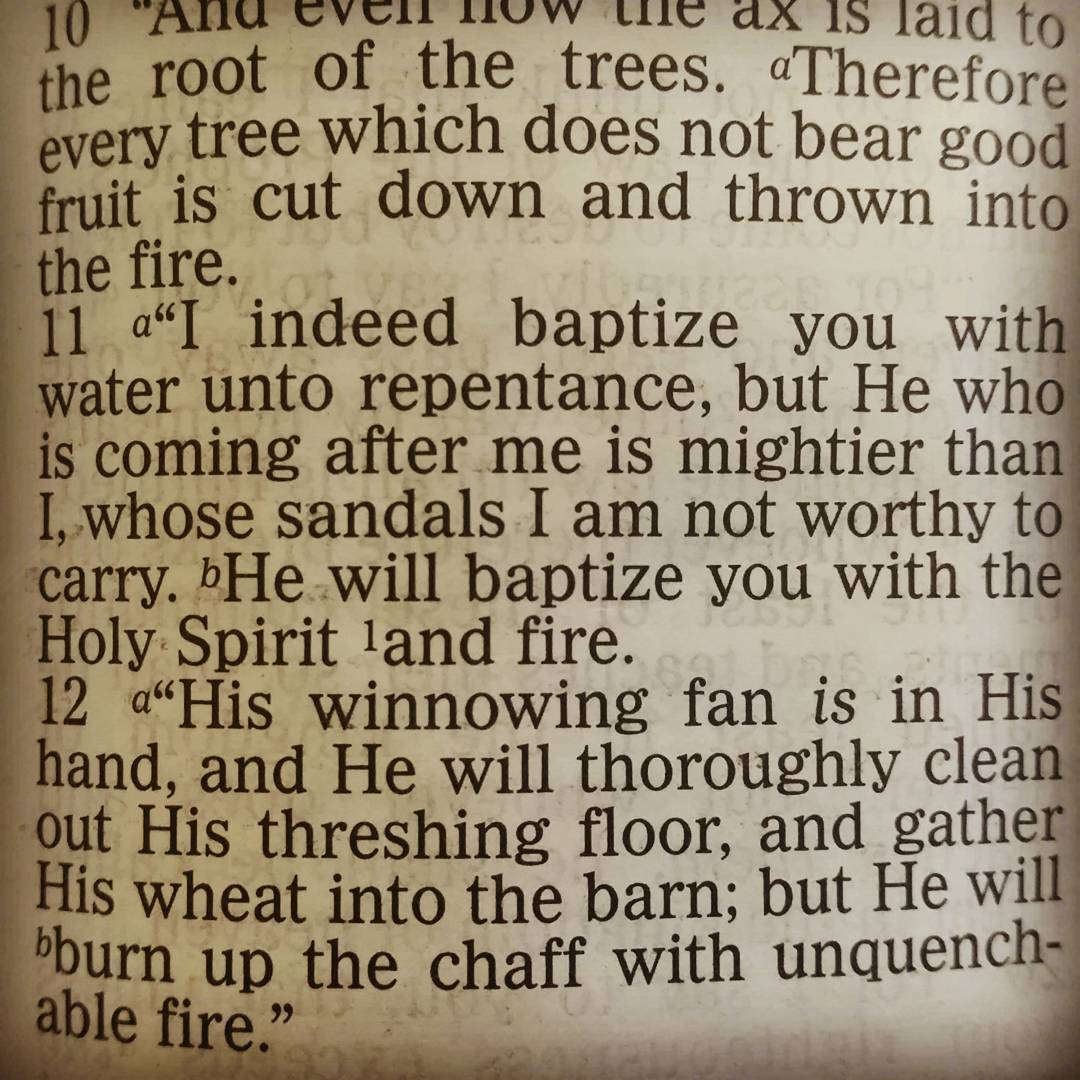
John the Baptist: Water and Fire

Introduction

This Sunday I will be preaching a sermon on John the Baptist, and I have got to say if John the Baptist was the greatest of those born of a woman (Luke 7:28), I have a lot to live up to. What’s more, the next thing Jesus says is that even the least in the Kingdom will be greater than John (very convicting). As I reflect on this, I think to myself, “I’ve baptised maybe 3 or 4 people in my life, preached a hand full of sermons and have hardly ever experienced or seen a person come into the Kingdom.” Not everything is that bad. I’ve seen incredible growth in people’s lives in the church that I minister in. Those baptisms I mentioned have happened this year, and our youth and young adults are starting to grasp concepts and parts of the Gospel that I have only just started to come to terms with myself. However, I think there are some great lessons to be learnt as we look at the (brief) ministry of John the Baptist (lessons that even I need to take into account).

First: John was Chosen

The first thing that stands out to me is that John was chosen by God. That might scare some people, however, not only does the angel Gabriel appear to John’s father Zacharias (Luke 1:11-20), but John’s coming, and ministry was foretold hundreds of years before he was born (Isaiah 40:3). I know that John was a particular case, but the New Testament says that we’ve been chosen in Him before even the creation of the world (Ephesians 1:4), and chosen for good works in Jesus Christ (Ephesians 2:10). So in this sense, we are all pretty special, and we all have a pretty important role to play in God’s plan. I think that the main point here is that we need to take the call on our lives seriously, just because we weren’t necessarily foretold, it doesn’t mean God didn’t have us in mind before the world was even created.

Second: John was Chosen to Prepare the Way

He said, “I am the voice of the one crying out in the wilderness, ‘Make straight the way of the Lord” (John 1:23, ESV). Another interesting element of John’s ministry was that he was chosen to prepare the way for the coming Messiah. John did this by baptising people (Matthew 3:5-6) and preaching a message of repentance and the immanence of the Kingdom of Heaven (Matthew 3:1-2).  Scripture doesn’t give us a lot to go off, but we know from Luke that all of this was wrapped up into the promise that John would “turn many of the children of Israel to the Lord their God” (Luke 1:16). This is a prominent call to Christians because the Church is called to do the same thing. For example, John preached a message of repentance and of the Kingdom, in the same way, we are to preach to the world that the only way in which a person can be saved from their sin is if they repent and believe in the Gospel (Acts 16:31; Romans 10:9) and that the Kingdom of God is near (Matthew 10:7; Luke 10:9).

Furthermore, John Baptised people who responded to his message immediately into the Jordan River. Likewise, Jesus commands us to baptise as this was a necessary part of the Great Commission (Matthew 28:16-20). However, why is baptism so important to both John, Jesus, and the early Church?

The Importance of Baptism

The act of Baptism is scattered all throughout the New Testament (Matthew 3:13-17; Mark 1:9-11; Acts 2:38; Acts 8:35-38; Acts 16:31-33). However, where we find the importance of baptism, and it’s meaning in Romans 6:1-14 (See also: Galatians 3:27; Colossians 2:11-14). The main thrust of Paul’s argument in this section of Scripture is that water baptism is a picture of a deeper spiritual reality that has happened to every believer. That is, we have all been baptised (immersed or united) into Jesus’ death (6:3), and resurrection (6:5), and as a result, sin no longer has the power to rule over the believer (6:14). Water baptism was important because it showed an unwavering act of commitment and trust that a person has been spiritually united with Christ by grace, through faith. Essentially, it meant that a person was born again and that they had become a new creation in Christ (2 Corinthians 5:17).

Third: Baptising and Preaching with Fire

Unfortunately though, one of the saddest things that I’ve seen in the Church (in my experience at least) is the under-appreciation and even neglect of baptism. These days we can wait months or even years before we baptise a professing Christian. This is usually because we want to wait until we are sure that they are serious about their commitment to Christ, or because we want to make sure they are “orthodox” before we dunk them in water. The saddest thing about this though is that this is just a product of the Gospel we preach. The Church preaches such a weak Gospel in the power of the flesh, and not in the power of the Spirit that we are afraid that people are really only giving Christianity “ago” because it’s new and fresh, not because they are fleeing the wrath to come or that they want to be reconciled to God. The early Church wasn’t like this. The early Church preached the Gospel that was the power of God unto salvation to whoever would believe (Romans 1:16). This was the same Gospel that, coupled with the power of the Holy Spirit, cut people to the heart and added thousands of people to the Church in one moment (Acts 3:37, 41). We’ve missed out on the relentless preaching of the Gospel and the immediate act of baptism that John held so dear. Leonard Ravenhill in his book Why Revival Tarries really gets to the heart of the matter when he says,

John the Baptist was in God’s School of Silence, the wilderness, until the day of his showing forth. Who was better fitted for the task of stirring a torpid nation from its sensual slumber than this sun-scorched, fire-baptised, desert-bred prophet-sent of God with a face like the judgement morning? In his eyes was the light of God, in his voice was the authority of God, and in his soul was the passion of God! Who, I ask, could be greater than John? Truly “he did no miracle,” that is, he never raised a dead man, but he did far more he raised a dead nation!

Likewise, who is better fitted for the task of stirring a dead world and even in many cases a dead Church then each one of you reading this blog? God has called every Christian to be filled with the Spirit (Ephesians 5:18) and preach the Gospel boldly. My point is this. Like John, preach the Gospel in its entirety, be filled with the Holy Spirit, and baptise people immediately upon their confession of faith because if the Gospel is preached in power, what have we to fear?

Conclusion

As we reflect on the calling that John the Baptist had on his life, we can start to be encouraged and pursue God, and His calling for the Church in the same manner. Let us consider God’s call on our lives, let us prepare the way for the second coming of our Lord with a fiery tongue that has been lit by the power of the Holy Spirit. Let us repent of our half measured Gospel, our measured half-life of faith, and walk in the Spirit so that we, like John, may stir the Church, and the world, into God’s Kingdom.

Glorifying God With Our New Year’s Resolutions

Introduction

It’s about this time of year, as Christmas slowly creeps upon us, with the New Year hand in hand, that we start to think about what the New Year will hold for us. This time of year we start making New Year’s resolutions which usually include working out more, eating right, reading a certain amount of books (tick), starting a new love life, getting promoted etc. etc. The problem, however, is that a lot of the resolutions we end up making are empty and end up not working out. I can’t even count how many times that I have promised to myself that I would work out better in the New Year, but instead, get caught up playing Halo or the new Fallout. For Christians, though, our resolutions can look a bit different. We can say to ourselves that we are going to pray more in the year to come or read the Bible more. These are great goals to set, don’t get me wrong. The problem, however, is that 9 out of 10 Christians (in my experience) that I’ve met fail to fulfil these resolutions as well. So maybe the question we should all be asking ourselves as the New Year approaches is, “as a Christian, what resolutions should I be setting for myself that I can actually fulfil so that God may be glorified?”

Glorifying God First

As I have mentioned in my blog on Identity and Idolatry: Part I, we were all created in the image and likeness of God (Gen 1:26-27). Furthermore, the reason why we were created was to reflect God’s image to the world so that He may be glorified and be made known to all of creation. If this is true (I will write on this in a separate blog), then as Christians we have to consider if the resolutions we want to make are set up so that they make God more known to the rest of the world.

John Piper has a lot of great stuff to say about glorifying God. However, one quote stands out to me where he says,

I asked, Why did God create the world? And I answered: God created this world for the praise of the glory of his grace displayed supremely in the death of Jesus. The problem is that at the heart of that answer is God’s self-promotion. God created the world for his own praise. For his own glory.

What Piper says is pretty profound. I think if we all gave serious consideration to what is being said, it would change the way we would do everything in our lives. God created everything (and ultimately us) so that His glory would be displayed to everyone and so that He would be praised. This means that when we make resolutions for the New Year, we need to ask the question, “does this display the glory of God, or is this self-serving?”

Making the Right Resolutions

If, as Christians, we want to make the resolutions for the New Year, we have to seriously consider a few essential things. First, we have to (like I have already mentioned) ask, “what will glorify God the most?” If we are mindful of glorifying God in every resolution we make, then it will be easier for us to decide which resolutions are worth pursuing and which ones aren’t.

Second, if we want to glorify God in our resolutions, then we must actually take seriously the call to reflect His greatness to all of creation. Unless we take seriously the call that God has on each Christians life to reveal His fame and glory to the world, every resolution (and everything we do for that matter), will ultimately fail and fall short of what God has intended for us. So take the time to read Scripture and pray to God so that the call to glorify God settles deep into your heart.

Lastly, we have to do whatever God is calling us to do without compromise. It is so easy to compromise on our resolutions. Many of us begin our New Year well, but a few months into our resolution, we start to neglect and compromise on what we originally set out to do. If we are serious about glorifying God in our resolutions, this can’t be an option. We have to see the resolutions that God has placed onto our hearts to its end, no matter how long this takes. This can only be done if we depend on God for everything, and if we walk by the Spirit (Galatians 5:16). Whatever your resolutions for the New Year may be, do it all to the glory of God without compromise and with a serious heart to reflect God to the entire world.

What Christmas Means to Me

Introduction

Christmas, what a wonderful time of the year. For half of the world, Christmas day is covered in snow, gingerbread houses, fireplaces, and eggnog. For the other half, Christmas day is all about the surf, the pool, ice-cold drinks, cold meats and trying to find the right balance of tan versus sunburn. Christmas means a lot of different things to a lot of different people. The one common thread at Christmas for the majority of the world are presents, Santa, and reindeer. For Christians, however, Christmas has a spiritual element to it.

It is pretty well known that Jesus’ birthday wasn’t on the 25th of December. However, Christians all around the world take the day to remember the birth of our Lord and Saviour. Christians think back to the day Jesus was born in a dirty old manger among animals, dirt and muck, and celebrate the beginning of what was to be the end of our problem with sin (John 3:16). For me, however, Christmas has not always been like this.

My Christmas’

I grew up in a non-Christian family. So Christmas for me was never about Jesus. Christmas was more about prawns and fresh seafood. It was about beer and cold drinks. It was about family and friends gathering around one another and having a good old time. Mostly, though, Christmas was about what presents I would be getting that year. Christmas was about me.

I have a lot of fond memories of Christmas. I remember getting really excited and waking up at 5 or 6 am ready to unwrap all the cool new toys that I had asked for that year. What I don’t remember is Jesus. I remember going to my Nanny’s house in New South Wales and spending time at the beach exploring the rocks and getting dunked by waves. What I don’t remember is Jesus. I remember the laughter and joy that our friends and family had when they came over and visited. What I don’t remember is Jesus.  I remember a lot of great things. Things that I will cherish for the rest of my life. What I don’t remember though is Jesus or anything about Him. It wasn’t until I became a Christian that the meaning of Christmas changed for me.

The Change

I think one of the biggest things I realised as I experienced my first few Christmas’ as a Christian was how much Jesus really was absent. I would turn the T.V on in the morning to find someone preaching on the Christmas story. Instead, I would discover cartoons or prosperity preachers. I became hyper-aware of how much God was not a part of Christmas in my family. This really surprised me (it probably shouldn’t have) because Christmas was meant to be all about Jesus, right? I guess so. What I’ve come to realise though is that Christmas is really a non-Christian holiday that Christians use to glorify God in the best way that they can. So it shouldn’t surprise us when we don’t find Jesus on many Christmas cards or on T.V. Why would there be? Christmas isn’t really Christian…

A New Meaning 

So then what does Christmas mean to me now? Well, Christmas means to me three main things. First, Christmas is a day of connection. Connecting to people, family and friends I never see for the rest of the year are vital for me because, for some of them, I am the only Christian influence that they might have that entire year. Second, Christmas is a day that the Gospel can be talked about almost freely without repercussions. Most people know who the “Jesus guy” is, now is the time to declare to them the depth and love of His grace so that they might enter into His kingdom. Lastly, it is a day in which I can bring glory to our Lord. For me, Christmas can be a day where God can be glorified in the gift-giving, food eating, and every other activity that I do. With these three things in mind, every Christmas day can be centred on the person and work of Christ. Christmas has taken on a new meaning.