The Language of Life

Abstract digital artwork of glowing sound waves transforming into rivers, trees, and stars against a dark cosmic background, symbolising words and speech as creation and life.

“Do not let any unwholesome talk come out of your mouths, but only what is helpful for building others up.”
Ephesians 4:29

Words are never just noise. They are breath given shape, soul exhaled. They move unseen but not unfelt, carrying weight like wind that bends trees or like fire that sets forests alight.

Too often we read Paul’s words here as if he were writing about manners. No swearing, no coarse language. Keep your speech tidy. But he is not warning about vocabulary. He is speaking about reality. Words carry power. They make or unmake. They can rot, corrode, and decay, or they can strengthen, shelter, and bring life.

The word Paul uses for “unwholesome” is sapros, the same word for rotten fruit. It is not simply impolite but decayed. Rotten speech infects, spreads mould, carries death within it. Words spoken in bitterness can poison a room. Sarcasm can chip away at the soul. Gossip can hollow out trust. This is what Paul warns against, not etiquette, but the slow rot of death.

In contrast, he says, let your words be for building. The tongue is a mortar or a hammer. With it, you can carve space for another to stand taller. With it, you can lay the foundations of belonging. With it, you can raise walls of shelter or tear them down. Each sentence is a brick laid either toward ruin or toward home.

We do ourselves a disservice when we shrink Paul’s words to mean “do not swear.” As if he were giving us a vocabulary list. The call is far more cosmic. Words are not about politeness. They are about creation.

Think of C. S. Lewis describing Aslan singing Narnia into being. The song itself carried trees into leaf, stars into burning, rivers into flowing. Or Tolkien’s Ilúvatar, who composed the great Music, and the world unfolded in its harmonies. These stories point us back to the truest one. The God of Genesis spoke light into being, called out the waters, named day and night, and breathed life into dust. Creation itself is worded into existence.

Poets know this better than most. They understand that words can open doors into the indescribable. A line of poetry can carry what paragraphs of prose cannot. A blessing spoken over the fire in a Celtic home was not ornament; it was survival and worship. To call down God’s presence over the most ordinary act was to stitch heaven and earth together with words.

When we speak blessings, we are not simply being kind. We are imaging the God in whose likeness we were made. Humanity was created to reflect him, to echo his ways into the world. He is the One who speaks light and light appears, who calls forth seas and stars, who breathes life into dust. His speech does not merely describe, it creates.

This is why rotten talk matters. Not because it is impolite, but because it denies who we are meant to be. And this is why blessing matters. Each time we speak hope, forgiveness, truth, or love, we mirror the God who spoke and it was so. Our tongues were made to echo his creative Word, to join him in bringing light out of darkness and life out of dust.

This echoes through Scripture. In Genesis, God speaks the world into being: “And God said, ‘Let there be light,’ and there was light” (Genesis 1:3). Proverbs tells us, “The tongue has the power of life and death” (Proverbs 18:21). James warns that “the tongue is a small part of the body, but it makes great boasts… Consider what a great forest is set on fire by a small spark” (James 3:5). He goes on to call it “a restless evil, full of deadly poison” (James 3:8). John’s gospel goes further still, saying, “In the beginning was the Word, and the Word was with God, and the Word was God… and the Word became flesh and dwelt among us” (John 1:1, 14). God does not just speak life into the world, he becomes the Word, dwelling within the world he called into being. If our speech is careless, it corrodes. If it is filled with grace, it participates in that same divine rhythm of creation and incarnation.

The mystics and saints knew this well. The Desert Fathers would spend days in silence, not because words were evil, but because words were heavy. They believed speech carried eternity in its syllables. St John of the Cross spoke of the need to keep words few, so that when they are spoken they carry the fragrance of heaven. The Celtic tradition spoke of blessing everything, lighting the fire, milking the cow, and closing the door at night. Words turned into prayers, words spoken as life poured over the ordinary. To speak was to join God in consecrating the world.

Think about the words that have most shaped your life. A teacher telling you that you had a gift. A friend who whispered, I am here. A parent who said, I love you. Perhaps, too, you carry words that wound, words that still echo years later. Both linger. Both shape the way you stand, the way you see yourself, the way you step into tomorrow.

This is why Paul urges us not to let rot fall from our mouths. To speak decay is to diminish the image of God in another. But to speak blessing is to water it, to call it forth, to give it space to bloom. When I say, you belong here, I am not merely transferring information. I am planting a seed of belonging. When I say, I forgive you, I am not just announcing a fact, I am opening a door to a new future. Words are sacramental. They are material things that carry invisible grace.

It matters in the ordinary. In how we speak to our children at the end of a long day. In how we address our partners in weariness or joy. In how we speak of others when they are not in the room. In how we comment online, in how we talk about people we disagree with, in how we handle the small irritations of life. Each moment carries a choice. Will I speak rot or life? Will my words corrode or build?

Think again of the power of a single phrase.
I forgive you.
You belong here.
You are not alone.
Peace be with you.

Each is more than air. Each is a doorway opening. Each is a world remade.

So may our mouths be more than noise. May our words become breath that lifts. May we learn the holy art of speaking life, until our speech itself becomes a kind of prayer.

The Ache of Beginnings: Reading Genesis 1–11 with Open Hands

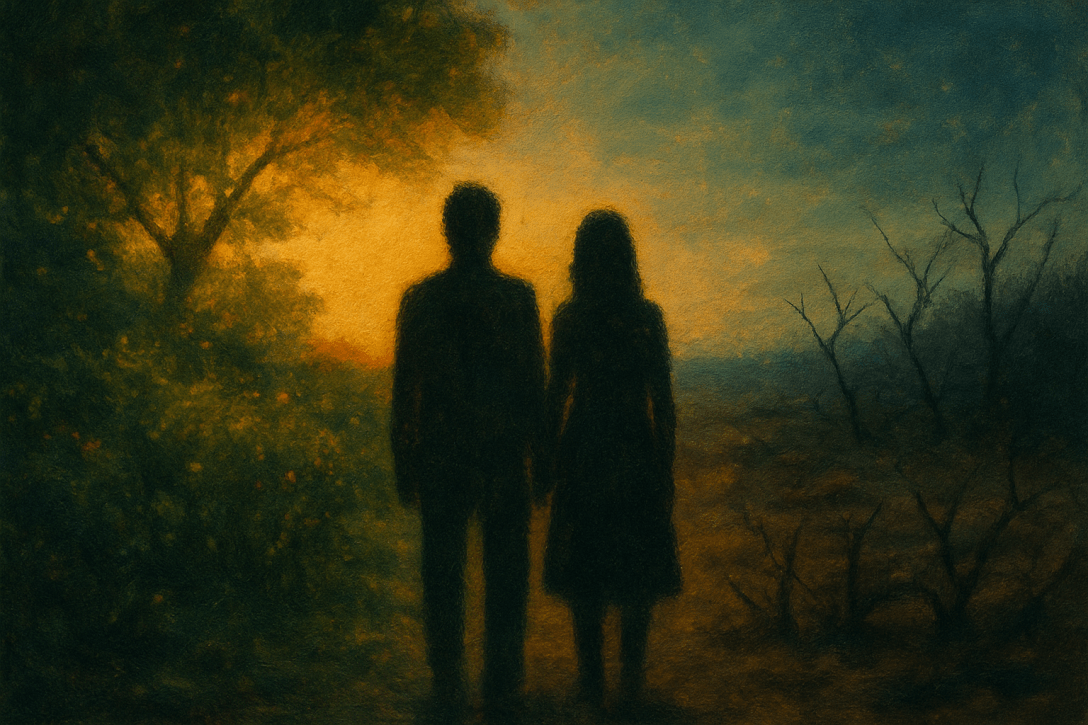
Two abstract silhouettes, male and female, stand together at twilight between a flourishing garden glowing with golden light and a barren wilderness of dry soil and thorns. The scene symbolises humanity east of Eden, caught between exile and communion with God.

Where did it all go wrong?

Genesis does not begin with a courtroom but with a garden. It does not give us a manual of origins but a story of longing, freedom, and fracture. These early chapters are less about when and more about why. They are not fossils of a world long gone but mirrors of our own. They speak of desire that bends, of Exile that begins, of God who keeps walking into the story anyway.

“In the beginning, God…” (Genesis 1:1). Before the ache, before the questions, there was only God. All that exists flows out of this life. Gregory of Nyssa said that only God truly has being in Himself, while all else exists only by participation. Creation is not necessary, but a gift. The beginning is not a moment in time but the eternal One whose presence holds everything in existence.

Wisdom desired, wisdom distorted

The tree was not poisonous. It was a possibility. Wisdom was always meant to be humanity’s inheritance, but in God’s time, not ours. In Genesis 3, the grasping of fruit is less about appetite and more about autonomy. To seize before its time is to make wisdom collapse into folly.

Paul would later write, “The wisdom of this world is foolishness with God” (1 Corinthians 3:19). The mystics often spoke of a wisdom that comes not by grasping but by surrender. True wisdom is received, not snatched. It ripens only in the soil of trust. To forget that all wisdom is participation in God is to fall back into Exile.

The question in the garden

When Adam and Eve hide, God does not thunder judgment first. He asks a question: “Where are you?” (Genesis 3:9). It is the first question God asks in Scripture, and it has never stopped echoing. It is less a demand for location than a call to self-awareness. Where are you? Not just in the garden, but in your soul, in your wandering, in your ache.

The desert fathers and mothers taught that prayer begins not with words but with awareness. To stand before God is to hear that question again and again. Where are you? The psalmist answers, “Where can I go from your Spirit? Where can I flee from your presence?” (Psalm 139:7). Even in hiding, God is near. Even in Exile, our being still participates in Him.

Shame, blame, and the covering of God

We cover ourselves with fig leaves, then point fingers to deflect the weight of our shame. The first man blames the first woman. The first woman blames the serpent. This is the rhythm of fallen humanity: hiding, deflecting, excusing. But even here, grace intrudes. God does not leave them naked. “The Lord God made garments of skin for Adam and his wife and clothed them” (Genesis 3:21).

The covering is both tender and terrible. Tender, because it restores dignity. Terrible, because it hints at the cost of covering. Life surrendered for life preserved. The cross is already flickering in the shadows of Eden. To be clothed by God is to be reminded that even when we try to cover ourselves in fear, our true being remains grounded in Him.

The curse and the serpent

The serpent is not annihilated but transformed. Dust becomes its food, enmity its destiny. The curse is not a spell but a new pattern of existence. Relationships fracture. Creation distorts. Struggle is woven into soil and womb alike.

Yet even here, hope is stitched in. “He will crush your head, and you will strike his heel” (Genesis 3:15). A wound will remain, but victory will come. The first gospel is spoken over the dust. The Eastern fathers often called this the “protoevangelium”, the first glimmer of redemption. Even in curse, God remains the source of being, and from Him redemption begins to unfold.

Exile and the ache of humanity

To be human is to be east of Eden. To till soil that resists. To live under a curse and yet still carry promise. Adam names Eve “mother of all living,” even as death has entered the story (Genesis 3:20). Exile is unavoidable, but so is God’s relentless pursuit.

And yet, to be truly human is more than east of Eden. It is to walk in the cool of the day with God. It is to flourish in the garden, unashamed, at peace with creation, with self, and with one another. Exile names our condition. Communion names our calling.

Julian of Norwich once wrote, “Our soul is made of God and in God it is grounded.” To be human is to ache for that grounding. We evolve, not merely biologically but spiritually, socially, and theologically. From garden to city, from scattering to gathering, from Babel’s confusion to Pentecost’s tongues of fire. Humanity is still in process, but its being remains anchored in the One who was there in the beginning.

The ache of new creation

Genesis 1 to 11 is not just about what went wrong but about what God will set right. These are the seed-stories, and they lean forward. From the waters of the flood to the scattering at Babel, creation keeps unravelling. And yet the Spirit hovers still, waiting to call forth a new beginning.

Paul names Jesus the “last Adam” (1 Corinthians 15:45), and John sees a new heaven and a new earth (Revelation 21:1). The garden at the beginning becomes the city at the end, the Tree of Life reappearing, its leaves “for the healing of the nations” (Revelation 22:2).

Gregory of Nyssa’s words echo here, too. Only God has being in Himself, and at the end, all creation will be drawn into that fullness. “In the beginning, God” will one day be heard again as “God all in all” (1 Corinthians 15:28). The end is a return to the beginning, to the One who called us into life.

We read these stories not as distant myths but as mirrors. They are the patterns we still live in: hiding, blaming, longing, wandering. But they are also the patterns of God: seeking, covering, promising, recreating.

Perhaps the most profound truth of Genesis 1 to 11 is not simply how the world began, but that God refuses to let the story end in Exile. The God who walks in the twilight of Eden still walks among us, still asks the old question, still whispers us toward new creation.

Running Between Worlds: A Poetic Retelling of Hebrews 11–12:2

Five shadowed figures walk along a narrow path through a golden field toward distant mountains, under a dark, moody sky.

I think of faith, and it feels like a pulse beneath the skin.
Not loud.
Not something you can point to.
Just the quiet certainty that what we hope for is already alive, even when the eyes see nothing.

This is how they lived, those who came before us.
They stepped forward into places they could not see.
They believed a voice that spoke before time began.
The world was called out of nothing, from what no hand could hold.

I remember Abel, whose blood still sings.
Enoch, who walked with God until the earth could no longer keep him.
Noah, hammering wood while the sky stayed clear.
Abraham, leaving the warmth of the known, set up tents in a land that was only his by promise.
Sarah, laughing at the thought, then held laughter itself in her arms.

The dying blesses the living.
The bound blessing the free.
The exiles blessed the land they had never touched.

Some saw seas open.
Some saw walls crumble.
Some silenced the mouths of lions.
Others felt the weight of chains, the teeth of the saw.
They wandered deserts, hid in caves, clothed in skins, strangers, the world was not worthy of.

And all of them died still looking forward,
eyes lit by a promise that waited for us too.

So here we are, surrounded by their presence,
their stories still breathing in the air around us.
We let go of what weighs us down.
We shake free from the sin that clings like a shadow.
We run, slow and steady, breath after breath,
our eyes on Jesus.

He is the one who began this faith.
He is the one who will bring it to completion.
For joy beyond the grave, He endured the cross.
He bore the shame and broke its hold.
And now He rests in light, at the right hand of God.

Faith and Mental Health, Part One: The Ache of Faith

A lone figure walks a winding path beneath a dark sky, passing a solitary tree, with distant hills fading into shadow.

See part II here

Faith isn’t always a song. Sometimes it’s silence. Sometimes it’s the weight in your chest or the prayer that doesn’t come out.

I wrote recently about how it can be hard to pray. That post came from the same place this one does: the collision of my faith, my own deconstruction, and my mental health. Depression and anxiety are not just private struggles for me. They press into the very practices I was taught to depend on: prayer, worship, and even reading Scripture.

When the Practices Don’t Come Easy

For a long time, I thought faith meant doing all the “Christian stuff” without faltering. Show up. Pray hard. Read daily. Worship freely. But when depression clouds over, prayer feels impossible. When anxiety tightens my chest, sitting still with Scripture feels unbearable.

Deconstruction only complicates it. The simple answers don’t work anymore. The sermons I once leaned on feel too neat. And so, I find myself in the strange space of still wanting God, believing, but struggling to do the very things that once marked faith.

Maybe that’s you, too. And perhaps you need to hear this: it is okay if faith feels hard. It is okay if you can’t pray like you used to. It is okay if your anxiety follows you into worship.

The Bible Doesn’t Hide This Struggle

Scripture gives us permission to feel this tension.

“Why are you downcast, O my soul? Why so disturbed within me?” (Psalm 42:5)

“You have taken from me friend and neighbour. Darkness is my closest friend.” (Psalm 88:18)

Job curses the day of his birth (Job 3:1–3).

Elijah collapses under a broom tree and prays, “I have had enough, Lord. Take my life.” (1 Kings 19:4).

Jeremiah laments bitterly: “Cursed be the day I was born.” (Jeremiah 20:14).

And Jesus himself says in the garden, “My soul is overwhelmed with sorrow to the point of death.” (Matthew 26:38).

If this is in the Bible, then you have permission to bring your sorrow too. You do not have to hide it or cover it with worship songs you can’t sing.

When Faith Becomes a Weapon

There is another layer to all this. It is not just the depression or the anxiety or the silence of God. It is the voices around you.

“If you prayed more, you wouldn’t feel this way.”

“If you just trusted God, the anxiety would go away.”

“Maybe you’re not as faithful as you think you are.”

I have heard those lines. Sometimes out loud. Sometimes in the quiet judgments that float in church air. They land heavily. Because if you are already depressed, those words do not lift you. They bury you. Suddenly, it is not just your mental health you are fighting; it is the shame that you have somehow failed God by being human.

This is spiritual gaslighting. It turns faith into a weapon. It tells you that God is measuring your serotonin levels and writing them down as proof of your devotion. That is not gospel. That is cruelty dressed up in religious language.

The Bible never says, “the faithful never falter.” What it does say is that “The Lord is close to the brokenhearted and saves those who are crushed in spirit.” (Psalm 34:18). What it does say is that Christ himself was “a man of sorrows, acquainted with grief.” (Isaiah 53:3).

So let me say it plainly. You are allowed to be a Christian with depression. You are allowed to follow Jesus while anxious. You are allowed to belong even if you never get “better.”

The Weight We Carry and the Silence of God

Depression changes how the brain works. Anxiety floods the body. Trauma plants itself deep in memory. None of this is weakness. But it makes faith practices like prayer, silence, and Scripture feel like mountains you do not have the energy to climb.

And when God seems silent on top of it, the weight doubles. Prayer feels like speaking into an empty room.

That silence is not new. Israel wandered in it for forty years (Deuteronomy 8:2). The exiles sat by Babylon’s rivers, asking how they could sing the songs of Zion in a strange land (Psalm 137:1–4). Four hundred years of silence stretched between Malachi and Matthew. And then Jesus himself cried from the cross: “My God, my God, why have you forsaken me?” (Mark 15:34, quoting Psalm 22:1).

The mystics dared to say this silence is not always absence. St John of the Cross called it the “dark night of the soul.” In that night, prayer feels empty, but God is nearer than ever, stripping away illusions and deepening love. Silence can feel like abandonment, yet it may be the place where God is holding us most closely.

So hear this: it is not a failure of faith to feel the weight of depression or to sit in silence where God feels far. You do not have to “fix yourself” before God will listen. You are allowed to come as you are, heavy, anxious, waiting in the quiet.

Not the End, Just the Beginning

This is not where the story resolves. It is just where it begins with honesty. Faith and mental health do not meet in quick fixes. They meet in ache. In saying the truth out loud.

If you are depressed, anxious, exhausted, or carrying grief, you are not less faithful. You are walking with Job in the ashes. With Elijah under the tree. With Jeremiah in the ruins. With Jesus in Gethsemane.

So take permission. You do not need to be a “better Christian” before you can come to God. You are already beloved. You are already enough.

Faith is not the absence of ache. Faith is bringing the ache to God, even when you are not sure God is listening.

God Who Walks in Twilight

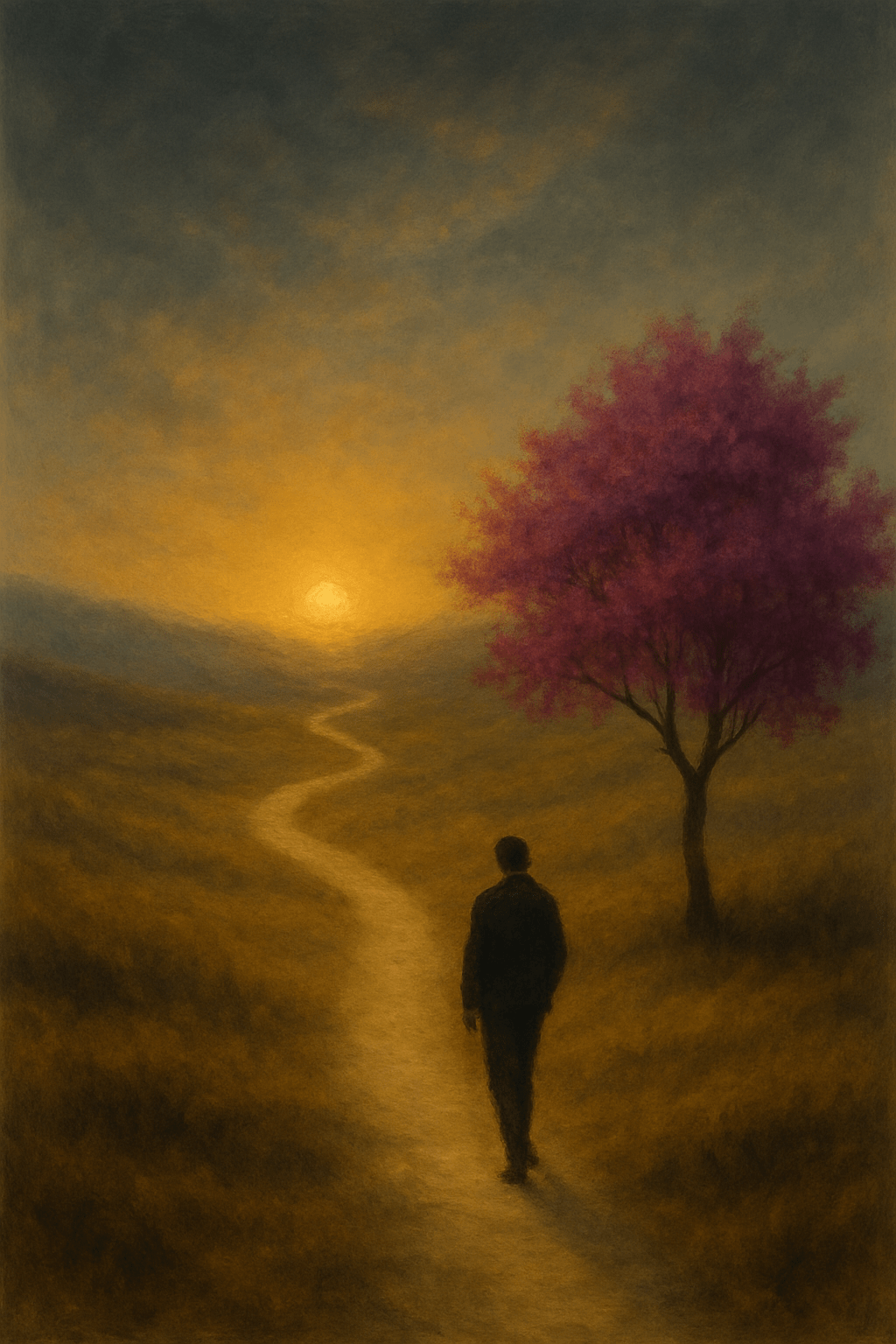
Twilight scene with a person walking on a winding path under a colourful evening sky, symbolising God walking in the cool of the day.

At the Wind of the Day

The first time we hear of God walking, it is not in a blaze of glory.
Not in the brightness of noon when everything is sharp and defined.
It is in the cool of the evening, Genesis says.
The Hebrew calls it l’ruach hayom, “at the wind of the day.”

That soft shift when the heat is letting go and the air changes,
when light seems to slip away almost without you noticing.
It is the time when the work has been done
but no one has yet gone to bed,
when the shadows pull long lines across the ground
and you feel that strange mix of ending and beginning at the same time.

From the start, God is not a voice far off in the heavens.
He is there in the dust, walking.
Unhurried.
Not pressing toward a task.
Just present in that in-between space.

And that time of day keeps turning up in the story, as if God likes it.
Abraham meets Him near the oaks of Mamre when the sun is leaning away.
Israel’s first Passover happens “between the evenings,”
with lamb’s blood on doorframes while the light is thinning.
In the Temple, the daily rhythm gives that same hour a place of its own
the evening sacrifice,
the smell of bread and incense
rising into the dimming sky.

Jesus keeps to the pattern.
On the road to Emmaus,
He meets two people when the day is almost spent.
He walks with them,
talks with them,
and sits at their table,
and in the breaking of bread,
as the darkness edges in from the fields,
they know Him.

It feels like twilight has always been His hour,
the place where He can hold light and dark together in one moment.

Maybe that is why most of life with God seems to happen in the in-between.
We live in the “already and not yet” of His kingdom.
Evening-souled people,
learning the slow pace of faith,
breathing out hope that has learned how to wait,
lingering in love that does not rush away.
He still comes walking when the air cools
and the day takes its last breath.


Creation to New Creation

That first walk in Eden ended badly,
with hiding and shame where welcome should have been.
But the story does not stay there.
At the end of Scripture, in the New Jerusalem,
there is no night at all, and the gates are never closed.
It is as if the first invitation to walk with Him is restored and made permanent.

The story that began with God searching for His image bearers in the evening breeze
ends with Him living among them,
no lamp needed,
because the Lamb Himself is their light.

For now, we live in the long dusk between creation and new creation.
But when the wind shifts,
when shadows stretch out over the ground,
when the air feels like it is holding its breath before the dark,
I think of Him.
I think of how He has not stopped walking.
And I hold onto the hope
that one day this twilight will give way,
not to night,
but to a dawn that never ends.