Small Oomphs

“Earth is so thick with divine possibility that it is a wonder we can walk anywhere without cracking our shins on altars.” – Barbara Brown Taylor


In many traditions, sacraments are the means by which God’s saving grace is poured out: baptism, communion, and Scripture. For some, they also include marriage, confession, ordination, and anointing the sick. These acts are official, sacred, and ritualised. They are meant to tether us to the divine.

But for many of us, church has lost its oomph.

We’re between churches, clinging by a thread, or slowly, quietly slipping out the side door, trying to find God, ourselves, and the world again. We’re not hostile; we’re just tired. Church has become a place of confusion—a lifeless Christianity where we feel like we’re always doing something wrong. We get into trouble when we go, and we get into trouble when we don’t.

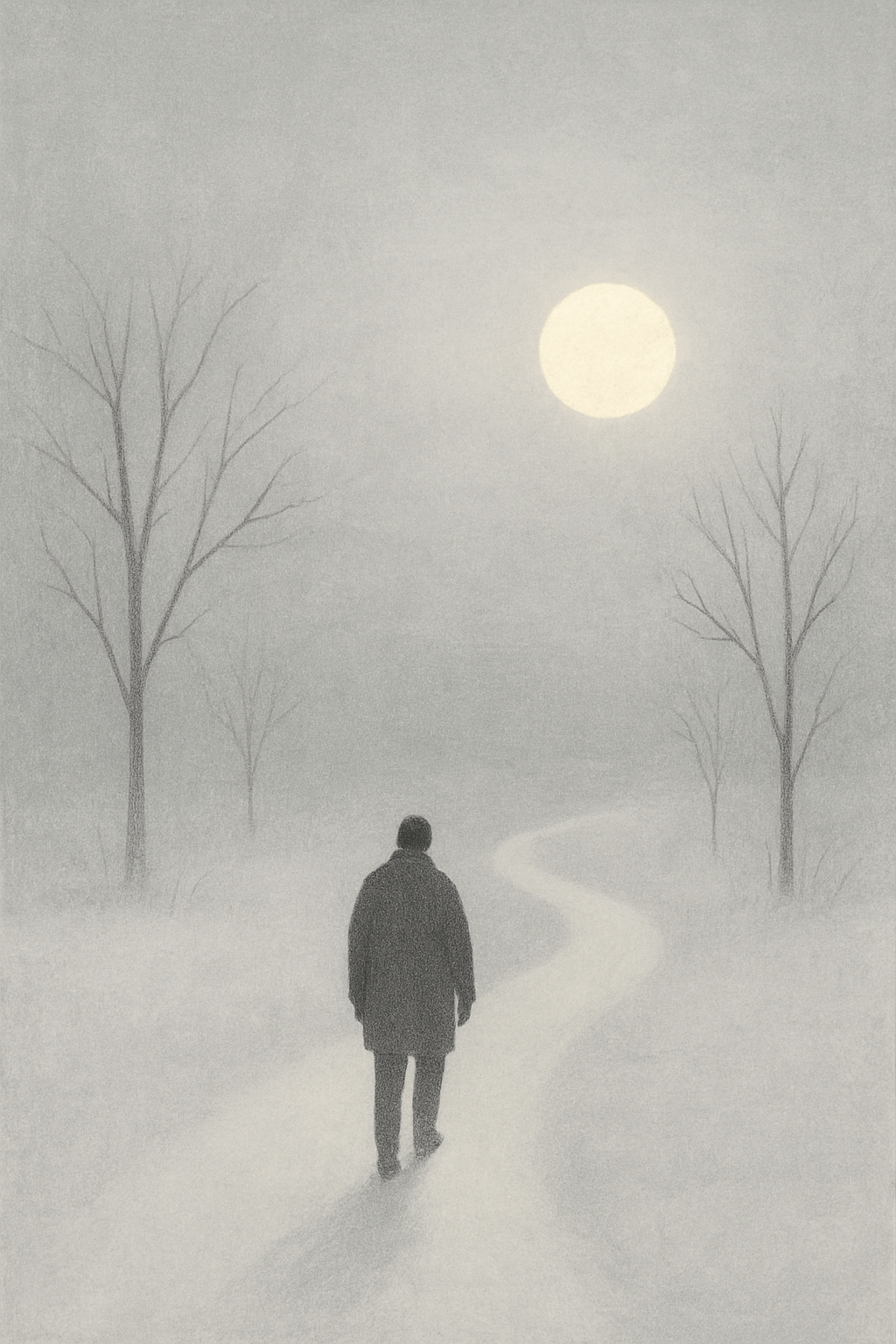
And so we drift. Or maybe… we walk.

I see you — not lost, but loosed,
from pew and creed, from tight-bound truths.
Your prayers now rise through silent skies,
no hymnal hand to harmonise.

You carry ash where fire once burned,
a sacred ache in lessons unlearned.
And still, you bless the broken road,
each doubt a stone, each step a psalm.

No steeple shadows where you stand,
yet grace still gathers in your hands.
You’re not alone in holy strife —
this, too, is part of a faithful life.


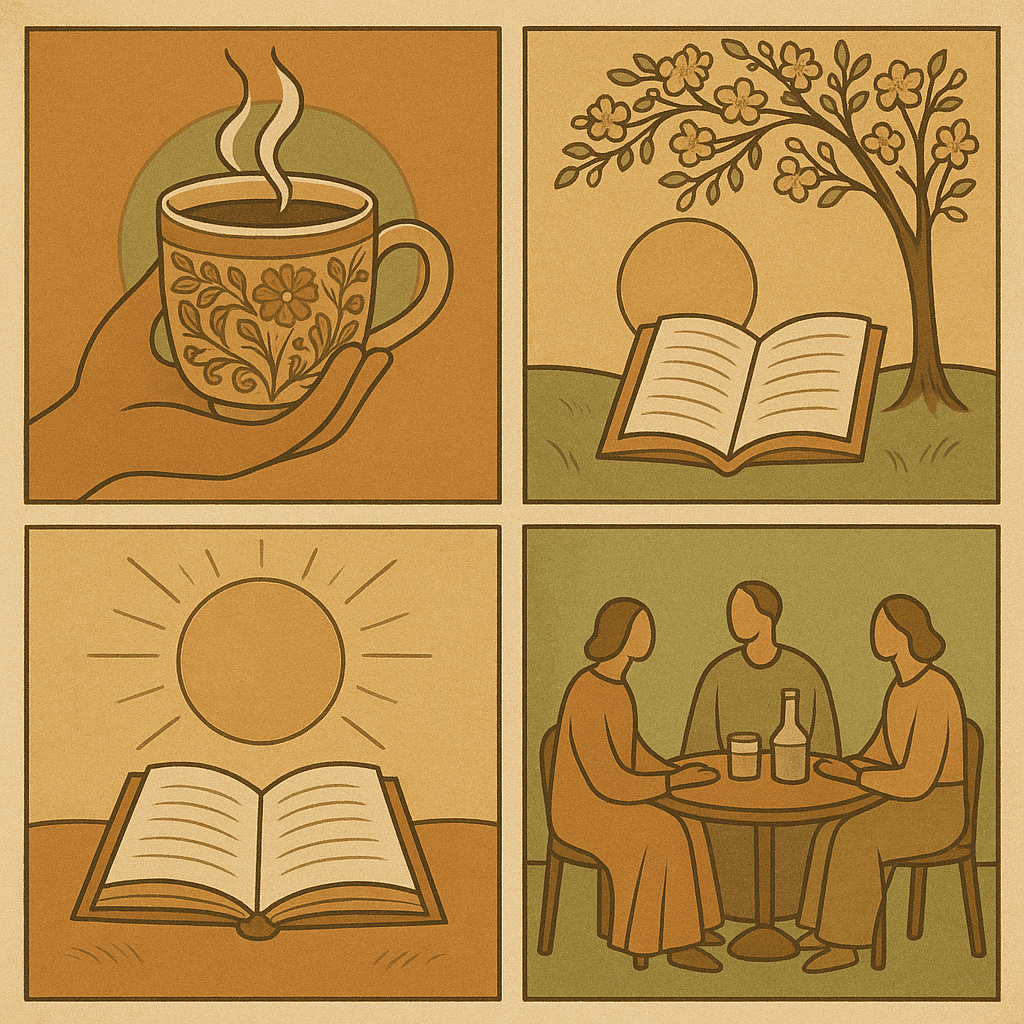
And yet, grace is not confined to altar rails or sanctuary walls. Sometimes, it greets us in the smallest of things — the steam rising from a morning coffee, the comfort of a well-worn novel, the warmth of soup shared on a cold day. These aren’t just distractions or creature comforts. They can be sacraments too, if we have eyes to see.

1 Corinthians 10:31 — “So whether you eat or drink or whatever you do, do it all for the glory of God.”

To make a cup of coffee with care, to read a story that stirs your soul, to laugh at the dinner table with someone you love — these are not lesser spiritual moments. They are the liturgies of the everyday, the sacred stitched into the ordinary. In these acts, God is not distant. He is here, humming quietly beneath the noise, waiting to be noticed.

Psalm 19:1–3“The heavens declare the glory of God… day after day they pour forth speech; night after night they reveal knowledge. They have no speech… yet their voice goes out into all the earth.

In these wandering years, it’s easy to feel the absence of God — to feel the numbness, the long ache. It might take years before you feel whole again, before you even consider walking into a church.

Maybe you never will.

But as you walk the broken road, remember—

“Taste and see that the Lord is good.” (Psalm 34:8)

Even here.
Even now.

In the small things.

The Long Night

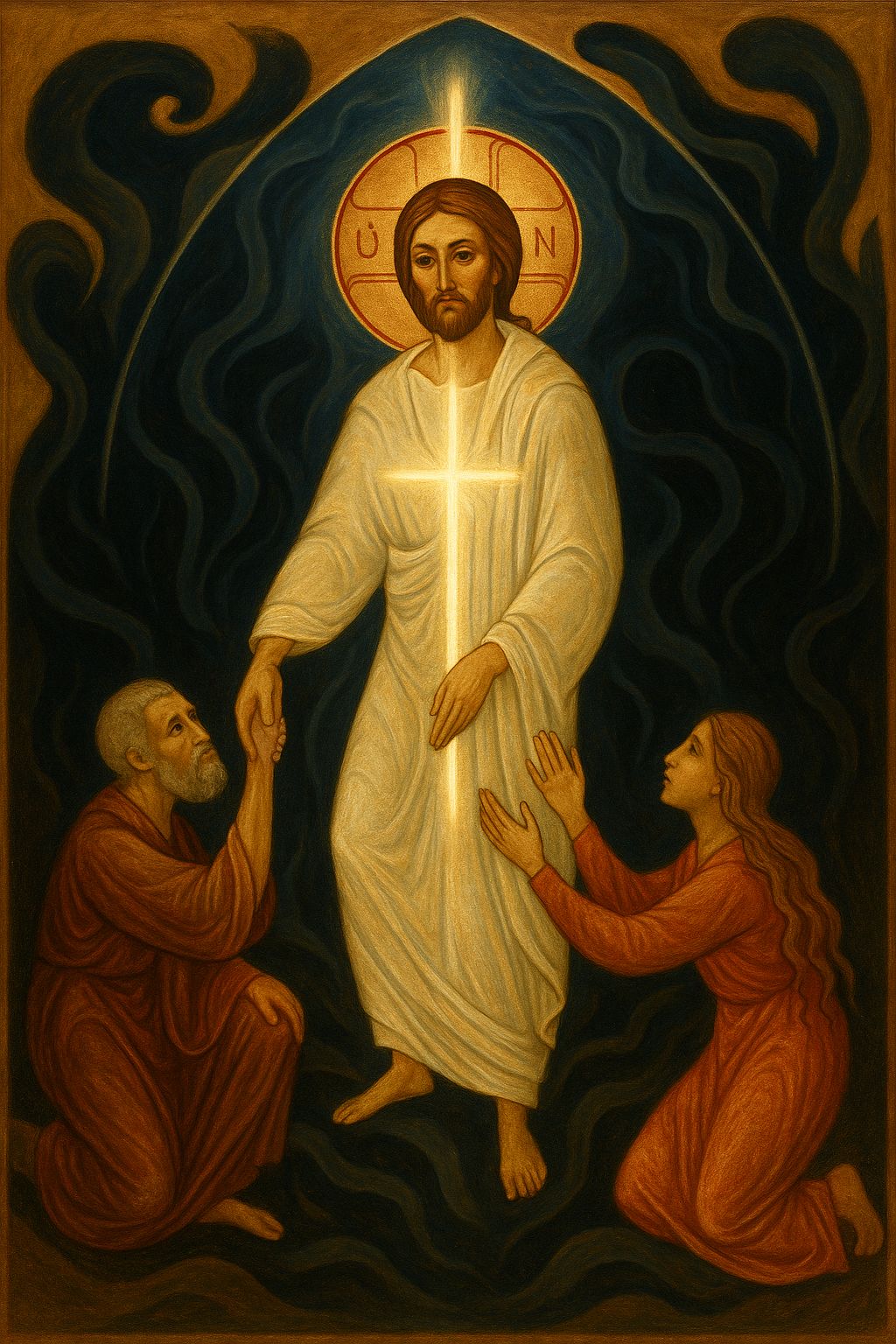
Sheol saw me and was shattered, and Death ejected me and many with me. I measured its depth and I was not held captive, for I became a light to those who were in its depths.”

– (Ode 42)

He walked the long night

where no prayers reach,

where silence is thicker than stone.

Sheol held its breath.

The tomb was not still—

it trembled.

He wore no armor

but the memory of light.

He sang no song

but still the gates cracked.

One by one

He called the names of the forgotten.

Dust stirred.

Chains rusted.

Even Death blinked and turned

its face away,

unable to hold Him

who had measured its depth

and found it shallow.

– (a poem I wrote inspired by Ode) The Long Night

Unbuilding

Do you believe in God? I used to answer quickly.

Now, I pause —

not out of rebellion, but reverence.

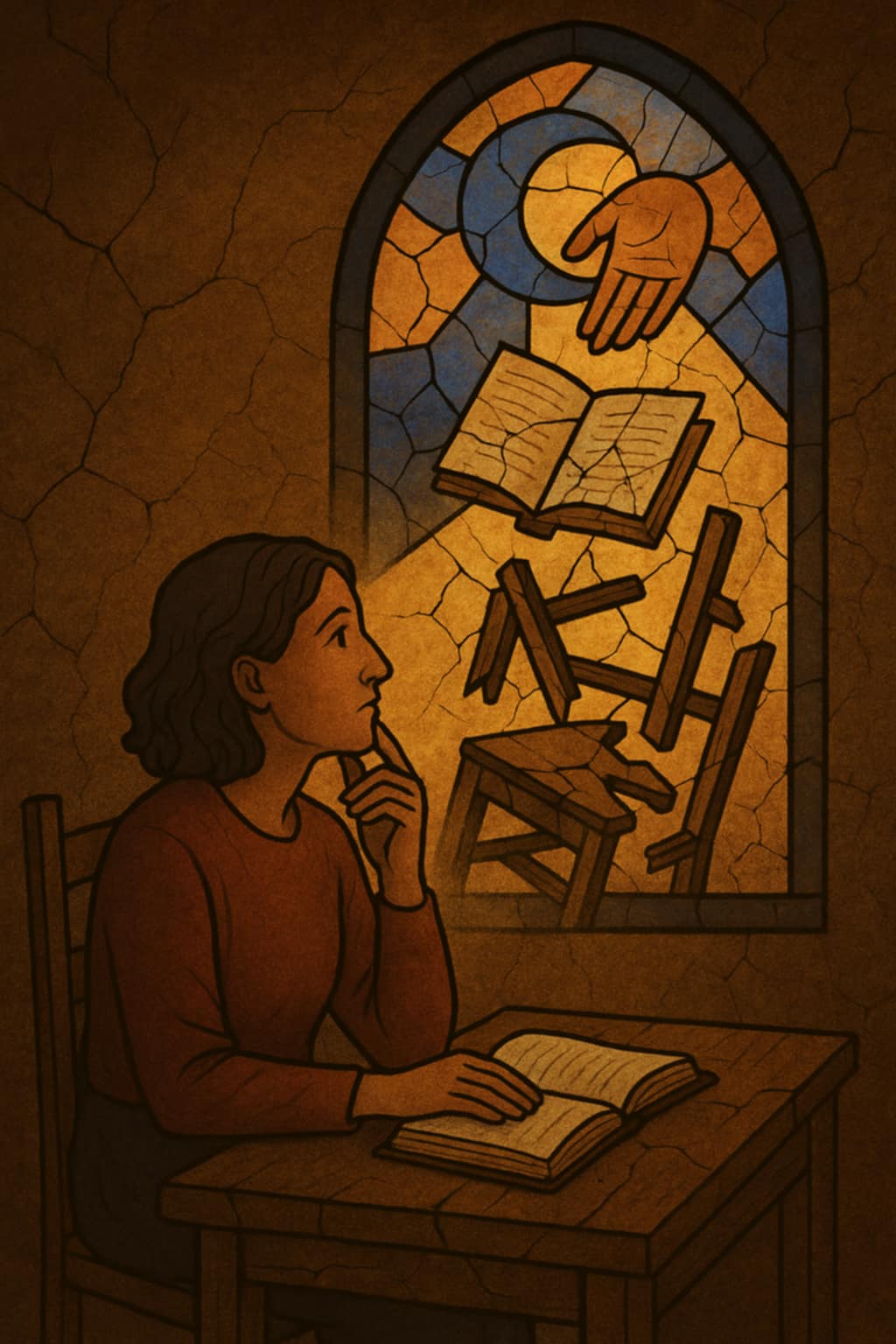
I dismantle doctrines like old furniture,

finding splinters of truth and tradition embedded in my hands.

The creeds I once recited now echo with questions, each word a doorway to deeper understanding or further doubt.

In the quiet morning, amidst the smell of roasted coffee, I find sacredness in the mundane, grace in the unspoken.

Scripture pages worn thin from searching, not for answers, but for the presence that lingers between lines.

I am both the builder and the ruins, the seeker and the found.

Do you believe in God? I still ask, not seeking certainty, but connection.

Every Church Needs a Nerdy Mystic

I once heard Tim Mackie from the Bible Project say that every (local) church needs a bible nerd. I couldn’t agree more. I’ve been a Christian for over a decade and around several churches. Usually, a church falls into one of two categories. They’re either highly focused on worship songs and emotionally connecting to God via the Spirit (both good things), or they’re so Scripture-focused (preaching and teaching the Bible) that Christianity becomes an intellectual ascent to a set of doctrines (again – doctrine is a great thing – I have a degree in it). The problem is that without the Scriptures shaping the local church, it becomes chaotic, messy, and unhinged. Without prayer, music, emotions, and practising the presence of God, the church becomes stale, another club to belong to, and lacks life. I will never go to another church that preaches well but never lingers in God’s presence. I will never go to a church that throws out the Book in favour of fever and emotionalism. Getting the balance right is, of course, challenging. We’re not perfect. But if I have to listen to another TED talk at church just because they have better music, I may as well stay home. If I have to endure another 1-2 hrs of dreariness to hear people take the teaching of Scripture seriously, I may as well listen to podcasts and throw on some Hillsong. Why can’t we have the best of both worlds? Why can’t we have excellent bible teaching (not just surface-level rubbish – meaty, juicy, heartfelt teaching of Scripture), great music, prayer, emotional responses, and God’s presence? Well, maybe every church needs a nerdy mystic (a scary word, I know).

A bible nerd mystic: noun – a person who froths and geeks out over Scripture while lingering in God’s presence and embracing the mystery and transcendence.

It seems that the Bible’s people had the best of both worlds:

Moses was a mystic and loved to teach. He performed miracles (Exodus 4:3-4, 6-7, 30; 7:14-25; 8-12; 14:21-31; 15:22-25; 17:1-13; Numbers 12:13-15; 16:44-50), he taught Torah (Exodus 18:20; 24:3-4; Deuteronomy 4:1-2; 5:1; 6:1-9; 31:9-13), and he frequently spends time in the presence of God (Exodus 3:1-6; 24:12-18; 33:7-11; 34:28).

Jesus was both a massive Bible nerd and a mystic (Jesus is God, so that’s kinda cheating). On the one hand, he went around healing people (Matthew 8:2-3, 5-13, 14-15; 9:20-22, 27-31; 12:9-13) and casting out demons (Luke 4:33-37, 41; 8:2, 26-39). We have Jesus going into the wilderness (Mattew 4:1-11) and into isolated places in nature to recalibrate and pray (Matthew 14:13, Mark 6:31-32, Luke 6:12, John 6:15), and even situations where Jesus hears the voice of God (Matthew 3:16-17; 17:5 John12:28-30). Yet, on the other hand, we have Jesus the rabbi clearly nerding out over Scripture and interpreting it (Matthew 4:4, 7, 10; 21:13; 22:37-40; Luke 4:18-19) and teaching people around him (Matthew 5-7; 13:1-9; Mark 1:21-22; 4:1-2; 6:34; Luke 5:3).

Paul had a list of similar experiences. He healed (Acts 14:8-10; 19:11-12; 20:9-12; 28:8-9) and cast out demons (Acts 16:16-18). He went into the wilderness to recalibrate his thinking (Galatians 1:17-18) and had mystical experiences and visions hearing God’s voice (Acts 9:3-6; 22:17-21; 23:11; 2 Corinthians 12:2-4). Yet Paul still taught the scriptures (Acts 17:2-3; 18:4-5; 19:8-10; 20:7-12) and thought they were important enough for others to continue teaching (2 Timothy 3:16-17).

We don’t need to trade one for the other. Our churches should be filled with a sense of both worlds. We can have the tangible expressions of God’s presence and the deep meat of teaching the Scriptures. One should only be happening with the other, yet they often don’t.

My Story I

“Almost everyone can agree that one of the big differences between us and our ancestors of five hundred years ago is that they lived in an ‘enchanted’ world, and we do not.”

Charles Taylor

If I had to distil my entire life into one thing, it would be the search for ‘magic.’ From an early age, I was fascinated by other and bigger things. I remember running around in the yard trying to dig up fossils, reading books about ancient Egypt, and going to the science centre for my birthday (all I wanted were Pokemon Cards). I loved reading books like Eragon, Harry Potter, and The Chronicles of Narnia. My favourite video games as a kid were anything with a sword or gun, but in particular, it was The Legend of Zelda: Ocarina of Time (OoT), released on November 21 1998, that I loved the most. I played the heck out of that thing. For those who don’t know, OoT is the first attempt at an open-world 3d game and is considered by many to be the greatest video game of all time, scoring almost a perfect score on every gaming website. In the game, you could trek into deep forests, climb high mountains, swim rivers and lakes, visit populated villages, and save princesses. But the most essential element in the game was that the world felt more alive, authentic, and meaningful than the one I lived in.


Now, you can chalk all this up to a young boy indulging in escapism, having a wild imagination, not yet matured. I get that. If that’s the case, I’ve never grown up. Maturity, for me, has been less about searching for the magic in the world and more about realising it was here all along. Western Culture (the Church has a massive role in this) has veritably done away with the world in the wardrobe, the sacred groves in the forests, the transcendent high places that strike awe in the beholder, and traded it in for formulas, fast food spirituality and living—a bland, tasteless existence. Can you hardly blame me then for chasing hedonism in place of ‘magic?’ The moment I was able to, I chased women, started clubbing, and partying in a desperate bid to experience the world afresh. However, much like the Preacher in Ecclesiastes, it was all meaningless. I needed more. I wanted more. I craved something more until, one day, I tasted a bit of that lost ‘magic.’


I would love to tell you that once I met Jesus, everything changed, life got better, and the drudgery of life washed away in a sea of awe and wonder. It didn’t. The decision to follow Jesus has been met with suffering and hardship: death, divorce, broken hearts, depression, and a lot of uncertainty and doubt. Christianity hasn’t made things clearer for me. What it has done, however, is rebuilt me through trials in a way life never would have in and of its own.


When I met Jesus, it was off the back of a failed relationship that had gone through an abortion. I was still interested in something other than life, but ultimately, the decision to try out Jesus was just another day and another choice. There was no voice from heaven, no beam of light, no stirring deep within my soul. I just decided that Jesus probably had some good things to say and was worth listening to. Since then, over the years, slowly but surely, Jesus has peeled back the layers of my disenchanted heart and shown me that what I was looking for was under my nose the entire time. Salvation for me has been a slow transformative process, not a single instant event. The Cross is less about (but not void of) any atonement theory and more about a pathway into the world unified unto God, the created world, and My Self. As I nerded out over theology, the bible, and spirituality, I realised every church and gathering could be a sacred grove. Every door opened could have a Narnia behind it. Every road travelled could be turned into a pilgrimage. I’ve been a Christian for over ten years, and I can say that God hasn’t finished turning this mess into a slightly less mess.

I look forward to where He’ll have me in another ten. For now I will leave you with this quote:

The Christian story of incarnation in the body of a boy- a boy whose ancestors were both famous and infamous – is one that can spur us towards living with the courage that is indigenous to us. To be human is to be in the image of something good, and image comes from imagination. To be human is to be in the imagination of God, and the imagination is the source of integrity as well as cracks. To be born is to be born into a story of possibility, a story of failure, a story of imagination and the failure of imagination. To be born is to be born with the possibility of courage. Hello to courage.

Pádraig Ó Tuama