
God Who Walks in Twilight

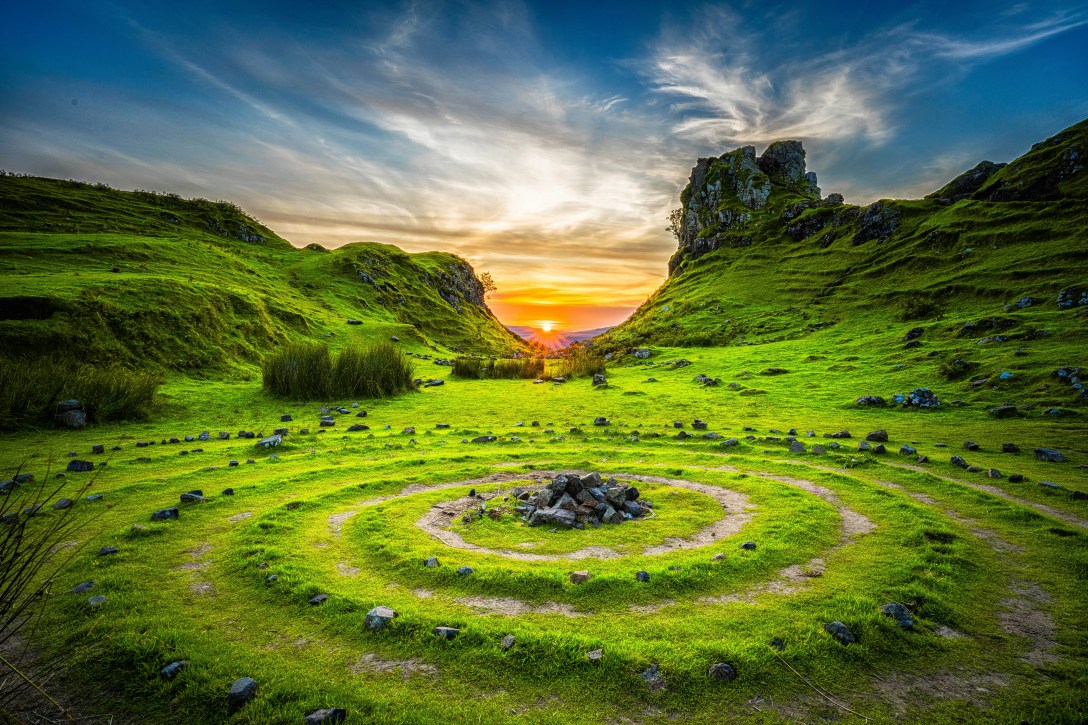
Twilight scene with a person walking on a winding path under a colourful evening sky, symbolising God walking in the cool of the day.

At the Wind of the Day

The first time we hear of God walking, it is not in a blaze of glory.
Not in the brightness of noon when everything is sharp and defined.
It is in the cool of the evening, Genesis says.
The Hebrew calls it l’ruach hayom, “at the wind of the day.”

That soft shift when the heat is letting go and the air changes,
when light seems to slip away almost without you noticing.
It is the time when the work has been done
but no one has yet gone to bed,
when the shadows pull long lines across the ground
and you feel that strange mix of ending and beginning at the same time.

From the start, God is not a voice far off in the heavens.
He is there in the dust, walking.
Unhurried.
Not pressing toward a task.
Just present in that in-between space.

And that time of day keeps turning up in the story, as if God likes it.
Abraham meets Him near the oaks of Mamre when the sun is leaning away.
Israel’s first Passover happens “between the evenings,”
with lamb’s blood on doorframes while the light is thinning.
In the Temple, the daily rhythm gives that same hour a place of its own
the evening sacrifice,
the smell of bread and incense
rising into the dimming sky.

Jesus keeps to the pattern.
On the road to Emmaus,
He meets two people when the day is almost spent.
He walks with them,
talks with them,
and sits at their table,
and in the breaking of bread,
as the darkness edges in from the fields,
they know Him.

It feels like twilight has always been His hour,
the place where He can hold light and dark together in one moment.

Maybe that is why most of life with God seems to happen in the in-between.
We live in the “already and not yet” of His kingdom.
Evening-souled people,
learning the slow pace of faith,
breathing out hope that has learned how to wait,
lingering in love that does not rush away.
He still comes walking when the air cools
and the day takes its last breath.


Creation to New Creation

That first walk in Eden ended badly,
with hiding and shame where welcome should have been.
But the story does not stay there.
At the end of Scripture, in the New Jerusalem,
there is no night at all, and the gates are never closed.
It is as if the first invitation to walk with Him is restored and made permanent.

The story that began with God searching for His image bearers in the evening breeze
ends with Him living among them,
no lamp needed,
because the Lamb Himself is their light.

For now, we live in the long dusk between creation and new creation.
But when the wind shifts,
when shadows stretch out over the ground,
when the air feels like it is holding its breath before the dark,
I think of Him.
I think of how He has not stopped walking.
And I hold onto the hope
that one day this twilight will give way,
not to night,
but to a dawn that never ends.

Not Drenched, But Drawn: Rethinking Baptism in the Spirit

“The Spirit himself bears witness with our spirit that we are children of God.”

—Romans 8:16

They told us to wait for the wind.

To pray until the fire fell.

To tarry until we were baptised again—

not in water, but in power.

And so we did.

We begged for signs.

For the sudden tongue,

the holy heat,

the trembling proof that God had come close.

But God had already come close.

The Language That Divides

The phrase “baptism in the Spirit” has become a boundary line—between the anointed and the merely saved, between the spiritually alive and the doctrinally dull. But Scripture speaks differently. It does not cast the Spirit as a second experience but as the seal of the first.

In 1 Corinthians 12:13, Paul writes:

“For in one Spirit we were all baptised into one body.”

Not some. Not a chosen few. All. The Spirit is not a delayed second act. He is the very breath we inhale at new birth. The theology of “Spirit baptism” as a dramatic post-conversion event, often used to signal deeper intimacy or greater power, too easily fractures the body of Christ. It creates a hierarchy of holiness, a performance of spirituality, an upper room without a cross. But Pentecost was never a formula. It was the fulfilment of an ancient promise—God with us, within us, among us.

The Spirit as Union, Not Upgrade

Jesus breathes on His disciples in John 20 and says, “Receive the Holy Spirit.”

No rushing wind.
No thunder.
Just breath.

No spectacle—only substance.
This is not emotional hype,
not a dopamine rush mistaken for doxology.
It is Genesis again: the Spirit hovering,
and then entering—God breathing into dust,
and dust waking to communion.

It is Ezekiel’s valley, bones strewn like broken hope,
and the Word, like a prophet’s cry, calling sinews and skin back to purpose—
but only breath makes them truly live.
Not machinery of religion. Not memory of tradition.
Only breathe.
Only Spirit.

This is no theatrical power (though it can sometimes happen, like in Acts 2).
No divine electricity waiting for a better switch.
The Spirit is not the upgrade to your faith.
He is its origin and its goal—
The bond that binds us into the Triune life.

To receive the Spirit is not to perform
but to participate.
To be drawn into the perichoresis—
that dance of Father, Son, and Spirit,
where love has no beginning and union knows no end.

The Spirit is not a badge you earn, not a second tier for the elite.

He is the down payment of our inheritance (Eph 1:13–14), the seal of our adoption (Rom 8:15), the whisper that dares call God Abba.

He is not the sensation of holiness,
But the substance of it.
Not proof of ecstasy,
but the presence of intimacy.

“He who is joined to the Lord becomes one spirit with Him.”
—1 Corinthians 6:17

This is the deepest baptism—
not of water, fire, or even tongues or trembling limbs.
But of union.
Of soul sealed to Spirit.
Of a humanity lifted into the life of God.

Participation in the Triune Life

To be filled with the Spirit is not to overflow with noise,

But to abide in silence, thick with love.

To be caught up in the life of the Trinity.

The early church spoke of theosis

that we become by grace what Christ is by nature.

“That you may become partakers of the divine nature.”

—2 Peter 1:4

Not a Second Baptism—A First Love

We are not waiting for the Spirit.

We are awakening to Him.

Not tarrying for power,

But turning to Presence.

The language of “Spirit baptism” has too often led us to look for a moment,

a manifestation,

a miracle.

But the Spirit is not a showman.

He is the Spirit of adoption.

He teaches us to cry, “Abba.”

To know God not in performance.

But in participation.

Not in a fire that consumes

But in flame that communes.

(A Reflection on) The Theology of Lingering

Dallas Willard once said, “hurry is the great enemy of the spiritual life in our day.” I remember years ago listening to a podcast by Rob Bell, who talked about how we’ve lost the ability just to be bored. John Mark Comer argues that we must ruthlessly eliminate hurry from our lives. Every generation says this, but life isn’t the same as it used to be. Our weeks are filled with to-do lists, meetings, and appointments. We work forty-hour weeks (if you’re lucky), we try to eat right and stay healthy, go home, look after the kids, clean the house, go to church, try to catch up with that friend for coffee or lunch, meet your spouses needs, listen to that podcast, read that blog (the irony is not lost on me), catch up with the latest social media news, video, tweet, or reel. We study, try to improve our skill set, and bring work home with us (because there is rarely enough time to do your job in a 9-5), which is what it means to be a functioning human being in 2024.

In the 90s and early 2000s, I felt like imagination was king. Boredom drove me to creativity. I couldn’t mindlessly flick through reels of videos, watch people playing Fortnight, or throw on a podcast (all things I love, by the way). Instead, a rock or a piece of clay became a fossil. The front trees and gardens became hideouts for me to store waterbombs and hide from the other kids on the street. I used to write my name in Egyptian hieroglyphics (not very well, mind you). I used to spend time with my mum. We talked—a lot. I remember my first-ever coffee (a mocha with whipped cream on top) and trips to Wet n’ Wild. I remember going to my Nannas house on holidays and playing cricket in the street with my Dad. Going to the beach or doing road trips always seemed convenient and easy. Nowadays, travelling more than half an hour gets the best of you. It takes work to keep focused and your attention on things that should be important to you. Unconsciously, I reach for my phone to see if I have a notification. Switching off when friends talk about something that doesn’t matter to you is so easy. It’s easy to go to church for an hour and a half a week, passively take in a sermon, half-heartedly sing a few songs and “hurry God” like He is a fast food worker and McDonald’s or something. Most of us don’t know how to slow down, rest, be bored, and linger.

In six days, God created the universe, and on the seventh, He rested, or to put it another way, he lingered, hung around, and delighted in what he had made (Genesis 1-2). The definition of lingering is to stay in a place longer than is expected or usual. It is unusual in our day and age to linger, to stay in one place and enjoy it without distraction or a “productive purpose.” When was the last time you sat, meandered, or rested while just taking in the world around you? Have you ever sighed a breath of relief and just lingered on what you have already accomplished (no matter how seemingly insignificant)? When have you last just plodded around in the messiness of your space and just delighted in your stage of life? I love that God rests. He didn’t need to. God doesn’t have a cap on His capacity. He wasn’t taking the day off because he was tired. He rested and lingered and delighted in his creation because (I believe) He brought him joy.

Fast forward in the story, and in the Exodus, we have Israel enslaved and forced to work every day. They were the peak of productivity. Their worth was weighed in the bricks they made and the work they did. Israelite identity became so entrenched in their slavery that even when they had been freed, they longed to return to it (Exodus 16:3). What I find funny is that the Jews wanted to go back into slavery even while having God’s tangible presence with them in the wilderness (Exodus 13:21). Even after they got into the promised land, established a kingdom and a temple with God dwelling among his chosen people, they still worshipped other gods. Israel forgot to dwell with God and linger in his presence. Though God wasn’t far from any of them, they never stopped and experienced his presence in any intimate and authentic way. I wonder how different history might have been had Adan and Eve lingered with God in the Garden, if the Jews lingered with God in the wilderness, or dwelt with him more intimately in the temple. How different might things have been if the disciples lingered with Jesus? Rather than expecting things from him, they were just with him. Maybe they would have seen Jesus as the messiah he was instead of what they expected him to be.

And this is the problem. We expect God to be something or someone he doesn’t want to be. Just like the Jews, we have theological categories (some of which are helpful) that impose expectations of God into history. God heals. Therefore, whenever I pray, he heals. Except he doesn’t. God is in control. Therefore, everything must work according to his will, except life is chaotic and challenging, and it rarely feels like God is in control. God is love. Yet he often feels distant. God is wrathful. Yet evil always seems to prevail. These categories came to me through books and podcasts, not God himself (though, of course, these are things God can use). These things are true, but I don’t always know it.

In Celtic spirituality, thresholds are seen as a line between one space and the next, one time and another. I’m not just talking about the threshold between your bedroom and the hallway; I’m talking about the thin places in our lives that God whispers and beckons us through so that we may linger, refreshed, transformed, and made new. We may need to stop and linger more often.

The Church of Eden

Some people, in order to discover God, read books. But there is a great book: the very appearance of created things. Look above you! Look below you! Note it. Read it. God, whom you want to discover, never wrote that book with ink. Instead, He set before your eyes the things that He had made. Can you ask for a louder voice than that?

Saint Augustine. The City of God, Book XVI

In my experience, Christianity and nature don’t go together. I think a lot of us Protestants are scared of making an idol out of cheese. Stepping out and getting any spiritual substance from nature feels like pagan worship. Nevertheless, for thousands of years, the Church and even the Old Testament Jews have had a rich tradition of finding God not only in the pages of sacred texts or within the walls of a temple or a church but in nature itself. For me, church on a Sunday can get boring. Nature doesn’t. At church, we have baptisms in a font. In nature, God baptises the world with ever-winding rivers, boundless oceans, and tranquil lakes. At church, we have choirs and bands that stir a crowd. In nature, God stirs the heart with the clap of the trees, the melody of the wind, and the euphony of the animals. At church, we preach from the Scriptures to teach, correct, and rebuke. In nature, God strikes the reader with awe as we pore over the stars. In church, we meet with God in sometimes clinical rituals, polished halls, and typically with masks on. In nature, we meet with God in untamed sacraments, wild establishments, and unmasked hearts.

I’m not a hippy. I don’t hug trees, and I’m not about to join PETA. I’m not even a good environmentalist. I love long showers, I’m often lazy with recycling, and I love a good steak. (and wings). There are days, weeks even where I’d rather spend my time playing video games, binging the Big Bang Theory, and scrolling through Facebook. I love rainy days, coffee, and sleeping in. As much as I know nature is a good place for me to be, it takes more effort than I’m proud to admit to get amongst. Nevertheless, when I’m forced to climb that mountain and see that view, or when I’m walking along the esplanade and I see the ocean stretched out before me, I’m always struck, even just a little, by how God takes up and dwells in more than the four walls of a church.

Elsewhere, I argue that our churches should be a slice of paradise. A taste of the newly created earth. A miniature Eden and a sacred space. I can’t remember the last time, if ever, where I felt awe-inspired, moved, and truly like I was treading hollowed ground in a church. Particularly within the Protestant tradition, we have demystified, disenchanted, and robbed our sacred spaces of their “magic.” We’ve traded awe and wonder for fog machines and light. We’ve sold profound unity and community and bought programs. We’ve replaced stories and myths with conversations about the weather and movies. We’ve exchanged God’s presence for “doing church.”

In the beginning, God created the world; it was wild and waste; there was darkness and chaos, but God’s Spirit hovered over the deep. Over six days, God moulded the world. He placed the stars, the sun, and the moon in the sky and gave them purpose. God divided the seas above from the waters below, filled them, and gave them purpose. He raised trees, shrubs, bushes, mountains, oceans, rivers, and streams from the earth and gave them purpose. God filled the world with birds, fish, and land animals and gave them purpose. He created humanity and gave them purpose. Finally, on the seventh day, God dwelled with what He had made, and there was purpose and goodness. This is how things are supposed to be in our local churches. Our local churches should feel like we’ve tasted a bit of heaven. Goodness, purpose, God’s presence, unity, flourishing, and life should all be markers of a healthy church. Yet I talk to people who experience emptiness, frustration, shallow relationships, trivial teachings, and superficial prayers every week. It seems that our churches are less Eden and more Tower of Babel.

The Biblical Prosperity Gospel

For I know the plans I have for you,” declares the Lord, “plans to prosper you and not to harm you, plans to give you hope and a future.

– Jeremiah 29:11

The prosperity Gospel has wormed its way into the folds of the church for decades. Where I live, on the Sunshine Coast, versions of it prevail among our many churches. Most churches I’ve been to wouldn’t say “trust in God, and you’ll be financially blessed” (though I have heard this on a few occasions). Instead, most churches default to preaching a prosperity, self-help, positive thinking hybrid message all tied up in the love of God and a love of self. I’m harsh, I know. It’s easy to sit here behind my laptop and bash on churches. Trust me, I know how I can come off. I just get frustrated with the shallow promises made by those in positions of influence over those desperately seeking substance and meaning. The Good News and good biblical preaching were never meant to offer cheap and easy answers to our challenging and complex lives. When I read the Bible, it meets us right at the crossroads of suffering and hardship. It never gives us one-liners to “speak into existence” or “manifest.” God never gives us meretricious promises to grasp on to. However, there is some truth to the hopeful expectation of prosperity and blessing. We find many such ideas in the Scriptures:

The first case of prosperity and human flourishing appears in Genesis 1, where God blesses humanity and tells them to be fruitful and multiply (Genesis 1:28). Though it is important to note that the blessing is one of posterity, not material gain per se. In Genesis 2, God gives humanity a garden with every kind of tree that is pleasing to the eye and good for food (Genesis 1:29-30; 2:8-9) as well as gold, resin and onyx in abundance and rivers giving life to the land around them (Genesis 2:10-14). Animals dwell in peace with Adam (Genesis 1:30-31; 2:19-20) as humans (Genesis 2:21-25), and creation and God are in harmony with one another (Genesis 2:1-2). All is well. However, in Genesis 3, we have humanity taking more than they’re supposed to (Genesis 3:6). Greed, selfishness, and the desire to be like God takes over (Genesis 3:5, 22). Humanity’s connection to one another (Genesis 3:7) and the Garden are severed as they’re exiled from the presence of God (Genesis 3:24).

From here, God sets up an entire story where He chooses a people to flourish and be blessed in Eden-like spaces so that God may freely dwell with His creation. Yet time and time again, these people fail at creating these spaces even as God promises them blessings, prosperity and abundance (Genesis 12:2; Deuteronomy 8:18; Jeremiah 29:11; Philippians 4:19). It’s important to understand that the promises of God, particularly when relating to the idea of wealth and prosperity, isn’t something New Testament Christians can necessarily expect to come true in the present age. God’s promises are yes and amen in Christ (2 Corinthians 1:20). God does bless people beyond what they deserve. God does want good things for His people. Yet the very essence of the mission of God was to come in the likeness of sinful flesh (Philippians 2), in the brokenness of humanity as one who was with the poor and outcast, without splendour (Isaiah 53) so that we might lay our burdens onto Him as we meet head on the suffering of life (Psalm 55:22; Matthew 11:29; 1 Peter 5:7). Indeed, we can do all things through Christ who strengthens us (Philippians 4:13), yet what Paul means is that we are to learn to be content in every situation where we lack (Philippians 4:10-12). No matter the problem, Christ is enough.

Finally, the abundant life God wanted for us in the Garden will be again experienced in the coming age, in the new heavens and earth. Humanity will once again flourish where death and sickness will be no more (Revelation 21:4). There will be no more thirst or hunger (Revelation 21:6), no more division between humanity (Galatians 3:8; Revelation 7:9-17), and rivers of life flow freely once more to give life to the land with the tree of life, providing fruit to heal all the people (Revelation 22:1-5). Once again, God can dwell with His people, and all is in harmony (Revelation 21:3).

This blog is by no means an exhaustive theological reflection on this issue. However, even a small and concise overview like this quickly demonstrates that prosperity and human flourishing happen in a way the widespread prosperity, self-help gospel has come to fail so many people. You do not give $77.77 to a televangelist to get doubly blessed. You do not sow a financial seed into a project hoping to get that house or car you’ve been wanting. The real prosperity Gospel is God promising that the sufferings in this life are nothing compared to the glory we should anticipate experiencing in the next. Those in positions of influence who take advantage of those who can barely afford to feed their own families, who take advantage of those who are sick, depressed and broken – these prosperity self-help preachers are the most reprehensible of people and deserve nothing more than to meet God face to face.