
When Christians Misunderstand the Gospel: Why “God Reigns” Is More Radical Than We Think

A lone silhouetted figure runs along a distant mountain ridge beneath a vast twilight sky of deep blue and violet. Golden light breaks at the horizon, symbolising heaven and earth meeting in the reign of God. The atmosphere is quiet, cosmic, and filled with hope.

What if the greatest misunderstanding in modern Christianity is not about morality or politics but about the gospel itself? What if the good news we share is smaller than the one Jesus announced?

We often describe the gospel as a private story about forgiveness, heaven and personal salvation. Yet in Scripture the gospel is something far larger. It is the announcement that God reigns. It is not only about the state of our souls but about the state of the world. It is a claim about reality itself, a declaration that creation has a rightful King.

And that claim changes everything.

The Gospel as Royal Proclamation

In Hebrew, the word for good news is besorah, a royal announcement of victory (Isaiah 52). In Greek, it is euangelion, the public declaration that a king has triumphed (Mark 1).

Imagine an ancient city under siege. The people wait behind their walls, anxious for word from the battlefield. Then a runner appears on the hills, covered in dust, shouting between breaths, “Good news! Victory! The king has won!”

That was euangelion. It was not advice or philosophy but the kind of announcement that makes the world different because it is true.

When Isaiah writes, “How beautiful on the mountains are the feet of those who bring good news, who say to Zion, ‘Your God reigns’” (Isaiah 52:7), he is describing that runner. The heart of the gospel is that Yahweh has returned to rule His world.

Centuries later, Jesus begins His ministry with the same royal declaration: “The time is fulfilled, and the Kingdom of God has come near. Repent and believe the good news” (Mark 1:15). He is not inventing a new religion but announcing that Israel’s long-awaited hope has arrived. God’s reign is breaking in.

The Kingdom Woven into Creation

The story of God’s Kingdom does not begin with Jesus. It begins in Genesis, where the rhythm of creation beats with divine rule (Genesis 1-2).

In the first three days, God shapes the realms of creation: light and darkness, sky and sea, land and vegetation. In the next three, He fills those realms with rulers: the sun and moon, the birds and fish, the animals and humanity.

The story is one of order and relationship. God reigns by creating and sharing. His rule is not control but care. Humanity, made in His image (Genesis 1:26-28), is invited to share that reign and to reflect His goodness, justice and creativity into the world.

To rule, in the biblical sense, is not to dominate. It is to cultivate. It is to join God in the work of making the world flourish.

The Kingdom of God is not a future dream. It is the structure of reality itself. Heaven and earth were made to live together (Genesis 2:15). Sin fractures that harmony, but the mission of God is to bring it back, to restore what was lost and heal what was broken.

Jesus: The King in Person

When Jesus announces the Kingdom, He is not speaking about a distant future or an inner feeling. He is proclaiming a change of reality. Where He walks, heaven and earth meet. The sick are healed, the outcasts restored, and the powers of darkness pushed back (Luke 4:18-9; Matthew 12:28).

At the cross, the world’s false rulers do their worst. Yet in that act of humiliation, the true King is enthroned (John 19:19). Through resurrection, His victory is declared not over Rome but over the powers that hold all creation captive: sin, death and decay (1 Corinthians 15:25-26).

Paul’s hymn in Colossians captures it perfectly:

“He is the image of the invisible God, the firstborn over all creation. In Him all things hold together. Through Him God was pleased to reconcile all things, whether on earth or in heaven” (Colossians 1:15-20).

This is not private spirituality. It is cosmic renewal. Christ holds the whole story together. In Him, the Creator’s original dream of heaven and earth united is set in motion again.

The People of the King

The early Christians understood this far better than we often do. They did not treat faith as an escape plan but as a new citizenship (Philippians 3:20). They believed that the Spirit who raised Jesus now lived within them, calling them to live as citizens of a new world (Romans 8:11).

Every act of love and hospitality, every work of justice or reconciliation, was an echo of the good news. It was a small proclamation that “our God reigns” (Isaiah 52:7).

The Kingdom is not confined to heaven or to church gatherings (though, as I argue elsewhere, the church should be a slice of the new creation). It is wherever the reign of Christ shapes hearts and habits, homes and communities (Matthew 5-7). It is wherever people reflect His character in the ordinary and the everyday.

N. T. Wright once said that the church does not bring the Kingdom by force; it embodies it by faithfulness. That is the invitation: to embody the reign of the King.

The Kingdom Completed: New Creation

The story of Scripture ends where it began, but expanded and fulfilled. A garden becomes a city. Heaven and earth are reunited.

John’s vision in Revelation captures it:

“I saw a new heaven and a new earth… and I heard a voice from the throne saying, ‘See, the home of God is among mortals’” (Revelation 21:1–3).

This is not an escape from the world, but rather its healing. The good news is not that we leave creation, but that God enters into it and restores it (Romans 8:19–21).

Every tear will be wiped away. Every injustice will be answered. The scars of the old world will become the beauty of the new (Revelation 21:4–5). The reign of God will fill everything.

Living Under His Reign

If the gospel is the announcement that God reigns, then discipleship is the art of living as if that reign were already true (Matthew 6:10). Repentance means realigning with reality, turning from our small empires to join the life of the King.

Faith is allegiance. It is trust that God’s rule is good and that life under His care is freedom, not bondage (John 8:36).

Every prayer, every meal, every act of mercy or courage is a way of saying again, “Your God reigns” (Isaiah 52:7).

The gospel is not good advice. It is good news.

And that news is this: heaven has begun to come down to earth. The reign of God is arriving quietly, patiently, beautifully, until all things are made new.
The Image of God Revisited: From Eden to New Creation

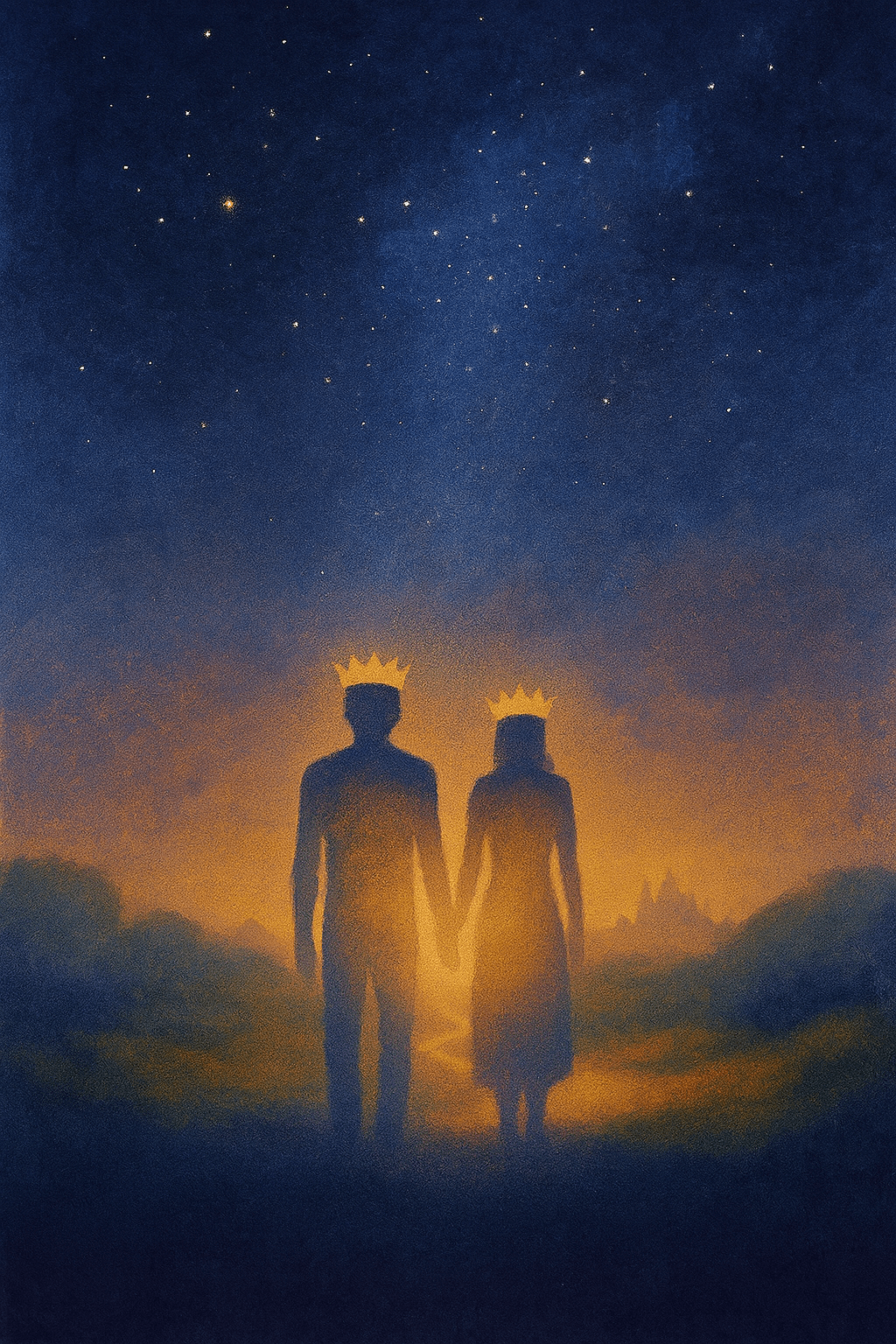
Abstract contemplative artwork of two glowing human silhouettes standing hand in hand under a vast starry night sky. Golden crowns rest on their heads, symbolising humanity’s royal vocation as the image of God. They are bathed in soft golden light, walking toward a distant radiant city on the horizon, with deep blues and purples blending into warm tones of dawn.”

The Bible begins with one of its most subversive claims: humanity is made in the “image of God” (Genesis 1:26–27). This phrase has sparked centuries of reflection. What does it mean to bear God’s image? Is it about dignity, rationality, creativity, or something even greater?

Humanity in the Image of God: Creation as a Cosmic Temple

Genesis 1 is not only a story of beginnings but a story of ordering. The repeated refrain “And God said… and it was so… and God saw that it was good” has the rhythm of a liturgy. Each day God separates, names, and fills, establishing order out of chaos (Genesis 1:2–10).

In the ancient Near Eastern world, temples were microcosms of the universe. They represented the ordered dwelling place of a deity within the chaotic world outside. At the heart of every temple stood an image of the god, placed there after the temple was “ordered” through ritual. This image signified the presence and rule of the god within that sacred space.

Genesis takes this familiar idea but reimagines it in a radically different way. The cosmos itself is God’s temple. The heavens are his canopy (Isaiah 40:22), the earth his footstool (Isaiah 66:1). The seven days of creation culminate in God’s “rest” (Genesis 2:2–3), which in temple language means not inactivity but taking up residence and beginning to reign. God has ordered his cosmic sanctuary, and now he rules from it.

The twist is the image placed within this temple. Unlike the lifeless idols of stone or wood, God’s image is living humanity (Genesis 1:26–28). Men and women are appointed as his representatives, reflecting his character and carrying out his rule in creation. In John Walton’s words, the world is God’s cosmic temple, and humanity is his living idol.

This means the vocation of the image-bearer is inseparable from worship. To be made in God’s image is to participate in the ordering of creation, to extend the boundaries of sacred space until all the earth becomes filled with the knowledge of the Lord (Habakkuk 2:14). Humanity’s task is temple work: to tend, to guard, and to expand the harmony of God’s presence.

Eden as the First Temple and Humanity’s Priestly Role

Genesis does not describe Eden in architectural terms, but later Scripture makes clear that the garden and the temple are deeply connected. The garden is the archetype of sacred space, and the temple is patterned after it.

In Eden, Adam and Eve are given the commission “to work it and keep it” (Genesis 2:15). These two Hebrew verbs abad (to serve) and shamar (to guard), reappear later in the Torah, not for farmers but for priests. The Levites are said “to serve and to guard” the tabernacle (Numbers 3:7–8; 8:25–26). Their task is not just maintenance but worship, guarding the holiness of God’s dwelling from intrusion and defilement. Adam and Eve, then, can be mapped onto the priesthood as its first representatives, called to minister in God’s sanctuary.

The parallels between Eden and Israel’s sanctuary reinforce this. Both are entered from the east (Genesis 3:24; Ezekiel 40:6). Both are filled with imagery of trees, cherubim, and rivers of life (Genesis 2:10–14; 1 Kings 6:29–35; Ezekiel 47:1–12). Gold and precious stones adorn Eden (Genesis 2:11–12), just as they decorate the temple (1 Kings 7:48–50). Even the menorah, with its branches and blossoms, recalls the tree of life at the garden’s centre.

Scholars have argued that the temple is a deliberate echo of Eden, a place where heaven and earth meet, where God’s presence dwells, and where humanity is invited to serve as a kind of priesthood. What Adam and Eve were in the garden, Israel’s priests became in the temple. And what Israel’s priests foreshadowed, the church is called to embody in Christ: a royal priesthood serving in the cosmic temple of the new creation (1 Peter 2:9; Revelation 21:22).

The Distortion of the Image of God Through Idolatry

When humanity abandoned its calling, the image of God became distorted. Instead of reflecting the living God into the world, human beings turned their gaze downward and outward to created things. Scripture calls this idolatry.

The psalmist captures the tragedy with cutting irony: “Their idols are silver and gold, made by human hands. They have mouths, but cannot speak, eyes, but cannot see. They have ears, but cannot hear, noses, but cannot smell… Those who make them will be like them, and so will all who trust in them” (Psalm 115:4–8).

We become what we worship. When we worship idols, we are shaped by their lifelessness. They cannot speak, and so their worshippers lose the voice of true praise. They cannot see, and so their worshippers lose spiritual sight. They cannot act, and so their worshippers lose vitality, becoming passive shadows of what God created them to be. The tragedy of idolatry is not only that we fail to worship God but that we are dehumanised in the process.

Paul makes this point in Romans 1. Refusing to glorify God, humanity “exchanged the glory of the immortal God for images made to look like a mortal human being and birds and animals and reptiles” (Romans 1:23). In turning from the Creator to creation, humans traded their vocation as living images of God for dead imitations of what they desired. Instead of becoming radiant icons of God’s glory, we turn into caricatures, mirrors of idols that can never give life.

This is why idolatry is not just a matter of bowing to statues or pagan gods. It is about misplaced devotion. Career, nation, wealth, pleasure, or even family can become idols when they take the place of God. And when they do, they shape us. A culture that worships money becomes consumed by greed. A society that worships power tends to become violent. A person who worships self becomes hollow. As the prophets warn, idolatry always diminishes. It silences, blinds, and hardens.

Idolatry is the anti-image. It reverses humanity’s vocation. Instead of being mirrors angled toward God and creation, as N. T. Wright puts it, we become mirrors angled in on ourselves. We reflect nothing beyond our own emptiness. This is why the Bible treats idolatry not as a minor sin but as the root distortion of what it means to be human.

Israel as a Kingdom of Priests and a Corporate Image of God

Israel was chosen to carry forward the vocation of Adam and Eve. At Sinai, God declared: “You shall be to me a kingdom of priests and a holy nation” (Exodus 19:6). Scholars stress that Israel was called corporately to bear God’s image by reflecting his character to the nations (Deuteronomy 4:6–8; Isaiah 42:6).

The tabernacle and temple were microcosms of Eden, places where God’s presence dwelt (Exodus 25:8–9; 1 Kings 8:10–11). Israel’s priests mirrored Adam’s task, serving and guarding holy space. Yet, like Adam, Israel fell into idolatry (2 Kings 17:7–18; Jeremiah 2:11–13).

Jesus Christ as the True Image of God

The New Testament announces that Jesus Christ is “the image of the invisible God” (Colossians 1:15). What Adam distorted and Israel failed to embody, Christ fulfils. He is the perfect image, “the radiance of God’s glory and the exact representation of his being” (Hebrews 1:3).

Where Adam reached for autonomy, Jesus humbled himself in obedience (Philippians 2:6–8). Where Israel was faithless, Jesus remained faithful. In Jesus, we see true humanity at last: the angled mirror restored. He reflects God into the world and lifts creation’s praises back to the Father.

At the cross, the curse of Adam was undone (Romans 5:17–19). The cross itself becomes a new “tree of life” (Revelation 2:7; 22:2), and from Christ flows the river of living water (John 7:37–39). In the resurrection, humanity’s vocation is renewed (1 Corinthians 15:20–22).

The Church as a New Creation and Royal Priesthood

Through union with Christ, the church is restored as the image-bearing community. Paul calls believers “a new creation” (2 Corinthians 5:17). Peter calls them “a chosen people, a royal priesthood, a holy nation” (1 Peter 2:9). This echoes both the Edenic and Sinai experiences.

Empowered by the Spirit (Acts 2:1–4), the church is called to extend God’s reign, to embody his presence in the world, and to reflect his character to the nations (Matthew 5:14–16). The church is not saved to escape the world but to anticipate the renewal of creation, partnering with God, bearing His image in Spirit-filled lives of holiness, justice, and worship.

Revelation and the Fulfilment of the Image of God

The final pages of Scripture reveal where the entire story has been leading. John’s vision in Revelation is not about escaping earth but about heaven and earth becoming one, creation renewed, restored, and filled with God’s presence.

He sees a new heaven and a new earth (Revelation 21:1). The holy city comes down, radiant and alive, like a bride prepared for her husband (Revelation 21:2). A voice from the throne declares what was always God’s intention: “Look, God’s dwelling place is now among the people, and he will dwell with them” (Revelation 21:3). What was glimpsed in Eden, God walking with humanity in the cool of the day, is now fulfilled on a cosmic scale.

John says there is no temple. “I did not see a temple in the city, because the Lord God Almighty and the Lamb are its temple” (Revelation 21:22). The temple has served its purpose as a signpost. Now the whole creation has become the sanctuary. God’s presence is not contained in any building but fills every space, and his people live fully as priests within it.

The imagery takes us straight back to Eden. A river of life flows from the throne, and on each side stands the tree of life, bearing fruit each month and bringing healing to the nations (Revelation 22:1–2). The garden sanctuary, lost through sin, is restored, expanded, and secured forever. The exile east of Eden is undone, and humanity is brought home.

And what of the image of God? It reaches its fulfilment here. “They will see his face, and his name will be on their foreheads” (Revelation 22:4). To bear God’s name is to bear his image perfectly, no longer fractured by sin, no longer bent toward idols, no longer half-lit by shadows. Humanity’s destiny is communion, not autonomy, participation in glory rather than deformation into lifelessness. “They will reign for ever and ever” (Revelation 22:5).

Here everything comes together. The cosmic temple finds its goal. The priesthood of Eden, the vocation of Israel, the faithfulness of Christ, and the Spirit-filled life of the church are all gathered up and perfected in the New Jerusalem. What was distorted by idolatry and restored in Christ is now complete.

To speak of the image of God is to speak of our future. We are not creatures fumbling for meaning in the dark. We are God’s living images, created to reflect his glory into creation and creation’s praise back to him. Revelation shows us that future fulfilled: humanity radiant with God’s presence, reigning with the Lamb, mirrors angled perfectly at last.

The Contemplative Gospel Part I: Creation, Fall, and Our Lost Communion with God

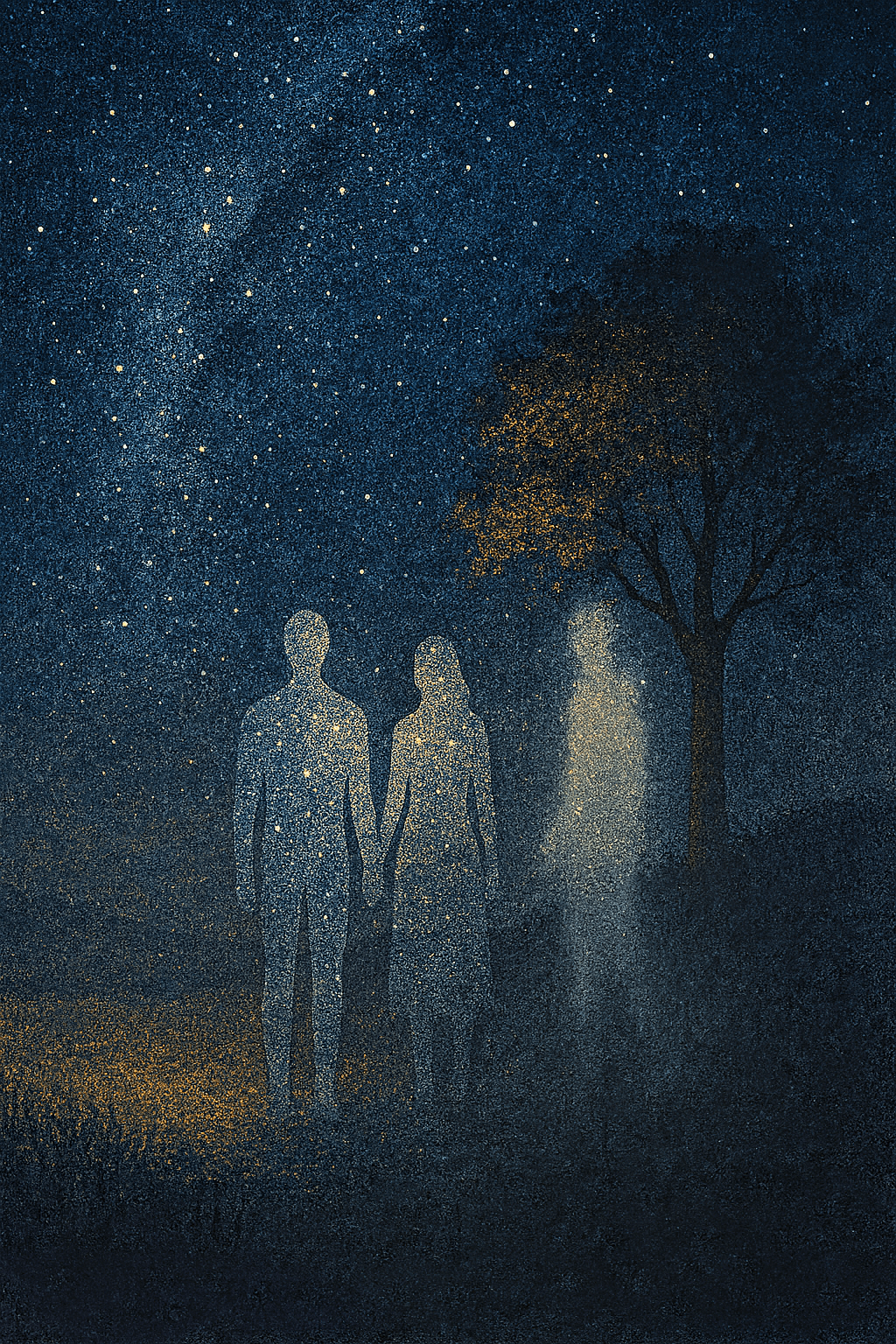
Abstract contemplative artwork of two glowing human silhouettes beneath a starry night sky, their bodies filled with starlight. Beside them stands a lone tree, half in shadow and half in light. Near the tree, a larger silhouette made of starlight represents God walking with them. The scene is cosmic, sacred, and symbolic, in deep blues, purples, and gold.

The Gospel Begins with Wonder, Not Sin

The gospel does not begin with sin. It begins with wonder.

“In the beginning, God created the heavens and the earth” (Genesis 1:1). From the first moment, creation was spoken into being within God’s own presence. Life emerged as song, at his call, not apart from him but held inside his life. Mountains rose and oceans gathered, their beauty already shimmering with his nearness.

And then God stooped low, pressing his breath into dust. Humanity came alive, not only because of lungs and blood, but because every heartbeat throbbed with the life of God. As Paul would later say, “In him we live and move and have our being” (Acts 17:28).

The world has never existed outside of God. We dwell in him, even as he dwells in us. Every breath you take is not just survival. It is communion.


Created to Share in the Divine Life

Let us make humankind in our image, according to our likeness” (Genesis 1:26). From the beginning, we were not just creatures surviving on borrowed breath. We were made as mirrors of the divine, meant to shine with another’s glory.

The apostle Peter writes, “we were made to be partakers of the divine nature” (2 Peter 1:4). Creation is not simply about survival or usefulness. It is about communion. It is about living our lives inside the very life of God.

Irenaeus of Lyons once said, “The glory of God is a human being fully alive, and the life of the human consists in beholding God.” That is creation’s secret. We were meant to live every breath as communion, every heartbeat as sacrament. The mystics remind us again and again that the world is charged with God. Meister Eckhart could say that every creature is “a word of God and a book about God.” Before sermons, before catechisms, creation itself was already preaching. “The heavens declare the glory of God” (Psalm 19:1).

What would it look like to see creation, the tree outside your window, the face across the table, as a word of God spoken to you?


The Fracture of the Fall

But then the story bends.

The serpent’s whisper is subtle. “You will be like God” (Genesis 3:5). The tragedy is that likeness to God was already our inheritance. What could have been received through communion, we tried to seize through grasping. What was meant to be given in love, we reached for in desire.

And in the reaching, something broke. Their eyes opened, but not to glory. Only to shame (Genesis 3:7). Hearts that once lived open to God turned inward and hid from the Presence that still walked in the garden (Genesis 3:8). Communion became exile.


Sin as Broken Communion and Blindness

For the mystic, sin is not simply breaking rules. It is breaking communion. Augustine captures it in his Confessions: “You have made us for Yourself, O Lord, and our hearts are restless until they rest in You.” Restlessness is the echo of what we lost. It is the ache of a heart turned from the fountain of life, thirsting for water while standing beside the spring. Jeremiah gave it his own words: “My people have forsaken me, the spring of living water, and dug their own cisterns, broken cisterns that cannot hold water” (Jeremiah 2:13).

Gregory of Nyssa, the great contemplative, saw humanity as created for an endless ascent into God. Our destiny was always to go deeper into beauty without end. But in the fall, our gaze turned from the Infinite to ourselves. We lost our horizon. We curved inwards. The soul that was meant to climb into God instead closed in on itself.

This is why the mystics often speak of sin as blindness. John of the Cross wrote of the dark night, when the soul cannot perceive the light even though it surrounds her. That is Eden’s exile. The Presence never left. The light still shines in the darkness, but our eyes have forgotten how to see it (John 1:5).


God’s Presence Remains After the Fall

And yet, even here, grace remains.

God does not abandon Adam and Eve to their shame. He clothes them with garments (Genesis 3:21). He keeps walking, keeps calling: “Where are you?” (Genesis 3:9). This is not the cry of a detective chasing criminals. It is the voice of a lover searching for his beloved. Even in exile, God follows. Even in our turning, he does not turn.

Julian of Norwich, reflecting on human sin, once heard Christ speak these words to her: “Sin is behovely, but all shall be well, and all shall be well, and all manner of thing shall be well.” For her, sin was not the end. It was the place where mercy would be revealed.

We are dust, but dust still held by God’s breath. We are exiles, but never outside his gaze. The wound is real, but so is the promise. The God who made us to share in his own life will not rest until we do.


A Contemplative Practice

Take a few minutes today to sit quietly. Place your hand on your chest. Feel your breath rise and fall. With each inhale, pray: “In You I live.” With each exhale, pray: “In You I rest.”

As you breathe, remember that the first breath you ever received was God’s. Even in exile, his life still holds you.

The Language of Life

Abstract digital artwork of glowing sound waves transforming into rivers, trees, and stars against a dark cosmic background, symbolising words and speech as creation and life.

“Do not let any unwholesome talk come out of your mouths, but only what is helpful for building others up.”
Ephesians 4:29

Words are never just noise. They are breath given shape, soul exhaled. They move unseen but not unfelt, carrying weight like wind that bends trees or like fire that sets forests alight.

Too often we read Paul’s words here as if he were writing about manners. No swearing, no coarse language. Keep your speech tidy. But he is not warning about vocabulary. He is speaking about reality. Words carry power. They make or unmake. They can rot, corrode, and decay, or they can strengthen, shelter, and bring life.

The word Paul uses for “unwholesome” is sapros, the same word for rotten fruit. It is not simply impolite but decayed. Rotten speech infects, spreads mould, carries death within it. Words spoken in bitterness can poison a room. Sarcasm can chip away at the soul. Gossip can hollow out trust. This is what Paul warns against, not etiquette, but the slow rot of death.

In contrast, he says, let your words be for building. The tongue is a mortar or a hammer. With it, you can carve space for another to stand taller. With it, you can lay the foundations of belonging. With it, you can raise walls of shelter or tear them down. Each sentence is a brick laid either toward ruin or toward home.

We do ourselves a disservice when we shrink Paul’s words to mean “do not swear.” As if he were giving us a vocabulary list. The call is far more cosmic. Words are not about politeness. They are about creation.

Think of C. S. Lewis describing Aslan singing Narnia into being. The song itself carried trees into leaf, stars into burning, rivers into flowing. Or Tolkien’s Ilúvatar, who composed the great Music, and the world unfolded in its harmonies. These stories point us back to the truest one. The God of Genesis spoke light into being, called out the waters, named day and night, and breathed life into dust. Creation itself is worded into existence.

Poets know this better than most. They understand that words can open doors into the indescribable. A line of poetry can carry what paragraphs of prose cannot. A blessing spoken over the fire in a Celtic home was not ornament; it was survival and worship. To call down God’s presence over the most ordinary act was to stitch heaven and earth together with words.

When we speak blessings, we are not simply being kind. We are imaging the God in whose likeness we were made. Humanity was created to reflect him, to echo his ways into the world. He is the One who speaks light and light appears, who calls forth seas and stars, who breathes life into dust. His speech does not merely describe, it creates.

This is why rotten talk matters. Not because it is impolite, but because it denies who we are meant to be. And this is why blessing matters. Each time we speak hope, forgiveness, truth, or love, we mirror the God who spoke and it was so. Our tongues were made to echo his creative Word, to join him in bringing light out of darkness and life out of dust.

This echoes through Scripture. In Genesis, God speaks the world into being: “And God said, ‘Let there be light,’ and there was light” (Genesis 1:3). Proverbs tells us, “The tongue has the power of life and death” (Proverbs 18:21). James warns that “the tongue is a small part of the body, but it makes great boasts… Consider what a great forest is set on fire by a small spark” (James 3:5). He goes on to call it “a restless evil, full of deadly poison” (James 3:8). John’s gospel goes further still, saying, “In the beginning was the Word, and the Word was with God, and the Word was God… and the Word became flesh and dwelt among us” (John 1:1, 14). God does not just speak life into the world, he becomes the Word, dwelling within the world he called into being. If our speech is careless, it corrodes. If it is filled with grace, it participates in that same divine rhythm of creation and incarnation.

The mystics and saints knew this well. The Desert Fathers would spend days in silence, not because words were evil, but because words were heavy. They believed speech carried eternity in its syllables. St John of the Cross spoke of the need to keep words few, so that when they are spoken they carry the fragrance of heaven. The Celtic tradition spoke of blessing everything, lighting the fire, milking the cow, and closing the door at night. Words turned into prayers, words spoken as life poured over the ordinary. To speak was to join God in consecrating the world.

Think about the words that have most shaped your life. A teacher telling you that you had a gift. A friend who whispered, I am here. A parent who said, I love you. Perhaps, too, you carry words that wound, words that still echo years later. Both linger. Both shape the way you stand, the way you see yourself, the way you step into tomorrow.

This is why Paul urges us not to let rot fall from our mouths. To speak decay is to diminish the image of God in another. But to speak blessing is to water it, to call it forth, to give it space to bloom. When I say, you belong here, I am not merely transferring information. I am planting a seed of belonging. When I say, I forgive you, I am not just announcing a fact, I am opening a door to a new future. Words are sacramental. They are material things that carry invisible grace.

It matters in the ordinary. In how we speak to our children at the end of a long day. In how we address our partners in weariness or joy. In how we speak of others when they are not in the room. In how we comment online, in how we talk about people we disagree with, in how we handle the small irritations of life. Each moment carries a choice. Will I speak rot or life? Will my words corrode or build?

Think again of the power of a single phrase.
I forgive you.
You belong here.
You are not alone.
Peace be with you.

Each is more than air. Each is a doorway opening. Each is a world remade.

So may our mouths be more than noise. May our words become breath that lifts. May we learn the holy art of speaking life, until our speech itself becomes a kind of prayer.

The Ache of Beginnings: Reading Genesis 1–11 with Open Hands

Two abstract silhouettes, male and female, stand together at twilight between a flourishing garden glowing with golden light and a barren wilderness of dry soil and thorns. The scene symbolises humanity east of Eden, caught between exile and communion with God.

Where did it all go wrong?

Genesis does not begin with a courtroom but with a garden. It does not give us a manual of origins but a story of longing, freedom, and fracture. These early chapters are less about when and more about why. They are not fossils of a world long gone but mirrors of our own. They speak of desire that bends, of Exile that begins, of God who keeps walking into the story anyway.

“In the beginning, God…” (Genesis 1:1). Before the ache, before the questions, there was only God. All that exists flows out of this life. Gregory of Nyssa said that only God truly has being in Himself, while all else exists only by participation. Creation is not necessary, but a gift. The beginning is not a moment in time but the eternal One whose presence holds everything in existence.

Wisdom desired, wisdom distorted

The tree was not poisonous. It was a possibility. Wisdom was always meant to be humanity’s inheritance, but in God’s time, not ours. In Genesis 3, the grasping of fruit is less about appetite and more about autonomy. To seize before its time is to make wisdom collapse into folly.

Paul would later write, “The wisdom of this world is foolishness with God” (1 Corinthians 3:19). The mystics often spoke of a wisdom that comes not by grasping but by surrender. True wisdom is received, not snatched. It ripens only in the soil of trust. To forget that all wisdom is participation in God is to fall back into Exile.

The question in the garden

When Adam and Eve hide, God does not thunder judgment first. He asks a question: “Where are you?” (Genesis 3:9). It is the first question God asks in Scripture, and it has never stopped echoing. It is less a demand for location than a call to self-awareness. Where are you? Not just in the garden, but in your soul, in your wandering, in your ache.

The desert fathers and mothers taught that prayer begins not with words but with awareness. To stand before God is to hear that question again and again. Where are you? The psalmist answers, “Where can I go from your Spirit? Where can I flee from your presence?” (Psalm 139:7). Even in hiding, God is near. Even in Exile, our being still participates in Him.

Shame, blame, and the covering of God

We cover ourselves with fig leaves, then point fingers to deflect the weight of our shame. The first man blames the first woman. The first woman blames the serpent. This is the rhythm of fallen humanity: hiding, deflecting, excusing. But even here, grace intrudes. God does not leave them naked. “The Lord God made garments of skin for Adam and his wife and clothed them” (Genesis 3:21).

The covering is both tender and terrible. Tender, because it restores dignity. Terrible, because it hints at the cost of covering. Life surrendered for life preserved. The cross is already flickering in the shadows of Eden. To be clothed by God is to be reminded that even when we try to cover ourselves in fear, our true being remains grounded in Him.

The curse and the serpent

The serpent is not annihilated but transformed. Dust becomes its food, enmity its destiny. The curse is not a spell but a new pattern of existence. Relationships fracture. Creation distorts. Struggle is woven into soil and womb alike.

Yet even here, hope is stitched in. “He will crush your head, and you will strike his heel” (Genesis 3:15). A wound will remain, but victory will come. The first gospel is spoken over the dust. The Eastern fathers often called this the “protoevangelium”, the first glimmer of redemption. Even in curse, God remains the source of being, and from Him redemption begins to unfold.

Exile and the ache of humanity

To be human is to be east of Eden. To till soil that resists. To live under a curse and yet still carry promise. Adam names Eve “mother of all living,” even as death has entered the story (Genesis 3:20). Exile is unavoidable, but so is God’s relentless pursuit.

And yet, to be truly human is more than east of Eden. It is to walk in the cool of the day with God. It is to flourish in the garden, unashamed, at peace with creation, with self, and with one another. Exile names our condition. Communion names our calling.

Julian of Norwich once wrote, “Our soul is made of God and in God it is grounded.” To be human is to ache for that grounding. We evolve, not merely biologically but spiritually, socially, and theologically. From garden to city, from scattering to gathering, from Babel’s confusion to Pentecost’s tongues of fire. Humanity is still in process, but its being remains anchored in the One who was there in the beginning.

The ache of new creation

Genesis 1 to 11 is not just about what went wrong but about what God will set right. These are the seed-stories, and they lean forward. From the waters of the flood to the scattering at Babel, creation keeps unravelling. And yet the Spirit hovers still, waiting to call forth a new beginning.

Paul names Jesus the “last Adam” (1 Corinthians 15:45), and John sees a new heaven and a new earth (Revelation 21:1). The garden at the beginning becomes the city at the end, the Tree of Life reappearing, its leaves “for the healing of the nations” (Revelation 22:2).

Gregory of Nyssa’s words echo here, too. Only God has being in Himself, and at the end, all creation will be drawn into that fullness. “In the beginning, God” will one day be heard again as “God all in all” (1 Corinthians 15:28). The end is a return to the beginning, to the One who called us into life.

We read these stories not as distant myths but as mirrors. They are the patterns we still live in: hiding, blaming, longing, wandering. But they are also the patterns of God: seeking, covering, promising, recreating.

Perhaps the most profound truth of Genesis 1 to 11 is not simply how the world began, but that God refuses to let the story end in Exile. The God who walks in the twilight of Eden still walks among us, still asks the old question, still whispers us toward new creation.