Books for the Road: Reading Through Doubt and Deconstruction

You’re not alone if you’re wrestling with doubt, rethinking your faith, or wandering the winding path of deconstruction. This journey is confusing, lonely, and sometimes even terrifying for many. But you’re not the first to walk it—and you don’t have to do it without companions.

Here are a few books that have offered wisdom, empathy, and even a little light in the dark for fellow pilgrims:

1. Faith After Doubt — Brian McLaren

McLaren gently reframes doubt not as the enemy of faith but as part of its maturation. If you’re deconstructing, this book offers a four-stage model that validates your questions and invites you to move forward with integrity.

2. The Audacity of Peace: Invisible Jesus in a Violent World — Scot McKnight

McKnight confronts the disconnect between the real Jesus and the distorted versions we often inherit. Rooted in peacemaking and justice, this book invites us to rediscover the counter-cultural Christ that many feared didn’t exist. It’s a bold, timely read for those burned by power-shaped religion.

3. The Sin of Certainty — Peter Enns

If “believing the right things” no longer works for you, Enns offers a different take: trust. Drawing from Scripture and his own story, he makes space for a more dynamic, less rigid faith.

4. When Everything’s on Fire — Brian Zahnd

I cannot recommend this book enough. Zahnd speaks to the crisis many face when faith burns down. But rather than leaving it all behind, he makes a passionate case for a deeper, post-deconstruction Christianity rooted in mystery and beauty.

5. Perhaps: Reclaiming the Space Between Doubt and Dogmatism — Josh McNall

McNall argues that we don’t need to choose between rigid certainty and total scepticism. Perhaps is a compelling call to humility and hope—a way to hold convictions while remaining open to mystery.

This isn’t a map—but maybe it’s a stack of trail notes passed from one wanderer to another.

I’d love to hear if you’ve read something that helped you stay in the wrestle.

Following the Winter Sun

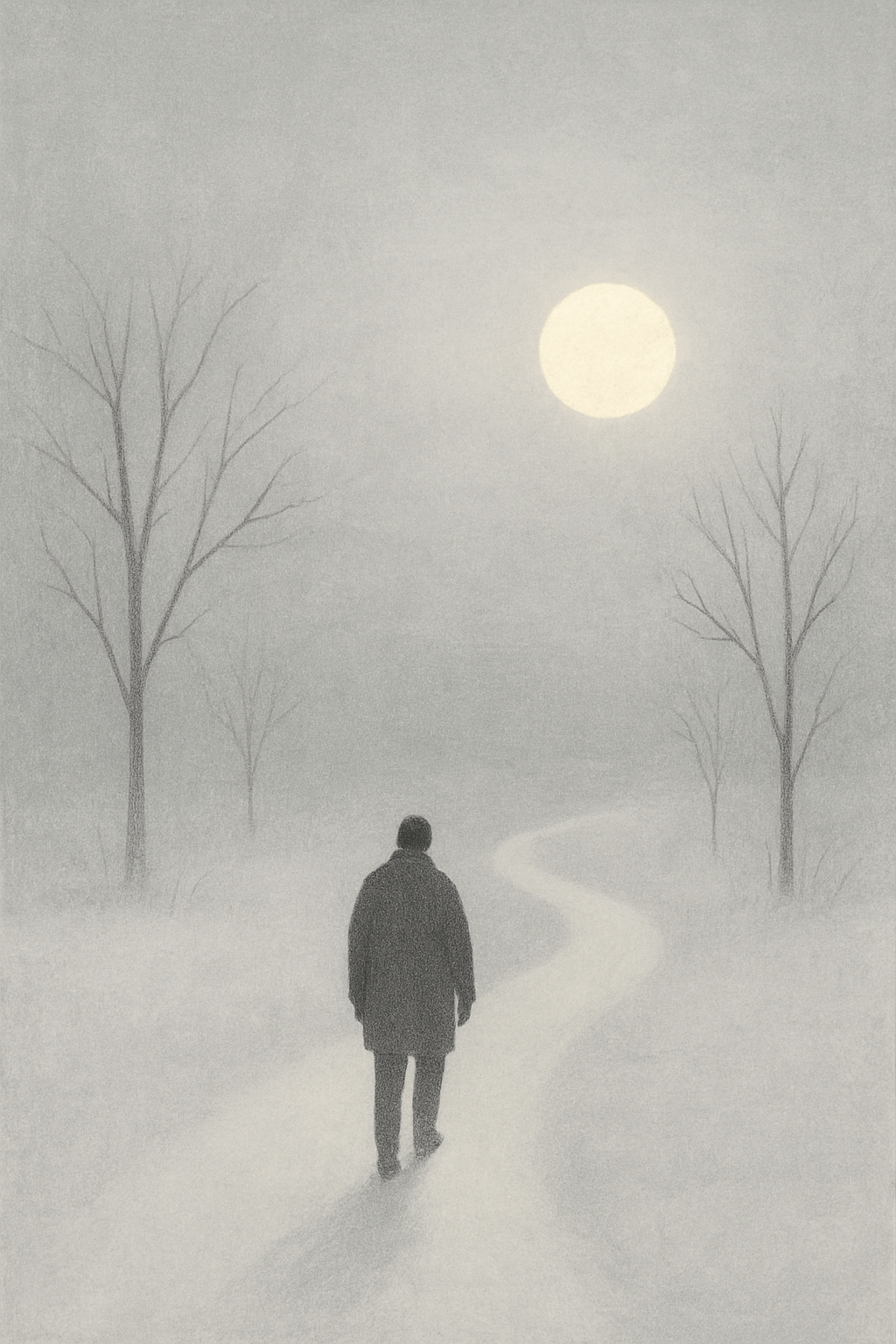
There are seasons in the soul when the warmth of faith feels far off. The glow that once saturated your days with clarity fades into a pale shimmer low on the horizon. These are the winter months of discipleship—when following Jesus feels less like dancing in the light and more like trudging through shadows.

And yet, the call remains.

Christ does not promise us eternal summer (at least in this life). His road leads through the wilderness (Mark 1:12–13), through the long dark of Gethsemane (Luke 22:44), and through the silence between Good Friday and Easter morning. “Take up your cross,” He said (Luke 9:23), not your picnic blanket. Faith becomes less about the brilliance of belief and more about the posture of trust, especially when nothing feels certain.

To follow the winter sun is to trace faint light when it offers no heat. It is to remember that the sun is still rising, even when its warmth is hidden. In the same way, to follow Jesus in seasons of silence, sorrow, or struggle is to walk with Him not for what He gives, but for who He is.

“Your word is a lamp to my feet and a light to my path” (Psalm 119:105). But notice—lamps in ancient times did not flood the road. They lit only the next few steps. God rarely overwhelms us with certainty. Instead, He invites us to walk in rhythm with Him, step by unsure step.

The winter sun teaches us that light is still light, even when dim. Christ is still Christ, even when His presence feels like absence. And sometimes, that kind of trust is the holiest kind.

I have followed the sun
when it was warm,
when it laid itself across my back
like a blessing.
When it sang golden through the leaves
and made holiness seem easy.

But now—
it is winter.
The sun slips sideways
into low skies and long shadows.
It does not warm,
only glimmers.
And still—
I follow.

I do not follow because it is bright,
but because I have seen it rise
from behind the hills
too many mornings
to doubt its return.

I do not follow because I feel it—
most days, I don’t.
I follow because
once, it found me
when I wasn’t looking.
And that kind of finding
is hard to forget.

So I walk
with a stiff wind against my chest,
shoes wet with old rain,
the path uncertain—
but I walk.

Because some loves
are not about feeling
but choosing.

And some mornings
are not about light
but trust.

And I trust
that even this cold sun
knows where it’s going—
and that it is worth
following.

Small Oomphs

“Earth is so thick with divine possibility that it is a wonder we can walk anywhere without cracking our shins on altars.” – Barbara Brown Taylor


In many traditions, sacraments are the means by which God’s saving grace is poured out: baptism, communion, and Scripture. For some, they also include marriage, confession, ordination, and anointing the sick. These acts are official, sacred, and ritualised. They are meant to tether us to the divine.

But for many of us, church has lost its oomph.

We’re between churches, clinging by a thread, or slowly, quietly slipping out the side door, trying to find God, ourselves, and the world again. We’re not hostile; we’re just tired. Church has become a place of confusion—a lifeless Christianity where we feel like we’re always doing something wrong. We get into trouble when we go, and we get into trouble when we don’t.

And so we drift. Or maybe… we walk.

I see you — not lost, but loosed,
from pew and creed, from tight-bound truths.
Your prayers now rise through silent skies,
no hymnal hand to harmonise.

You carry ash where fire once burned,
a sacred ache in lessons unlearned.
And still, you bless the broken road,
each doubt a stone, each step a psalm.

No steeple shadows where you stand,
yet grace still gathers in your hands.
You’re not alone in holy strife —
this, too, is part of a faithful life.


And yet, grace is not confined to altar rails or sanctuary walls. Sometimes, it greets us in the smallest of things — the steam rising from a morning coffee, the comfort of a well-worn novel, the warmth of soup shared on a cold day. These aren’t just distractions or creature comforts. They can be sacraments too, if we have eyes to see.

1 Corinthians 10:31 — “So whether you eat or drink or whatever you do, do it all for the glory of God.”

To make a cup of coffee with care, to read a story that stirs your soul, to laugh at the dinner table with someone you love — these are not lesser spiritual moments. They are the liturgies of the everyday, the sacred stitched into the ordinary. In these acts, God is not distant. He is here, humming quietly beneath the noise, waiting to be noticed.

Psalm 19:1–3“The heavens declare the glory of God… day after day they pour forth speech; night after night they reveal knowledge. They have no speech… yet their voice goes out into all the earth.

In these wandering years, it’s easy to feel the absence of God — to feel the numbness, the long ache. It might take years before you feel whole again, before you even consider walking into a church.

Maybe you never will.

But as you walk the broken road, remember—

“Taste and see that the Lord is good.” (Psalm 34:8)

Even here.
Even now.

In the small things.

The Long Night

Sheol saw me and was shattered, and Death ejected me and many with me. I measured its depth and I was not held captive, for I became a light to those who were in its depths.”

– (Ode 42)

He walked the long night

where no prayers reach,

where silence is thicker than stone.

Sheol held its breath.

The tomb was not still—

it trembled.

He wore no armor

but the memory of light.

He sang no song

but still the gates cracked.

One by one

He called the names of the forgotten.

Dust stirred.

Chains rusted.

Even Death blinked and turned

its face away,

unable to hold Him

who had measured its depth

and found it shallow.

– (a poem I wrote inspired by Ode) The Long Night

Unbuilding

Do you believe in God? I used to answer quickly.

Now, I pause —

not out of rebellion, but reverence.

I dismantle doctrines like old furniture,

finding splinters of truth and tradition embedded in my hands.

The creeds I once recited now echo with questions, each word a doorway to deeper understanding or further doubt.

In the quiet morning, amidst the smell of roasted coffee, I find sacredness in the mundane, grace in the unspoken.

Scripture pages worn thin from searching, not for answers, but for the presence that lingers between lines.

I am both the builder and the ruins, the seeker and the found.

Do you believe in God? I still ask, not seeking certainty, but connection.