
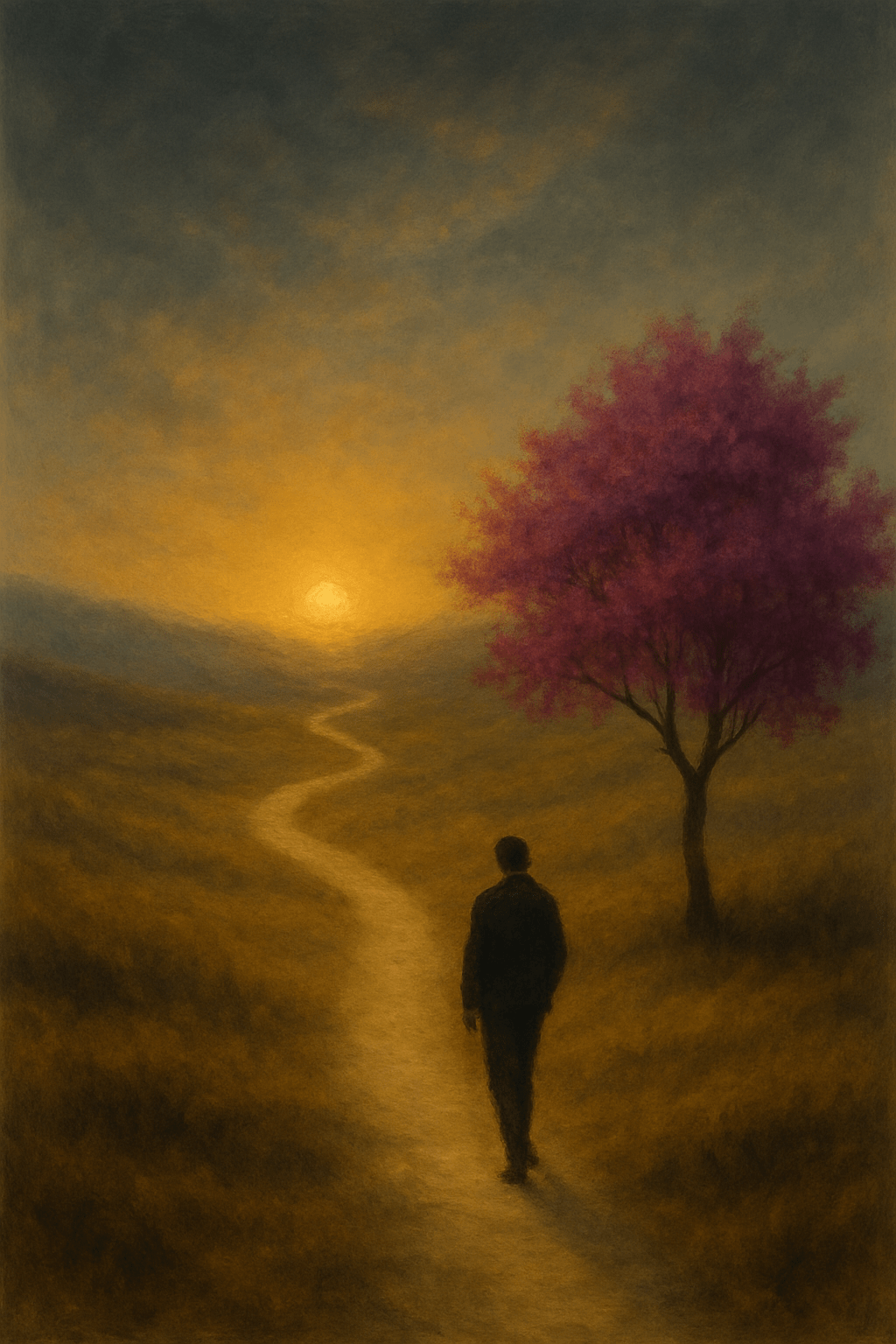
Faith does not erase suffering. If Part I was about honesty in the ache, Part II is about the slow tenderness of hope. Not a hope that denies pain or covers it up, but one that sits with it, honours it, and still dares to believe that God has not let go.
Picking Up the Thread
The Bible’s honesty about despair is matched by its honesty about hope. The psalms of lament often end in trust, but never without tears first. Job ends not with tidy answers but with God showing up in the whirlwind (Job 38). Jesus rises from the grave, but he rises with scars still on his body (John 20:27).
Hope in the Christian story is not neat or fast. It is not the removal of pain but the presence of God within it. Hope does not compete with suffering. It accompanies it. And it points forward, to new creation.
God With Us in Weakness
At the centre of Christian faith is the incarnation. God chose to take on human flesh, not in power but in vulnerability.
The Gospels give us a Jesus who is weary by a well (John 4:6), who weeps at the tomb of a friend (John 11:35), who withdraws to pray alone when the crowds overwhelm him (Luke 5:16), and who sweats blood in Gethsemane under the weight of anguish (Luke 22:44).
This is not a God who condemns weakness. This is a God who enters it.
Paul writes that the Spirit intercedes for us with groans too deep for words (Romans 8:26). When you cannot pray, when the silence feels unbearable, the Spirit is praying in you. When words fail, God does not. This is the same Spirit who raised Jesus from the dead and who will one day give life to our mortal bodies (Romans 8:11).
The Slow Dawn of Healing
Psychology tells us that healing is rarely instant. Trauma does not evaporate. Depression is not prayed away. Anxiety does not dissolve just because we will it to.
Healing takes time, care, and patience. It takes therapy, medication, a safe community, and embodied practices that help the body and mind recover. None of these are signs of weak faith. They are means of grace.
Taking your medication can be sacramental. Going to therapy can be more nourishing than confession. Choosing to keep breathing, even when you want to disappear, can be holy. These are not second-rate versions of spirituality. They are faith lived in the grit of real life.
Theologian Jürgen Moltmann once wrote that hope is not an escape from reality, but the strength to endure reality because God’s future has already broken into it. Healing is like that too. Slow. Patient. Painful at times. But still a witness that God is not done.
The Mystic Thread
Mystics spoke of hope not as triumph but as trust in darkness. St John of the Cross called the “dark night of the soul” not abandonment but the hidden place where God works most deeply. It is love stripped bare, learning to cling when nothing else remains. Hope is not the quick confidence that all will be fixed, but the quiet courage to stay when nothing makes sense, trusting that God is near even when unseen.
Hope, in this sense, is not shallow optimism. It is not pretending. It is a quiet trust that even in silence, even in sorrow, God is present. It is a trust that the story is moving toward new creation, when God will wipe away every tear (Revelation 21:4).
A Community of Sanctuary
The church at its best is not a hall of triumph but a sanctuary for the weary. A place where people can say “I’m not okay” and still belong.
Too often, churches have offered slogans instead of presence and belonging. But the call of the church is to be the body of Christ, scarred, vulnerable, open to touch. The early church carried one another’s burdens (Galatians 6:2). They wept together. They broke bread together. They bore witness to a kingdom where the wounded are not cast out but welcomed.
What would it look like if our churches became places where mental health struggles were not seen as shameful but as part of what it means to be human? Places where therapy is affirmed, medication is blessed, and silence is held without fear?
The world does not need churches that tell people to “pray harder.” It needs communities that sit in the dark and wait together for dawn, trusting that God and his kingdom is already breaking in.
The Shape of Hope
So what does hope look like when you live with depression, anxiety, or the weight of trauma?
Hope is not always joy. Sometimes it is simply endurance. Sometimes it is the quiet conviction that your story is not over. Sometimes it is the love of a friend who does not leave. Sometimes it is the courage to wake up to another day.
Hope is the scarred Christ showing up in the locked room to say, “Peace be with you” (John 20:19). Hope is the Spirit praying when you cannot. Hope is the Father who does not break a bruised reed or snuff out a smouldering wick (Isaiah 42:3).
Hope is tenderness. It does not rush. It does not shame. It does not demand. It whispers: you are not alone. And one day, this tenderness will give way to joy when creation itself is made new.
A Closing Blessing
So, may you know that your sorrow is not a failure.
May you find a small mercy in the day, even if it is only breath.
May the silence not undo you, but hold you,
until you can trust that God is still there.
May hope come like a slow dawn,
not rushing, not demanding, but faithful.
And may you remember that the One who carries scars
carries you, too,
into the promise of all things made new.


 Scribbling Theology