
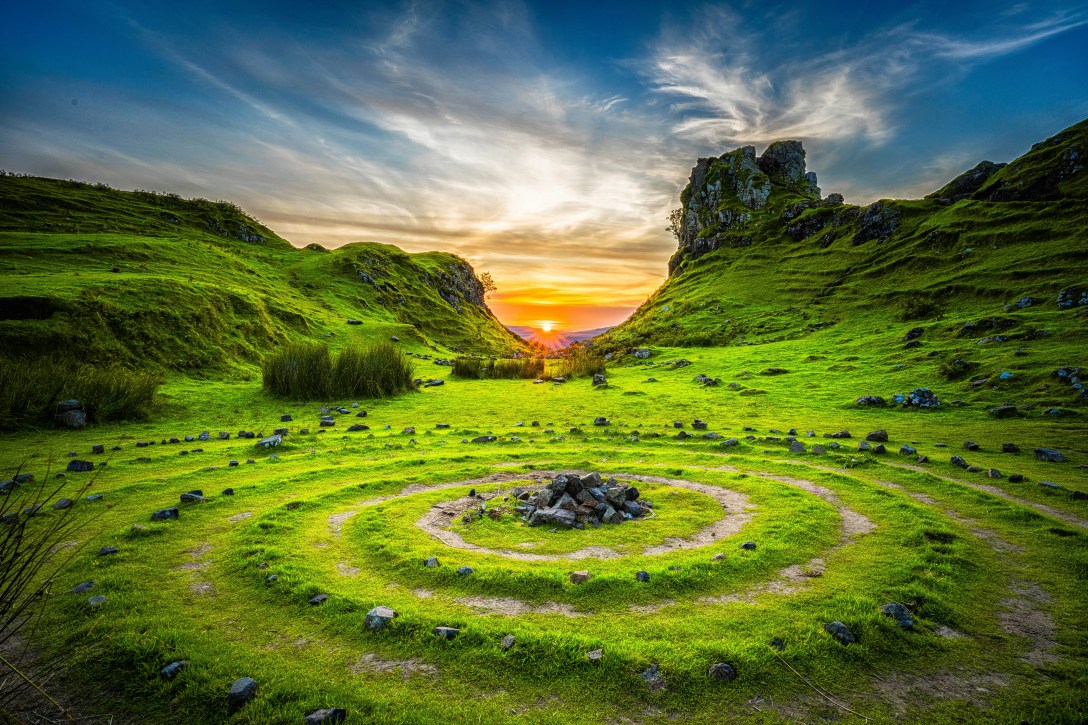
The Church of Eden

Some people, in order to discover God, read books. But there is a great book: the very appearance of created things. Look above you! Look below you! Note it. Read it. God, whom you want to discover, never wrote that book with ink. Instead, He set before your eyes the things that He had made. Can you ask for a louder voice than that?

Saint Augustine. The City of God, Book XVI

In my experience, Christianity and nature don’t go together. I think a lot of us Protestants are scared of making an idol out of cheese. Stepping out and getting any spiritual substance from nature feels like pagan worship. Nevertheless, for thousands of years, the Church and even the Old Testament Jews have had a rich tradition of finding God not only in the pages of sacred texts or within the walls of a temple or a church but in nature itself. For me, church on a Sunday can get boring. Nature doesn’t. At church, we have baptisms in a font. In nature, God baptises the world with ever-winding rivers, boundless oceans, and tranquil lakes. At church, we have choirs and bands that stir a crowd. In nature, God stirs the heart with the clap of the trees, the melody of the wind, and the euphony of the animals. At church, we preach from the Scriptures to teach, correct, and rebuke. In nature, God strikes the reader with awe as we pore over the stars. In church, we meet with God in sometimes clinical rituals, polished halls, and typically with masks on. In nature, we meet with God in untamed sacraments, wild establishments, and unmasked hearts.

I’m not a hippy. I don’t hug trees, and I’m not about to join PETA. I’m not even a good environmentalist. I love long showers, I’m often lazy with recycling, and I love a good steak. (and wings). There are days, weeks even where I’d rather spend my time playing video games, binging the Big Bang Theory, and scrolling through Facebook. I love rainy days, coffee, and sleeping in. As much as I know nature is a good place for me to be, it takes more effort than I’m proud to admit to get amongst. Nevertheless, when I’m forced to climb that mountain and see that view, or when I’m walking along the esplanade and I see the ocean stretched out before me, I’m always struck, even just a little, by how God takes up and dwells in more than the four walls of a church.

Elsewhere, I argue that our churches should be a slice of paradise. A taste of the newly created earth. A miniature Eden and a sacred space. I can’t remember the last time, if ever, where I felt awe-inspired, moved, and truly like I was treading hollowed ground in a church. Particularly within the Protestant tradition, we have demystified, disenchanted, and robbed our sacred spaces of their “magic.” We’ve traded awe and wonder for fog machines and light. We’ve sold profound unity and community and bought programs. We’ve replaced stories and myths with conversations about the weather and movies. We’ve exchanged God’s presence for “doing church.”

In the beginning, God created the world; it was wild and waste; there was darkness and chaos, but God’s Spirit hovered over the deep. Over six days, God moulded the world. He placed the stars, the sun, and the moon in the sky and gave them purpose. God divided the seas above from the waters below, filled them, and gave them purpose. He raised trees, shrubs, bushes, mountains, oceans, rivers, and streams from the earth and gave them purpose. God filled the world with birds, fish, and land animals and gave them purpose. He created humanity and gave them purpose. Finally, on the seventh day, God dwelled with what He had made, and there was purpose and goodness. This is how things are supposed to be in our local churches. Our local churches should feel like we’ve tasted a bit of heaven. Goodness, purpose, God’s presence, unity, flourishing, and life should all be markers of a healthy church. Yet I talk to people who experience emptiness, frustration, shallow relationships, trivial teachings, and superficial prayers every week. It seems that our churches are less Eden and more Tower of Babel.

Social Justice Part I – Environmentalism: A Theology of Creation Care

I’m almost 30 years old, and it has only been within the last 12 months of my life that I’ve begun the journey of being self-aware and reflective. I’m flawed and sinful. I’m more racist and sexist then I’d like to admit. I care less about our earth than I think I should. I don’t love my neighbours (Mark 12:30-30) as I ought, I don’t bless those who persecute me (Matthew 5:11-12, 44), I’m not a peacemaker (Matthew 5:9) or pure in heart (Matthew 5:8). Nevertheless, I ask you, dear reader, to evaluate yourself as I invite you to consider some of the most significant social justice issues of our time and whether or not you’re working towards the love of others and the glory of God, or against them. In this series, together, we will explore:

  1. Environmentalism: A theology of caring for creation
  2. Racism: A theology of race and inclusivism
  3. Gender: A theology of biblical manhood and womanhood
  4. Poverty: A theology of the outcast and marginalised

I desire that together we prayerfully consider our place in these issues and act in a way that images God and loves others more then we have before. In this post, we will be discussing environmentalism: a theology of land and creation.

 Right now, we are facing a human-made disaster of global scale, our greatest threat in thousands of years: climate change. If we don’t take action, the collapse of our civilisation and the extinction of much of the natural world is on the horizon.

Sir David Attenborough 

That is a scary quote. Environmental experts estimate that at least 95% of the current global warming trend is human contributed. According to the journal of nature, in 2015, the global number of trees has fallen by approximately 45.8% since the onset of human civilisation as we know it. The Royal Society estimates that since preindustrial times, greenhouse gases such as CO2 emissions have increased 40% with more than half of those emissions increasing from the ’70s. Coupled with a 150% increase in methane gases and a 20% increase in nitrous oxide (and the above data), this has lead to increase in the earth’s average surface temperature, rising oceans, and the extinction of wildlife. If we are to take this evidence seriously, then we are destroying the planet. Corporations, governments, and consumers have taken advantage of the world that we live in, and have profited off it without remorse. We have been given Eden, and instead of guarding and keeping it (Gen 2:15), we have used and abused it. What though, does the Scriptures have to say about our earth and the role we play in looking after it as Christians?

“In the beginning, God created the heavens and the earth” (Genesis 1:1). As we read the Bible, if we can be sure of anything, it’s that creation finds itself in the hands of Yahweh, the God of the Bible. “For in him all things were created: things in heaven and on earth, visible and invisible” (Colossians 1:16 c.f. Romans 11:36). Because all of creation finds its very being in the hands of Yahweh, Christians everywhere can have a certain sense of peace knowing that God is sovereign over history and creation itself (Job 42:2; Proverbs 16:33; Isaiah 45:7-9; Matthew 10:29-31; Romans 8:28; Ephesians 1:11). However, it would be unwise to believe that God is sovereign and to make the illogical conclusion that we’re then to do nothing. For whatever reason, Yahweh has decided to partner with humanity in the looking after of His good created order. From Adam and Eve (Genesis 1-2), Cain and Abel (Genesis 5), Noah (Genesis 6-9), Abraham (Genesis 15), Moses (Exodus 4:16; 7:1), Israel (Exodus 19:6), then finally to Christ and the Church (1 Peter 2:9; Revelation 1:26), God has chosen to partner with humanity in the ruling and care of the earth, and its inhabitants (Genesis 1:28).

God, it seems, didn’t make a good investment. Humanity ruined their chance and couldn’t keep up their end of the bargain (Genesis 3). Instead of ruling over creation by guarding and keeping it, they let evil enter into creation and rule over them. As a consequence, humanity and creation are cursed (Genesis 3:14-19), humanity is exiled from the presence of God (Genesis 3:22-24), and sinful creation groans for redemption and new life (Romans 8:19-23). We pollute the land through bloodshed and war (Numbers 35:33-34). We defile the earth by transgressing God’s law (Isaiah 24:4-6). God gives us guidelines on how to farm that we reject (Exodus 23:10-11). All of this is still true today. Creation coughs and spits as it absorbs the consequences of our polluted behaviour.

It doesn’t matter if you believe in the statistics quoted above. If you are a Christian, it should bother you how we take care of the Garden God has given us. If the Bible calls us to look after the earth, and I believe it does, then we should be doing our part. We should be eating less meat, which leads to less farm land, and it turn, less deforestation. We should be making wise investments in renewable energy. We should be protecting our wild life and biodiversity. We should be thinking of ways we can better distribute resources so everyone has clean water, food, and education. However, the issue goes deeper than merely recycling and buying LED lights for the house (though that’s a great start).

True creation care happens at the very core of the issue, the human heart. Unless people change inwardly, we can’t hope to have an outward effect on the world. The Gospel, the Good News of Jesus Christ, the new covenant supernaturally changes the hearts and minds of the people (Ezekiel 36:26; Jeremiah 31:33). If we want to combat climate change, if we’re going to guard and keep our Garden, we need people transformed by God’s Holy Spirit. Then, we will love others by lifting them out of poverty, fight gender inequality and racism, and partner with God in saving people from their sins. This is simply obeying the command to love others as ourselves. As we love others better, as our hearts are changed, the environment is naturally cared for. Real change starts with the people, not with the policy. The political policy will reflect the people as they are conformed to the image of God’s son (Rom 8:29).

As a longtime professor of biblical studies, a professional exegete, an author, a theologian, and – most importantly – a committed Christian, my objective in this little book [Stewards of Eden] is to demonstrate via the most authoritative voice in the church’s life, that of Scripture, that the stewardship of this planet is not alien or peripheral to the message of the gospel. Rather, our rule of faith and praxis has a great deal to say about this subject. And what the Bible has to say is that the responsible stewardship of creation is not only an expression of the character of our God; it is the role he entrusted to those made in his image.

Sandra L. Richter