Following the Winter Sun

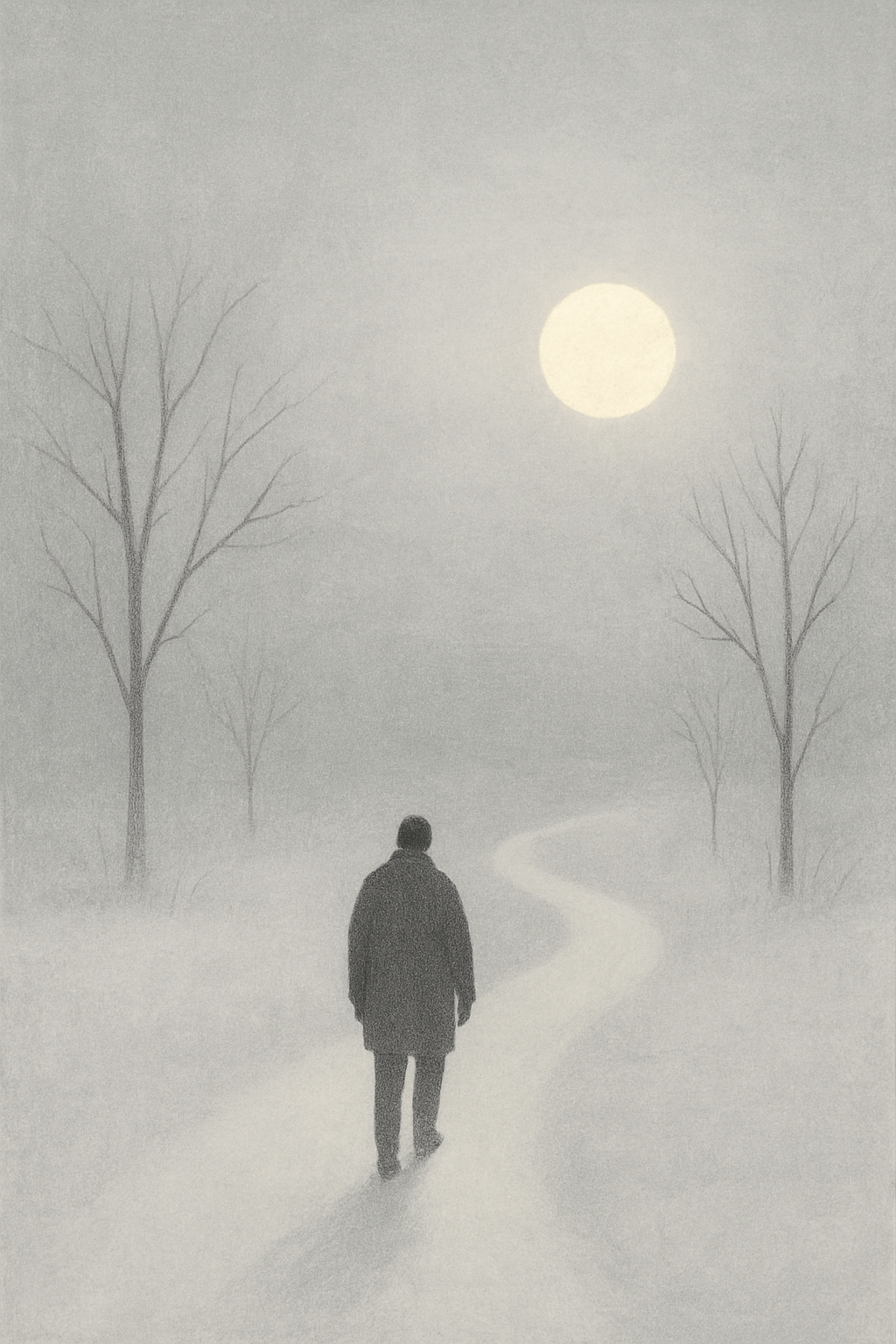
There are seasons in the soul when the warmth of faith feels far off. The glow that once saturated your days with clarity fades into a pale shimmer low on the horizon. These are the winter months of discipleship—when following Jesus feels less like dancing in the light and more like trudging through shadows.

And yet, the call remains.

Christ does not promise us eternal summer (at least in this life). His road leads through the wilderness (Mark 1:12–13), through the long dark of Gethsemane (Luke 22:44), and through the silence between Good Friday and Easter morning. “Take up your cross,” He said (Luke 9:23), not your picnic blanket. Faith becomes less about the brilliance of belief and more about the posture of trust, especially when nothing feels certain.

To follow the winter sun is to trace faint light when it offers no heat. It is to remember that the sun is still rising, even when its warmth is hidden. In the same way, to follow Jesus in seasons of silence, sorrow, or struggle is to walk with Him not for what He gives, but for who He is.

“Your word is a lamp to my feet and a light to my path” (Psalm 119:105). But notice—lamps in ancient times did not flood the road. They lit only the next few steps. God rarely overwhelms us with certainty. Instead, He invites us to walk in rhythm with Him, step by unsure step.

The winter sun teaches us that light is still light, even when dim. Christ is still Christ, even when His presence feels like absence. And sometimes, that kind of trust is the holiest kind.

I have followed the sun
when it was warm,
when it laid itself across my back
like a blessing.
When it sang golden through the leaves
and made holiness seem easy.

But now—
it is winter.
The sun slips sideways
into low skies and long shadows.
It does not warm,
only glimmers.
And still—
I follow.

I do not follow because it is bright,
but because I have seen it rise
from behind the hills
too many mornings
to doubt its return.

I do not follow because I feel it—
most days, I don’t.
I follow because
once, it found me
when I wasn’t looking.
And that kind of finding
is hard to forget.

So I walk
with a stiff wind against my chest,
shoes wet with old rain,
the path uncertain—
but I walk.

Because some loves
are not about feeling
but choosing.

And some mornings
are not about light
but trust.

And I trust
that even this cold sun
knows where it’s going—
and that it is worth
following.
Small Oomphs

“Earth is so thick with divine possibility that it is a wonder we can walk anywhere without cracking our shins on altars.” – Barbara Brown Taylor


In many traditions, sacraments are the means by which God’s saving grace is poured out: baptism, communion, and Scripture. For some, they also include marriage, confession, ordination, and anointing the sick. These acts are official, sacred, and ritualised. They are meant to tether us to the divine.

But for many of us, church has lost its oomph.

We’re between churches, clinging by a thread, or slowly, quietly slipping out the side door, trying to find God, ourselves, and the world again. We’re not hostile; we’re just tired. Church has become a place of confusion—a lifeless Christianity where we feel like we’re always doing something wrong. We get into trouble when we go, and we get into trouble when we don’t.

And so we drift. Or maybe… we walk.

I see you — not lost, but loosed,
from pew and creed, from tight-bound truths.
Your prayers now rise through silent skies,
no hymnal hand to harmonise.

You carry ash where fire once burned,
a sacred ache in lessons unlearned.
And still, you bless the broken road,
each doubt a stone, each step a psalm.

No steeple shadows where you stand,
yet grace still gathers in your hands.
You’re not alone in holy strife —
this, too, is part of a faithful life.


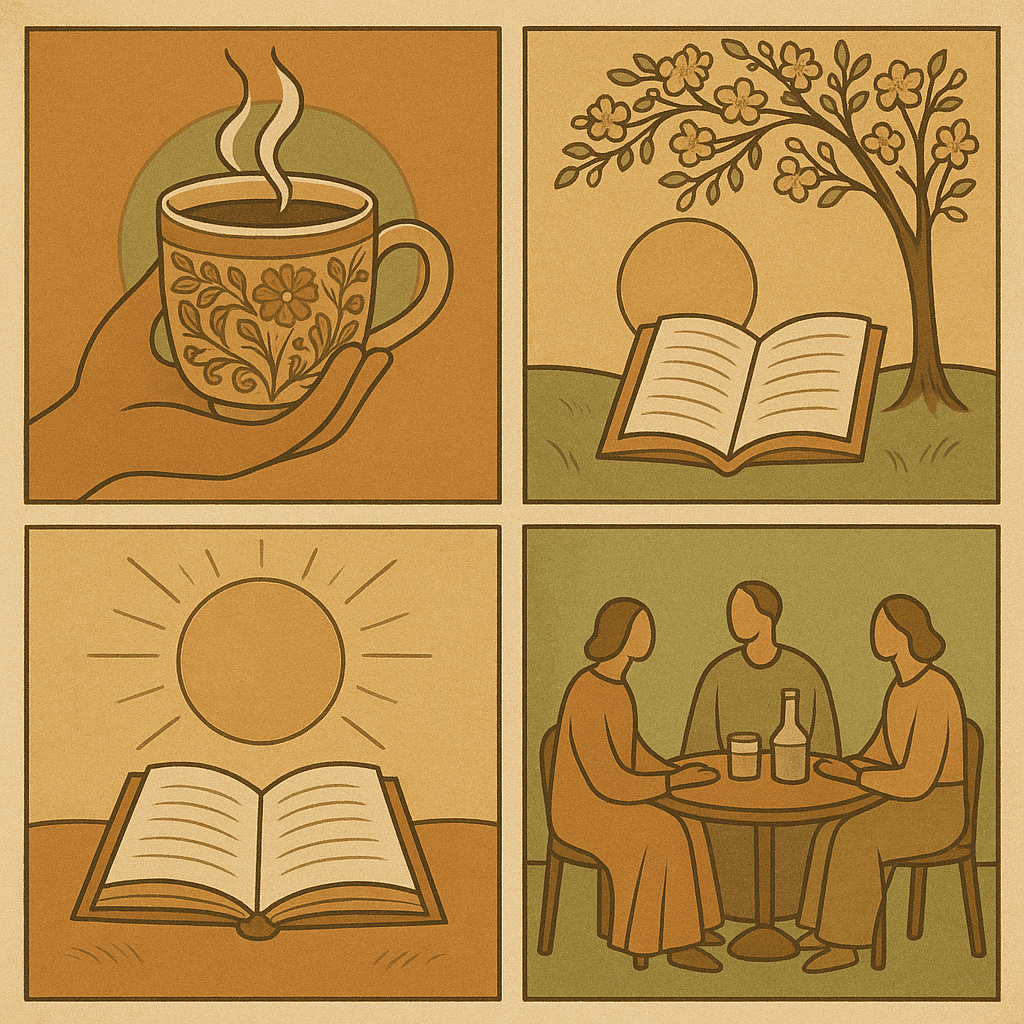
And yet, grace is not confined to altar rails or sanctuary walls. Sometimes, it greets us in the smallest of things — the steam rising from a morning coffee, the comfort of a well-worn novel, the warmth of soup shared on a cold day. These aren’t just distractions or creature comforts. They can be sacraments too, if we have eyes to see.

1 Corinthians 10:31 — “So whether you eat or drink or whatever you do, do it all for the glory of God.”

To make a cup of coffee with care, to read a story that stirs your soul, to laugh at the dinner table with someone you love — these are not lesser spiritual moments. They are the liturgies of the everyday, the sacred stitched into the ordinary. In these acts, God is not distant. He is here, humming quietly beneath the noise, waiting to be noticed.

Psalm 19:1–3“The heavens declare the glory of God… day after day they pour forth speech; night after night they reveal knowledge. They have no speech… yet their voice goes out into all the earth.

In these wandering years, it’s easy to feel the absence of God — to feel the numbness, the long ache. It might take years before you feel whole again, before you even consider walking into a church.

Maybe you never will.

But as you walk the broken road, remember—

“Taste and see that the Lord is good.” (Psalm 34:8)

Even here.
Even now.

In the small things.

The Church of Eden

Some people, in order to discover God, read books. But there is a great book: the very appearance of created things. Look above you! Look below you! Note it. Read it. God, whom you want to discover, never wrote that book with ink. Instead, He set before your eyes the things that He had made. Can you ask for a louder voice than that?

Saint Augustine. The City of God, Book XVI

In my experience, Christianity and nature don’t go together. I think a lot of us Protestants are scared of making an idol out of cheese. Stepping out and getting any spiritual substance from nature feels like pagan worship. Nevertheless, for thousands of years, the Church and even the Old Testament Jews have had a rich tradition of finding God not only in the pages of sacred texts or within the walls of a temple or a church but in nature itself. For me, church on a Sunday can get boring. Nature doesn’t. At church, we have baptisms in a font. In nature, God baptises the world with ever-winding rivers, boundless oceans, and tranquil lakes. At church, we have choirs and bands that stir a crowd. In nature, God stirs the heart with the clap of the trees, the melody of the wind, and the euphony of the animals. At church, we preach from the Scriptures to teach, correct, and rebuke. In nature, God strikes the reader with awe as we pore over the stars. In church, we meet with God in sometimes clinical rituals, polished halls, and typically with masks on. In nature, we meet with God in untamed sacraments, wild establishments, and unmasked hearts.

I’m not a hippy. I don’t hug trees, and I’m not about to join PETA. I’m not even a good environmentalist. I love long showers, I’m often lazy with recycling, and I love a good steak. (and wings). There are days, weeks even where I’d rather spend my time playing video games, binging the Big Bang Theory, and scrolling through Facebook. I love rainy days, coffee, and sleeping in. As much as I know nature is a good place for me to be, it takes more effort than I’m proud to admit to get amongst. Nevertheless, when I’m forced to climb that mountain and see that view, or when I’m walking along the esplanade and I see the ocean stretched out before me, I’m always struck, even just a little, by how God takes up and dwells in more than the four walls of a church.

Elsewhere, I argue that our churches should be a slice of paradise. A taste of the newly created earth. A miniature Eden and a sacred space. I can’t remember the last time, if ever, where I felt awe-inspired, moved, and truly like I was treading hollowed ground in a church. Particularly within the Protestant tradition, we have demystified, disenchanted, and robbed our sacred spaces of their “magic.” We’ve traded awe and wonder for fog machines and light. We’ve sold profound unity and community and bought programs. We’ve replaced stories and myths with conversations about the weather and movies. We’ve exchanged God’s presence for “doing church.”

In the beginning, God created the world; it was wild and waste; there was darkness and chaos, but God’s Spirit hovered over the deep. Over six days, God moulded the world. He placed the stars, the sun, and the moon in the sky and gave them purpose. God divided the seas above from the waters below, filled them, and gave them purpose. He raised trees, shrubs, bushes, mountains, oceans, rivers, and streams from the earth and gave them purpose. God filled the world with birds, fish, and land animals and gave them purpose. He created humanity and gave them purpose. Finally, on the seventh day, God dwelled with what He had made, and there was purpose and goodness. This is how things are supposed to be in our local churches. Our local churches should feel like we’ve tasted a bit of heaven. Goodness, purpose, God’s presence, unity, flourishing, and life should all be markers of a healthy church. Yet I talk to people who experience emptiness, frustration, shallow relationships, trivial teachings, and superficial prayers every week. It seems that our churches are less Eden and more Tower of Babel.

2024

Some may or may not know I took a year off writing (despite this, I’ve had the most views since I started writing). In 2023, I posted one blog (I felt compelled then). It is 2024, and I’m slowly emerging out of blogging hibernation. From my first blog in 2015 to my next, as is faithful with most things in life, my theology and thoughts on Christian spirituality have evolved. I look back on my first blog and chuckle. I’m sure I’ll look back on 2024 in another ten years and cringe. Since I started blogging, I’ve started and graduated from bible college. I’ve married and remarried. I’ve gone through different jobs, moved around, and gone through various churches (finally, I’ve found a nice one to rest in). I’ve had my doubts and struggles. I’ve wanted to walk away from the faith. I’ve wanted to give up and try other things. Yet here I am, still tripping after Jesus (good blog title).

So what does this year hold for Scribbling Theology? More meaningless ramblings of a guy who has literally no idea what he’s talking about (I guarantee that). We’ll discuss God’s creation, beauty and some of the not-so-traditional ways of engaging with God. On the flip side, we’ll discuss the importance of finding a healthy community of believers where you can flourish. We’ll talk about liturgy and the importance of ancient rituals and beliefs. We’ll talk about how stories, both new and old, can transform us and lead us deeper into ourselves (collectively and individually) and into the presence of God. I’ll review a book or two (to start you off read, “How to Know a Person by David Brooks”), a podcast or three and maybe spin a poem. I don’t know where I’ll start or finish. But as always, Scribbling Theology has been an outlet, a creative and even spiritual practice that has helped me to release and vent my own thoughts.

Christian Nihilism

We’ve all heard about Christian Hedonism, but what if it’s difficult to enjoy God? What about Christian Nihilism?

Vanity of vanities, says the Preacher,
    vanity of vanities! All is vanity.
What does man gain by all the toil
    at which he toils under the sun?
A generation goes, and a generation comes,
    but the earth remains forever.
The sun rises, and the sun goes down,
    and hastens to the place where it rises.
The wind blows to the south
    and goes around to the north;
around and around goes the wind,
    and on its circuits, the wind returns.
All streams run to the sea,
    but the sea is not full;
to the place where the streams flow,
    there they flow again.
All things are full of weariness;
    a man cannot utter it;
the eye is not satisfied with seeing,
    nor the ear filled with hearing.
What has been is what will be,
    and what has been done is what will be done,
    and there is nothing new under the sun.
Is there a thing of which it is said,
    “See, this is new”?
It has been already
    in the ages before us.
There is no remembrance of former things,
    nor will there be any remembrance
of later things yet to be
    among those who come after.

~ Ecclesiastes 1:2-11 ~

John Piper has famously coined the term “Christian Hedonism.” Piper defines Christian Hedonism as, “the conviction that God’s ultimate goal in the world (his glory) and our deepest desire (to be happy) are one and the same because God is most glorified in us when we are most satisfied in him. Not only is God the supreme source of satisfaction for the human soul, but God himself is glorified by our being satisfied in him. Therefore, our pursuit of joy in him is essential.”

Piper’s definition here has two key phrases I would like the highlight. 1. “God is most glorified in us when we are most satisfied in him. 2. “Our pursuit of joy in him is essential.” These two ideas are the essence of Christian hedonism, feasting on God and indulging in Him. What Piper espouses is a wonderful idea, and I thank God that Piper has been teaching this throughout his life and ministry. However, (and I’m sure that Piper addresses all this within Christian Hedonism), what if Christians find it impossible to find contentment and joy in God? While I believe our pursuit of joy and contentment in God is essential so that we glorify Him, there are seasons, if not entire lifetimes, where some of us experience the never-ending onslaught of suffering and angst the world has in store for us. God becomes distant and impossible to relate to at times. You feel like you could never glorify God, not even in your best moments. Jesus becomes an idea rather than the person you used to be swooning over. Where there was purpose and meaning, now is chaos and the unfamiliar. You begin to think like the Preacher, “vanity of vanities” – this all becomes meaningless suffering and grief. The cloud of uncertainty settles upon the heart as you wander through life like a lost bedouin. “Exiles”, the Bible calls us (1 Peter 1:1-2), and you certainly begin to feel like one. How do we make sense of all of this “vanity?” I propose Christian Existentialism Nihilism.

Christianity and Nihilism


Christian Nihilism is an oxymoron if ever there was one. On the one hand, you have Christianity that teaches us to be joyful, happy, and content in all things. Christianity teaches us that there’s a purpose, a plan, and meaning in the darkest places (true, by the way). On the other hand, Nihilism teaches us that life and suffering are ultimately random, meaningless, and chaotic. For proponents of Nihilism like Friedrich Nietzsche, the belief in God and the practice of religion is a crutch that humanity uses to make sense of a senseless existence. Christian Nihilism is an almost paradoxical embracement of both realities. As one walks through life through the seemingly purposeless and brutal sufferings that life brings us, we are to embrace the pain and grief it throws at us (allow the barbs of suffering to settle in your heart). Christian Nihilism is the idea that while joy and contentment in God might be ideal, they might never be experienced on this side of eternity. It is embracing the chaos while trusting that God will make all things work together for our good, even if the good isn’t always seen.


In reality, this isn’t anything new. The Bible often speaks of the suffering and pain Christians are to go through. I suppose what I aim to do with this idea is to alleviate the burden of joy for those who are constantly pursuing it and only ever experiencing more pain and sorrow. To be clear, I’m not suggesting that Christian Hedonism is wrong. I’m just putting a new card on the table as I wrestle with a reality that I’ve experienced, and I’m sure many others do. Pursuing joy and contentment in God has been an extremely tiring journey that has yielded little fruit for me. However, I believe God is doing something in me apart from my effort and typical expectations. As I walk, I painfully groan with creation as I patiently await the new world.

Now all has been heard;
    here is the conclusion of the matter:
Fear God and keep his commandments,
    for this is the duty of all mankind.
For God will bring every deed into judgment,
    including every hidden thing,
    whether it is good or evil.

~ Ecclesiastes 12:13-14 ~