
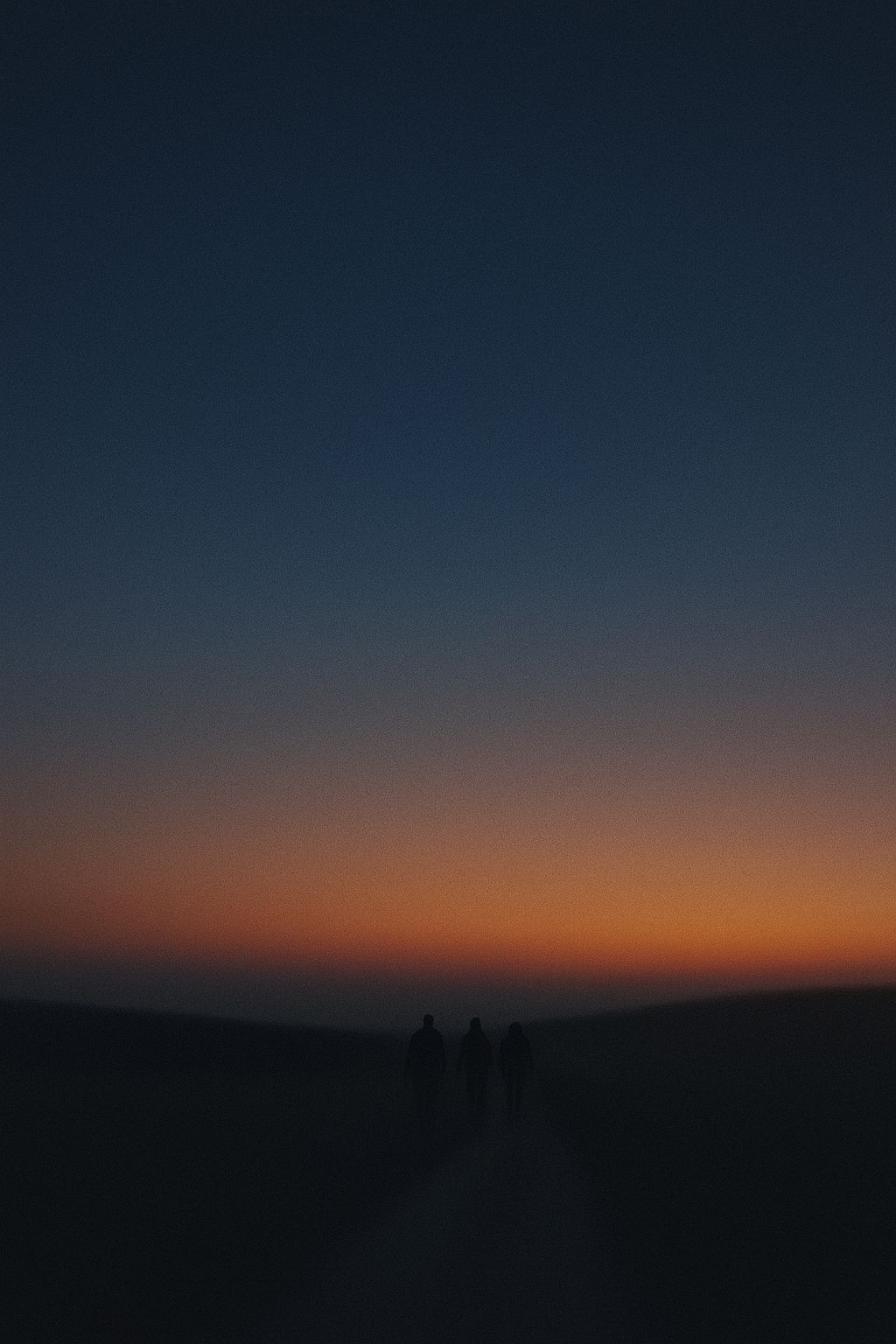
God Who Walks in Twilight

Twilight scene with a person walking on a winding path under a colourful evening sky, symbolising God walking in the cool of the day.

At the Wind of the Day

The first time we hear of God walking, it is not in a blaze of glory.
Not in the brightness of noon when everything is sharp and defined.
It is in the cool of the evening, Genesis says.
The Hebrew calls it l’ruach hayom, “at the wind of the day.”

That soft shift when the heat is letting go and the air changes,
when light seems to slip away almost without you noticing.
It is the time when the work has been done
but no one has yet gone to bed,
when the shadows pull long lines across the ground
and you feel that strange mix of ending and beginning at the same time.

From the start, God is not a voice far off in the heavens.
He is there in the dust, walking.
Unhurried.
Not pressing toward a task.
Just present in that in-between space.

And that time of day keeps turning up in the story, as if God likes it.
Abraham meets Him near the oaks of Mamre when the sun is leaning away.
Israel’s first Passover happens “between the evenings,”
with lamb’s blood on doorframes while the light is thinning.
In the Temple, the daily rhythm gives that same hour a place of its own
the evening sacrifice,
the smell of bread and incense
rising into the dimming sky.

Jesus keeps to the pattern.
On the road to Emmaus,
He meets two people when the day is almost spent.
He walks with them,
talks with them,
and sits at their table,
and in the breaking of bread,
as the darkness edges in from the fields,
they know Him.

It feels like twilight has always been His hour,
the place where He can hold light and dark together in one moment.

Maybe that is why most of life with God seems to happen in the in-between.
We live in the “already and not yet” of His kingdom.
Evening-souled people,
learning the slow pace of faith,
breathing out hope that has learned how to wait,
lingering in love that does not rush away.
He still comes walking when the air cools
and the day takes its last breath.


Creation to New Creation

That first walk in Eden ended badly,
with hiding and shame where welcome should have been.
But the story does not stay there.
At the end of Scripture, in the New Jerusalem,
there is no night at all, and the gates are never closed.
It is as if the first invitation to walk with Him is restored and made permanent.

The story that began with God searching for His image bearers in the evening breeze
ends with Him living among them,
no lamp needed,
because the Lamb Himself is their light.

For now, we live in the long dusk between creation and new creation.
But when the wind shifts,
when shadows stretch out over the ground,
when the air feels like it is holding its breath before the dark,
I think of Him.
I think of how He has not stopped walking.
And I hold onto the hope
that one day this twilight will give way,
not to night,
but to a dawn that never ends.

Written in Heaven

A biblical theology of suffering and hope

Suffering will find you

as it found Him.

But your name is written in heaven,

In light no shadow can touch.

In the beginning,

God breathed into dust

and called it good.

But even before the dust was firm beneath our feet,

a shadow waited.

The Serpent spoke,

and we listened.

The Garden shrank behind flaming swords,

and we stepped into the world

with thorns in our hands

and longing in our bones.

(Genesis 3)


Pain was not the beginning

but it was the consequence of forgetting

who we are.

Still, God did not turn away.

He clothed the shame.

He called the wanderers.

He wrestled with Jacob,

wept with Hannah,

answered Job not with reasons

but with a storm.

He carved covenant into stone,

carried the cries of Israel through wilderness,

and spoke comfort even in exile.

(Exodus, Deuteronomy, Isaiah, Lamentations)


And when words would no longer suffice,

The Word became flesh (John 1).

Not safe flesh,

not unmarked flesh

but bruised, bloody, breakable.

He came not to explain suffering

but to inhabit it.

To be born under empire,

to labour in obscurity,

to sweat blood,

to carry a cross.

“He was a man of sorrows,

acquainted with grief.”

(Isaiah 53:3)


The God of the cosmos

entered the wound of the world

and made it His dwelling place.

The cross is not a detour.

It is the way.

“If anyone would follow me,” He says,

“Let them deny themselves,

take up their cross daily,

and follow.”

(Luke 9:23)

This is not cruelty.

It is an invitation.

To union. To dying. To resurrection.

To be baptised not only in water,

but into His death.

(Romans 6:3–5)


And yet

your name is written in heaven.

(Luke 10:20)

This is what He told them, not after comfort, but after conflict.

Not when they were safe, but when they were sent.

When they saw demons fall and darkness tremble,

He said:

“Do not rejoice in this…”

“Rejoice that your names are written in heaven.”

Because what matters

is not that you wield power,

but that you are known.

Held.

Remembered.

Inscribed in the eternal.

“See, I have engraved you

on the palms of my hands.”

(Isaiah 49:16)


The apostles knew.

They were beaten and blessed.

Scattered and sealed.

They rejoiced to suffer disgrace for the Name. (Acts 5:41)

Paul was no stranger to thorns

in the flesh, in the church, in his prayers.

And yet he wrote:

“We suffer with Him,

that we may also be glorified with Him.”

(Romans 8:17)

“These light and momentary afflictions

are preparing for us

an eternal weight of glory.”

(2 Corinthians 4:17)

Even creation groans, but not in despair,

in birth.

(Romans 8:22)


The Spirit does not take away the ache.

The Spirit groans with us.

Prays when we have no words.

Dwells in the dust with us

until all things are made new.

And they will be.

For He will come again.

Not as a suffering servant,

but as the One who wipes every tear.

(Revelation 21:4)


And He will not forget.

He will open the book, the Lamb’s book

and read the names

that the world has tried to erase.

The names written in heaven

before the foundations of the world.

(Revelation 13:8)

Yours among them.

Suffering is not the evidence that you are lost.

It is the path of the saints,

the shape of the cross,

the echo of Eden groaning toward glory.

And you,

even as you weep,

even when you are wounded—

are not forgotten.

Your name is written in heaven,

in light no shadow can touch.

And the One who knows it

still bears scars of His own.