The Deep, the Breath, and the Beginning of Meaning

Poetic and Theological Reflections on Genesis 1:1–2

“Now the earth was formless and empty, darkness was over the surface of the deep, and the Spirit of God was hovering over the waters.”Genesis 1:2

In the beginning

there was no beginning.

Not like we think.

Not a ticking clock

not a big bang or a blank slate.

Only

deep.

dark.

Formless

unfurnished

uninviting.

And the Breath of God

hovering

not rushing

not fixing

not panicking

just waiting.

A mother-bird

brooding over brokenness

wings sheltering what could be.

This is where our story starts

not in triumph

but in tension.

Not in arrival

but in anticipation.

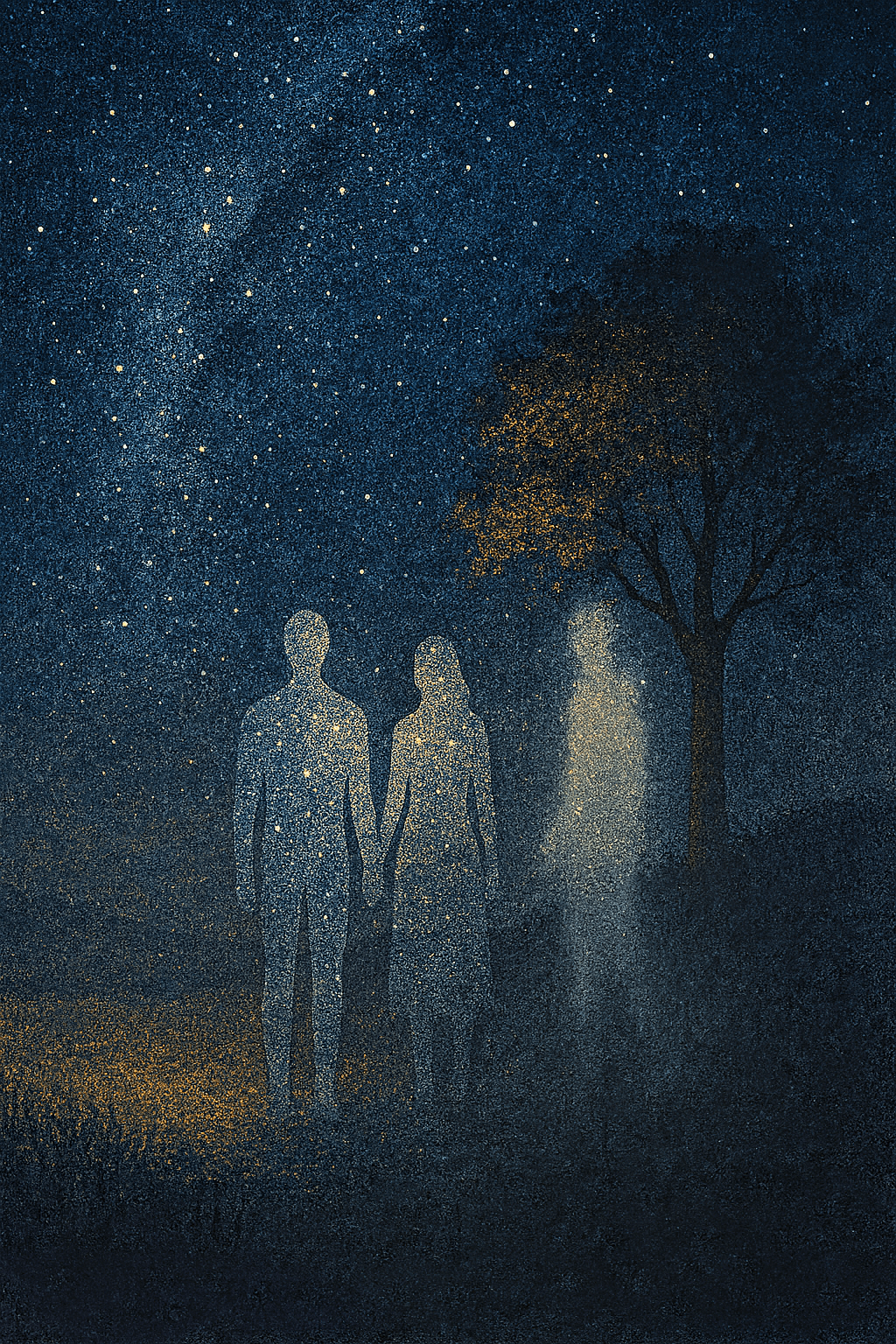
In the beginning,

God didn’t make things

not first.

God made room.

A place.

A sacred space.

He carved order out of what was not yet useful.

He called forth function

from futility.

He said:

“Let this be a place where I dwell

and they dwell.

Let it be home.”

The first act of creation

was not to build

but to breathe.

And the Breath still moves

over your chaos.

over your depths.

over your formless days

and unlit nights.

Don’t rush the Spirit.

It’s still hovering.

It’s still preparing.

It’s still holy.

Because in the beginning,

God made time to wait.

And called even the waiting good.

A Theological Reflection

Genesis does not begin with a scientific explanation nor with abstract philosophy. It begins with God. “In the beginning, God created the heavens and the earth” (Genesis 1:1). But what follows is striking: “Now the earth was formless and empty”—tohu v’vohu in Hebrew—”darkness was over the surface of the deep, and the Spirit of God was hovering over the waters” (Genesis 1:2). The story opens not with perfection, but with potential. Not with answers but with mystery.

This state of tohu v’vohu—wild, waste, and without purpose—is not described as a problem to be eradicated but a canvas awaiting intention. In the biblical imagination, this primordial chaos is not evil. It is simply untamed. The deep, or tehom, is not a demonic force to conquer, as in the Babylonian Enuma Elish, but an unordered reality that awaits divine speech.

Genesis 1 is not a science textbook. Nor is it an ancient myth. It is sacred theology told through poetic narrative. As I’ve written elsewhere, Genesis 1 is not about material origins but functional order. It’s not primarily about how the world was made but how God gave it meaning. In the ancient Near Eastern mindset, something did not truly “exist” until it had a name, a function, a role in the cosmic order. As Old Testament scholar John Walton argues, creation in Genesis is about assigning purpose, not assembling matter.

This is evident in the structure of the text: six days of calling forth realms and rulers—light and dark (Day 1), sky and sea (Day 2), land and vegetation (Day 3), and then the lights (Day 4), birds and fish (Day 5), animals and humanity (Day 6). Each act ends with God’s affirmation: “And God saw that it was good” (Genesis 1:10, 12, 18, etc.). Good not as morally perfect, but functioning as intended. Creation is liturgy. Each day builds like a worship service, culminating in God’s rest on the seventh day (Genesis 2:1–3).

Genesis 1 portrays the world as a cosmic temple, with God taking up residence on Day 7. In the ancient world, a temple was not finished until the deity rested within it. “The heavens are my throne, and the earth is my footstool,” says the Lord in Isaiah 66:1—a temple image that harks back to Eden. When God rests, it’s not because he is tired but because creation is complete, purposeful, and ready to be inhabited by the divine presence.

Notice also what God does not do. The Spirit of God does not launch into production but hoversrachaph in Hebrew—like a bird tending its young (Deuteronomy 32:11 uses the same word to describe an eagle hovering over its nest). This is not a moment of domination but of delicate presence. Before God says a word, God is simply there, waiting, brooding, holding space. The Spirit does not conquer the darkness but prepares the way for light.

This image is carried throughout Scripture. In the Gospels, when Jesus is baptized, the heavens open, and the Spirit descends like a dove (Luke 3:22). The waters part, the voice speaks, and once again, God hovers over the waters—not in creation now, but in new creation. Paul will echo this theme in 2 Corinthians 5:17: “If anyone is in Christ, the new creation has come.” Creation and re-creation are both acts of divine hovering, divine speaking, divine presence.

Likewise, in John 1, we hear another beginning: “In the beginning was the Word… through him all things were made” (John 1:1–3). This is Genesis 1, revisited with Christ at the centre. The chaos is not overcome by violence but illumined by speech: “The light shines in the darkness, and the darkness has not overcome it” (John 1:5). There is no war between light and dark in Genesis, just a calling forth—of form from formlessness, rhythm from silence, cosmos from chaos.

So we are reminded that Genesis is not just history—it is theological storytelling. It doesn’t answer all the questions of “how,” but it speaks profoundly to the questions of “why.” Who are we? What kind of world do we live in? What kind of God do we serve?

A God who hovers.

A God who speaks meaning into voids.

A God who rests not when he is done making but when the world is ready to be home.

So when we look into our own chaos—personal, cultural, existential—we do so not with fear but with faith. Because the God of Genesis 1 still hovers. Still speaks. Still brings light out of darkness.

Genesis opens not with resolution but with possibility.

Books for the Road: Reading Through Doubt and Deconstruction

You’re not alone if you’re wrestling with doubt, rethinking your faith, or wandering the winding path of deconstruction. This journey is confusing, lonely, and sometimes even terrifying for many. But you’re not the first to walk it—and you don’t have to do it without companions.

Here are a few books that have offered wisdom, empathy, and even a little light in the dark for fellow pilgrims:

1. Faith After Doubt — Brian McLaren

McLaren gently reframes doubt not as the enemy of faith but as part of its maturation. If you’re deconstructing, this book offers a four-stage model that validates your questions and invites you to move forward with integrity.

2. The Audacity of Peace: Invisible Jesus in a Violent World — Scot McKnight

McKnight confronts the disconnect between the real Jesus and the distorted versions we often inherit. Rooted in peacemaking and justice, this book invites us to rediscover the counter-cultural Christ that many feared didn’t exist. It’s a bold, timely read for those burned by power-shaped religion.

3. The Sin of Certainty — Peter Enns

If “believing the right things” no longer works for you, Enns offers a different take: trust. Drawing from Scripture and his own story, he makes space for a more dynamic, less rigid faith.

4. When Everything’s on Fire — Brian Zahnd

I cannot recommend this book enough. Zahnd speaks to the crisis many face when faith burns down. But rather than leaving it all behind, he makes a passionate case for a deeper, post-deconstruction Christianity rooted in mystery and beauty.

5. Perhaps: Reclaiming the Space Between Doubt and Dogmatism — Josh McNall

McNall argues that we don’t need to choose between rigid certainty and total scepticism. Perhaps is a compelling call to humility and hope—a way to hold convictions while remaining open to mystery.

This isn’t a map—but maybe it’s a stack of trail notes passed from one wanderer to another.

I’d love to hear if you’ve read something that helped you stay in the wrestle.

Following the Winter Sun

There are seasons in the soul when the warmth of faith feels far off. The glow that once saturated your days with clarity fades into a pale shimmer low on the horizon. These are the winter months of discipleship—when following Jesus feels less like dancing in the light and more like trudging through shadows.

And yet, the call remains.

Christ does not promise us eternal summer (at least in this life). His road leads through the wilderness (Mark 1:12–13), through the long dark of Gethsemane (Luke 22:44), and through the silence between Good Friday and Easter morning. “Take up your cross,” He said (Luke 9:23), not your picnic blanket. Faith becomes less about the brilliance of belief and more about the posture of trust, especially when nothing feels certain.

To follow the winter sun is to trace faint light when it offers no heat. It is to remember that the sun is still rising, even when its warmth is hidden. In the same way, to follow Jesus in seasons of silence, sorrow, or struggle is to walk with Him not for what He gives, but for who He is.

“Your word is a lamp to my feet and a light to my path” (Psalm 119:105). But notice—lamps in ancient times did not flood the road. They lit only the next few steps. God rarely overwhelms us with certainty. Instead, He invites us to walk in rhythm with Him, step by unsure step.

The winter sun teaches us that light is still light, even when dim. Christ is still Christ, even when His presence feels like absence. And sometimes, that kind of trust is the holiest kind.

I have followed the sun
when it was warm,
when it laid itself across my back
like a blessing.
When it sang golden through the leaves
and made holiness seem easy.

But now—
it is winter.
The sun slips sideways
into low skies and long shadows.
It does not warm,
only glimmers.
And still—
I follow.

I do not follow because it is bright,
but because I have seen it rise
from behind the hills
too many mornings
to doubt its return.

I do not follow because I feel it—
most days, I don’t.
I follow because
once, it found me
when I wasn’t looking.
And that kind of finding
is hard to forget.

So I walk
with a stiff wind against my chest,
shoes wet with old rain,
the path uncertain—
but I walk.

Because some loves
are not about feeling
but choosing.

And some mornings
are not about light
but trust.

And I trust
that even this cold sun
knows where it’s going—
and that it is worth
following.

Small Oomphs

“Earth is so thick with divine possibility that it is a wonder we can walk anywhere without cracking our shins on altars.” – Barbara Brown Taylor


In many traditions, sacraments are the means by which God’s saving grace is poured out: baptism, communion, and Scripture. For some, they also include marriage, confession, ordination, and anointing the sick. These acts are official, sacred, and ritualised. They are meant to tether us to the divine.

But for many of us, church has lost its oomph.

We’re between churches, clinging by a thread, or slowly, quietly slipping out the side door, trying to find God, ourselves, and the world again. We’re not hostile; we’re just tired. Church has become a place of confusion—a lifeless Christianity where we feel like we’re always doing something wrong. We get into trouble when we go, and we get into trouble when we don’t.

And so we drift. Or maybe… we walk.

I see you — not lost, but loosed,
from pew and creed, from tight-bound truths.
Your prayers now rise through silent skies,
no hymnal hand to harmonise.

You carry ash where fire once burned,
a sacred ache in lessons unlearned.
And still, you bless the broken road,
each doubt a stone, each step a psalm.

No steeple shadows where you stand,
yet grace still gathers in your hands.
You’re not alone in holy strife —
this, too, is part of a faithful life.


And yet, grace is not confined to altar rails or sanctuary walls. Sometimes, it greets us in the smallest of things — the steam rising from a morning coffee, the comfort of a well-worn novel, the warmth of soup shared on a cold day. These aren’t just distractions or creature comforts. They can be sacraments too, if we have eyes to see.

1 Corinthians 10:31 — “So whether you eat or drink or whatever you do, do it all for the glory of God.”

To make a cup of coffee with care, to read a story that stirs your soul, to laugh at the dinner table with someone you love — these are not lesser spiritual moments. They are the liturgies of the everyday, the sacred stitched into the ordinary. In these acts, God is not distant. He is here, humming quietly beneath the noise, waiting to be noticed.

Psalm 19:1–3“The heavens declare the glory of God… day after day they pour forth speech; night after night they reveal knowledge. They have no speech… yet their voice goes out into all the earth.

In these wandering years, it’s easy to feel the absence of God — to feel the numbness, the long ache. It might take years before you feel whole again, before you even consider walking into a church.

Maybe you never will.

But as you walk the broken road, remember—

“Taste and see that the Lord is good.” (Psalm 34:8)

Even here.
Even now.

In the small things.

The Long Night

Sheol saw me and was shattered, and Death ejected me and many with me. I measured its depth and I was not held captive, for I became a light to those who were in its depths.”

– (Ode 42)

He walked the long night

where no prayers reach,

where silence is thicker than stone.

Sheol held its breath.

The tomb was not still—

it trembled.

He wore no armor

but the memory of light.

He sang no song

but still the gates cracked.

One by one

He called the names of the forgotten.

Dust stirred.

Chains rusted.

Even Death blinked and turned

its face away,

unable to hold Him

who had measured its depth

and found it shallow.

– (a poem I wrote inspired by Ode) The Long Night