
When Christians Misunderstand the Gospel: Why “God Reigns” Is More Radical Than We Think

A lone silhouetted figure runs along a distant mountain ridge beneath a vast twilight sky of deep blue and violet. Golden light breaks at the horizon, symbolising heaven and earth meeting in the reign of God. The atmosphere is quiet, cosmic, and filled with hope.

What if the greatest misunderstanding in modern Christianity is not about morality or politics but about the gospel itself? What if the good news we share is smaller than the one Jesus announced?

We often describe the gospel as a private story about forgiveness, heaven and personal salvation. Yet in Scripture the gospel is something far larger. It is the announcement that God reigns. It is not only about the state of our souls but about the state of the world. It is a claim about reality itself, a declaration that creation has a rightful King.

And that claim changes everything.

The Gospel as Royal Proclamation

In Hebrew, the word for good news is besorah, a royal announcement of victory (Isaiah 52). In Greek, it is euangelion, the public declaration that a king has triumphed (Mark 1).

Imagine an ancient city under siege. The people wait behind their walls, anxious for word from the battlefield. Then a runner appears on the hills, covered in dust, shouting between breaths, “Good news! Victory! The king has won!”

That was euangelion. It was not advice or philosophy but the kind of announcement that makes the world different because it is true.

When Isaiah writes, “How beautiful on the mountains are the feet of those who bring good news, who say to Zion, ‘Your God reigns’” (Isaiah 52:7), he is describing that runner. The heart of the gospel is that Yahweh has returned to rule His world.

Centuries later, Jesus begins His ministry with the same royal declaration: “The time is fulfilled, and the Kingdom of God has come near. Repent and believe the good news” (Mark 1:15). He is not inventing a new religion but announcing that Israel’s long-awaited hope has arrived. God’s reign is breaking in.

The Kingdom Woven into Creation

The story of God’s Kingdom does not begin with Jesus. It begins in Genesis, where the rhythm of creation beats with divine rule (Genesis 1-2).

In the first three days, God shapes the realms of creation: light and darkness, sky and sea, land and vegetation. In the next three, He fills those realms with rulers: the sun and moon, the birds and fish, the animals and humanity.

The story is one of order and relationship. God reigns by creating and sharing. His rule is not control but care. Humanity, made in His image (Genesis 1:26-28), is invited to share that reign and to reflect His goodness, justice and creativity into the world.

To rule, in the biblical sense, is not to dominate. It is to cultivate. It is to join God in the work of making the world flourish.

The Kingdom of God is not a future dream. It is the structure of reality itself. Heaven and earth were made to live together (Genesis 2:15). Sin fractures that harmony, but the mission of God is to bring it back, to restore what was lost and heal what was broken.

Jesus: The King in Person

When Jesus announces the Kingdom, He is not speaking about a distant future or an inner feeling. He is proclaiming a change of reality. Where He walks, heaven and earth meet. The sick are healed, the outcasts restored, and the powers of darkness pushed back (Luke 4:18-9; Matthew 12:28).

At the cross, the world’s false rulers do their worst. Yet in that act of humiliation, the true King is enthroned (John 19:19). Through resurrection, His victory is declared not over Rome but over the powers that hold all creation captive: sin, death and decay (1 Corinthians 15:25-26).

Paul’s hymn in Colossians captures it perfectly:

“He is the image of the invisible God, the firstborn over all creation. In Him all things hold together. Through Him God was pleased to reconcile all things, whether on earth or in heaven” (Colossians 1:15-20).

This is not private spirituality. It is cosmic renewal. Christ holds the whole story together. In Him, the Creator’s original dream of heaven and earth united is set in motion again.

The People of the King

The early Christians understood this far better than we often do. They did not treat faith as an escape plan but as a new citizenship (Philippians 3:20). They believed that the Spirit who raised Jesus now lived within them, calling them to live as citizens of a new world (Romans 8:11).

Every act of love and hospitality, every work of justice or reconciliation, was an echo of the good news. It was a small proclamation that “our God reigns” (Isaiah 52:7).

The Kingdom is not confined to heaven or to church gatherings (though, as I argue elsewhere, the church should be a slice of the new creation). It is wherever the reign of Christ shapes hearts and habits, homes and communities (Matthew 5-7). It is wherever people reflect His character in the ordinary and the everyday.

N. T. Wright once said that the church does not bring the Kingdom by force; it embodies it by faithfulness. That is the invitation: to embody the reign of the King.

The Kingdom Completed: New Creation

The story of Scripture ends where it began, but expanded and fulfilled. A garden becomes a city. Heaven and earth are reunited.

John’s vision in Revelation captures it:

“I saw a new heaven and a new earth… and I heard a voice from the throne saying, ‘See, the home of God is among mortals’” (Revelation 21:1–3).

This is not an escape from the world, but rather its healing. The good news is not that we leave creation, but that God enters into it and restores it (Romans 8:19–21).

Every tear will be wiped away. Every injustice will be answered. The scars of the old world will become the beauty of the new (Revelation 21:4–5). The reign of God will fill everything.

Living Under His Reign

If the gospel is the announcement that God reigns, then discipleship is the art of living as if that reign were already true (Matthew 6:10). Repentance means realigning with reality, turning from our small empires to join the life of the King.

Faith is allegiance. It is trust that God’s rule is good and that life under His care is freedom, not bondage (John 8:36).

Every prayer, every meal, every act of mercy or courage is a way of saying again, “Your God reigns” (Isaiah 52:7).

The gospel is not good advice. It is good news.

And that news is this: heaven has begun to come down to earth. The reign of God is arriving quietly, patiently, beautifully, until all things are made new.
The Image of God Revisited: From Eden to New Creation

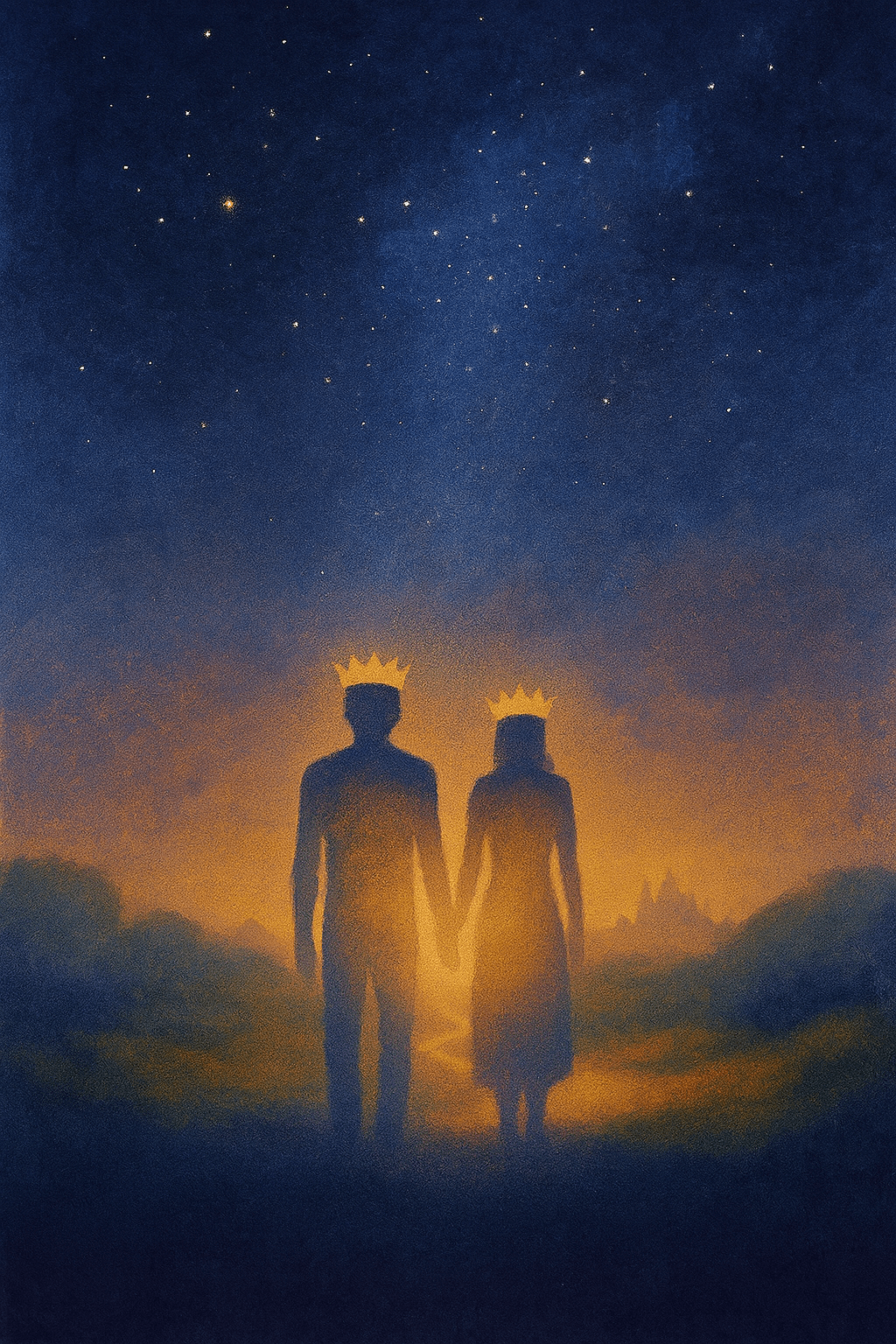
Abstract contemplative artwork of two glowing human silhouettes standing hand in hand under a vast starry night sky. Golden crowns rest on their heads, symbolising humanity’s royal vocation as the image of God. They are bathed in soft golden light, walking toward a distant radiant city on the horizon, with deep blues and purples blending into warm tones of dawn.”

The Bible begins with one of its most subversive claims: humanity is made in the “image of God” (Genesis 1:26–27). This phrase has sparked centuries of reflection. What does it mean to bear God’s image? Is it about dignity, rationality, creativity, or something even greater?

Humanity in the Image of God: Creation as a Cosmic Temple

Genesis 1 is not only a story of beginnings but a story of ordering. The repeated refrain “And God said… and it was so… and God saw that it was good” has the rhythm of a liturgy. Each day God separates, names, and fills, establishing order out of chaos (Genesis 1:2–10).

In the ancient Near Eastern world, temples were microcosms of the universe. They represented the ordered dwelling place of a deity within the chaotic world outside. At the heart of every temple stood an image of the god, placed there after the temple was “ordered” through ritual. This image signified the presence and rule of the god within that sacred space.

Genesis takes this familiar idea but reimagines it in a radically different way. The cosmos itself is God’s temple. The heavens are his canopy (Isaiah 40:22), the earth his footstool (Isaiah 66:1). The seven days of creation culminate in God’s “rest” (Genesis 2:2–3), which in temple language means not inactivity but taking up residence and beginning to reign. God has ordered his cosmic sanctuary, and now he rules from it.

The twist is the image placed within this temple. Unlike the lifeless idols of stone or wood, God’s image is living humanity (Genesis 1:26–28). Men and women are appointed as his representatives, reflecting his character and carrying out his rule in creation. In John Walton’s words, the world is God’s cosmic temple, and humanity is his living idol.

This means the vocation of the image-bearer is inseparable from worship. To be made in God’s image is to participate in the ordering of creation, to extend the boundaries of sacred space until all the earth becomes filled with the knowledge of the Lord (Habakkuk 2:14). Humanity’s task is temple work: to tend, to guard, and to expand the harmony of God’s presence.

Eden as the First Temple and Humanity’s Priestly Role

Genesis does not describe Eden in architectural terms, but later Scripture makes clear that the garden and the temple are deeply connected. The garden is the archetype of sacred space, and the temple is patterned after it.

In Eden, Adam and Eve are given the commission “to work it and keep it” (Genesis 2:15). These two Hebrew verbs abad (to serve) and shamar (to guard), reappear later in the Torah, not for farmers but for priests. The Levites are said “to serve and to guard” the tabernacle (Numbers 3:7–8; 8:25–26). Their task is not just maintenance but worship, guarding the holiness of God’s dwelling from intrusion and defilement. Adam and Eve, then, can be mapped onto the priesthood as its first representatives, called to minister in God’s sanctuary.

The parallels between Eden and Israel’s sanctuary reinforce this. Both are entered from the east (Genesis 3:24; Ezekiel 40:6). Both are filled with imagery of trees, cherubim, and rivers of life (Genesis 2:10–14; 1 Kings 6:29–35; Ezekiel 47:1–12). Gold and precious stones adorn Eden (Genesis 2:11–12), just as they decorate the temple (1 Kings 7:48–50). Even the menorah, with its branches and blossoms, recalls the tree of life at the garden’s centre.

Scholars have argued that the temple is a deliberate echo of Eden, a place where heaven and earth meet, where God’s presence dwells, and where humanity is invited to serve as a kind of priesthood. What Adam and Eve were in the garden, Israel’s priests became in the temple. And what Israel’s priests foreshadowed, the church is called to embody in Christ: a royal priesthood serving in the cosmic temple of the new creation (1 Peter 2:9; Revelation 21:22).

The Distortion of the Image of God Through Idolatry

When humanity abandoned its calling, the image of God became distorted. Instead of reflecting the living God into the world, human beings turned their gaze downward and outward to created things. Scripture calls this idolatry.

The psalmist captures the tragedy with cutting irony: “Their idols are silver and gold, made by human hands. They have mouths, but cannot speak, eyes, but cannot see. They have ears, but cannot hear, noses, but cannot smell… Those who make them will be like them, and so will all who trust in them” (Psalm 115:4–8).

We become what we worship. When we worship idols, we are shaped by their lifelessness. They cannot speak, and so their worshippers lose the voice of true praise. They cannot see, and so their worshippers lose spiritual sight. They cannot act, and so their worshippers lose vitality, becoming passive shadows of what God created them to be. The tragedy of idolatry is not only that we fail to worship God but that we are dehumanised in the process.

Paul makes this point in Romans 1. Refusing to glorify God, humanity “exchanged the glory of the immortal God for images made to look like a mortal human being and birds and animals and reptiles” (Romans 1:23). In turning from the Creator to creation, humans traded their vocation as living images of God for dead imitations of what they desired. Instead of becoming radiant icons of God’s glory, we turn into caricatures, mirrors of idols that can never give life.

This is why idolatry is not just a matter of bowing to statues or pagan gods. It is about misplaced devotion. Career, nation, wealth, pleasure, or even family can become idols when they take the place of God. And when they do, they shape us. A culture that worships money becomes consumed by greed. A society that worships power tends to become violent. A person who worships self becomes hollow. As the prophets warn, idolatry always diminishes. It silences, blinds, and hardens.

Idolatry is the anti-image. It reverses humanity’s vocation. Instead of being mirrors angled toward God and creation, as N. T. Wright puts it, we become mirrors angled in on ourselves. We reflect nothing beyond our own emptiness. This is why the Bible treats idolatry not as a minor sin but as the root distortion of what it means to be human.

Israel as a Kingdom of Priests and a Corporate Image of God

Israel was chosen to carry forward the vocation of Adam and Eve. At Sinai, God declared: “You shall be to me a kingdom of priests and a holy nation” (Exodus 19:6). Scholars stress that Israel was called corporately to bear God’s image by reflecting his character to the nations (Deuteronomy 4:6–8; Isaiah 42:6).

The tabernacle and temple were microcosms of Eden, places where God’s presence dwelt (Exodus 25:8–9; 1 Kings 8:10–11). Israel’s priests mirrored Adam’s task, serving and guarding holy space. Yet, like Adam, Israel fell into idolatry (2 Kings 17:7–18; Jeremiah 2:11–13).

Jesus Christ as the True Image of God

The New Testament announces that Jesus Christ is “the image of the invisible God” (Colossians 1:15). What Adam distorted and Israel failed to embody, Christ fulfils. He is the perfect image, “the radiance of God’s glory and the exact representation of his being” (Hebrews 1:3).

Where Adam reached for autonomy, Jesus humbled himself in obedience (Philippians 2:6–8). Where Israel was faithless, Jesus remained faithful. In Jesus, we see true humanity at last: the angled mirror restored. He reflects God into the world and lifts creation’s praises back to the Father.

At the cross, the curse of Adam was undone (Romans 5:17–19). The cross itself becomes a new “tree of life” (Revelation 2:7; 22:2), and from Christ flows the river of living water (John 7:37–39). In the resurrection, humanity’s vocation is renewed (1 Corinthians 15:20–22).

The Church as a New Creation and Royal Priesthood

Through union with Christ, the church is restored as the image-bearing community. Paul calls believers “a new creation” (2 Corinthians 5:17). Peter calls them “a chosen people, a royal priesthood, a holy nation” (1 Peter 2:9). This echoes both the Edenic and Sinai experiences.

Empowered by the Spirit (Acts 2:1–4), the church is called to extend God’s reign, to embody his presence in the world, and to reflect his character to the nations (Matthew 5:14–16). The church is not saved to escape the world but to anticipate the renewal of creation, partnering with God, bearing His image in Spirit-filled lives of holiness, justice, and worship.

Revelation and the Fulfilment of the Image of God

The final pages of Scripture reveal where the entire story has been leading. John’s vision in Revelation is not about escaping earth but about heaven and earth becoming one, creation renewed, restored, and filled with God’s presence.

He sees a new heaven and a new earth (Revelation 21:1). The holy city comes down, radiant and alive, like a bride prepared for her husband (Revelation 21:2). A voice from the throne declares what was always God’s intention: “Look, God’s dwelling place is now among the people, and he will dwell with them” (Revelation 21:3). What was glimpsed in Eden, God walking with humanity in the cool of the day, is now fulfilled on a cosmic scale.

John says there is no temple. “I did not see a temple in the city, because the Lord God Almighty and the Lamb are its temple” (Revelation 21:22). The temple has served its purpose as a signpost. Now the whole creation has become the sanctuary. God’s presence is not contained in any building but fills every space, and his people live fully as priests within it.

The imagery takes us straight back to Eden. A river of life flows from the throne, and on each side stands the tree of life, bearing fruit each month and bringing healing to the nations (Revelation 22:1–2). The garden sanctuary, lost through sin, is restored, expanded, and secured forever. The exile east of Eden is undone, and humanity is brought home.

And what of the image of God? It reaches its fulfilment here. “They will see his face, and his name will be on their foreheads” (Revelation 22:4). To bear God’s name is to bear his image perfectly, no longer fractured by sin, no longer bent toward idols, no longer half-lit by shadows. Humanity’s destiny is communion, not autonomy, participation in glory rather than deformation into lifelessness. “They will reign for ever and ever” (Revelation 22:5).

Here everything comes together. The cosmic temple finds its goal. The priesthood of Eden, the vocation of Israel, the faithfulness of Christ, and the Spirit-filled life of the church are all gathered up and perfected in the New Jerusalem. What was distorted by idolatry and restored in Christ is now complete.

To speak of the image of God is to speak of our future. We are not creatures fumbling for meaning in the dark. We are God’s living images, created to reflect his glory into creation and creation’s praise back to him. Revelation shows us that future fulfilled: humanity radiant with God’s presence, reigning with the Lamb, mirrors angled perfectly at last.