Gaining Wisdom

He who learns must suffer. And even in our sleep pain that cannot forget falls drop by drop upon the heart, and in our own despair, against our will, comes wisdom to us by the awful grace of God.

 – Aeschylus, Agamemnon 1. 177

Yoda, Gandalf, Rafiki, Dumbeldore, Morpheus, Professor X are among some of the greatest and wisest of characters throughout fictional cinematic history. We immediately gravitate towards these characters because they guide the hero (us) along the path, without them, there would be no happy ending. We love them because each one of us craves to either have someone like that in our lives or because we wish we were like that ourselves. How great would it be to be as wise as these characters? Even within our own history, we envy those who have gone before who seemed glimpse into the world a little then ourselves. Buddha, Muhammed, The Dhali Lama, The Pope, Jesus Himself. Each one (whether you’re religious or not) a guru and a sage in their own right. Each one has changed the course of history and that of their people in profound ways we’re only still beginning to comprehend. If only we had just a slice of their wisdom and insight into the world, maybe we’d have inner peace, perhaps we’d have it all together like they did. Maybe.

Unfortunately, wisdom has a high price. Nothing in this world is free, and wisdom is no exception to this rule. Whether it was fighting a Balrog, fighting in the clone wars and being overthrown by the Sith or being on the constant lookout for the One, Yoda, Gandalf, Rafiki, Dumbeldore, Morpheus, Professor X all went through their own trials to gain the wisdom and knowledge they had. Gautama (the actual name for the Buddha) had to observe and experience suffering before realising it had to be overcome and thus becoming enlightened. Even the Dhali Lama, how many lives (it’s a Hindu thing) has he gone through to accumulate the wisdom he aims to share with the world? Then there’s Jesus Christ Himself the Son of God, the greatest of them all, yet even He suffered and died so that His saving Gospel could go forth into every nation, tribe and tongue. Wisdom comes at a high cost, and it is pain, trials and tribulation.

Not only does it take pain and trials to acquire wisdom, but it takes a vast amount of time to accumulate it. There’s a reason why age is associated with wisdom. It is because those who are older have gone through the pain, they’ve experienced the vanity of this world and grasp what it is that makes the world tick. This is tied to their experiences. No amount of sitting under a tree or inspirational mountain hikes or #worshipsessions will give you wisdom, it’s something God teaches you as you walk gradually through the highs and lows of life. But it does begin with God (Prov 2:6), and as the Spirit carries you along the rough seas of life, you must always keep in mind that each vouge is a lesson that the Master has to bestow to you. We must have ears to hear and eyes to see and open hearts to receive.

The Epistle of James is a timely piece to read and meditate on. The main theological theme of James is wisdom and faith during trials and tribulations. James encourages us to ask God for wisdom. For He will give it liberally without hesitation (James 1:5). That the sort of wisdom God gives is “pure, peaceable, gentle, open to reason, full of mercy and good fruits, impartial and sincere” (James 3:17).  That these good fruits are produced through patience and a lifetime of learning through trials (James 5:7-12).

For me, I am learning to embrace and cherish each moment that is painful and hard (and there’s been a few of them lately) as I try to remember that God is working this out for my good (Romans 8:28), that He is sovereign over history which includes my life (Genesis 5:20; Psalm 115:3; Proverbs 16:9), and that out of He will conform me to the likeness of His Son Jesus (Romans 8:29) who is wise beyond measure (Colossians 2:3).

“Time, as it grows old, teaches all things.”
― Aeschylus, Prometheus Bound

Let’s Fight Depression

I have learned to kiss the waves that throw me up against the Rock of Ages. – C. H. Spurgeon

It’s only been hours since Jarrid Wilson pastor, and author of Love Is Oxygen: How God Can Give You Life and Change Your World, and Jesus Swagger died by suicide. As a personal favourite of mine, the news hit me hard. For the past two hours, I’ve been at a loss for word, tearing up, confused, shocked, and unable to properly process how someone like Jarrid – with a beautiful wife and two amazing kids, a successful author and megachurch pastor could, in a single moment give it all away. My heart aches for him, his friends and his family. I can bearly begin to fathom the hurt, trauma and anguish in the days, weeks, months and even years that are ahead for those closest to him. However, this hasn’t been the only case recently where a pastor has chosen to end their life rather than continue on. Suicide, depression and mental health problems are bombarding the Church in what seems like higher numbers than ever before. Personally, as someone who identifies strongly with this, I can’t help but say “this is not the kind of Christianity that I signed up for.” So many questions are rolling around in my head. Why is this happening to us? What is depression, and why is it so crippling? How do we fight this? Where’s God in all of this? I really don’t know.

This is not the Christianity I signed up for. Sure, I didn’t expect it to be all rainbows and butterflies, but the Christian life is meant to be full of joy and love and goodness, right? We were all told that God has a great and wonderful plan for our lives, that He wants to bless and prosper us. Where’s the light and easy yoke? Where’s the comfort, and the peace that surpasses all understanding? These are all legitimate promises and verses in the Bible, yet, in reality, it often feels like we rarely ever experience it. The fallen world gets the better of us. Sin crouches at the door, and it feels like we rarely rule over it. Depression smashes us and leaves us without hope, and we end up feeling like the Psalter who says:

My soul thirsts for God,
    for the living God.
When shall I come and appear before God?
My tears have been my food
    day and night,
while they say to me all the day long,
    “Where is your God?”
These things I remember,
    as I pour out my soul:
how I would go with the throng
    and lead them in procession to the house of God
with glad shouts and songs of praise,
    a multitude keeping festival.

Why are you cast down, O my soul,
    and why are you in turmoil within me? (Psalm 42:2-5a)

Notice though the glimmer of hope, how he longs to gladly shout praises amid his sorrow.  How hard it is to see the light at the end of the tunnel. I get that … I really do. God, dear beloved friend, gets it even more. Jesus, the man of sorrows shares in your pain, your anguish and your tears and He took them to the Cross. He longs to take hold of you and never let go. He loves you more then I could ever express in mere words. I know it’s impossible for you to see, but He offers new life.

Depression is dark and uncertain, but God called forth light and defeated darkness on the Cross so that we might live and live it abundantly. 

I don’t have answers. God does. Take up your swords fellow depressed and beaten down brothers and sisters, slay that which seeks to destroy your soul, take hold of the One who wants to bear your burden and for God sakes join arms with others. Please, we want to help you even if all we can do is hug you tight and pray. The fight sucks, but it is worth it…

Finally, here is my challenge:

  1. Christians make yourself available and make that publically known to everyone around you. Don’t let someone slip through the cracks because you were too lazy to love someone.
  2. Pastors stop preaching trash. Get it into your thick skull, the message of the Bible isn’t sunshine and lollipops. It’s light overcoming darkness, and that’s yet to come to completion until our King returns. Preach the Cross. Preach freedom. Preach life. Just don’t forget to preach it out of the reality we live in, not the one we try to create for ourselves.
  3. If you’re struggling hardcore with this and you know me. Contact me, please. Let’s walk, talk and drink coffee together. I’ll listen, pray and give you a hug. You’re worth it and much much more.

Existential Christianity

A friend of mine once said the “Gospel” we preach today is the reason why so many people are at a loss with the Church. It’s the reason why so many of us are struggling with depression, anxiety, gender identity, and why once-famous Christians are walking away. Maybe. I think everyone believes that their “Gospel” is the right one. I think everyone thinks that if everyone just got their “Gospel” then the world would change and BAM! Jesus comes back and all is well with the world. The problem with thinking like that is that even in the midst of biblical Christianity, the Apostles had a lot of crap to deal with. Life didn’t get better for them, it got worse. They had hope in Jesus, but in their immediate set of circumstances, the Church was killed and ostracised for being a cult and for rebelling against the State (the Roman Empire). I’m now half a world away and two thousand years into the future. There might not be a Roman Empire per se, but mental health issues, social and educational persecution, the prosperity Gospel, liberalism and a swath of issues are on the front lines of the Church’s Western Front. Principalities and powers indeed.

Not only that but more than ever in the history of humanity information and in turn philosophical and scientific theories are spreading like wildfire. You can walk into one room full of ten people with vastly different perspectives and get ten different definitions on the meaning of life and how it should be lived. Even among Christians, I’ve rarely met any two people who could agree on what it even means to be Christian. We all say yes and amen at “love thy neighbour,” but what it actually means to do that looks completely different to whoever it is your talking to.

Personally, as I venture down the black hole that is theological and philosophical thought, I find myself, in my strive for wisdom, in a constant inner war between two primary concepts; meaninglessness and purpose (found in Christ). I find myself very much at home with the existentialist or even the authour of Ecclesiastes. There is a realness to life I think we all try to avoid. We all wear smiles as we attempt to turn that frown upside down. It’s socially awkward to admit that life sucks. “How are you?” “Yeah, good” or “not bad” is our autoresponse. Life slaps us in the face when a loved one dies or a tragedy befalls us. Suddenly it’s ok to cry, to mourn and to hurt… yet… every one of us does that every day. There’s a beautiful dread to life that we hate admitting exists. If it weren’t for the Gospel then where would I, or any of us be?

Here’s my point to all of this. Human, get good at talking about the pain and the hurt and the despair. These are real things forming (perhaps even unwittingly) an identity inside every one of us. They take root, they form us and they make us into who we are behind the masks we all wear. Then thrust the Gospel of life into their hearts. Peel back the layers of chaos and bring the shalom each one us truly aches for. Life is beautiful but it can be more in Jesus the Messiah.

“For the whole law is fulfilled in one word: You shall love your neighbour as yourself. Let love be genuine. Abhor what is evil; hold fast to what is good. Rejoice with those who rejoice, weep with those who weep. By this, all people will know that you are my disciples if you have love for one another” (Galatians 5:14; Romans 12:9, 15; John 13:35).

Life and Death: Genesis 1-11 Part III

Death is the sound of distant thunder at a picnic. – W. H. Auden

Quick note: I’ve skipped a few sections in this series, but I felt compelled to write about this sooner rather than later. So like Starwars, some of these posts will be out of order. Thanks 🙂

There is nothing more sobering than the death of a loved one. When someone dies, it is the perfect time to deeply reflect on the value of life, purpose and destiny. Why does death exist? Why do we all have to die? After we die, then what? Important questions and the answer largely depends on what you believe about humanity, God and the Bible. It’s taken me a while to write this post because I’m constantly challenged on my perspective of death. Growing up, death was a reasonably foreign idea. I had a cat that died, but apart from that, I didn’t really have any relationship with it. It probably wasn’t until my dad died just a few years ago that the reality of death kicked in.

In the Bible, the first place we come across the idea of death is in Genesis 2:15-17. Here God has placed mankind in Eden to work and keep it. Then God tells them that they could eat from any tree in the Garden except the tree of knowledge of good evil; otherwise, they’ll die. What an odd story. Eat fruit from any tree except this one, or you’ll die? Is the fruit poisoned? Does God really like this one particular tree? Are they allergic to its fruit? What’s going on here? A careful reflection on the story might lead one to consider that there’s more going on here than meets the eye. First, there are two main trees in the Garden here (Gen 2:9). The tree of knowledge of good and evil and the tree of life. Don’t eat from one, but you can from the other. In the story, these trees were representative of important and more profound realities. Wisdom/knowledge and eternal life. Let’s focus on the tree of life for a moment.

In the ancient near eastern world, these kinds of trees are associated with youth and the reversal of age. In the Gilgamesh Epic, there is a plant called “old man becomes young” that grows at the bottom of the cosmic river. In the rest of the Bible, the tree of life is portrayed as offering life and new life (Prov 3:16-18; 15-4), and can also be found in Revelation (2:7; 22:1-2, 14-15, 18-19) where the tree of life and the river of life are associated. For me, this sheds a bit of light on the meaning of what’s going on here in Genesis. A new creation is happening in Revelation. Renewal of the earth and the removal of sin and corruption where creation is finally united to God in the complete sense of that phrase. In Genesis 2, something similar is happening, unity, flourishing and absence of sin.

Furthermore, the mention of rivers in Genesis 2 flowing out from the Garden coupled with the tree of life says to me that this is where all life and goodness comes from, this Garden, this sacred space. Except for one crucial difference. In Revelation, there is no tree of knowledge, there is no presence of sin.

Now for the tree of knowledge of good and evil. The name given to the tree is counter-intuitive. Knowledge is good, right? Isn’t gaining the ability to discern between good and evil something we should have? Obviously, something more is at play in the story. First, it’s important to note that the Hebrew word for evil here is different from the way we use it today. Western philosophy is loaded with a certain ethical definition that isn’t necessarily in the original Hebrew word. It’s probably better to understand the word evil as bad or not good for you. For example, the word can also be used of things God does (Jdg 9:56-57; 2 Sam 12:11; Isa 45:7). However, we know that God is good and that in Him there is no darkness at all (1 John 1:5), so the word doesn’t always have to have the same philosophical definition that we have for it. I suppose my point is; this tree represents knowledge to distinguish between what’s bad for us and what’s good for us in the world. We call this wisdom. Essentially, eating from the tree meant choosing to live by our own wisdom (this is the definition Genesis 3 gives for defining to be like a god), rather than living by Yahweh’s wisdom. Let’s just stop for a moment. It’s not like Adam and Eve didn’t know what the right thing to do was. They certainly believed that they were going to die if they ate the fruit from the tree. It wasn’t until the serpent tempted them that they decided to become gods themselves.

So now to death. God said, “of the tree of the knowledge of good and evil you shall not eat, for in the day that you eat of it you shall surely die” (Gen 2:17). The thing is Adam and Eve don’t die when they ate the fruit, at least not in the conventional sense. Adam lived until he was 930 years old. He had a long full life, longer than ours. So then death needs to be understood as something more than simply not existing. First, the plain meaning of death here does incorporate physical death. Adam might live until 930 years old, but he does end up dying, and I believe that’s something that’s not apart of God’s good creation (Gen 3:19; Rom 5:12; 1 Cor 15:55). However, the kind of death emphasised here is a relational separation from God who is the source of all light and life (Gen 2:7; Job 33:4; Neh 9:6; John 1:3-4; 1 Tim 6:13). Like I argue in my post on Genesis 1, Moses’ audience and the later Exilic audience would have understood Genesis 2-3 as their current experience, being separated from the land, sacred space, and God’s presence as a result of human rebellion.

To conclude, death is two-fold.  It is separation from God’s presence and the ceasing of one’s physical existence. One inevitably leads to the other. Because Adam and Eve were exiled from the Garden (God’s presence), so was all of humanity in Adam. Because the inevitable consequence of rebellion and separation is physical death, all shall die. But there is good news. God makes all things (including death) work together for the good of those who love Him, according to His purposes (Rom 8:28). Though we all may die, those who turn to Christ will actually find their life (Matt 10:39, 16:25; Mark 8:35; John 11:25-26), and will take part in His resurrection (John 6:39; Rom 6; 1 Cor 6:14, 15:20-23; 1 Thess 4:16; Rev 21:1-5). We’re all exiles now (1 Peter 1:1-2), but one day, those who have bowed the knee to Christ and given Him their allegiance will be raised up on the last day and rule alongside Him in a New Heaven and a New Earth in perfect harmony with God, one another, and creation. So let’s choose to eat from the tree of life (God’s wisdom), rather than choosing to decide what’s good for us. The fear of God is the beginning of wisdom (Prov 9:10), and it is a fearful thing to fall into the hands of the living God indeed (Heb 10:31).

Genesis 1-11 Part II: In the Beginning

In the beginning, God created the heavens and the earth. The earth was without form and void, and darkness was over the face of the deep. And the Spirit of God was hovering over the face of the waters. – Genesis 1:1-2

A long time ago before I became a Christian, I remember dating a girl who’s family were hardcore believers. I remember one day being at their house, bored, and picking up a Creation magazine. Two things stuck out to me. First, that the earth was around 6000-10,000 years old and second that they didn’t believe aliens existed. Immediately I knew they were crazy. However, it wasn’t long until I thought these things myself. When I became a Christian, I hit the ground running with the Scriptures. I soaked up everything it had to say and just believed what I thought it was telling me. For most of my Christian life, I believed that God created the earth around 6000 years ago, that there was a real talking snake in the Garden, and that ideas like evolution were a lie cleverly constructed to deceive the world into believing that God doesn’t exist. I was taught by many people (people who are still dear friends today) that unless you believed these things you weren’t taking Jesus, the Bible or the Faith seriously. So I joined their tribe. I often went street preaching, seeking to debunk evolution and turn people to Jesus. For me, atheism and evolution went hand in hand, and if you could disprove one, the other would fall. Sure, I had heard about Christians out there who believed in evolution (they’re known as theistic evolutionists). However, they were considered liberal, twisting the Scriptures, compromising and it probably wasn’t long until they walked away from the Faith altogether. Since then, a lot has changed. Bible college set me on a trajectory of seriously studying the Scriptures in its original context and genre. I remember quite clearly that the first theological position that shifted was my eschatology. I went from being a Premillenail Dispensationalist to a Convenential Amillinealist. The next thing that started to change was my approach to the Scripture itself. I went from reading Bible verses in isolation from one another to seeing huge thematic threads that reverberated throughout the entire Biblical narrative (I came to know this as biblical theology).

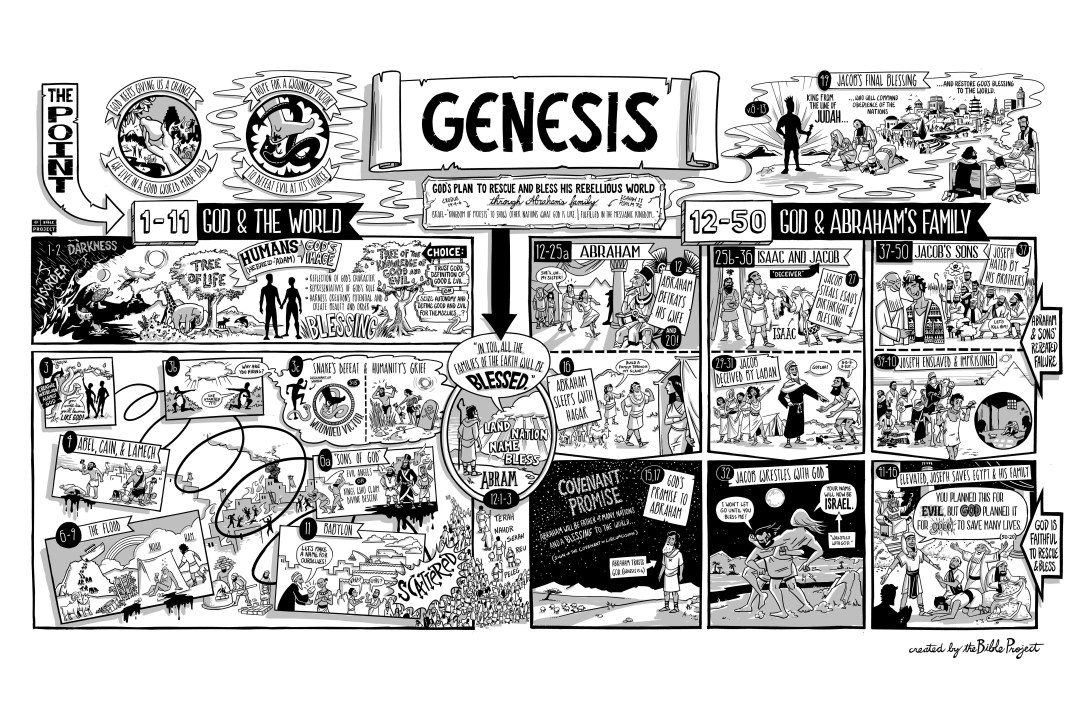
I began to understand the importance of context, genre, audience, authorship and to look for the authors intent (much of which I discuss here). Huge biblical themes like temple and sacred space, priesthood, union with God and much more, lit up the Bible as it began to sing to me a sweet alluring song that I haven’t been able to get out of my head to this day (not that I’ve tried). Eventually, I came across Tim Mackie and the Bible Project. They kept pointing out how important the story of Genesis 1-11 was for the entire biblical narrative, and wow was I amazed. Coupled with what I was learning at college, these guys turned the Bible from Netflix into 4k VR surround sound where, at times, it was almost like I could touch God Himself through the very pages I was reading. Now, as a result of all this, over the last three years or so I’ve shifted in my view of Genesis 1. Let’s explore.

Genesis 1 has been the subject of much speculation and debate for thousands of years. Each generation or era has a different take on what’s happening in the text, and I actually don’t think that’s a horrible thing. I believe God intends for us to reflect on whatever it is we’re reading in the Bible into our own context and live out the implications as God’s people. However, this shouldn’t be at the expense of the original intended meaning of the text. As far as I can tell, I see three main theological themes being explored in the first chapter. 1. God and who He is. 2. The ordering or construction of sacred space. 3. The establishing of humanity and their vocation in relation to God, sacred space, and the created order.

When we turn to the first page in the Bible, the very first thing the author wants us to notice is that there is a god and that this god created the heavens and the earth. Who is this god? This is where context is so important. If Moses wrote Genesis (I discuss authorship in a previous post), then his cognitive environment would have shaped his understanding of who this god was. For Moses and the Israelites in the Exodus events, the same God who brought them out of Egpyt was the same God who was the Creator in Genesis 1. This can be further supported by the use of the title “LORD God” in Genesis 2:4 (and onwards) where the author seems to be making an emphatic claim that this is indeed Yahweh Himself. The God of Israel is the God of the entire cosmos.

Just this line of thought alone has some profound implication for its readers. The most obvious is that God doesn’t merely create the universe, order it, and leave it to its own devices (deism). Instead, if this god is Yahweh Himself, we see that He is always at work throughout human history. God is both transcendent and immanent. He is distinct from His creation but is at work in it and often through it to bring about the redemption of a fallen world. The New Testament later picks this up by throwing Jesus into the mix (see: John 1 and Col 1:15-17).

Furthermore, in a polytheistic world, the idea that one God created the cosmos would have been a little edgy. In the ancient near eastern world (ANE), there were many other creation narratives, each depicting a council of gods creating the cosmos, usually chaotically, through violence and battle. Instead, God here simply speaks, and there is light, stars, animals etc. Very chill. To me, this says something about God’s character. Rather than having chaos reign, God is all about order, peace, shalom. In fact, this can be further supported by the use of the word create. This leads me to my next point. Order out of chaos and sacred space.

Here is where I blend a few ideas together. First, we read that the earth was formless and void. The Hebrew wording here can be translated as wild and waste, desolate and chaotic. Picture, if you can, a tumultuous watery wasteland that continuously churns and destroys. This was the state of the world before day one. Immediately the readers would have picked up on what was happening here. In the surrounding ANE world, there were plenty of creation narratives where chaotic and wild waters were to be overcome by the gods. It’s where the great leviathan dwelt, chaotic and dark sea creatures at odds with the plans of the gods (see the Enûma Eliš as an example). To the ANE world, dark, chaotic waters and leviathan were something to be feared, yet in the text, God simply brings order out of this chaos by speaking, unlike the ANE gods that wared over it. Furthermore, the leviathan was made to be a good creature, not an evil one in Genesis 1:20-23 (c.f. Ps 104:26). Similarities? Yes. Absolutely. It goes without saying that we’re going to find similarities between people groups in the same cognitive environment.

The differences, however, are important. Instead of God having to fight or war for lordship over the chaos and darkness, He is lord from the very beginning. The chaos creatures are actually His, and so are the waters. They’re subdued and ready to be moulded in the hands of the Creator. From here, God takes the wild watery wastes and uses them to form His sacred space – temple.

John Walton in his book “The Lost World of Genesis 1” argues that the Hebrew word for “created” in Genesis 1:1 shouldn’t be understood as ex nihilo (creation out of nothing), rather it should be understood that God orders the cosmos into a cosmic temple (sacred space). I recommend you read his book and wrap your head around the full argument. From what I’ve learned from him and other resources I concur. The ANE world was more concerned with function and order then they were about the material origins we’d usually read into the text. One analogy Walton uses is the difference between a house and a home. The way we usually read the text is like building a house. We place down the foundations, the walls, roof etc. Where the ANE was more interested in a home with furniture, food etc. A home is where one thrives, lives and flourishes, the other is more about material origins. This is likely what’s happening in the text. The author is more interested in function and home in the sacred space God is about to order, rather than the material origins of the universe. In this blog, I explore the theme of temple and how it relates to the biblical story. In the next post, we’ll explore more about the theme of temple and how it relates to what’s happening here.

So to wrap up this part of the series:

  1. The god in Genesis 1 is Yahweh. He is the sole creator, sustainer and Lord of life.
  2. The earth was in a wild, dark and chaotic space then God starts to order it.
  3. God is arranging a sacred space or temple.