
When Christians Misunderstand the Gospel: Why “God Reigns” Is More Radical Than We Think

A lone silhouetted figure runs along a distant mountain ridge beneath a vast twilight sky of deep blue and violet. Golden light breaks at the horizon, symbolising heaven and earth meeting in the reign of God. The atmosphere is quiet, cosmic, and filled with hope.

What if the greatest misunderstanding in modern Christianity is not about morality or politics but about the gospel itself? What if the good news we share is smaller than the one Jesus announced?

We often describe the gospel as a private story about forgiveness, heaven and personal salvation. Yet in Scripture the gospel is something far larger. It is the announcement that God reigns. It is not only about the state of our souls but about the state of the world. It is a claim about reality itself, a declaration that creation has a rightful King.

And that claim changes everything.

The Gospel as Royal Proclamation

In Hebrew, the word for good news is besorah, a royal announcement of victory (Isaiah 52). In Greek, it is euangelion, the public declaration that a king has triumphed (Mark 1).

Imagine an ancient city under siege. The people wait behind their walls, anxious for word from the battlefield. Then a runner appears on the hills, covered in dust, shouting between breaths, “Good news! Victory! The king has won!”

That was euangelion. It was not advice or philosophy but the kind of announcement that makes the world different because it is true.

When Isaiah writes, “How beautiful on the mountains are the feet of those who bring good news, who say to Zion, ‘Your God reigns’” (Isaiah 52:7), he is describing that runner. The heart of the gospel is that Yahweh has returned to rule His world.

Centuries later, Jesus begins His ministry with the same royal declaration: “The time is fulfilled, and the Kingdom of God has come near. Repent and believe the good news” (Mark 1:15). He is not inventing a new religion but announcing that Israel’s long-awaited hope has arrived. God’s reign is breaking in.

The Kingdom Woven into Creation

The story of God’s Kingdom does not begin with Jesus. It begins in Genesis, where the rhythm of creation beats with divine rule (Genesis 1-2).

In the first three days, God shapes the realms of creation: light and darkness, sky and sea, land and vegetation. In the next three, He fills those realms with rulers: the sun and moon, the birds and fish, the animals and humanity.

The story is one of order and relationship. God reigns by creating and sharing. His rule is not control but care. Humanity, made in His image (Genesis 1:26-28), is invited to share that reign and to reflect His goodness, justice and creativity into the world.

To rule, in the biblical sense, is not to dominate. It is to cultivate. It is to join God in the work of making the world flourish.

The Kingdom of God is not a future dream. It is the structure of reality itself. Heaven and earth were made to live together (Genesis 2:15). Sin fractures that harmony, but the mission of God is to bring it back, to restore what was lost and heal what was broken.

Jesus: The King in Person

When Jesus announces the Kingdom, He is not speaking about a distant future or an inner feeling. He is proclaiming a change of reality. Where He walks, heaven and earth meet. The sick are healed, the outcasts restored, and the powers of darkness pushed back (Luke 4:18-9; Matthew 12:28).

At the cross, the world’s false rulers do their worst. Yet in that act of humiliation, the true King is enthroned (John 19:19). Through resurrection, His victory is declared not over Rome but over the powers that hold all creation captive: sin, death and decay (1 Corinthians 15:25-26).

Paul’s hymn in Colossians captures it perfectly:

“He is the image of the invisible God, the firstborn over all creation. In Him all things hold together. Through Him God was pleased to reconcile all things, whether on earth or in heaven” (Colossians 1:15-20).

This is not private spirituality. It is cosmic renewal. Christ holds the whole story together. In Him, the Creator’s original dream of heaven and earth united is set in motion again.

The People of the King

The early Christians understood this far better than we often do. They did not treat faith as an escape plan but as a new citizenship (Philippians 3:20). They believed that the Spirit who raised Jesus now lived within them, calling them to live as citizens of a new world (Romans 8:11).

Every act of love and hospitality, every work of justice or reconciliation, was an echo of the good news. It was a small proclamation that “our God reigns” (Isaiah 52:7).

The Kingdom is not confined to heaven or to church gatherings (though, as I argue elsewhere, the church should be a slice of the new creation). It is wherever the reign of Christ shapes hearts and habits, homes and communities (Matthew 5-7). It is wherever people reflect His character in the ordinary and the everyday.

N. T. Wright once said that the church does not bring the Kingdom by force; it embodies it by faithfulness. That is the invitation: to embody the reign of the King.

The Kingdom Completed: New Creation

The story of Scripture ends where it began, but expanded and fulfilled. A garden becomes a city. Heaven and earth are reunited.

John’s vision in Revelation captures it:

“I saw a new heaven and a new earth… and I heard a voice from the throne saying, ‘See, the home of God is among mortals’” (Revelation 21:1–3).

This is not an escape from the world, but rather its healing. The good news is not that we leave creation, but that God enters into it and restores it (Romans 8:19–21).

Every tear will be wiped away. Every injustice will be answered. The scars of the old world will become the beauty of the new (Revelation 21:4–5). The reign of God will fill everything.

Living Under His Reign

If the gospel is the announcement that God reigns, then discipleship is the art of living as if that reign were already true (Matthew 6:10). Repentance means realigning with reality, turning from our small empires to join the life of the King.

Faith is allegiance. It is trust that God’s rule is good and that life under His care is freedom, not bondage (John 8:36).

Every prayer, every meal, every act of mercy or courage is a way of saying again, “Your God reigns” (Isaiah 52:7).

The gospel is not good advice. It is good news.

And that news is this: heaven has begun to come down to earth. The reign of God is arriving quietly, patiently, beautifully, until all things are made new.
God Who Walks in Twilight

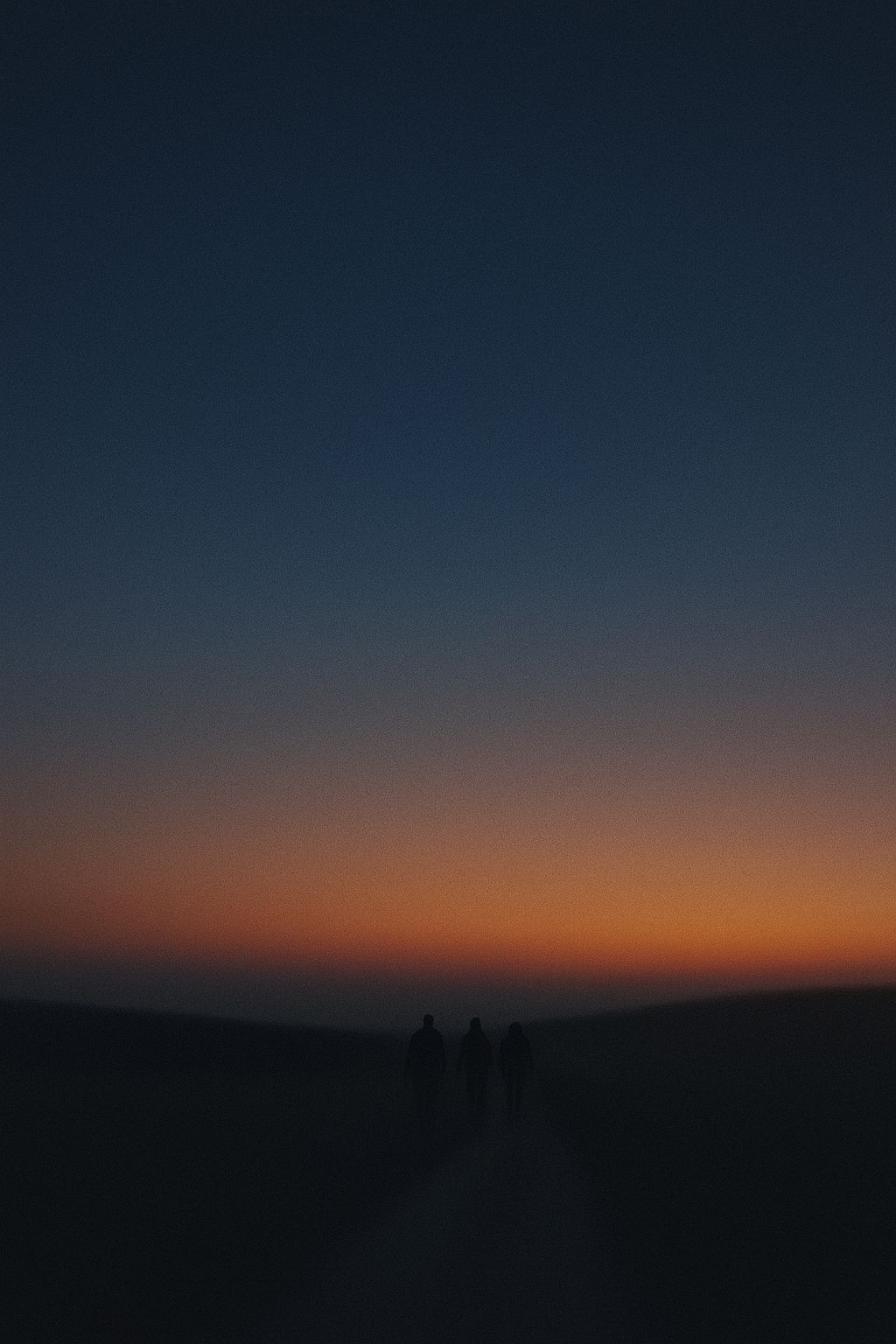
Twilight scene with a person walking on a winding path under a colourful evening sky, symbolising God walking in the cool of the day.

At the Wind of the Day

The first time we hear of God walking, it is not in a blaze of glory.
Not in the brightness of noon when everything is sharp and defined.
It is in the cool of the evening, Genesis says.
The Hebrew calls it l’ruach hayom, “at the wind of the day.”

That soft shift when the heat is letting go and the air changes,
when light seems to slip away almost without you noticing.
It is the time when the work has been done
but no one has yet gone to bed,
when the shadows pull long lines across the ground
and you feel that strange mix of ending and beginning at the same time.

From the start, God is not a voice far off in the heavens.
He is there in the dust, walking.
Unhurried.
Not pressing toward a task.
Just present in that in-between space.

And that time of day keeps turning up in the story, as if God likes it.
Abraham meets Him near the oaks of Mamre when the sun is leaning away.
Israel’s first Passover happens “between the evenings,”
with lamb’s blood on doorframes while the light is thinning.
In the Temple, the daily rhythm gives that same hour a place of its own
the evening sacrifice,
the smell of bread and incense
rising into the dimming sky.

Jesus keeps to the pattern.
On the road to Emmaus,
He meets two people when the day is almost spent.
He walks with them,
talks with them,
and sits at their table,
and in the breaking of bread,
as the darkness edges in from the fields,
they know Him.

It feels like twilight has always been His hour,
the place where He can hold light and dark together in one moment.

Maybe that is why most of life with God seems to happen in the in-between.
We live in the “already and not yet” of His kingdom.
Evening-souled people,
learning the slow pace of faith,
breathing out hope that has learned how to wait,
lingering in love that does not rush away.
He still comes walking when the air cools
and the day takes its last breath.


Creation to New Creation

That first walk in Eden ended badly,
with hiding and shame where welcome should have been.
But the story does not stay there.
At the end of Scripture, in the New Jerusalem,
there is no night at all, and the gates are never closed.
It is as if the first invitation to walk with Him is restored and made permanent.

The story that began with God searching for His image bearers in the evening breeze
ends with Him living among them,
no lamp needed,
because the Lamb Himself is their light.

For now, we live in the long dusk between creation and new creation.
But when the wind shifts,
when shadows stretch out over the ground,
when the air feels like it is holding its breath before the dark,
I think of Him.
I think of how He has not stopped walking.
And I hold onto the hope
that one day this twilight will give way,
not to night,
but to a dawn that never ends.

The God Who Refuses to Behave: Wrestling with God at Peniel

I’ve been told God is tidy. Predictable.

A polite guest who knocks at the door of my heart (Revelation 3:20)
and waits patiently until I invite Him in.

Calm. Respectable.
Never raising His voice.
Never moving a chair out of place
unless I have done something so bad He cannot ignore it.

But that is not the God I have met.

The God I know does not knock.

He storms in
like a summer squall,
blowing the screen door off its hinges.

I have felt Him in the sting of sudden tears while washing dishes.
In the silence after a friend spoke truth I did not want to hear.
In the way a bush can blaze in the middle of nowhere (Exodus 3:2).

He walks through locked rooms (John 20:19).
He meets you in the night for a wrestling with God
until you cannot tell if you are losing or being saved
just as Jacob did at Peniel (Genesis 32:24–30).

Some days I love Him for this.
Some days I do not.


Not the God of Neat Theology

I used to think faith was holding the right answers in a tight grip.

I could draw the Trinity’s diagram.
Recite the problem of evil like a manual.
God as a solved equation.

But He slipped through my grip.

Like wind through a cracked window
rattling the frame.

Job knew this.
He asked for reasons and got a whirlwind (Job 38–41).

Questions instead of answers.
Not cruelty, invitation.
Awe, not explanation.

The Bible’s God has edges.

Fire on Sinai (Exodus 19:18).
A whisper Elijah almost misses (1 Kings 19:12).
Splitting seas (Exodus 14:21–22).
Walking gardens at dusk (Genesis 3:8).

Same God.
No one pattern.
The same untameable God who shows up in ways we never expect.


The Unmanageable Presence

We put Him in systems.
Creeds.
Charts.

Doctrine matters.
But I have seen how beautiful cages still hold prisoners.

And the God inside always finds a way out.

Jeremiah sees almond blossoms in winter (Jeremiah 1:11–12).
Hosea marries the unfaithful (Hosea 3:1).
Mary gives birth in straw and animal breath (Luke 2:7).

None of it fits the script.

The mystics knew.

Meister Eckhart prayed, “God, rid me of God.”
Julian of Norwich called Him “our clothing”
close as skin
but also a love without edge or floor.


The Rebellion of Love

I have heard Him in creation groaning (Romans 8:22).
In the psalmist’s clenched fist:
“Awake, O Lord! Why do You sleep?” (Psalm 44:23).

I have seen Him in the eyes of the crucified
where my answers go to die (Mark 15:34).

I do not want the domesticated god anymore.

The god who never interrupts.
The god who never overturns.

The real God flips tables (John 2:15).
Strips my blankets.
Leaves me with Himself.

No roadmap.
No checklist.

Just a Presence.
Wild. Untameable.
Too beautiful to bear for long.


The Limp of Faith: Wrestling with God

Jacob left Peniel with a blessing and a limp.

The limp is holy.
The awkward walk of those who have been wrestling with God
and lived to tell of it.

I have learned to live with mine.
To let mystery sit where certainty used to.

God’s ways are higher (Isaiah 55:8–9).
Not just in glory
in strangeness too.

Let the theologians frown.
Let the pious keep their polite God.

I will take the One who wrestles me until dawn.
Who wounds to heal.
Who tears down my idols
and gives me Himself.


The Dangerous God Who Saves

He will not fit my doctrines.
But He will fit my wounds.

He splits seas.
Mends hearts.
Consumes like fire (Hebrews 12:29).
Hides me like a refuge (Psalm 32:7).

He will not behave.
And that is good news.

Because a God who will not behave
is a God who will cross every line to find me.

Even the line between life and death.

If that is dangerous theology
then give me more danger.


And if You will not behave

If You will not behave
neither will I.

I will not pray tidy prayers.
I will pray with fists.
With silence.
With the names I do not know how to use for You.

If You will not stay in the lines
take me with You.

Past the fences.
Past the rules.
Past the maps I drew to keep from getting lost.

Find me in the dark.
Wrestle me to the ground.

Bless me with the limp
that teaches me how to walk.

And I will call it love.

Written in Heaven

A biblical theology of suffering and hope

Suffering will find you

as it found Him.

But your name is written in heaven,

In light no shadow can touch.

In the beginning,

God breathed into dust

and called it good.

But even before the dust was firm beneath our feet,

a shadow waited.

The Serpent spoke,

and we listened.

The Garden shrank behind flaming swords,

and we stepped into the world

with thorns in our hands

and longing in our bones.

(Genesis 3)


Pain was not the beginning

but it was the consequence of forgetting

who we are.

Still, God did not turn away.

He clothed the shame.

He called the wanderers.

He wrestled with Jacob,

wept with Hannah,

answered Job not with reasons

but with a storm.

He carved covenant into stone,

carried the cries of Israel through wilderness,

and spoke comfort even in exile.

(Exodus, Deuteronomy, Isaiah, Lamentations)


And when words would no longer suffice,

The Word became flesh (John 1).

Not safe flesh,

not unmarked flesh

but bruised, bloody, breakable.

He came not to explain suffering

but to inhabit it.

To be born under empire,

to labour in obscurity,

to sweat blood,

to carry a cross.

“He was a man of sorrows,

acquainted with grief.”

(Isaiah 53:3)


The God of the cosmos

entered the wound of the world

and made it His dwelling place.

The cross is not a detour.

It is the way.

“If anyone would follow me,” He says,

“Let them deny themselves,

take up their cross daily,

and follow.”

(Luke 9:23)

This is not cruelty.

It is an invitation.

To union. To dying. To resurrection.

To be baptised not only in water,

but into His death.

(Romans 6:3–5)


And yet

your name is written in heaven.

(Luke 10:20)

This is what He told them, not after comfort, but after conflict.

Not when they were safe, but when they were sent.

When they saw demons fall and darkness tremble,

He said:

“Do not rejoice in this…”

“Rejoice that your names are written in heaven.”

Because what matters

is not that you wield power,

but that you are known.

Held.

Remembered.

Inscribed in the eternal.

“See, I have engraved you

on the palms of my hands.”

(Isaiah 49:16)


The apostles knew.

They were beaten and blessed.

Scattered and sealed.

They rejoiced to suffer disgrace for the Name. (Acts 5:41)

Paul was no stranger to thorns

in the flesh, in the church, in his prayers.

And yet he wrote:

“We suffer with Him,

that we may also be glorified with Him.”

(Romans 8:17)

“These light and momentary afflictions

are preparing for us

an eternal weight of glory.”

(2 Corinthians 4:17)

Even creation groans, but not in despair,

in birth.

(Romans 8:22)


The Spirit does not take away the ache.

The Spirit groans with us.

Prays when we have no words.

Dwells in the dust with us

until all things are made new.

And they will be.

For He will come again.

Not as a suffering servant,

but as the One who wipes every tear.

(Revelation 21:4)


And He will not forget.

He will open the book, the Lamb’s book

and read the names

that the world has tried to erase.

The names written in heaven

before the foundations of the world.

(Revelation 13:8)

Yours among them.

Suffering is not the evidence that you are lost.

It is the path of the saints,

the shape of the cross,

the echo of Eden groaning toward glory.

And you,

even as you weep,

even when you are wounded—

are not forgotten.

Your name is written in heaven,

in light no shadow can touch.

And the One who knows it

still bears scars of His own.

The Deep, the Breath, and the Beginning of Meaning

Poetic and Theological Reflections on Genesis 1:1–2

“Now the earth was formless and empty, darkness was over the surface of the deep, and the Spirit of God was hovering over the waters.”Genesis 1:2

In the beginning

there was no beginning.

Not like we think.

Not a ticking clock

not a big bang or a blank slate.

Only

deep.

dark.

Formless

unfurnished

uninviting.

And the Breath of God

hovering

not rushing

not fixing

not panicking

just waiting.

A mother-bird

brooding over brokenness

wings sheltering what could be.

This is where our story starts

not in triumph

but in tension.

Not in arrival

but in anticipation.

In the beginning,

God didn’t make things

not first.

God made room.

A place.

A sacred space.

He carved order out of what was not yet useful.

He called forth function

from futility.

He said:

“Let this be a place where I dwell

and they dwell.

Let it be home.”

The first act of creation

was not to build

but to breathe.

And the Breath still moves

over your chaos.

over your depths.

over your formless days

and unlit nights.

Don’t rush the Spirit.

It’s still hovering.

It’s still preparing.

It’s still holy.

Because in the beginning,

God made time to wait.

And called even the waiting good.

A Theological Reflection

Genesis does not begin with a scientific explanation nor with abstract philosophy. It begins with God. “In the beginning, God created the heavens and the earth” (Genesis 1:1). But what follows is striking: “Now the earth was formless and empty”—tohu v’vohu in Hebrew—”darkness was over the surface of the deep, and the Spirit of God was hovering over the waters” (Genesis 1:2). The story opens not with perfection, but with potential. Not with answers but with mystery.

This state of tohu v’vohu—wild, waste, and without purpose—is not described as a problem to be eradicated but a canvas awaiting intention. In the biblical imagination, this primordial chaos is not evil. It is simply untamed. The deep, or tehom, is not a demonic force to conquer, as in the Babylonian Enuma Elish, but an unordered reality that awaits divine speech.

Genesis 1 is not a science textbook. Nor is it an ancient myth. It is sacred theology told through poetic narrative. As I’ve written elsewhere, Genesis 1 is not about material origins but functional order. It’s not primarily about how the world was made but how God gave it meaning. In the ancient Near Eastern mindset, something did not truly “exist” until it had a name, a function, a role in the cosmic order. As Old Testament scholar John Walton argues, creation in Genesis is about assigning purpose, not assembling matter.

This is evident in the structure of the text: six days of calling forth realms and rulers—light and dark (Day 1), sky and sea (Day 2), land and vegetation (Day 3), and then the lights (Day 4), birds and fish (Day 5), animals and humanity (Day 6). Each act ends with God’s affirmation: “And God saw that it was good” (Genesis 1:10, 12, 18, etc.). Good not as morally perfect, but functioning as intended. Creation is liturgy. Each day builds like a worship service, culminating in God’s rest on the seventh day (Genesis 2:1–3).

Genesis 1 portrays the world as a cosmic temple, with God taking up residence on Day 7. In the ancient world, a temple was not finished until the deity rested within it. “The heavens are my throne, and the earth is my footstool,” says the Lord in Isaiah 66:1—a temple image that harks back to Eden. When God rests, it’s not because he is tired but because creation is complete, purposeful, and ready to be inhabited by the divine presence.

Notice also what God does not do. The Spirit of God does not launch into production but hoversrachaph in Hebrew—like a bird tending its young (Deuteronomy 32:11 uses the same word to describe an eagle hovering over its nest). This is not a moment of domination but of delicate presence. Before God says a word, God is simply there, waiting, brooding, holding space. The Spirit does not conquer the darkness but prepares the way for light.

This image is carried throughout Scripture. In the Gospels, when Jesus is baptized, the heavens open, and the Spirit descends like a dove (Luke 3:22). The waters part, the voice speaks, and once again, God hovers over the waters—not in creation now, but in new creation. Paul will echo this theme in 2 Corinthians 5:17: “If anyone is in Christ, the new creation has come.” Creation and re-creation are both acts of divine hovering, divine speaking, divine presence.

Likewise, in John 1, we hear another beginning: “In the beginning was the Word… through him all things were made” (John 1:1–3). This is Genesis 1, revisited with Christ at the centre. The chaos is not overcome by violence but illumined by speech: “The light shines in the darkness, and the darkness has not overcome it” (John 1:5). There is no war between light and dark in Genesis, just a calling forth—of form from formlessness, rhythm from silence, cosmos from chaos.

So we are reminded that Genesis is not just history—it is theological storytelling. It doesn’t answer all the questions of “how,” but it speaks profoundly to the questions of “why.” Who are we? What kind of world do we live in? What kind of God do we serve?

A God who hovers.

A God who speaks meaning into voids.

A God who rests not when he is done making but when the world is ready to be home.

So when we look into our own chaos—personal, cultural, existential—we do so not with fear but with faith. Because the God of Genesis 1 still hovers. Still speaks. Still brings light out of darkness.

Genesis opens not with resolution but with possibility.