Through the Dry Blue Desert

This poem was inspired by a recent blog I posted that shares about my journey and where I’m at now in the journey of faith. Read that then read this, sometimes there are only things that only poetry can explain.

The blue desert is unyielding and never fair. Wind – the deserts breath whisps around us, drawing us nearer to death.

Our mouths are dry from speaking destruction, our throats are rough from vomiting and gaging chaos into the world.

Yet we thirst for our Oasis in the world’s strange blue desert. Somewhere safe, abundant, flourishing and satisfying.

Our Oasis is there waiting for us to drink from Him. Pleading for us to rest in Him and to invite others to find Him.

Walk wanderer walk and you will find life everlasting.

A Scary Search for God Through A Million Miles of Blue Desert

Weird title hey? I was looking over the books of one of my favourite author’s Donald Miller and sort of meshed all the books I’ve read together. So enjoy that. Anyway, here are some random musings for the week. This is about really what I’m going through now in my walk with God. I hope this resonates with some of you. I’d love to hear from some of you 🙂

For me, my journey in the Faith started just before I turned twenty. God and Jesus were unfamiliar people, Christianity immediately seemed to be far too institutional, and the people in it weren’t any better then I was outside of the Faith. I hit the ground running, eager to be light years ahead theologically of anyone I knew and to change the world, the church, and the Faith for Jesus. Needless to say, I was vomiting zeal while injecting uninformed idealism into my veins. Furthermore, I was desperate to belong, On any given day I was inches away from being Reformed, charismatic, or some other tribe within the Christian-Protestant tradition (I think I was almost Catholic or Orthodox at one point). I read copious amounts of books on prayer, the Bible, revival, church, theology, and the classics from Spurgeon, Murray, Torrey, Finney. I went to a bible college where, like a sponge, I soaked up a theological education that placed me, so I thought, on top of the “Christian ladder.” I would even hit the streets where I would share the Gospel with anyone who’d walk by, desperate to pluck a soul from the fiery furnace of Hell that I believed any and all were destined to go without the forgiveness of sins. I was, as they say, a machine. It wasn’t until I started walking with a mentor and close friend of mine that I started to realise I was doing a lot but something really lacked in my relationship with God. The intimacy was missing that I think every Christian from time to time mulls over and wonders if God is even there. All of a sudden I started searching for God instead of doing a bunch of things, and it scared me. Suddenly my grounding wasn’t in my actions, my reading list or my theological education but I desperately was trying to find grounding in God Himself and in doing so, I hoped to find out who I truly was. This journey has been as strange, bewildering, lonely and hopeless as wandering through a million miles of dry blue desert (and it’s still going).

What am I even talking about? I’m not sure I know. What I do know is this. God is more than books and theology. God is more than the sermons and lectures, works and good things that I do. I’m reminded of a quote by Donald Miller where he says:

“There is something beautiful about a billion stars held steady by a God who knows what He is doing. (They hang there, the stars, like notes on a page of music, free-form verse, silent mysteries swirling in the blue like jazz.) And as I lay there, it occurred to me that God is up there somewhere. Of course, I had always known He was, but this time I felt it, I realized it, the way a person realizes they are hungry or thirsty. The knowledge of God seeped out of my brain and into my heart. I imagined Him looking down on this earth, half angry because His beloved mankind had cheated on Him, had committed adultery, and yet hopelessly in love with her, drunk with love for her.”

I read that and let out a breath I didn’t know I had been holding on to for maybe the last seven years. I need the knowledge of God to seep out of my brain and into my heart. I want to feel God as much as I read about God. I want to actually talk to Him, hear Him and feel His Spirit working in and through me. If the Christian life is only listening, reading, doing and never experiencing, I’m not sure that I want it.

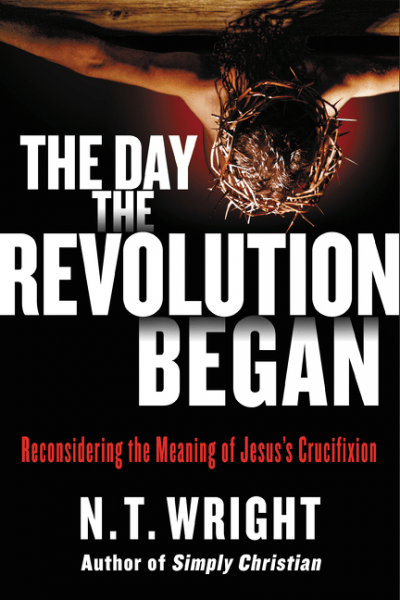
The Day the Revolution Began: A Developing Book Review

So I’m reading “The Day The Revolution Began” by N. T. Wright. I’m up to chapter 5 and I thought I’d share my thoughts on the book and Wright so far. My hope is that this review will serve as a platform for discussion and edification. I’m interested to hear any of your thoughts.

1. N. T. Wright is one of my favourite modern day theologians for a multiplicity of reasons including his work on Second Temple Judaism, justification and works, and his refreshing take on Christus Victor. Revolution, in particular, has given some great insight so far into the background of the Cross and into biblical themes such as priesthood and how that is fulfilled in Christ as well as clarifying some things around Christus Victor and the context that the Reformers were writing in.

2. I have read either in parts or all of many of his books and have always found myself challenged and often motivated to live out the Christian life in its fullness, in some ways Revolution is no exception to this. I have certainly been spurred to take seriously idolatry which is always for me personally, refreshing.

3. Despite the praises I give to Wright, I have some issues with Revolution. I have told one friend of mine that reading the book is sort of like an abusive relationship, there are things I hate about the book but I’m always drawn back to it. In particular, I have an issue with the way Wright caricatures Penal Substitutionary Atonement (PSA). I have always come to appreciate the scholarship and academic tone of Wright’s works, however, so far whenever he talks about PSA he speaks about it with venom and likens PSA to that of pagan worship. If I didn’t know any better (but I do) I would say that Wright and anyone who believes this about PSA completely misunderstands PSA’s depths and beauty.

(However, I understand that Wright is broad brushing from experience and usually wouldn’t pit this against theologians such as Thomas R. Schreiner. In fact, Wright both affirms PSA and doesn’t lump him into his broad brushing of PSA in a recent debate with Schreiner centred around Revolution.

4. Unfortunately, I can understand how some could be led to reject altogether the idea of PSA in favour of Christus Victor or any other model of the atonement. However, don’t fall into the trap of pitting one against the other. Properly taught, the atonement incorporates so many things including both PSA, CV and I suspect other theories as well. But to reject PSA in favour of other models is grossly unbiblical and can have vastly unhealthy implications that I’m not sure I could predict (this can be true of holding exclusively to PSA as well).

5. Would I recommend the book? In short, yes. It is worth a read. But I recommend it lightly seasoned with a warning. Wright is not a heretic, nor is he dangerous, but Revolution (at least so far) can have you asking more questions than rolling around in answers. Wright is unforgiving in his treatment of PSA but don’t let that lead you to reject it in favour of exclusively any other model.

Conclusion: The atonement is vast, deep and stunning. A proper approach to it would lead any soul to be reconciled to God and any Christian into a deeper relationship with Him. I pray that a book such as this would lend towards that goal for any who pick it up as I firmly believe that was Wright’s intent in writing it.

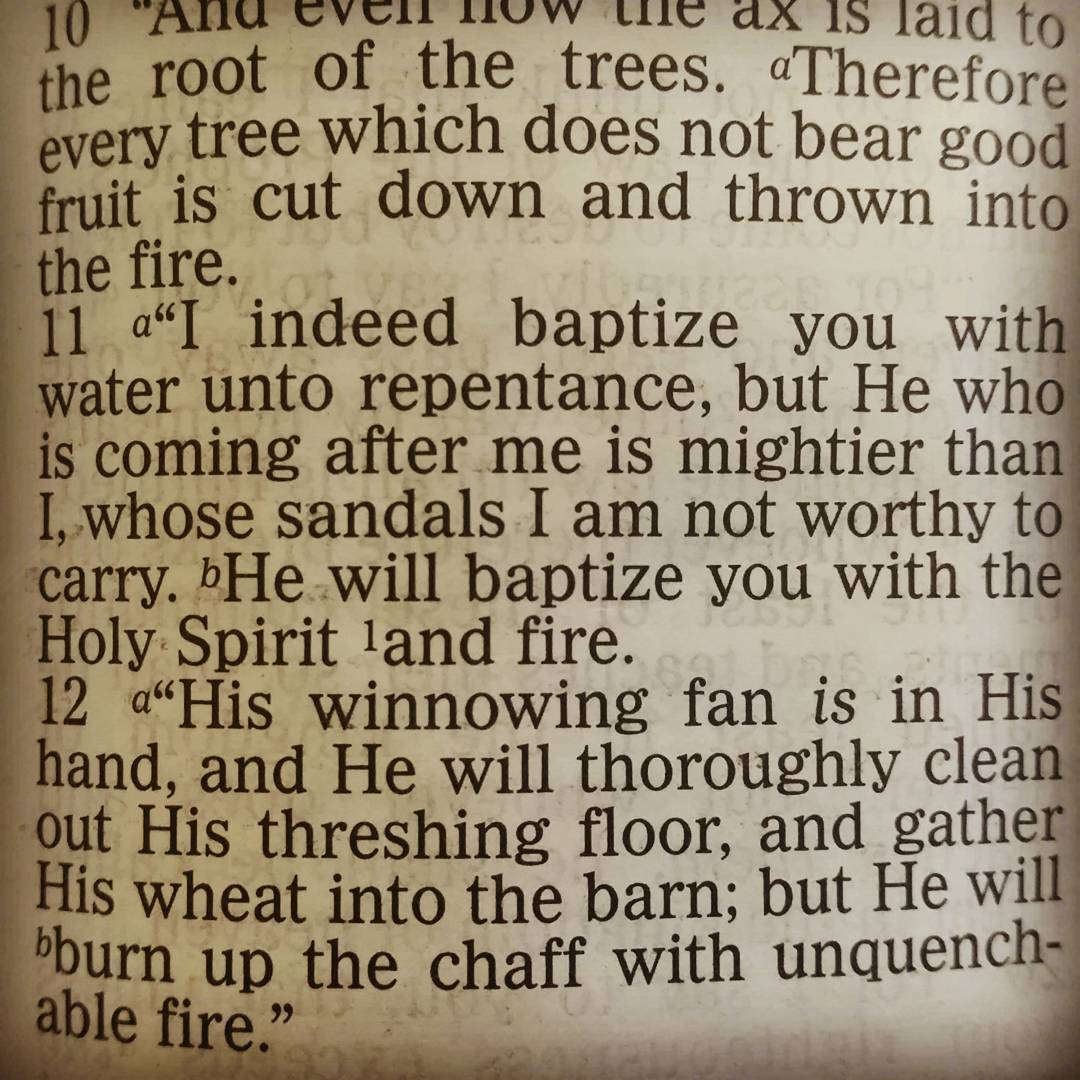
John the Baptist: Water and Fire

Introduction

This Sunday I will be preaching a sermon on John the Baptist, and I have got to say if John the Baptist was the greatest of those born of a woman (Luke 7:28), I have a lot to live up to. What’s more, the next thing Jesus says is that even the least in the Kingdom will be greater than John (very convicting). As I reflect on this, I think to myself, “I’ve baptised maybe 3 or 4 people in my life, preached a hand full of sermons and have hardly ever experienced or seen a person come into the Kingdom.” Not everything is that bad. I’ve seen incredible growth in people’s lives in the church that I minister in. Those baptisms I mentioned have happened this year, and our youth and young adults are starting to grasp concepts and parts of the Gospel that I have only just started to come to terms with myself. However, I think there are some great lessons to be learnt as we look at the (brief) ministry of John the Baptist (lessons that even I need to take into account).

First: John was Chosen

The first thing that stands out to me is that John was chosen by God. That might scare some people, however, not only does the angel Gabriel appear to John’s father Zacharias (Luke 1:11-20), but John’s coming, and ministry was foretold hundreds of years before he was born (Isaiah 40:3). I know that John was a particular case, but the New Testament says that we’ve been chosen in Him before even the creation of the world (Ephesians 1:4), and chosen for good works in Jesus Christ (Ephesians 2:10). So in this sense, we are all pretty special, and we all have a pretty important role to play in God’s plan. I think that the main point here is that we need to take the call on our lives seriously, just because we weren’t necessarily foretold, it doesn’t mean God didn’t have us in mind before the world was even created.

Second: John was Chosen to Prepare the Way

He said, “I am the voice of the one crying out in the wilderness, ‘Make straight the way of the Lord” (John 1:23, ESV). Another interesting element of John’s ministry was that he was chosen to prepare the way for the coming Messiah. John did this by baptising people (Matthew 3:5-6) and preaching a message of repentance and the immanence of the Kingdom of Heaven (Matthew 3:1-2).  Scripture doesn’t give us a lot to go off, but we know from Luke that all of this was wrapped up into the promise that John would “turn many of the children of Israel to the Lord their God” (Luke 1:16). This is a prominent call to Christians because the Church is called to do the same thing. For example, John preached a message of repentance and of the Kingdom, in the same way, we are to preach to the world that the only way in which a person can be saved from their sin is if they repent and believe in the Gospel (Acts 16:31; Romans 10:9) and that the Kingdom of God is near (Matthew 10:7; Luke 10:9).

Furthermore, John Baptised people who responded to his message immediately into the Jordan River. Likewise, Jesus commands us to baptise as this was a necessary part of the Great Commission (Matthew 28:16-20). However, why is baptism so important to both John, Jesus, and the early Church?

The Importance of Baptism

The act of Baptism is scattered all throughout the New Testament (Matthew 3:13-17; Mark 1:9-11; Acts 2:38; Acts 8:35-38; Acts 16:31-33). However, where we find the importance of baptism, and it’s meaning in Romans 6:1-14 (See also: Galatians 3:27; Colossians 2:11-14). The main thrust of Paul’s argument in this section of Scripture is that water baptism is a picture of a deeper spiritual reality that has happened to every believer. That is, we have all been baptised (immersed or united) into Jesus’ death (6:3), and resurrection (6:5), and as a result, sin no longer has the power to rule over the believer (6:14). Water baptism was important because it showed an unwavering act of commitment and trust that a person has been spiritually united with Christ by grace, through faith. Essentially, it meant that a person was born again and that they had become a new creation in Christ (2 Corinthians 5:17).

Third: Baptising and Preaching with Fire

Unfortunately though, one of the saddest things that I’ve seen in the Church (in my experience at least) is the under-appreciation and even neglect of baptism. These days we can wait months or even years before we baptise a professing Christian. This is usually because we want to wait until we are sure that they are serious about their commitment to Christ, or because we want to make sure they are “orthodox” before we dunk them in water. The saddest thing about this though is that this is just a product of the Gospel we preach. The Church preaches such a weak Gospel in the power of the flesh, and not in the power of the Spirit that we are afraid that people are really only giving Christianity “ago” because it’s new and fresh, not because they are fleeing the wrath to come or that they want to be reconciled to God. The early Church wasn’t like this. The early Church preached the Gospel that was the power of God unto salvation to whoever would believe (Romans 1:16). This was the same Gospel that, coupled with the power of the Holy Spirit, cut people to the heart and added thousands of people to the Church in one moment (Acts 3:37, 41). We’ve missed out on the relentless preaching of the Gospel and the immediate act of baptism that John held so dear. Leonard Ravenhill in his book Why Revival Tarries really gets to the heart of the matter when he says,

John the Baptist was in God’s School of Silence, the wilderness, until the day of his showing forth. Who was better fitted for the task of stirring a torpid nation from its sensual slumber than this sun-scorched, fire-baptised, desert-bred prophet-sent of God with a face like the judgement morning? In his eyes was the light of God, in his voice was the authority of God, and in his soul was the passion of God! Who, I ask, could be greater than John? Truly “he did no miracle,” that is, he never raised a dead man, but he did far more he raised a dead nation!

Likewise, who is better fitted for the task of stirring a dead world and even in many cases a dead Church then each one of you reading this blog? God has called every Christian to be filled with the Spirit (Ephesians 5:18) and preach the Gospel boldly. My point is this. Like John, preach the Gospel in its entirety, be filled with the Holy Spirit, and baptise people immediately upon their confession of faith because if the Gospel is preached in power, what have we to fear?

Conclusion

As we reflect on the calling that John the Baptist had on his life, we can start to be encouraged and pursue God, and His calling for the Church in the same manner. Let us consider God’s call on our lives, let us prepare the way for the second coming of our Lord with a fiery tongue that has been lit by the power of the Holy Spirit. Let us repent of our half measured Gospel, our measured half-life of faith, and walk in the Spirit so that we, like John, may stir the Church, and the world, into God’s Kingdom.


Glorifying God With Our New Year’s Resolutions

Introduction

It’s about this time of year, as Christmas slowly creeps upon us, with the New Year hand in hand, that we start to think about what the New Year will hold for us. This time of year we start making New Year’s resolutions which usually include working out more, eating right, reading a certain amount of books (tick), starting a new love life, getting promoted etc. etc. The problem, however, is that a lot of the resolutions we end up making are empty and end up not working out. I can’t even count how many times that I have promised to myself that I would work out better in the New Year, but instead, get caught up playing Halo or the new Fallout. For Christians, though, our resolutions can look a bit different. We can say to ourselves that we are going to pray more in the year to come or read the Bible more. These are great goals to set, don’t get me wrong. The problem, however, is that 9 out of 10 Christians (in my experience) that I’ve met fail to fulfil these resolutions as well. So maybe the question we should all be asking ourselves as the New Year approaches is, “as a Christian, what resolutions should I be setting for myself that I can actually fulfil so that God may be glorified?”

Glorifying God First

As I have mentioned in my blog on Identity and Idolatry: Part I, we were all created in the image and likeness of God (Gen 1:26-27). Furthermore, the reason why we were created was to reflect God’s image to the world so that He may be glorified and be made known to all of creation. If this is true (I will write on this in a separate blog), then as Christians we have to consider if the resolutions we want to make are set up so that they make God more known to the rest of the world.

John Piper has a lot of great stuff to say about glorifying God. However, one quote stands out to me where he says,

I asked, Why did God create the world? And I answered: God created this world for the praise of the glory of his grace displayed supremely in the death of Jesus. The problem is that at the heart of that answer is God’s self-promotion. God created the world for his own praise. For his own glory.

What Piper says is pretty profound. I think if we all gave serious consideration to what is being said, it would change the way we would do everything in our lives. God created everything (and ultimately us) so that His glory would be displayed to everyone and so that He would be praised. This means that when we make resolutions for the New Year, we need to ask the question, “does this display the glory of God, or is this self-serving?”

Making the Right Resolutions

If, as Christians, we want to make the resolutions for the New Year, we have to seriously consider a few essential things. First, we have to (like I have already mentioned) ask, “what will glorify God the most?” If we are mindful of glorifying God in every resolution we make, then it will be easier for us to decide which resolutions are worth pursuing and which ones aren’t.

Second, if we want to glorify God in our resolutions, then we must actually take seriously the call to reflect His greatness to all of creation. Unless we take seriously the call that God has on each Christians life to reveal His fame and glory to the world, every resolution (and everything we do for that matter), will ultimately fail and fall short of what God has intended for us. So take the time to read Scripture and pray to God so that the call to glorify God settles deep into your heart.

Lastly, we have to do whatever God is calling us to do without compromise. It is so easy to compromise on our resolutions. Many of us begin our New Year well, but a few months into our resolution, we start to neglect and compromise on what we originally set out to do. If we are serious about glorifying God in our resolutions, this can’t be an option. We have to see the resolutions that God has placed onto our hearts to its end, no matter how long this takes. This can only be done if we depend on God for everything, and if we walk by the Spirit (Galatians 5:16). Whatever your resolutions for the New Year may be, do it all to the glory of God without compromise and with a serious heart to reflect God to the entire world.