
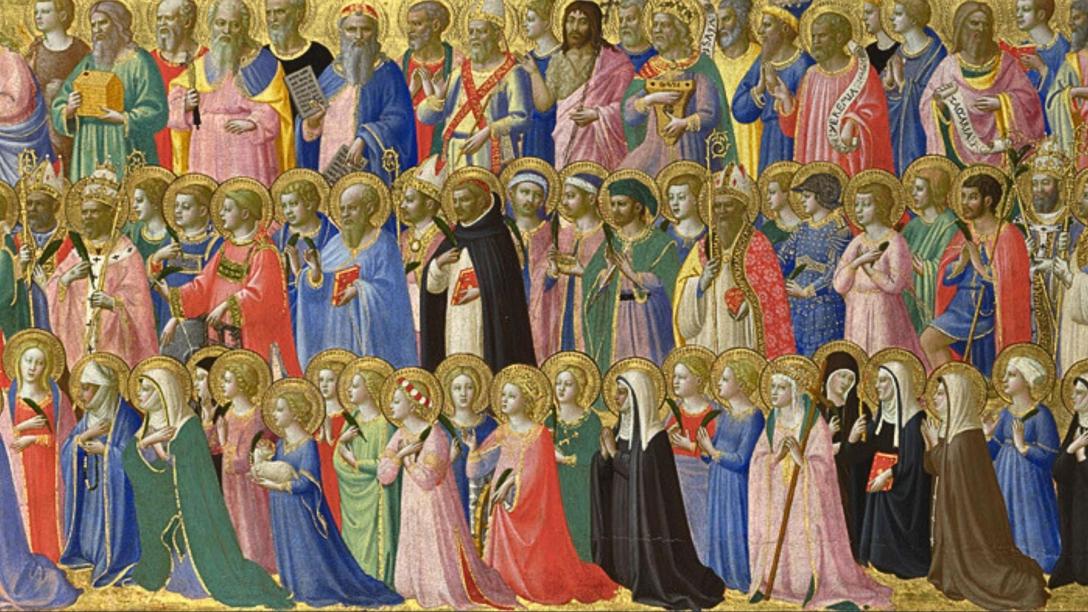
Suggest celebrating All Saints’ Day in some Protestant churches, and there’s a reasonable chance somebody will ask whether you’re planning to start praying to Mary next.
I’m not, for the record.
But I do find our discomfort with the saints rather interesting, especially at this time of year.
Yesterday was Halloween, a celebration that seems to generate an extraordinary amount of anxiety in certain Christian circles. I’ve written about that previously, so I won’t revisit the argument here.
Today, however, is All Saints’ Day. The Christian celebration from which Halloween, or All Hallows’ Eve, gets its name. Yet in many Protestant churches, the occasion will pass without much attention.
Obviously, this isn’t true everywhere. Anglicans, Lutherans, Methodists and others have long maintained traditions of remembering the saints. But in some evangelical and independent Protestant communities, the language of sainthood can still feel suspiciously Catholic.
I wonder whether, in our determination to distance ourselves from certain Catholic practices, we’ve ended up neglecting something that belongs to the whole Church.
After all, saints were around long before the Reformation.
Did the Reformers Actually Reject the Saints?
The Protestant Reformation raised serious questions about the veneration and invocation of saints, particularly whether Christians should seek the prayers of those who had died.
These weren’t trivial concerns. They involved genuine theological disagreements about prayer, mediation, biblical authority and practices that had developed within the medieval Church.
But the Reformers weren’t necessarily opposed to remembering the saints themselves.
The Augsburg Confession, one of the foundational documents of Lutheran theology, explicitly approves remembering the saints so that Christians might imitate their faith and good works.
Its accompanying Apology goes further, describing three appropriate ways of honouring them: giving thanks to God for their lives, strengthening our faith through their example, and imitating their virtues.
The same documents reject invoking the saints. Evidently, the Reformers responsible for them could distinguish between remembering faithful Christians and seeking their intercession.
The Reformed tradition also retained the language of sainthood. Chapter 26 of the Westminster Confession describes the communion of saints as a shared participation in Christ and in one another’s spiritual gifts. It doesn’t prescribe celebrating All Saints’ Day, but it certainly doesn’t treat sainthood as a foreign concept.
John Wesley was rather fond of the occasion, too. In his journal entry for 1 November 1767, he described All Saints’ Day as a festival he loved.
So the idea that remembering the saints is somehow inherently un-Protestant doesn’t hold up particularly well.
I suspect part of the problem is that, in certain circles, we’ve inherited a suspicion of Catholicism without necessarily understanding the theological arguments behind it. Something looks Catholic, so we assume it must be unbiblical.
For a movement that places so much emphasis on returning to Scripture, that seems a rather strange way of approaching things.
Paul Had a Rather Generous Definition of Sainthood
The New Testament doesn’t reserve the word saint for an exclusive collection of spiritual celebrities.
Paul opens his first letter to the Corinthians by addressing the believers as those sanctified in Christ Jesus and called to be saints (1 Corinthians 1:2).
Which, if you’ve read Corinthians, is rather amusing.
The Corinthian church was an absolute mess. They were fighting over leadership, dealing with sexual misconduct, taking one another to court, and somehow managing to turn the Lord’s Supper into an occasion where wealthy members ate well while poorer members were left hungry.
Yet Paul still calls them saints.
He certainly doesn’t excuse their behaviour. Much of the letter is devoted to confronting it. But the Greek word hagioi, usually translated as saints or holy ones, describes their identity as people belonging to God.
Their holiness is grounded in Christ, and Paul expects that relationship to transform how they live.
Of course, Catholic theology also recognises that all Christians are called to holiness, while formal canonisation recognises particular individuals. The disagreements between our traditions are more complicated than simply who gets to be called a saint.
Still, Paul’s language challenges our tendency to associate sainthood with extraordinary religious achievement.
The Corinthians were saints who still had an awful lot to learn about following Jesus.
I find that rather reassuring, actually.
We Have Our Own Saints. We Just Don’t Call Them That.
One of the more amusing things about Protestant discomfort with the saints is that we’re perfectly capable of creating our own religious heroes.
We quote Luther, Calvin, Wesley, Spurgeon, Bonhoeffer and whichever contemporary theologian happens to be popular in our particular circles.
We name institutions after them, write books about their lives, preserve their sermons and occasionally defend them well beyond what their behaviour deserves.
I’m not suggesting this is identical to Catholic veneration. But there is a certain irony in being comfortable celebrating the legacy of a Reformer while becoming deeply uncomfortable with the suggestion that we honour the saints.
Perhaps the language is what bothers us.
And to be fair, there are important distinctions worth preserving.
Catholic and Orthodox Christians distinguish between worship owed to God and the honour given to saints. They understand the saints’ intercession within the unique mediation of Christ. Many Protestants remain unconvinced that requesting prayers from departed Christians has sufficient biblical warrant, particularly in light of passages such as 1 Timothy 2:5.
I think those disagreements deserve serious theological attention. We don’t need to pretend they can all be resolved with a cheerful appeal to Christian unity.
But surely we can appreciate Augustine without praying to him. We can learn from Gregory of Nyssa without agreeing with every theological conclusion he reached. We can honour Francis of Assisi without treating every story associated with him as historically reliable.
We should also be capable of remembering these people honestly, including their failures. Christian history contains extraordinary faithfulness alongside cruelty, prejudice and abuses of power.
The saints weren’t flawless, and we do them no favours by pretending otherwise.
Perhaps we’d have a healthier understanding of Christian history if we stopped treating its most influential figures as either untouchable heroes or people whose every mistake disqualifies them from being remembered.
The Church Is Bigger Than Our Little Corner of It
The Apostles’ Creed includes a phrase I’ve become increasingly fond of:
I believe in the communion of saints.
It’s easy to recite those words without considering what we’re actually confessing.
Christians have understood the communion of saints in different ways, particularly regarding the relationship between those still living and those who have died in Christ. But the phrase reminds us that Christian faith belongs to a community much larger than our own congregation or denomination.
We didn’t invent Christianity.
We inherited the Scriptures through generations of Christians who preserved, copied, translated and interpreted them. Our creeds emerged through centuries of theological debate, prayer and sometimes rather unpleasant disagreement. Even the language we use to describe God has been shaped by people who lived long before us.
Hebrews 12:1 describes believers as surrounded by a great cloud of witnesses, following the stories of faithfulness and suffering recounted in the previous chapter.
I don’t think we need to imagine those witnesses sitting in heavenly grandstands, watching our every move. Their lives bear witness to God’s faithfulness and encourage those still running the race.
And I think there’s a certain humility that comes from recognising our place in that story.
We can sometimes speak about biblical Christianity as though we’ve independently rediscovered the original faith, untouched by centuries of Christian history.
Yet even our understanding of what constitutes biblical Christianity has been shaped by the Christians who came before us.
That doesn’t mean tradition should be accepted uncritically. The Reformers themselves demonstrated why inherited practices sometimes need to be challenged.
But perhaps we could approach our Christian ancestors with a little more curiosity and a little less suspicion.
The Saints Who Never Made the Calendar
One of the traditional readings for All Saints’ Day is Revelation 7:9–17, where John describes an enormous multitude gathered before the throne of God and the Lamb, drawn from every nation, tribe, people and language.
It’s an extraordinary picture.
John’s vision offers suffering Christian communities a glimpse of God’s victory over death and the powers that oppose his Kingdom. The people gathered around the Lamb are promised that their hunger and thirst will end, and that God will wipe away their tears.
Another reading, Matthew 5:1–12, gives us Jesus’ description of those who are blessed: the meek, the merciful, the peacemakers, those who mourn, and those who hunger and thirst for righteousness.
It’s hardly a list of qualities that would guarantee somebody religious celebrity status.
And perhaps that’s worth remembering when we think about the saints.
For every Augustine or Francis whose name survives in the history books, there are countless Christians whose stories have disappeared.
People who cared for the sick, welcomed strangers, resisted injustice, raised families, or simply tried to follow Jesus through some fairly difficult circumstances.
Some probably did all of that rather imperfectly.
They won’t have feast days named after them. There are no stained-glass windows telling their stories. But their lives were part of the Church’s story all the same.
And for some of us, the saints we remember most fondly won’t be famous theologians or ancient martyrs.
They’ll be people we knew.
A grandparent who taught us to pray. A friend who stayed when life became difficult. Somebody whose quiet generosity made a difference without anyone else noticing.
All Saints’ Day gives us an opportunity to remember them.
There’s something particularly meaningful about that in a culture where death is often treated as something to avoid discussing. Christians can sometimes be so eager to proclaim the hope of heaven that we rush past the grief of losing somebody.
But Jesus wept at the tomb of Lazarus, even knowing what he was about to do.
We can believe in the resurrection and still be devastated by death. In fact, Scripture calls death an enemy, one that Christ has defeated through his own resurrection and will finally destroy (1 Corinthians 15:26).
Remembering those who have died can be an expression of that hope. We can speak their names, give thanks for their lives, and acknowledge the absence they’ve left behind.
We don’t need to settle every theological disagreement about the departed to recognise the value of doing that.
Perhaps It’s Time We Reclaimed the Saints
I don’t think Protestant churches need to adopt every Catholic or Orthodox practice associated with the saints. Some disagreements are substantial, and there’s no point pretending otherwise.
But I do think we ought to reconsider our instinctive suspicion of sainthood.
We can remember the martyrs who endured persecution, learn from the theologians who wrestled with difficult questions, and give thanks for the people whose ordinary faithfulness shaped our own lives.
We can even set aside a day to do it.
All Saints’ Day reminds us that the Church existed long before our particular denomination came along, and that the Christian story will continue long after we’re gone.
Most of us will never have our names written into a church calendar. We probably won’t have theological colleges named after us, or biographies written about our lives.
But perhaps somebody will remember that we loved them well, that we showed up when they needed us, or that something about the way we lived helped them recognise Jesus.
I quite like that thought.
And if Paul was comfortable calling the Corinthians saints, perhaps Protestants can learn to be a little more comfortable with the word too.

