The Image of God Revisited: From Eden to New Creation

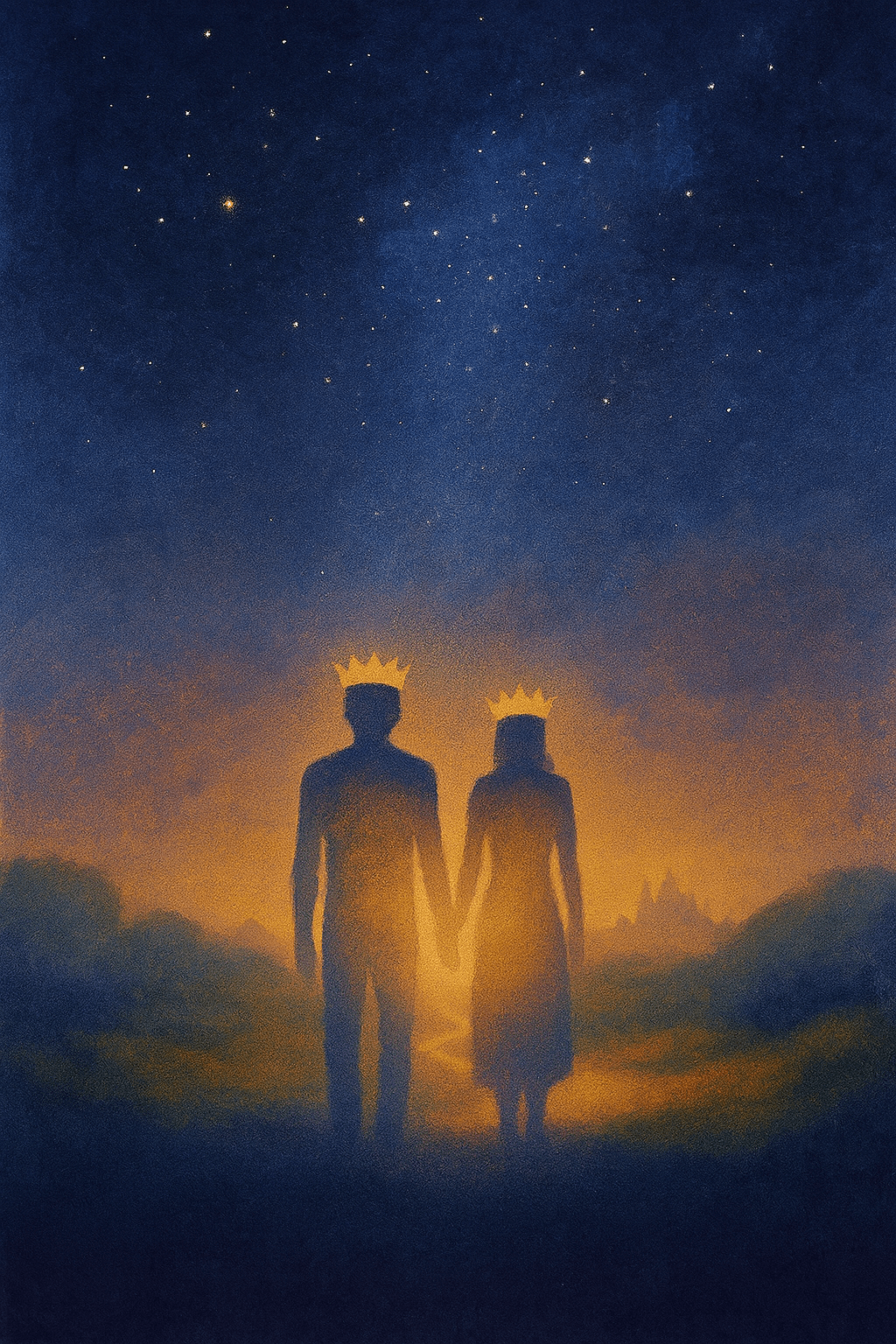
Abstract contemplative artwork of two glowing human silhouettes standing hand in hand under a vast starry night sky. Golden crowns rest on their heads, symbolising humanity’s royal vocation as the image of God. They are bathed in soft golden light, walking toward a distant radiant city on the horizon, with deep blues and purples blending into warm tones of dawn.”

The Bible begins with one of its most subversive claims: humanity is made in the “image of God” (Genesis 1:26–27). This phrase has sparked centuries of reflection. What does it mean to bear God’s image? Is it about dignity, rationality, creativity, or something even greater?

Humanity in the Image of God: Creation as a Cosmic Temple

Genesis 1 is not only a story of beginnings but a story of ordering. The repeated refrain “And God said… and it was so… and God saw that it was good” has the rhythm of a liturgy. Each day God separates, names, and fills, establishing order out of chaos (Genesis 1:2–10).

In the ancient Near Eastern world, temples were microcosms of the universe. They represented the ordered dwelling place of a deity within the chaotic world outside. At the heart of every temple stood an image of the god, placed there after the temple was “ordered” through ritual. This image signified the presence and rule of the god within that sacred space.

Genesis takes this familiar idea but reimagines it in a radically different way. The cosmos itself is God’s temple. The heavens are his canopy (Isaiah 40:22), the earth his footstool (Isaiah 66:1). The seven days of creation culminate in God’s “rest” (Genesis 2:2–3), which in temple language means not inactivity but taking up residence and beginning to reign. God has ordered his cosmic sanctuary, and now he rules from it.

The twist is the image placed within this temple. Unlike the lifeless idols of stone or wood, God’s image is living humanity (Genesis 1:26–28). Men and women are appointed as his representatives, reflecting his character and carrying out his rule in creation. In John Walton’s words, the world is God’s cosmic temple, and humanity is his living idol.

This means the vocation of the image-bearer is inseparable from worship. To be made in God’s image is to participate in the ordering of creation, to extend the boundaries of sacred space until all the earth becomes filled with the knowledge of the Lord (Habakkuk 2:14). Humanity’s task is temple work: to tend, to guard, and to expand the harmony of God’s presence.

Eden as the First Temple and Humanity’s Priestly Role

Genesis does not describe Eden in architectural terms, but later Scripture makes clear that the garden and the temple are deeply connected. The garden is the archetype of sacred space, and the temple is patterned after it.

In Eden, Adam and Eve are given the commission “to work it and keep it” (Genesis 2:15). These two Hebrew verbs abad (to serve) and shamar (to guard), reappear later in the Torah, not for farmers but for priests. The Levites are said “to serve and to guard” the tabernacle (Numbers 3:7–8; 8:25–26). Their task is not just maintenance but worship, guarding the holiness of God’s dwelling from intrusion and defilement. Adam and Eve, then, can be mapped onto the priesthood as its first representatives, called to minister in God’s sanctuary.

The parallels between Eden and Israel’s sanctuary reinforce this. Both are entered from the east (Genesis 3:24; Ezekiel 40:6). Both are filled with imagery of trees, cherubim, and rivers of life (Genesis 2:10–14; 1 Kings 6:29–35; Ezekiel 47:1–12). Gold and precious stones adorn Eden (Genesis 2:11–12), just as they decorate the temple (1 Kings 7:48–50). Even the menorah, with its branches and blossoms, recalls the tree of life at the garden’s centre.

Scholars have argued that the temple is a deliberate echo of Eden, a place where heaven and earth meet, where God’s presence dwells, and where humanity is invited to serve as a kind of priesthood. What Adam and Eve were in the garden, Israel’s priests became in the temple. And what Israel’s priests foreshadowed, the church is called to embody in Christ: a royal priesthood serving in the cosmic temple of the new creation (1 Peter 2:9; Revelation 21:22).

The Distortion of the Image of God Through Idolatry

When humanity abandoned its calling, the image of God became distorted. Instead of reflecting the living God into the world, human beings turned their gaze downward and outward to created things. Scripture calls this idolatry.

The psalmist captures the tragedy with cutting irony: “Their idols are silver and gold, made by human hands. They have mouths, but cannot speak, eyes, but cannot see. They have ears, but cannot hear, noses, but cannot smell… Those who make them will be like them, and so will all who trust in them” (Psalm 115:4–8).

We become what we worship. When we worship idols, we are shaped by their lifelessness. They cannot speak, and so their worshippers lose the voice of true praise. They cannot see, and so their worshippers lose spiritual sight. They cannot act, and so their worshippers lose vitality, becoming passive shadows of what God created them to be. The tragedy of idolatry is not only that we fail to worship God but that we are dehumanised in the process.

Paul makes this point in Romans 1. Refusing to glorify God, humanity “exchanged the glory of the immortal God for images made to look like a mortal human being and birds and animals and reptiles” (Romans 1:23). In turning from the Creator to creation, humans traded their vocation as living images of God for dead imitations of what they desired. Instead of becoming radiant icons of God’s glory, we turn into caricatures, mirrors of idols that can never give life.

This is why idolatry is not just a matter of bowing to statues or pagan gods. It is about misplaced devotion. Career, nation, wealth, pleasure, or even family can become idols when they take the place of God. And when they do, they shape us. A culture that worships money becomes consumed by greed. A society that worships power tends to become violent. A person who worships self becomes hollow. As the prophets warn, idolatry always diminishes. It silences, blinds, and hardens.

Idolatry is the anti-image. It reverses humanity’s vocation. Instead of being mirrors angled toward God and creation, as N. T. Wright puts it, we become mirrors angled in on ourselves. We reflect nothing beyond our own emptiness. This is why the Bible treats idolatry not as a minor sin but as the root distortion of what it means to be human.

Israel as a Kingdom of Priests and a Corporate Image of God

Israel was chosen to carry forward the vocation of Adam and Eve. At Sinai, God declared: “You shall be to me a kingdom of priests and a holy nation” (Exodus 19:6). Scholars stress that Israel was called corporately to bear God’s image by reflecting his character to the nations (Deuteronomy 4:6–8; Isaiah 42:6).

The tabernacle and temple were microcosms of Eden, places where God’s presence dwelt (Exodus 25:8–9; 1 Kings 8:10–11). Israel’s priests mirrored Adam’s task, serving and guarding holy space. Yet, like Adam, Israel fell into idolatry (2 Kings 17:7–18; Jeremiah 2:11–13).

Jesus Christ as the True Image of God

The New Testament announces that Jesus Christ is “the image of the invisible God” (Colossians 1:15). What Adam distorted and Israel failed to embody, Christ fulfils. He is the perfect image, “the radiance of God’s glory and the exact representation of his being” (Hebrews 1:3).

Where Adam reached for autonomy, Jesus humbled himself in obedience (Philippians 2:6–8). Where Israel was faithless, Jesus remained faithful. In Jesus, we see true humanity at last: the angled mirror restored. He reflects God into the world and lifts creation’s praises back to the Father.

At the cross, the curse of Adam was undone (Romans 5:17–19). The cross itself becomes a new “tree of life” (Revelation 2:7; 22:2), and from Christ flows the river of living water (John 7:37–39). In the resurrection, humanity’s vocation is renewed (1 Corinthians 15:20–22).

The Church as a New Creation and Royal Priesthood

Through union with Christ, the church is restored as the image-bearing community. Paul calls believers “a new creation” (2 Corinthians 5:17). Peter calls them “a chosen people, a royal priesthood, a holy nation” (1 Peter 2:9). This echoes both the Edenic and Sinai experiences.

Empowered by the Spirit (Acts 2:1–4), the church is called to extend God’s reign, to embody his presence in the world, and to reflect his character to the nations (Matthew 5:14–16). The church is not saved to escape the world but to anticipate the renewal of creation, partnering with God, bearing His image in Spirit-filled lives of holiness, justice, and worship.

Revelation and the Fulfilment of the Image of God

The final pages of Scripture reveal where the entire story has been leading. John’s vision in Revelation is not about escaping earth but about heaven and earth becoming one, creation renewed, restored, and filled with God’s presence.

He sees a new heaven and a new earth (Revelation 21:1). The holy city comes down, radiant and alive, like a bride prepared for her husband (Revelation 21:2). A voice from the throne declares what was always God’s intention: “Look, God’s dwelling place is now among the people, and he will dwell with them” (Revelation 21:3). What was glimpsed in Eden, God walking with humanity in the cool of the day, is now fulfilled on a cosmic scale.

John says there is no temple. “I did not see a temple in the city, because the Lord God Almighty and the Lamb are its temple” (Revelation 21:22). The temple has served its purpose as a signpost. Now the whole creation has become the sanctuary. God’s presence is not contained in any building but fills every space, and his people live fully as priests within it.

The imagery takes us straight back to Eden. A river of life flows from the throne, and on each side stands the tree of life, bearing fruit each month and bringing healing to the nations (Revelation 22:1–2). The garden sanctuary, lost through sin, is restored, expanded, and secured forever. The exile east of Eden is undone, and humanity is brought home.

And what of the image of God? It reaches its fulfilment here. “They will see his face, and his name will be on their foreheads” (Revelation 22:4). To bear God’s name is to bear his image perfectly, no longer fractured by sin, no longer bent toward idols, no longer half-lit by shadows. Humanity’s destiny is communion, not autonomy, participation in glory rather than deformation into lifelessness. “They will reign for ever and ever” (Revelation 22:5).

Here everything comes together. The cosmic temple finds its goal. The priesthood of Eden, the vocation of Israel, the faithfulness of Christ, and the Spirit-filled life of the church are all gathered up and perfected in the New Jerusalem. What was distorted by idolatry and restored in Christ is now complete.

To speak of the image of God is to speak of our future. We are not creatures fumbling for meaning in the dark. We are God’s living images, created to reflect his glory into creation and creation’s praise back to him. Revelation shows us that future fulfilled: humanity radiant with God’s presence, reigning with the Lamb, mirrors angled perfectly at last.
The Contemplative Gospel Part I: Creation, Fall, and Our Lost Communion with God

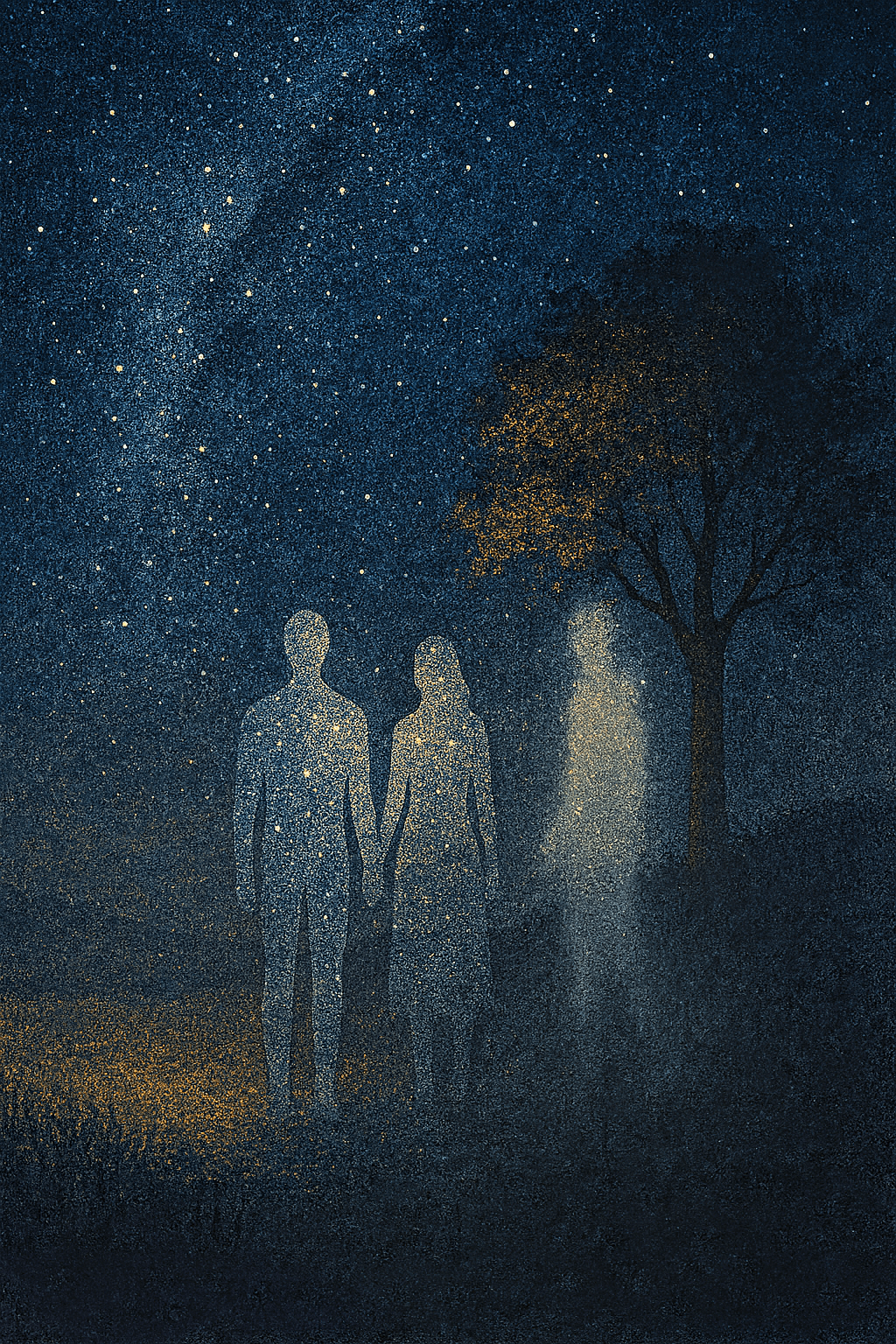
Abstract contemplative artwork of two glowing human silhouettes beneath a starry night sky, their bodies filled with starlight. Beside them stands a lone tree, half in shadow and half in light. Near the tree, a larger silhouette made of starlight represents God walking with them. The scene is cosmic, sacred, and symbolic, in deep blues, purples, and gold.

The Gospel Begins with Wonder, Not Sin

The gospel does not begin with sin. It begins with wonder.

“In the beginning, God created the heavens and the earth” (Genesis 1:1). From the first moment, creation was spoken into being within God’s own presence. Life emerged as song, at his call, not apart from him but held inside his life. Mountains rose and oceans gathered, their beauty already shimmering with his nearness.

And then God stooped low, pressing his breath into dust. Humanity came alive, not only because of lungs and blood, but because every heartbeat throbbed with the life of God. As Paul would later say, “In him we live and move and have our being” (Acts 17:28).

The world has never existed outside of God. We dwell in him, even as he dwells in us. Every breath you take is not just survival. It is communion.


Created to Share in the Divine Life

Let us make humankind in our image, according to our likeness” (Genesis 1:26). From the beginning, we were not just creatures surviving on borrowed breath. We were made as mirrors of the divine, meant to shine with another’s glory.

The apostle Peter writes, “we were made to be partakers of the divine nature” (2 Peter 1:4). Creation is not simply about survival or usefulness. It is about communion. It is about living our lives inside the very life of God.

Irenaeus of Lyons once said, “The glory of God is a human being fully alive, and the life of the human consists in beholding God.” That is creation’s secret. We were meant to live every breath as communion, every heartbeat as sacrament. The mystics remind us again and again that the world is charged with God. Meister Eckhart could say that every creature is “a word of God and a book about God.” Before sermons, before catechisms, creation itself was already preaching. “The heavens declare the glory of God” (Psalm 19:1).

What would it look like to see creation, the tree outside your window, the face across the table, as a word of God spoken to you?


The Fracture of the Fall

But then the story bends.

The serpent’s whisper is subtle. “You will be like God” (Genesis 3:5). The tragedy is that likeness to God was already our inheritance. What could have been received through communion, we tried to seize through grasping. What was meant to be given in love, we reached for in desire.

And in the reaching, something broke. Their eyes opened, but not to glory. Only to shame (Genesis 3:7). Hearts that once lived open to God turned inward and hid from the Presence that still walked in the garden (Genesis 3:8). Communion became exile.


Sin as Broken Communion and Blindness

For the mystic, sin is not simply breaking rules. It is breaking communion. Augustine captures it in his Confessions: “You have made us for Yourself, O Lord, and our hearts are restless until they rest in You.” Restlessness is the echo of what we lost. It is the ache of a heart turned from the fountain of life, thirsting for water while standing beside the spring. Jeremiah gave it his own words: “My people have forsaken me, the spring of living water, and dug their own cisterns, broken cisterns that cannot hold water” (Jeremiah 2:13).

Gregory of Nyssa, the great contemplative, saw humanity as created for an endless ascent into God. Our destiny was always to go deeper into beauty without end. But in the fall, our gaze turned from the Infinite to ourselves. We lost our horizon. We curved inwards. The soul that was meant to climb into God instead closed in on itself.

This is why the mystics often speak of sin as blindness. John of the Cross wrote of the dark night, when the soul cannot perceive the light even though it surrounds her. That is Eden’s exile. The Presence never left. The light still shines in the darkness, but our eyes have forgotten how to see it (John 1:5).


God’s Presence Remains After the Fall

And yet, even here, grace remains.

God does not abandon Adam and Eve to their shame. He clothes them with garments (Genesis 3:21). He keeps walking, keeps calling: “Where are you?” (Genesis 3:9). This is not the cry of a detective chasing criminals. It is the voice of a lover searching for his beloved. Even in exile, God follows. Even in our turning, he does not turn.

Julian of Norwich, reflecting on human sin, once heard Christ speak these words to her: “Sin is behovely, but all shall be well, and all shall be well, and all manner of thing shall be well.” For her, sin was not the end. It was the place where mercy would be revealed.

We are dust, but dust still held by God’s breath. We are exiles, but never outside his gaze. The wound is real, but so is the promise. The God who made us to share in his own life will not rest until we do.


A Contemplative Practice

Take a few minutes today to sit quietly. Place your hand on your chest. Feel your breath rise and fall. With each inhale, pray: “In You I live.” With each exhale, pray: “In You I rest.”

As you breathe, remember that the first breath you ever received was God’s. Even in exile, his life still holds you.

God Who Walks in Twilight

Twilight scene with a person walking on a winding path under a colourful evening sky, symbolising God walking in the cool of the day.

At the Wind of the Day

The first time we hear of God walking, it is not in a blaze of glory.
Not in the brightness of noon when everything is sharp and defined.
It is in the cool of the evening, Genesis says.
The Hebrew calls it l’ruach hayom, “at the wind of the day.”

That soft shift when the heat is letting go and the air changes,
when light seems to slip away almost without you noticing.
It is the time when the work has been done
but no one has yet gone to bed,
when the shadows pull long lines across the ground
and you feel that strange mix of ending and beginning at the same time.

From the start, God is not a voice far off in the heavens.
He is there in the dust, walking.
Unhurried.
Not pressing toward a task.
Just present in that in-between space.

And that time of day keeps turning up in the story, as if God likes it.
Abraham meets Him near the oaks of Mamre when the sun is leaning away.
Israel’s first Passover happens “between the evenings,”
with lamb’s blood on doorframes while the light is thinning.
In the Temple, the daily rhythm gives that same hour a place of its own
the evening sacrifice,
the smell of bread and incense
rising into the dimming sky.

Jesus keeps to the pattern.
On the road to Emmaus,
He meets two people when the day is almost spent.
He walks with them,
talks with them,
and sits at their table,
and in the breaking of bread,
as the darkness edges in from the fields,
they know Him.

It feels like twilight has always been His hour,
the place where He can hold light and dark together in one moment.

Maybe that is why most of life with God seems to happen in the in-between.
We live in the “already and not yet” of His kingdom.
Evening-souled people,
learning the slow pace of faith,
breathing out hope that has learned how to wait,
lingering in love that does not rush away.
He still comes walking when the air cools
and the day takes its last breath.


Creation to New Creation

That first walk in Eden ended badly,
with hiding and shame where welcome should have been.
But the story does not stay there.
At the end of Scripture, in the New Jerusalem,
there is no night at all, and the gates are never closed.
It is as if the first invitation to walk with Him is restored and made permanent.

The story that began with God searching for His image bearers in the evening breeze
ends with Him living among them,
no lamp needed,
because the Lamb Himself is their light.

For now, we live in the long dusk between creation and new creation.
But when the wind shifts,
when shadows stretch out over the ground,
when the air feels like it is holding its breath before the dark,
I think of Him.
I think of how He has not stopped walking.
And I hold onto the hope
that one day this twilight will give way,
not to night,
but to a dawn that never ends.

Not Drenched, But Drawn: Rethinking Baptism in the Spirit

“The Spirit himself bears witness with our spirit that we are children of God.”

—Romans 8:16

They told us to wait for the wind.

To pray until the fire fell.

To tarry until we were baptised again—

not in water, but in power.

And so we did.

We begged for signs.

For the sudden tongue,

the holy heat,

the trembling proof that God had come close.

But God had already come close.

The Language That Divides

The phrase “baptism in the Spirit” has become a boundary line—between the anointed and the merely saved, between the spiritually alive and the doctrinally dull. But Scripture speaks differently. It does not cast the Spirit as a second experience but as the seal of the first.

In 1 Corinthians 12:13, Paul writes:

“For in one Spirit we were all baptised into one body.”

Not some. Not a chosen few. All. The Spirit is not a delayed second act. He is the very breath we inhale at new birth. The theology of “Spirit baptism” as a dramatic post-conversion event, often used to signal deeper intimacy or greater power, too easily fractures the body of Christ. It creates a hierarchy of holiness, a performance of spirituality, an upper room without a cross. But Pentecost was never a formula. It was the fulfilment of an ancient promise—God with us, within us, among us.

The Spirit as Union, Not Upgrade

Jesus breathes on His disciples in John 20 and says, “Receive the Holy Spirit.”

No rushing wind.
No thunder.
Just breath.

No spectacle—only substance.
This is not emotional hype,
not a dopamine rush mistaken for doxology.
It is Genesis again: the Spirit hovering,
and then entering—God breathing into dust,
and dust waking to communion.

It is Ezekiel’s valley, bones strewn like broken hope,
and the Word, like a prophet’s cry, calling sinews and skin back to purpose—
but only breath makes them truly live.
Not machinery of religion. Not memory of tradition.
Only breathe.
Only Spirit.

This is no theatrical power (though it can sometimes happen, like in Acts 2).
No divine electricity waiting for a better switch.
The Spirit is not the upgrade to your faith.
He is its origin and its goal—
The bond that binds us into the Triune life.

To receive the Spirit is not to perform
but to participate.
To be drawn into the perichoresis—
that dance of Father, Son, and Spirit,
where love has no beginning and union knows no end.

The Spirit is not a badge you earn, not a second tier for the elite.

He is the down payment of our inheritance (Eph 1:13–14), the seal of our adoption (Rom 8:15), the whisper that dares call God Abba.

He is not the sensation of holiness,
But the substance of it.
Not proof of ecstasy,
but the presence of intimacy.

“He who is joined to the Lord becomes one spirit with Him.”
—1 Corinthians 6:17

This is the deepest baptism—
not of water, fire, or even tongues or trembling limbs.
But of union.
Of soul sealed to Spirit.
Of a humanity lifted into the life of God.

Participation in the Triune Life

To be filled with the Spirit is not to overflow with noise,

But to abide in silence, thick with love.

To be caught up in the life of the Trinity.

The early church spoke of theosis

that we become by grace what Christ is by nature.

“That you may become partakers of the divine nature.”

—2 Peter 1:4

Not a Second Baptism—A First Love

We are not waiting for the Spirit.

We are awakening to Him.

Not tarrying for power,

But turning to Presence.

The language of “Spirit baptism” has too often led us to look for a moment,

a manifestation,

a miracle.

But the Spirit is not a showman.

He is the Spirit of adoption.

He teaches us to cry, “Abba.”

To know God not in performance.

But in participation.

Not in a fire that consumes

But in flame that communes.

(A Reflection on) The Theology of Lingering

Dallas Willard once said, “hurry is the great enemy of the spiritual life in our day.” I remember years ago listening to a podcast by Rob Bell, who talked about how we’ve lost the ability just to be bored. John Mark Comer argues that we must ruthlessly eliminate hurry from our lives. Every generation says this, but life isn’t the same as it used to be. Our weeks are filled with to-do lists, meetings, and appointments. We work forty-hour weeks (if you’re lucky), we try to eat right and stay healthy, go home, look after the kids, clean the house, go to church, try to catch up with that friend for coffee or lunch, meet your spouses needs, listen to that podcast, read that blog (the irony is not lost on me), catch up with the latest social media news, video, tweet, or reel. We study, try to improve our skill set, and bring work home with us (because there is rarely enough time to do your job in a 9-5), which is what it means to be a functioning human being in 2024.

In the 90s and early 2000s, I felt like imagination was king. Boredom drove me to creativity. I couldn’t mindlessly flick through reels of videos, watch people playing Fortnight, or throw on a podcast (all things I love, by the way). Instead, a rock or a piece of clay became a fossil. The front trees and gardens became hideouts for me to store waterbombs and hide from the other kids on the street. I used to write my name in Egyptian hieroglyphics (not very well, mind you). I used to spend time with my mum. We talked—a lot. I remember my first-ever coffee (a mocha with whipped cream on top) and trips to Wet n’ Wild. I remember going to my Nannas house on holidays and playing cricket in the street with my Dad. Going to the beach or doing road trips always seemed convenient and easy. Nowadays, travelling more than half an hour gets the best of you. It takes work to keep focused and your attention on things that should be important to you. Unconsciously, I reach for my phone to see if I have a notification. Switching off when friends talk about something that doesn’t matter to you is so easy. It’s easy to go to church for an hour and a half a week, passively take in a sermon, half-heartedly sing a few songs and “hurry God” like He is a fast food worker and McDonald’s or something. Most of us don’t know how to slow down, rest, be bored, and linger.

In six days, God created the universe, and on the seventh, He rested, or to put it another way, he lingered, hung around, and delighted in what he had made (Genesis 1-2). The definition of lingering is to stay in a place longer than is expected or usual. It is unusual in our day and age to linger, to stay in one place and enjoy it without distraction or a “productive purpose.” When was the last time you sat, meandered, or rested while just taking in the world around you? Have you ever sighed a breath of relief and just lingered on what you have already accomplished (no matter how seemingly insignificant)? When have you last just plodded around in the messiness of your space and just delighted in your stage of life? I love that God rests. He didn’t need to. God doesn’t have a cap on His capacity. He wasn’t taking the day off because he was tired. He rested and lingered and delighted in his creation because (I believe) He brought him joy.

Fast forward in the story, and in the Exodus, we have Israel enslaved and forced to work every day. They were the peak of productivity. Their worth was weighed in the bricks they made and the work they did. Israelite identity became so entrenched in their slavery that even when they had been freed, they longed to return to it (Exodus 16:3). What I find funny is that the Jews wanted to go back into slavery even while having God’s tangible presence with them in the wilderness (Exodus 13:21). Even after they got into the promised land, established a kingdom and a temple with God dwelling among his chosen people, they still worshipped other gods. Israel forgot to dwell with God and linger in his presence. Though God wasn’t far from any of them, they never stopped and experienced his presence in any intimate and authentic way. I wonder how different history might have been had Adan and Eve lingered with God in the Garden, if the Jews lingered with God in the wilderness, or dwelt with him more intimately in the temple. How different might things have been if the disciples lingered with Jesus? Rather than expecting things from him, they were just with him. Maybe they would have seen Jesus as the messiah he was instead of what they expected him to be.

And this is the problem. We expect God to be something or someone he doesn’t want to be. Just like the Jews, we have theological categories (some of which are helpful) that impose expectations of God into history. God heals. Therefore, whenever I pray, he heals. Except he doesn’t. God is in control. Therefore, everything must work according to his will, except life is chaotic and challenging, and it rarely feels like God is in control. God is love. Yet he often feels distant. God is wrathful. Yet evil always seems to prevail. These categories came to me through books and podcasts, not God himself (though, of course, these are things God can use). These things are true, but I don’t always know it.

In Celtic spirituality, thresholds are seen as a line between one space and the next, one time and another. I’m not just talking about the threshold between your bedroom and the hallway; I’m talking about the thin places in our lives that God whispers and beckons us through so that we may linger, refreshed, transformed, and made new. We may need to stop and linger more often.