Charlie Kirk Wasn’t a Christian Martyr

Probably a political one…

When news spread that Charlie Kirk had died, the internet lit up. Some people grieved, others rejoiced, and many quickly called him a martyr for the faith. Within hours his name was being spoken with reverence, as though he had fallen in defence of Christianity itself.

But as I watched the commentaries roll across my feed, something in me felt unsettled. It was not about politics or even about Charlie Kirk as a person. It was about the word people kept using. Martyr.

That word means something sacred. And when it is used to crown someone who lived and died for political ideals, something in the heart of our faith begins to thin out.


What a Christian Martyr Really Is

In the earliest days of the Church, a martyr, from the Greek word martys, was not someone who died for an idea. A martyr was a witness. Someone who refused to stop proclaiming that Jesus Christ is Lord, even when it cost them their life.

Stephen, the first Christian martyr, was stoned to death because he would not renounce the gospel. His last words were not words of rage. They were words of forgiveness. “Lord, do not hold this sin against them.”

The early Christians understood that martyrdom was not about defending a system or a worldview. It was about bearing witness to a love that even death could not silence.

Tertullian once wrote, “The blood of the martyrs is the seed of the Church.” He did not mean that violence or victory would build the kingdom. He meant that forgiveness and mercy would.

True martyrdom looks like Jesus. It is not about conquering. It is about giving. It is not about being right. It is about being faithful. When we call someone a Christian martyr, we are saying that their death revealed Christ’s love, that somehow in their dying, heaven’s light broke through the world’s darkness.

When Politics Demands What Religion Once Did

Modern politics is a jealous god. It borrows the language of faith such as devotion, sacrifice and loyalty, and twists them into tools for power.

And like all gods, it demands offerings. It demands martyrs.

When we drape the cross in the flag, we start to confuse the kingdom of God with the ambitions of nations. We start to name enemies where Christ has called us to name neighbours. We turn a symbol of love into a banner for war.

Charlie Kirk’s voice was bold. He stood for what he believed, and many saw that as courage. But faithfulness is not measured by volume or defiance. It is measured by love.

Jesus never told us to take up our rights and follow him. He said, “Take up your cross.”

The gospel does not spread through outrage or dominance. It moves quietly through mercy. The Church does not grow through victory. It grows through love that refuses to die.

A Political Martyr

If Charlie Kirk was a martyr, then he was a political one, a man who gave himself fully to a cause he believed in. There is something deeply human in that. We all long to stand for something bigger than ourselves.

But dying for a cause is not the same as dying for Christ.

To die for a cause is to defend an idea of what is good. To die for Christ is to surrender to the One who is good.

The difference might sound small, but it changes everything.

A political martyr dies fighting enemies. A Christian martyr dies loving them.

A political martyr defends power. A Christian martyr lays it down.

A political martyr hopes their death proves they were right. A Christian martyr hopes it proves that love is real.

When the language of politics takes over the Church, these differences fade. The gospel starts to sound like another campaign, another tribe trying to win. But the story of Jesus is not about winning. It is about dying and rising again. It is about the power of love that does not need to win to transform the world.

And that is what troubles me most. Not that Charlie Kirk died, but that so many Christians can no longer tell the difference between his death and Stephen’s.

The Hunger for Heroes

Maybe it is because we are desperate for heroes.

We scroll through chaos and want someone to believe in. Politicians turn into saviours. Preachers turn into politicians. And people crave clarity in a world that feels uncertain and divided.

It is easier to anoint a martyr for our side than to become a witness of Christ’s love.

But the call of Christ has never been about winning the culture war. It is about loving the world that crucifies us. It is about carrying the cross through the noise and trusting that resurrection still happens in small, hidden ways.

When we forget that, we turn the gospel into a slogan. We trade the mystery of grace for the certainty of outrage.

And maybe that is the deeper sorrow behind Charlie Kirk’s story. Not that one man lived or died in vain, but that so many have mistaken zeal for discipleship and anger for faithfulness.

A Better Witness

To say Charlie Kirk was not a Christian martyr is not to dishonour him. It is to remember what martyrdom truly means. It is to keep sacred what belongs to God and not give it to Caesar.

I grieve his death. I grieve the confusion that made it so easy to sanctify politics in the language of faith. I grieve that we have forgotten how to die without hating those who stand against us.

Perhaps his story can still lead us somewhere better, not toward more division but toward deeper reflection.

Because the world does not need more martyrs for movements. It needs witnesses to love.

It needs people who, when faced with darkness, choose forgiveness instead of fury. People who refuse to mistake power for holiness. People who, like the martyrs of old, live and die bearing the likeness of Christ.

The only martyrdom worth claiming is the one that looks like Jesus, the one that whispers mercy even as it bleeds.

If we can remember that, maybe we will stop crowning our politicians as saints and start learning again what holiness really looks like.
Why Christians Should Celebrate Halloween

Reclaiming the Sacred Night through Celtic Eyes

Christians often avoid Halloween. It is seen as dark or demonic, a night of ghosts and ghouls better left unspoken. Yet in our fear of the dark, we have forgotten something ancient and holy.

The Celts called this season Samhain, the turning of the year when the veil between worlds grew thin. They lit fires not to summon spirits but to honour the mystery of life and death, to remember that the light makes its home in the night.

To them, the end of the year was not a time to fear but to listen to the whisper of the wind, to the stories of ancestors, to the quiet truth that death and life are interwoven. When the Church arrived in Celtic lands, it did not erase Samhain. It baptised it, transforming its wisdom into the rhythm of All Hallows Eve, All Saints Day, and All Souls Day, a sacred trinity of remembrance.

The Christian Roots of the Holy Evening

Halloween literally means All Hallows Eve, the night before All Saints Day on the first of November. In the early centuries, Christians would gather to remember those who had gone before them, the saints, the faithful, the beloved dead.

The theology was not one of fear but of communion. As the Apostles Creed declares, we believe in the communion of saints. That means heaven and earth are not far apart. We are one body, the living and the dead held together in Christ.

The night before All Saints was a vigil, a time to pray, to light candles, to tell stories, to remember. The darkness was not a place of dread but a threshold. It was a space where the Church stood with the saints, trusting that even the grave is not the end.

Halloween was never meant to glorify death but to proclaim that death has lost its sting (1 Corinthians 15:55).

The Celtic Way of Embracing the Thin Places

In Celtic Christianity, the sacred was never locked away in temples or confined to daylight. It breathed in the sea mist, the glow of the fire, the cry of the wind. The Celts spoke of thin places, moments and landscapes where heaven and earth seem to meet. Samhain was one of these thin places, a hinge between seasons, a pause between harvest and winter, light and dark, life and death.

To the Celtic mind, darkness was not evil. It was part of the whole. It was where seeds slept, where transformation began. The monks of Iona and Lindisfarne often prayed at night, seeing in the stars the promise of a God who keeps watch when all else rests. Psalm 139:12 says, “Even the darkness is not dark to you.” The night is as bright as the day.

When we hide from the dark, we lose something essential, the capacity to see God in mystery. Halloween, seen through Celtic eyes, becomes a sacred reminder that faith is not certainty but courage in the unknown.

Reclaiming the Night

Modern Christianity often separates light from darkness as if they were enemies, yet the story of Christ shows otherwise. God is born into the darkness of a stable. He prays in the dark garden of Gethsemane. He descends into the shadow of death before rising in dawn’s light.

To celebrate Halloween as Christians is not to glorify darkness but to declare that Christ’s light dwells there too. The pumpkins and candles, the laughter and costumes, can become acts of holy defiance. Each candle lit in the hollow of a pumpkin is a proclamation of John 1:5, The light shines in the darkness, and the darkness has not overcome it.

Children who dress as skeletons or ghosts are, in a strange way, acting out the gospel’s hope that death no longer has the final word. Laughter in the face of fear is resurrection courage.

To walk through the night, to look upon the symbols of mortality with wonder instead of terror, is to live out the truth of Romans 8:38-39, that nothing, not even death, can separate us from the love of God.

Practising a Sacred Halloween

Reclaiming Halloween does not mean ignoring its shadows; it means redeeming them. It means grounding the night in ritual, memory, and joy.

Here are a few ways Christians might enter the evening as a holy practice:

• Light a candle for loved ones who have died. Speak their names aloud. Let memory become prayer.
• Tell stories of the saints, not just the famous ones but the everyday holy people whose faith shaped your own.
• Bless your home and street as children wander through, handing out lollies with warmth and laughter. Generosity itself is light.
• Walk under the night sky and pray, “Even here, You are with me.”
• Join the joy of the children. Remember that play is not frivolous. It is spiritual resilience. To laugh at death is to trust in resurrection.

When the Celts kept Samhain they shared food with the poor and offered hospitality to wandering souls. To reclaim that spirit is to see Halloween as an act of community, where fear gives way to welcome and strangers become friends.

The Holy in the Haunting

Halloween, at its best, is a kind of Celtic sacrament, a sign that all creation, even the dark, can be redeemed. It reminds us that we are creatures of dust and spirit, flesh and breath, life and loss.

The Church’s fear of Halloween is perhaps a symptom of something deeper, our discomfort with mortality. But the gospel calls us not to denial but to transformation. The tomb, after all, became the doorway to life.

To enter the night is to practise hope. It is to walk where fear once reigned and whisper, “Christ is here too.” It is to remember that resurrection does not erase death. It transfigures it.

So this Halloween, light your candles. Laugh with your neighbours. Honour the saints and your loved ones who rest in God. Bless the children as they run through the dusk with sugar and delight.

Let it be known again that the light makes its home in the night, that even here, amid shadow and laughter, God is near.

The Shack: A Reflection

When William Paul Young wrote The Shack, he was not trying to explain why terrible things happen. He was writing his way through sorrow. Like Job, he sat among the ashes, surrounded by questions that would not rest. Out of that ache came a story. Not a sermon, but a parable about the God who meets us in our broken places.

The Silence of God

In the book of Job, the suffering man cries into the dark, “Oh, that I knew where I might find him.” Mackenzie, the father in The Shack, makes the same cry. He pleads for answers, for justice, for the God who seems to have turned away. And then, like Job, he receives not an explanation but an encounter.

The story reminds us that God does not stand outside pain, observing from a safe distance. God enters it. The cross is not a theory of evil but the place where God shares it. Gregory of Nyssa (c. 335–395) once wrote, “That which He has not assumed He has not healed.” When Christ took on our humanity, our confusion, our fear, our grief, He turned suffering into the place where healing begins.

The Human Face of God

What startled many readers of The Shack was how ordinary God seemed. The Father, called Papa, is a warm woman who laughs and bakes bread. The Spirit moves like a soft wind, full of life. Jesus is earthy, playful, and scarred.

For some, this felt irreverent. For others, it was freeing. It reminded us that the mystery of God is larger than our imagination, and that God is not afraid of being close. Irenaeus of Lyons (c. 130–202) once said, “The glory of God is a human being fully alive.” The divine shows up not in grand displays of power but in the tenderness of relationship.

For me, that image of God as a woman was strangely comforting. I have carried my own wounds around the word “father,” the kind of ache that makes intimacy with God feel complicated. Meeting God first in a motherly form would be a gentler introduction for my heart, an invitation to trust again before I could rediscover what “Father” might really mean. And that is all right.

God is not confined to any one image or gender. Scripture speaks of God as a mother who comforts her child, as a father who runs to embrace his son, as wisdom dancing at creation, as spirit breathing over the waters. God contains them all and yet exceeds them all. When God meets us, it is always in the way that heals us best.

And perhaps that is what The Shack captures so beautifully. God does not always have to relate to us in perfect theological categories. The God of the novel might not look exactly like the Trinitarian formulations of church history, but that does not make the encounter less true. Sometimes what is doctrinally perfect is not what is pastorally healing. Sometimes what is fact is not yet what is good for us.

God meets us where we are, not where we have managed to arrive theologically.

These kitchen scenes of cooking, laughing, and washing dishes are not incidental. They show us that heaven is not far away, and that holiness is not fragile. God is at home in our kitchens and our conversations, in the small things that hold the world together. Bread broken in love is never just bread. It becomes the body of grace in every act of forgiveness.

The Dance of Relationship

The story shows the Trinity not as an idea to explain but as a living dance of love. Mack finds himself in a circle of laughter, humility, and delight. Father, Son, and Spirit moving together. There is no hierarchy, no fear, only mutual joy.

This is what divine life looks like, communion that never ends. Mack’s healing does not come through answers but through being drawn into relationship. He learns to trust again. He learns that forgiveness is not demanded of him but offered to him. The Father holds his pain without rushing him. The Spirit guides him into honesty. Jesus walks beside him in the dirt, showing him that redemption is as simple and sacred as friendship.

The Trinity is not explained here. It is experienced. The story whispers that God’s power is not the power to control but the power to love without limit.

The Mystery of Shared Suffering

When Mack asks why God allowed his daughter to die, God does not give a reason. God grieves with him. The most daring moment in the book is when we see God cry. Those tears are not weakness. They are the heart of compassion.

In Christ, God takes our pain into Himself, and in doing so makes it holy. The tears of God in The Shack reflect the tears of Christ at Lazarus’ tomb, tears that do not remove death but transform it.

The story shifts our question from Why does God allow suffering? to Where is God in my suffering? And the answer, again and again, is Here.

The Shacks We Carry

Each of us has a shack, a place in our hearts that we have boarded up, a room where grief or guilt still lives. We avoid it. We build our lives around it. But this story invites us to step inside again, not alone but with God.

When we dare to enter that place, we may find what Mack finds, that the very ground of our pain can become the ground of God’s presence. The shack becomes a temple. It becomes a place of communion.

Athanasius of Alexandria (c. 296–373) once wrote, “God became what we are, that He might make us what He is.” In other words, God steps fully into our humanity so that our humanity can be gathered into divine love. God meets Mack not to undo what happened, but to show him that nothing, not even the deepest wound, can separate him from love. What changes is not the past but the way it is carried, from isolation to belonging, from despair to trust.

An Invitation

Perhaps The Shack is not a story to be solved but a space to inhabit. It does not offer tidy explanations. It opens a room for encounter. It asks whether we are willing to meet God, not the idea of God, but the living presence who cooks, who laughs, who cries, who stays.

So maybe the question for us is this.
Where is our own shack?
Where is that place we have locked away because it hurts too much to enter?
And what if God is already there, waiting by the fire, patient as bread rising in the oven, whispering, “You were never meant to carry this alone”?

The heart of the story is not about understanding suffering but about discovering love. It is not about solving God but trusting God. Faith is not built on answers. It is built on presence.

And maybe that is the quiet truth of The Shack: that God is nearer than we ever dared to believe, nearer than our pain, nearer than our fear, nearer than our own breath.

When Christians Misunderstand the Gospel: Why “God Reigns” Is More Radical Than We Think

A lone silhouetted figure runs along a distant mountain ridge beneath a vast twilight sky of deep blue and violet. Golden light breaks at the horizon, symbolising heaven and earth meeting in the reign of God. The atmosphere is quiet, cosmic, and filled with hope.

What if the greatest misunderstanding in modern Christianity is not about morality or politics but about the gospel itself? What if the good news we share is smaller than the one Jesus announced?

We often describe the gospel as a private story about forgiveness, heaven and personal salvation. Yet in Scripture the gospel is something far larger. It is the announcement that God reigns. It is not only about the state of our souls but about the state of the world. It is a claim about reality itself, a declaration that creation has a rightful King.

And that claim changes everything.

The Gospel as Royal Proclamation

In Hebrew, the word for good news is besorah, a royal announcement of victory (Isaiah 52). In Greek, it is euangelion, the public declaration that a king has triumphed (Mark 1).

Imagine an ancient city under siege. The people wait behind their walls, anxious for word from the battlefield. Then a runner appears on the hills, covered in dust, shouting between breaths, “Good news! Victory! The king has won!”

That was euangelion. It was not advice or philosophy but the kind of announcement that makes the world different because it is true.

When Isaiah writes, “How beautiful on the mountains are the feet of those who bring good news, who say to Zion, ‘Your God reigns’” (Isaiah 52:7), he is describing that runner. The heart of the gospel is that Yahweh has returned to rule His world.

Centuries later, Jesus begins His ministry with the same royal declaration: “The time is fulfilled, and the Kingdom of God has come near. Repent and believe the good news” (Mark 1:15). He is not inventing a new religion but announcing that Israel’s long-awaited hope has arrived. God’s reign is breaking in.

The Kingdom Woven into Creation

The story of God’s Kingdom does not begin with Jesus. It begins in Genesis, where the rhythm of creation beats with divine rule (Genesis 1-2).

In the first three days, God shapes the realms of creation: light and darkness, sky and sea, land and vegetation. In the next three, He fills those realms with rulers: the sun and moon, the birds and fish, the animals and humanity.

The story is one of order and relationship. God reigns by creating and sharing. His rule is not control but care. Humanity, made in His image (Genesis 1:26-28), is invited to share that reign and to reflect His goodness, justice and creativity into the world.

To rule, in the biblical sense, is not to dominate. It is to cultivate. It is to join God in the work of making the world flourish.

The Kingdom of God is not a future dream. It is the structure of reality itself. Heaven and earth were made to live together (Genesis 2:15). Sin fractures that harmony, but the mission of God is to bring it back, to restore what was lost and heal what was broken.

Jesus: The King in Person

When Jesus announces the Kingdom, He is not speaking about a distant future or an inner feeling. He is proclaiming a change of reality. Where He walks, heaven and earth meet. The sick are healed, the outcasts restored, and the powers of darkness pushed back (Luke 4:18-9; Matthew 12:28).

At the cross, the world’s false rulers do their worst. Yet in that act of humiliation, the true King is enthroned (John 19:19). Through resurrection, His victory is declared not over Rome but over the powers that hold all creation captive: sin, death and decay (1 Corinthians 15:25-26).

Paul’s hymn in Colossians captures it perfectly:

“He is the image of the invisible God, the firstborn over all creation. In Him all things hold together. Through Him God was pleased to reconcile all things, whether on earth or in heaven” (Colossians 1:15-20).

This is not private spirituality. It is cosmic renewal. Christ holds the whole story together. In Him, the Creator’s original dream of heaven and earth united is set in motion again.

The People of the King

The early Christians understood this far better than we often do. They did not treat faith as an escape plan but as a new citizenship (Philippians 3:20). They believed that the Spirit who raised Jesus now lived within them, calling them to live as citizens of a new world (Romans 8:11).

Every act of love and hospitality, every work of justice or reconciliation, was an echo of the good news. It was a small proclamation that “our God reigns” (Isaiah 52:7).

The Kingdom is not confined to heaven or to church gatherings (though, as I argue elsewhere, the church should be a slice of the new creation). It is wherever the reign of Christ shapes hearts and habits, homes and communities (Matthew 5-7). It is wherever people reflect His character in the ordinary and the everyday.

N. T. Wright once said that the church does not bring the Kingdom by force; it embodies it by faithfulness. That is the invitation: to embody the reign of the King.

The Kingdom Completed: New Creation

The story of Scripture ends where it began, but expanded and fulfilled. A garden becomes a city. Heaven and earth are reunited.

John’s vision in Revelation captures it:

“I saw a new heaven and a new earth… and I heard a voice from the throne saying, ‘See, the home of God is among mortals’” (Revelation 21:1–3).

This is not an escape from the world, but rather its healing. The good news is not that we leave creation, but that God enters into it and restores it (Romans 8:19–21).

Every tear will be wiped away. Every injustice will be answered. The scars of the old world will become the beauty of the new (Revelation 21:4–5). The reign of God will fill everything.

Living Under His Reign

If the gospel is the announcement that God reigns, then discipleship is the art of living as if that reign were already true (Matthew 6:10). Repentance means realigning with reality, turning from our small empires to join the life of the King.

Faith is allegiance. It is trust that God’s rule is good and that life under His care is freedom, not bondage (John 8:36).

Every prayer, every meal, every act of mercy or courage is a way of saying again, “Your God reigns” (Isaiah 52:7).

The gospel is not good advice. It is good news.

And that news is this: heaven has begun to come down to earth. The reign of God is arriving quietly, patiently, beautifully, until all things are made new.

A Theology of The Elder Scrolls: Part I

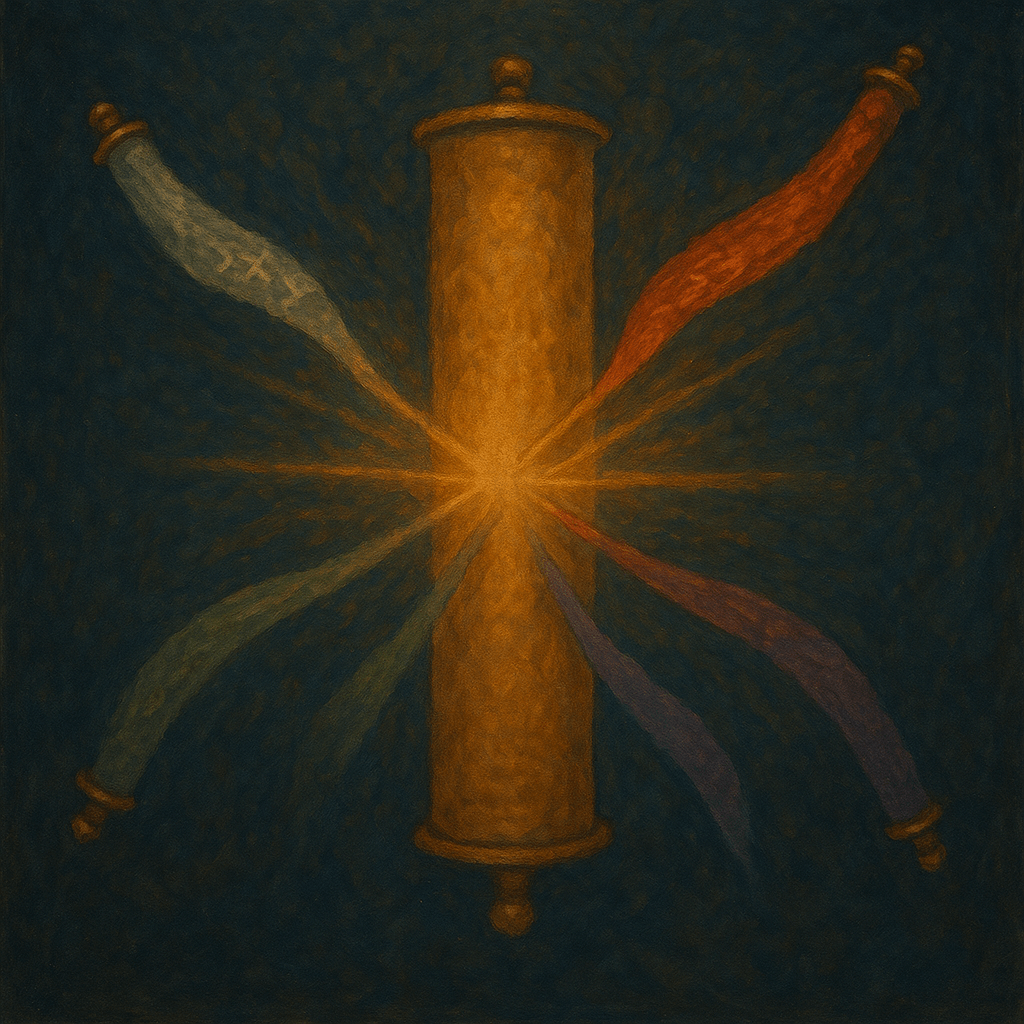
Abstract sacred artwork of an Elder Scroll splitting into five glowing scrolls—gold, silver, red, green, purple—whose crossing light beams form a radiant centre against a deep indigo sky, symbolising fractured prophecy and contested truths in The Elder Scrolls.

Hermeneutics, Method, and Epistemology in a World of Fractured Voices

A World of Fractured Voices

Tamriel doesn’t begin with a single creation story. It begins with many, and they rarely agree. Ask an Altmer, a Khajiit, a Nord, a Dunmer, a Yokudan, or an Imperial, and you’ll get a different version of how the world began and what it means. Each account is told with conviction, yet each undermines the others. Theology in Tamriel starts, not with certainty, but with a clash of voices.

  • The Altmeri Account — The Monomyth
    The High Elves see themselves as descended from the Aedra, divine beings who gave of themselves to shape the world. It was both noble and tragic: “Anuiel, who was Anu’s soul, became the many. Padomay, who was Anu’s brother, became the few. And their interplay created the et’Ada, the original spirits, who sacrificed themselves to give birth to the world.” (The Monomyth)
    For the Altmer, creation is a fall from divinity, and mortality is a kind of exile.
  • The Khajiiti Account — Words of Clan Mother Ahnissi
    The Khajiit remember creation through moons and shadows. Their matriarch tells how Jone and Jode danced the world into being: “When Ahnur and Fadomai were still in love, Ahnur gave birth to many children. Fadomai was tricked by Lorkhaj, who made her give birth to the Great Darkness. Yet out of her pain came Jone and Jode, the moons, who guide us still.” (Words of Clan Mother Ahnissi)
    For the Khajiit, Lorkhaj is no simple villain but the Moon Beast, betrayer and patron, curse, and blessing at once.
  • The Nordic Account — The Five Songs of King Wulfharth
    The Nords sing of Shor, their name for Lorkhan, as a warrior-father who carved out the world for the sake of men: “Shor made the world from the corpse of a god, and men rose from the earth, strong and free. But the elves hated this world, and they betrayed Shor, striking him down.” (The Five Songs of King Wulfharth)
    What the Altmer see as tragedy, the Nords see as triumph. The world is a gift won through blood and betrayal.
  • The Dunmeri Accounts — The 36 Lessons of Vivec and Velothi Tradition
    The Chimer abandoned the Aedra for the Daedra, believing the so-called “Ancestors” had betrayed mortals. Their prophet Vivec recasts creation as paradox: “The world is illusion, but the world is also true. To know this is CHIM.” (36 Lessons of Vivec, Sermon 12)
    For the Dunmer, the world is not simply wound or gift, but a puzzle to be unravelled.
  • The Yokudan Account — Satakal the Worldskin
    The Redguards, heirs of the Yokudans, remember creation as an endless cycle of devouring and rebirth. In their myth, Satakal the Worldskin consumes each world, and only those who learn the Walkabout escape to the next: “Satakal ate itself over and over, and every time a world was devoured a new world came to be.” (Satakal the Worldskin)
    Creation here is not a single act, but an eternal cycle of death and renewal.
  • The Imperial Synthesis — The Annotated Anuad
    The Empire, ever the administrator, tried to weave the rival myths into one “official” story: “Anu, the Everything, was in himself all things. Padomay, the Nothing, was his brother. Their conflict gave rise to the et’Ada, the Original Spirits, who then gave birth to Nirn.” (The Annotated Anuad)
    But even here, the contradictions remain. Lorkhan is both a deceiver and a necessary architect. The Imperial voice tidies, but cannot silence, the discord.

In Tamriel, creation is remembered as a tragedy and triumph, a betrayal and a gift, a prison and a puzzle. Every account claims to tell the truth. None agree. This fractured chorus is not a flaw. It is the theology.

Hermeneutics: Reading Amid Contradiction

Theology in Tamriel begins in a library, not a creed. One cannot simply ask, “What do the people believe?” because the answer depends on which book, song, or sermon you open. Vivec’s riddled sermons conceal as much as they reveal. The Nords glorify Shor; the Altmer vilify him. Even prophecy refuses clarity:

“The Scrolls change, and their meaning is never fixed. To read one is to risk madness.” (Divining the Elder Scrolls)

The hermeneutic task, then, is discernment. Truth must be sifted from contradiction, carried through paradox, wrestled from unreliable narrators.

The Player as Theologian

TES doesn’t just hand down these texts; it makes the player hold them. You might read The Monomyth in an Imperial library, only to find a bard in Windhelm singing Shor’s defiance, or an Ashlander dismissing Vivec’s sermons as lies. The game never tells you, which is “true.” Instead, it places you in the position of theologian gathering stories, comparing them, discerning patterns, and learning to live with contradictions you cannot resolve.

In this sense, TES turns every player into a pilgrim-reader. The task is not to possess final answers, but to walk among testimonies and weigh them.

Methodology: Theology as Pilgrimage, Not System

If theology often aims at coherence, theology in TES must be walked as pilgrimage. The Imperials’ Anuad gestures at system, but it cannot silence the Nords’ defiance or the Khajiiti moon-myths.

A theology of Tamriel can’t be written as one definitive voice. It must take the form of journeying through competing testimonies, living with tension as the method itself. Theology here is less a blueprint and more a pilgrimage through paradox.

Epistemology: Knowing Through Unreliable Narrators

In Tamriel, knowledge is not primarily about propositions but about relationships and allegiances. The unreliable narrator is not a mistake. It is the way truth appears. The Five Songs of King Wulfharth contradict themselves. Vivec insists “the world is illusion, but the world is also true” (36 Lessons of Vivec, Sermon 12). The Elder Scrolls themselves change with each reading.

To know is not to possess certainty but to live inside a story, to commit to a patron, to follow a path. The Khajiit trust the moons because their lives are woven into their phases. The Nords trust Shor because his story shapes their courage. Knowledge in Tamriel is lived allegiance, even when the stories clash.

Thus epistemology in TES is not propositional but relational. To know is to live inside a story, to commit to a patron, to walk a path, even while knowing that path contradicts another. Knowledge is not the absence of unreliability, but the courage to live with it.

Why This Matters

Without attending to method, a theology of TES would collapse into fan cataloguing a list of gods, myths, and cultures without coherence. Beginning with hermeneutics, methodology, and epistemology reminds us that these contradictions are not problems to be explained away, but the very form of Tamrielic revelation.

This matters because it teaches us how to read. It teaches us to hold paradox without panic, to see myth as meaning-bearing, to discern in fractured voices rather than demand a single answer. And this posture, once learned in Tamriel, can shape how we approach knowledge, faith, and story in our own world.

A Christian Glance: Contradiction, Myth, and the Shape of True Knowledge

For Christians, this way of knowing is not so strange. Scripture itself is full of tensions that don’t resolve neatly.

Consider the genealogies. Matthew traces Jesus’ line through Solomon and shapes it into symbolic groups of fourteen (Mt 1:1–17). Luke traces it instead through Nathan, another son of David, stretching back to Adam, “the son of God” (Lk 3:38). The lists diverge entirely after David. Both cannot be historically identical, yet both are true in what they proclaim: Matthew presents Jesus as Israel’s royal heir, Luke as the universal Son of Adam.

Or consider the words from the cross. In Matthew and Mark, Jesus dies with a cry of abandonment: “My God, my God, why have you forsaken me?” (Mt 27:46; Mk 15:34). In Luke, he breathes his last in trust: “Father, into your hands I commit my spirit” (Lk 23:46). In John, it is triumph: “It is finished” (Jn 19:30). These final words cannot be collapsed into one, yet the church preserved them all, as if contradiction itself was revelation: Christ’s death was both forsakenness and faith, defeat and victory.

These contradictions are not mistakes. They are invitations. They tell us that truth is not a tidy system but a mystery large enough to hold paradox. Knowing God is not mastering a set of airtight propositions, but learning to dwell faithfully in a story that resists simplification. Faith is the courage to inhabit contradiction, trusting that meaning is held in God.

Here, TES can sharpen Christian eyes. Tamriel’s fractured myths train us to see unreliable narration as a space where truth can still break through. For Christians, it may even be a more authentic way of engaging with knowledge: not by erasing tension, but by receiving it as part of how God chooses to reveal himself.

The Task Ahead

The first doctrine, then, is method. Both The Elder Scrolls and Scripture confront us with unreliability, contradiction, and the need for discernment. In Tamriel, the contradictions remain open. In Scripture, they are preserved as sacred testimony. Both demand that we read, not as consumers of facts, but as pilgrims seeking meaning.

In the next part, we turn to the heart of TES theology: Who, or what is God? Anu and Padomay, the primordial twins? The Aedra and Daedra? Or is divinity itself a riddle with no single answer?