The God Who Refuses to Behave: Wrestling with God at Peniel

I’ve been told God is tidy. Predictable.

A polite guest who knocks at the door of my heart (Revelation 3:20)
and waits patiently until I invite Him in.

Calm. Respectable.
Never raising His voice.
Never moving a chair out of place
unless I have done something so bad He cannot ignore it.

But that is not the God I have met.

The God I know does not knock.

He storms in
like a summer squall,
blowing the screen door off its hinges.

I have felt Him in the sting of sudden tears while washing dishes.
In the silence after a friend spoke truth I did not want to hear.
In the way a bush can blaze in the middle of nowhere (Exodus 3:2).

He walks through locked rooms (John 20:19).
He meets you in the night for a wrestling with God
until you cannot tell if you are losing or being saved
just as Jacob did at Peniel (Genesis 32:24–30).

Some days I love Him for this.
Some days I do not.


Not the God of Neat Theology

I used to think faith was holding the right answers in a tight grip.

I could draw the Trinity’s diagram.
Recite the problem of evil like a manual.
God as a solved equation.

But He slipped through my grip.

Like wind through a cracked window
rattling the frame.

Job knew this.
He asked for reasons and got a whirlwind (Job 38–41).

Questions instead of answers.
Not cruelty, invitation.
Awe, not explanation.

The Bible’s God has edges.

Fire on Sinai (Exodus 19:18).
A whisper Elijah almost misses (1 Kings 19:12).
Splitting seas (Exodus 14:21–22).
Walking gardens at dusk (Genesis 3:8).

Same God.
No one pattern.
The same untameable God who shows up in ways we never expect.


The Unmanageable Presence

We put Him in systems.
Creeds.
Charts.

Doctrine matters.
But I have seen how beautiful cages still hold prisoners.

And the God inside always finds a way out.

Jeremiah sees almond blossoms in winter (Jeremiah 1:11–12).
Hosea marries the unfaithful (Hosea 3:1).
Mary gives birth in straw and animal breath (Luke 2:7).

None of it fits the script.

The mystics knew.

Meister Eckhart prayed, “God, rid me of God.”
Julian of Norwich called Him “our clothing”
close as skin
but also a love without edge or floor.


The Rebellion of Love

I have heard Him in creation groaning (Romans 8:22).
In the psalmist’s clenched fist:
“Awake, O Lord! Why do You sleep?” (Psalm 44:23).

I have seen Him in the eyes of the crucified
where my answers go to die (Mark 15:34).

I do not want the domesticated god anymore.

The god who never interrupts.
The god who never overturns.

The real God flips tables (John 2:15).
Strips my blankets.
Leaves me with Himself.

No roadmap.
No checklist.

Just a Presence.
Wild. Untameable.
Too beautiful to bear for long.


The Limp of Faith: Wrestling with God

Jacob left Peniel with a blessing and a limp.

The limp is holy.
The awkward walk of those who have been wrestling with God
and lived to tell of it.

I have learned to live with mine.
To let mystery sit where certainty used to.

God’s ways are higher (Isaiah 55:8–9).
Not just in glory
in strangeness too.

Let the theologians frown.
Let the pious keep their polite God.

I will take the One who wrestles me until dawn.
Who wounds to heal.
Who tears down my idols
and gives me Himself.


The Dangerous God Who Saves

He will not fit my doctrines.
But He will fit my wounds.

He splits seas.
Mends hearts.
Consumes like fire (Hebrews 12:29).
Hides me like a refuge (Psalm 32:7).

He will not behave.
And that is good news.

Because a God who will not behave
is a God who will cross every line to find me.

Even the line between life and death.

If that is dangerous theology
then give me more danger.


And if You will not behave

If You will not behave
neither will I.

I will not pray tidy prayers.
I will pray with fists.
With silence.
With the names I do not know how to use for You.

If You will not stay in the lines
take me with You.

Past the fences.
Past the rules.
Past the maps I drew to keep from getting lost.

Find me in the dark.
Wrestle me to the ground.

Bless me with the limp
that teaches me how to walk.

And I will call it love.

Written in Heaven

A biblical theology of suffering and hope

Suffering will find you

as it found Him.

But your name is written in heaven,

In light no shadow can touch.

In the beginning,

God breathed into dust

and called it good.

But even before the dust was firm beneath our feet,

a shadow waited.

The Serpent spoke,

and we listened.

The Garden shrank behind flaming swords,

and we stepped into the world

with thorns in our hands

and longing in our bones.

(Genesis 3)


Pain was not the beginning

but it was the consequence of forgetting

who we are.

Still, God did not turn away.

He clothed the shame.

He called the wanderers.

He wrestled with Jacob,

wept with Hannah,

answered Job not with reasons

but with a storm.

He carved covenant into stone,

carried the cries of Israel through wilderness,

and spoke comfort even in exile.

(Exodus, Deuteronomy, Isaiah, Lamentations)


And when words would no longer suffice,

The Word became flesh (John 1).

Not safe flesh,

not unmarked flesh

but bruised, bloody, breakable.

He came not to explain suffering

but to inhabit it.

To be born under empire,

to labour in obscurity,

to sweat blood,

to carry a cross.

“He was a man of sorrows,

acquainted with grief.”

(Isaiah 53:3)


The God of the cosmos

entered the wound of the world

and made it His dwelling place.

The cross is not a detour.

It is the way.

“If anyone would follow me,” He says,

“Let them deny themselves,

take up their cross daily,

and follow.”

(Luke 9:23)

This is not cruelty.

It is an invitation.

To union. To dying. To resurrection.

To be baptised not only in water,

but into His death.

(Romans 6:3–5)


And yet

your name is written in heaven.

(Luke 10:20)

This is what He told them, not after comfort, but after conflict.

Not when they were safe, but when they were sent.

When they saw demons fall and darkness tremble,

He said:

“Do not rejoice in this…”

“Rejoice that your names are written in heaven.”

Because what matters

is not that you wield power,

but that you are known.

Held.

Remembered.

Inscribed in the eternal.

“See, I have engraved you

on the palms of my hands.”

(Isaiah 49:16)


The apostles knew.

They were beaten and blessed.

Scattered and sealed.

They rejoiced to suffer disgrace for the Name. (Acts 5:41)

Paul was no stranger to thorns

in the flesh, in the church, in his prayers.

And yet he wrote:

“We suffer with Him,

that we may also be glorified with Him.”

(Romans 8:17)

“These light and momentary afflictions

are preparing for us

an eternal weight of glory.”

(2 Corinthians 4:17)

Even creation groans, but not in despair,

in birth.

(Romans 8:22)


The Spirit does not take away the ache.

The Spirit groans with us.

Prays when we have no words.

Dwells in the dust with us

until all things are made new.

And they will be.

For He will come again.

Not as a suffering servant,

but as the One who wipes every tear.

(Revelation 21:4)


And He will not forget.

He will open the book, the Lamb’s book

and read the names

that the world has tried to erase.

The names written in heaven

before the foundations of the world.

(Revelation 13:8)

Yours among them.

Suffering is not the evidence that you are lost.

It is the path of the saints,

the shape of the cross,

the echo of Eden groaning toward glory.

And you,

even as you weep,

even when you are wounded—

are not forgotten.

Your name is written in heaven,

in light no shadow can touch.

And the One who knows it

still bears scars of His own.

Not Drenched, But Drawn: Rethinking Baptism in the Spirit

“The Spirit himself bears witness with our spirit that we are children of God.”

—Romans 8:16

They told us to wait for the wind.

To pray until the fire fell.

To tarry until we were baptised again—

not in water, but in power.

And so we did.

We begged for signs.

For the sudden tongue,

the holy heat,

the trembling proof that God had come close.

But God had already come close.

The Language That Divides

The phrase “baptism in the Spirit” has become a boundary line—between the anointed and the merely saved, between the spiritually alive and the doctrinally dull. But Scripture speaks differently. It does not cast the Spirit as a second experience but as the seal of the first.

In 1 Corinthians 12:13, Paul writes:

“For in one Spirit we were all baptised into one body.”

Not some. Not a chosen few. All. The Spirit is not a delayed second act. He is the very breath we inhale at new birth. The theology of “Spirit baptism” as a dramatic post-conversion event, often used to signal deeper intimacy or greater power, too easily fractures the body of Christ. It creates a hierarchy of holiness, a performance of spirituality, an upper room without a cross. But Pentecost was never a formula. It was the fulfilment of an ancient promise—God with us, within us, among us.

The Spirit as Union, Not Upgrade

Jesus breathes on His disciples in John 20 and says, “Receive the Holy Spirit.”

No rushing wind.
No thunder.
Just breath.

No spectacle—only substance.
This is not emotional hype,
not a dopamine rush mistaken for doxology.
It is Genesis again: the Spirit hovering,
and then entering—God breathing into dust,
and dust waking to communion.

It is Ezekiel’s valley, bones strewn like broken hope,
and the Word, like a prophet’s cry, calling sinews and skin back to purpose—
but only breath makes them truly live.
Not machinery of religion. Not memory of tradition.
Only breathe.
Only Spirit.

This is no theatrical power (though it can sometimes happen, like in Acts 2).
No divine electricity waiting for a better switch.
The Spirit is not the upgrade to your faith.
He is its origin and its goal—
The bond that binds us into the Triune life.

To receive the Spirit is not to perform
but to participate.
To be drawn into the perichoresis—
that dance of Father, Son, and Spirit,
where love has no beginning and union knows no end.

The Spirit is not a badge you earn, not a second tier for the elite.

He is the down payment of our inheritance (Eph 1:13–14), the seal of our adoption (Rom 8:15), the whisper that dares call God Abba.

He is not the sensation of holiness,
But the substance of it.
Not proof of ecstasy,
but the presence of intimacy.

“He who is joined to the Lord becomes one spirit with Him.”
—1 Corinthians 6:17

This is the deepest baptism—
not of water, fire, or even tongues or trembling limbs.
But of union.
Of soul sealed to Spirit.
Of a humanity lifted into the life of God.

Participation in the Triune Life

To be filled with the Spirit is not to overflow with noise,

But to abide in silence, thick with love.

To be caught up in the life of the Trinity.

The early church spoke of theosis

that we become by grace what Christ is by nature.

“That you may become partakers of the divine nature.”

—2 Peter 1:4

Not a Second Baptism—A First Love

We are not waiting for the Spirit.

We are awakening to Him.

Not tarrying for power,

But turning to Presence.

The language of “Spirit baptism” has too often led us to look for a moment,

a manifestation,

a miracle.

But the Spirit is not a showman.

He is the Spirit of adoption.

He teaches us to cry, “Abba.”

To know God not in performance.

But in participation.

Not in a fire that consumes

But in flame that communes.

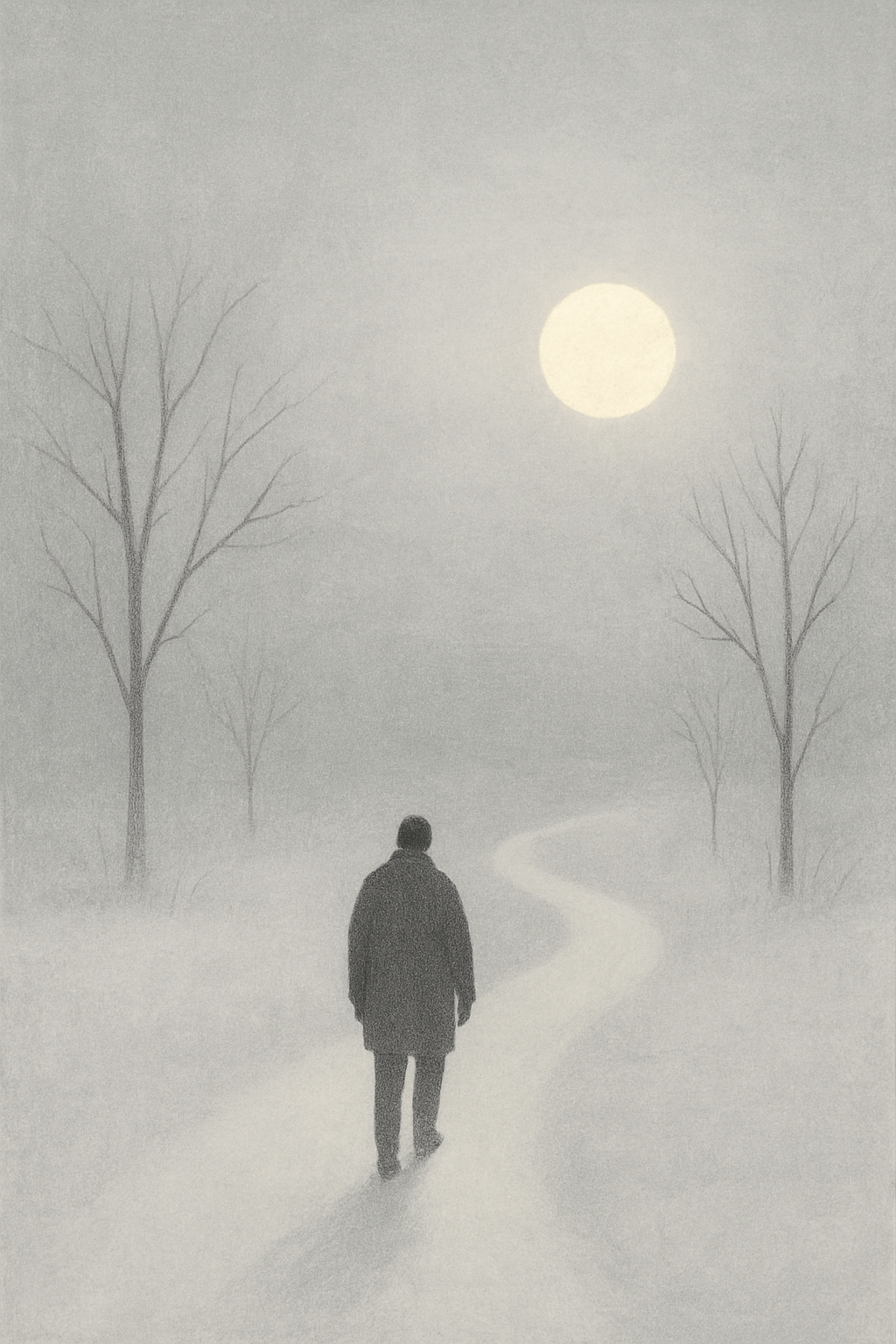
Following the Winter Sun

There are seasons in the soul when the warmth of faith feels far off. The glow that once saturated your days with clarity fades into a pale shimmer low on the horizon. These are the winter months of discipleship—when following Jesus feels less like dancing in the light and more like trudging through shadows.

And yet, the call remains.

Christ does not promise us eternal summer (at least in this life). His road leads through the wilderness (Mark 1:12–13), through the long dark of Gethsemane (Luke 22:44), and through the silence between Good Friday and Easter morning. “Take up your cross,” He said (Luke 9:23), not your picnic blanket. Faith becomes less about the brilliance of belief and more about the posture of trust, especially when nothing feels certain.

To follow the winter sun is to trace faint light when it offers no heat. It is to remember that the sun is still rising, even when its warmth is hidden. In the same way, to follow Jesus in seasons of silence, sorrow, or struggle is to walk with Him not for what He gives, but for who He is.

“Your word is a lamp to my feet and a light to my path” (Psalm 119:105). But notice—lamps in ancient times did not flood the road. They lit only the next few steps. God rarely overwhelms us with certainty. Instead, He invites us to walk in rhythm with Him, step by unsure step.

The winter sun teaches us that light is still light, even when dim. Christ is still Christ, even when His presence feels like absence. And sometimes, that kind of trust is the holiest kind.

I have followed the sun
when it was warm,
when it laid itself across my back
like a blessing.
When it sang golden through the leaves
and made holiness seem easy.

But now—
it is winter.
The sun slips sideways
into low skies and long shadows.
It does not warm,
only glimmers.
And still—
I follow.

I do not follow because it is bright,
but because I have seen it rise
from behind the hills
too many mornings
to doubt its return.

I do not follow because I feel it—
most days, I don’t.
I follow because
once, it found me
when I wasn’t looking.
And that kind of finding
is hard to forget.

So I walk
with a stiff wind against my chest,
shoes wet with old rain,
the path uncertain—
but I walk.

Because some loves
are not about feeling
but choosing.

And some mornings
are not about light
but trust.

And I trust
that even this cold sun
knows where it’s going—
and that it is worth
following.

Small Oomphs

“Earth is so thick with divine possibility that it is a wonder we can walk anywhere without cracking our shins on altars.” – Barbara Brown Taylor


In many traditions, sacraments are the means by which God’s saving grace is poured out: baptism, communion, and Scripture. For some, they also include marriage, confession, ordination, and anointing the sick. These acts are official, sacred, and ritualised. They are meant to tether us to the divine.

But for many of us, church has lost its oomph.

We’re between churches, clinging by a thread, or slowly, quietly slipping out the side door, trying to find God, ourselves, and the world again. We’re not hostile; we’re just tired. Church has become a place of confusion—a lifeless Christianity where we feel like we’re always doing something wrong. We get into trouble when we go, and we get into trouble when we don’t.

And so we drift. Or maybe… we walk.

I see you — not lost, but loosed,
from pew and creed, from tight-bound truths.
Your prayers now rise through silent skies,
no hymnal hand to harmonise.

You carry ash where fire once burned,
a sacred ache in lessons unlearned.
And still, you bless the broken road,
each doubt a stone, each step a psalm.

No steeple shadows where you stand,
yet grace still gathers in your hands.
You’re not alone in holy strife —
this, too, is part of a faithful life.


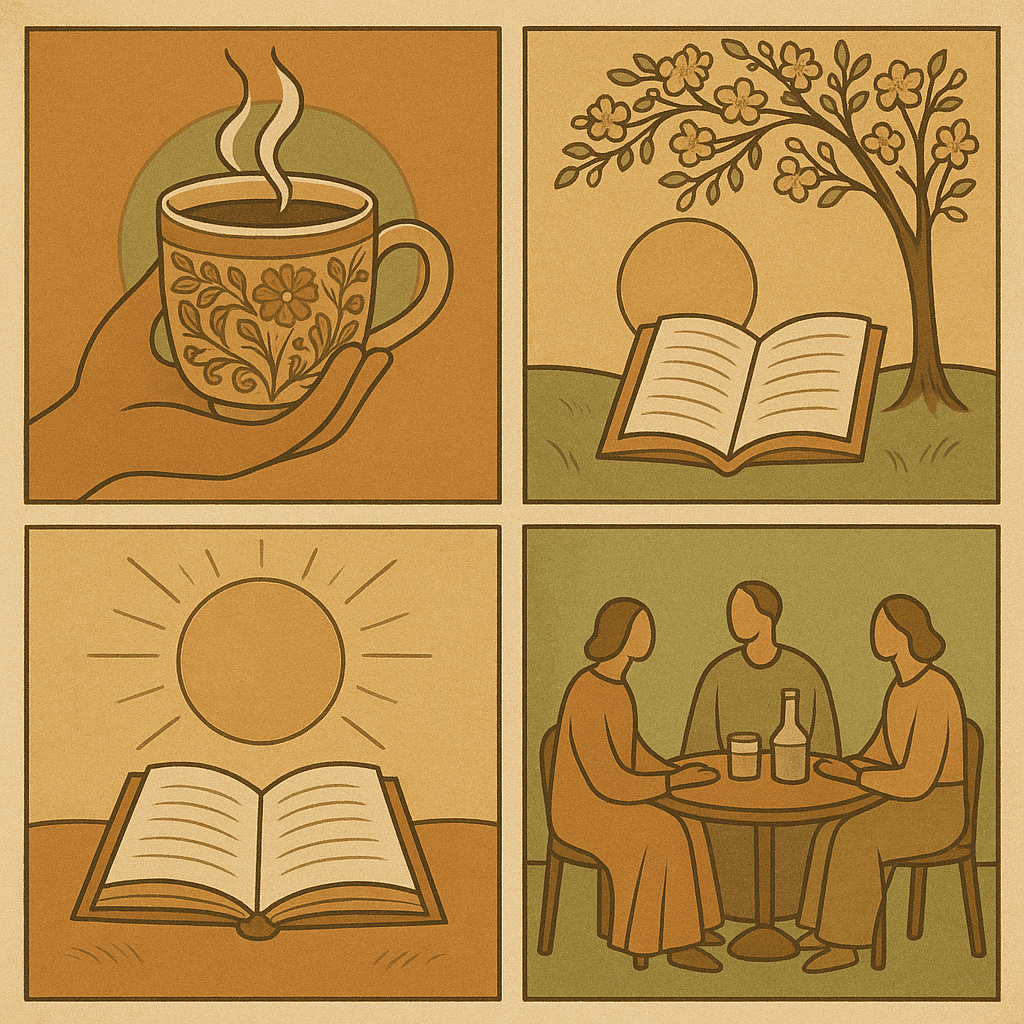
And yet, grace is not confined to altar rails or sanctuary walls. Sometimes, it greets us in the smallest of things — the steam rising from a morning coffee, the comfort of a well-worn novel, the warmth of soup shared on a cold day. These aren’t just distractions or creature comforts. They can be sacraments too, if we have eyes to see.

1 Corinthians 10:31 — “So whether you eat or drink or whatever you do, do it all for the glory of God.”

To make a cup of coffee with care, to read a story that stirs your soul, to laugh at the dinner table with someone you love — these are not lesser spiritual moments. They are the liturgies of the everyday, the sacred stitched into the ordinary. In these acts, God is not distant. He is here, humming quietly beneath the noise, waiting to be noticed.

Psalm 19:1–3“The heavens declare the glory of God… day after day they pour forth speech; night after night they reveal knowledge. They have no speech… yet their voice goes out into all the earth.

In these wandering years, it’s easy to feel the absence of God — to feel the numbness, the long ache. It might take years before you feel whole again, before you even consider walking into a church.

Maybe you never will.

But as you walk the broken road, remember—

“Taste and see that the Lord is good.” (Psalm 34:8)

Even here.
Even now.

In the small things.